Game theory II: The prisoners’ dilemma
In a two-person non-zero-sum game, we must obviously mark each element of the matrix with two numbers, representing the utility of each outcome to each player.
This is because the sum of their utilities is not constant, so that we cannot tell what one player's payoff is just by knowing the other's. Consider the following non-zero-sum two-person game, one that has been very widely discussed.Two suspects, Carrie and Larry, are being questioned about their role in an armed robbery. The police suspect that they committed the crime together, so the prisoners are kept apart, unable to communicate with each other. The police already have the evidence to convict each of them of a less serious offense—say, resisting arrest— but without a confession, they do not have the evidence to get convictions for the more serious offense. So they offer each of the suspects the same deal. The deal is this:
a) If one suspect confesses, and the other does not, the one who confesses goes free, and the other gets fifteen years in jail for armed robbery.
b) If they both confess, they both go to jail for five years.
c) If they both remain silent, they will both go to jail for six months on the charge of resisting arrest.
Here is the matrix that represents Carrie and Larry's options:
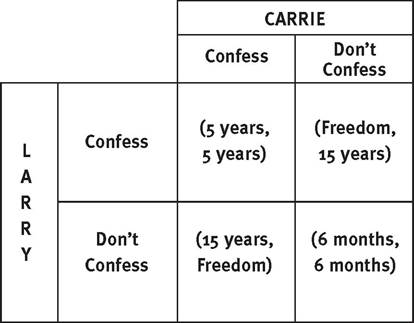
That is game theory's solution to the prisoners’ dilemma, and, given certain assumptions, it seems to be the right one. Acting rationally without communicating and with no reason to trust each other, they will both get five years. But most people who have thought about this case notice immediately an important fact about the situation: if Carrie and Larry had some reason to trust each other, they could both keep quiet and both get away with just six months. The “rational” solution to the problem gives them each five years, but this so-called co-operative solution, which they would both prefer, gives them both a shorter sentence.
The dilemma for Larry is whether to trust Carrie in the hope they will both get the six-month sentence while risking for himself a very long sentence if she confesses, or whether to refuse to trust her and probably get the five-year sentence, gaining the advantage that he avoids the risk of that long sentence altogether.
For this dilemma to arise it is essential that the game not be a zero-sum game. In a zero-sum game, since I win what you lose and vice versa, each of us can only lose by helping the other.
If we reconsider the Hobbesian state of nature, we can apply the game theory analysis to see why the choice of a state is one way of avoiding some of the situations that make life without government “solitary, poor, nasty, brutish and short.” Without the state, deciding whether to cooperate may be like the prisoners' dilemma.
Suppose, for example, in the state of nature, I am trying to grow bananas. There is only one other person around—call her Eve—and she, like me, loves bananas.
So we both grow them. In the state of nature, as Hobbes conceives of it, we shall each make raids on the other's banana plantations. In the ensuing skirmishes, some bananas will be damaged. More importantly—since we are, as Hobbes supposes, roughly equal in strength—we will each sometimes get hurt.Suppose we get fed up with this situation and both agree to observe a covenant: I won't steal Eve's bananas if she won't steal mine, and vice versa. Each of us is now considering whether to keep this covenant. (For the sake of simplicity I'll consider only two strategies—keeping and breaking the covenant—so a strategy of wait- and-see, of keeping the covenant until the other player breaks it, is ruled out.) Here is the matrix:
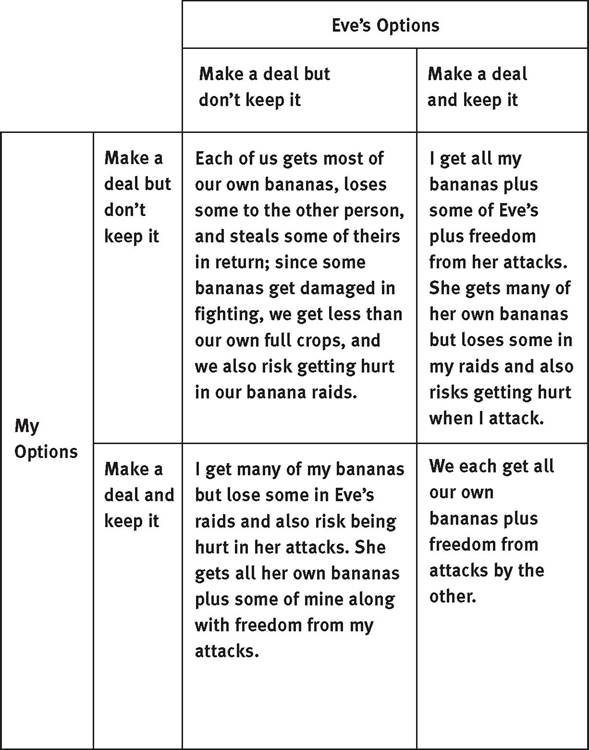
If Hobbes is right and we are both self-interested in the state of nature, then we are now in a situation like the prisoners' dilemma. If Eve keeps her word, then I shall do better if I break my word: not only will I get freedom from her attacks and all my bananas, but I'll get some of her bananas as well. If she doesn't keep her word, then I shall still do better if I break mine: we'll both continue to risk being hurt, but at least I'll get back some of the bananas Eve steals from me by stealing from her.
Since the situation is symmetrical, Eve has just as much reason not to keep her word, so both of us choose the strategy of making the covenant and then breaking it—and that puts us immediately back where we were, in the state of nature without the covenant. Notice that this matrix has exactly the structure of the prisoners' dilemma: we will end up in the top left-hand box of the matrix, when we would both rather be in the bottom right.
That was Hobbes' great insight, expressed in game-theory terms: he saw that if we human beings were self-interested in the state of nature, we needed to change the rules of the game before we had an incentive to cooperate.
To see that this is correct, we need only consider a matrix for the same situation once the Hobbesian sovereign is in control.Suppose that the sovereign punishes banana thieves by taking away all their bananas, and suppose that the sovereign usually detects thefts. Then, as you can easily work out, Eve and I are now both better off if we keep the covenant we have made with each other, for whatever the other person does, the risks of being punished outweigh the advantages. Game theory allows us to see very clearly why Hobbes thought self-interested people could not escape the state of nature unless they had a sovereign to enforce their agreements with each other.
6.6