The limits of prudence
I suggested at the end of 6.3 that there was a problem for Hobbes that followed from the fact that his theory was what I called “prudentialist.” The problem was that if, once we had set up the covenant, we discovered that there was a way of getting around it that was in our self-interest, nothing would stop us from using that way out.
Even after setting up the state and installing the sovereign,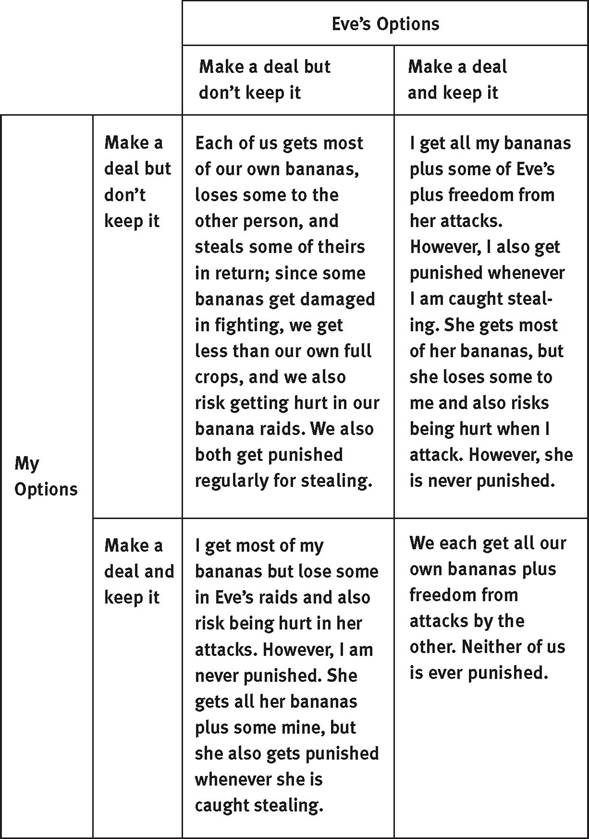
we cannot suppose that the sovereign would be infallibly able to detect wrongdoing; sometimes, even once the state is in place, a purely self-interested person would have reasons to disobey the law. It would be no use for Hobbes to appeal, at this point, to a general moral obligation to keep promises. For, as we have seen, Hobbes' argument is explicitly not meant to depend on moral principles. If we were allowed to draw on moral principles in defending the institution of the state, we could say a good deal more in its defense than Hobbes actually does. The institution of a state and of enforceable regulations can allow us to achieve many good things other than security. It can allow the maintenance of moral ideals—such as the ideal of helping those in suffering—which Hobbes refuses to consider. Hobbes' argument provides no basis for these ideas.
More than this, if the principle that we should keep our promises were the basis of our duty to obey, then we should have to face up to a fact that I pointed out in the last chapter, namely, that we normally suppose that the duty to obey promises can be overridden by other considerations. Far from leading to Hobbes' conclusion that we should obey the sovereign except when our lives are at risk, basing our duty as citizens on keeping promises as a moral principle would suggest that our duty was severely limited by other moral obligations.
But there is a deeper objection to Hobbes' appeal only to selfinterest: his argument completely fails to capture the sense of allegiance to their states that many people have. Many people think not only that they would give their lives for their countries, but also that this would sometimes be the right thing to do.
To make sense of this belief, we need to appeal to something more than self-interest. Unless you are guaranteed a place in heaven, it is surely never, in your self-interest to die (at least where the alternative is living a life that is not unbearably distressing).So other political philosophers have suggested answers to the question of justification that offer some prospect of explaining a moral identification with the state you belong to that lies beyond self-interest. And one way to do this is to give up an assumption of Hobbes' that I have already suggested we should reject: the assumption, that there are no moral principles that apply prior to the formation of the state. The two most important recent works of political philosophy both try, in different ways, to start from moral principles in a state of nature and derive from them an answer to the question of the justification of political authority. The first such proposal is in the works of the American philosopher John Rawls, whose most famous book is called A Theory of Justice.
6.7
More on the topic The limits of prudence:
- Limits of Impact
- THE METHOD: STEP BY STEP RESOLUTION
- Military conflicts are considered, with all due grounds, among the most dangerous and intractable types of conflicts.
- Normative Foundations
- I ETHICAL ISSUES ^10 ^96 ^179 ^352
- Tanzania
- CHAPTER 7 Speech and the Erosion of Relativism
- §79. Virtual Experience
- Conquering Republic, Revolutionary Politics
- Chapter 11 Jean Desmares, Roxelana (1643)[570]