InexactEvidence
Suppose you are looking out of your window at a tree in the distance. In doing so you obtain some knowledge about the tree. However, your knowledge is not exact; for example, while you now know that the tree is larger than 10cm and less than 1000cm, based on what you can see the exact height of the tree in cm is still unknown to you.
In [155] Timothy Williamson introduced the term ‘inexact knowledge' for the kind of epistemic state you would be in in situations like the one above.
A parallel distinction arises with respect to your evidence in such situations. Given that you have only seen the tree from a distance, and your eyesight is not perfect, your evidence includes some propositions—that there is a tree, that it's larger than 10cm and smaller than 1000cm—but does not include the proposition stating the tree's exact height. We may call your evidence in such cases inexact evidence.Being inexact is not the same as being inaccurate; if the tree appeared to be less than 500cm when it was in fact greater than 600cm, then your evidence, or apparent evidence, would be inaccurate, but in the case described in the opening paragraph your beliefs are not inaccurate. All of your evidence, or apparent evidence, is accurate. On the other hand, if you went out and measured the tree, the relevant source of inexactness in your evidence about the tree's height would be eliminated. But the phenomenon at hand is not ignorance or lack of evidence about the tree's exact height. If you had never seen the tree, but had been informed by a highly reliable person that the tree was less than 600cm, then your evidence would be exact, even though you still would not know the height of the tree. Nor is the relevant sense of exactness specificity: if you have been told that the tree is between 400cm and 500cm then your evidence is more specific than it would have been if you had only been told that the tree was between 300cm and 600cm, but the latter case is not closer in kind to the state of evidence you would find in the opening example.
I hope it is clear that the evidential status of someone who has seen a tree from a distance is relevantly different from any of the preceding examples.
While I cannot give an uncontroversial definition of what must be involved in cases where one's evidence is inexact, I hope the preceding examples have elucidated it sufficiently to provide a good enough handle on the kind of situation I am interested in to be worth discussing further.Evidence obtained via imperfect sensory faculties are paradigm examples of inexact evidence. However, it is not clear that it is always the case that when your evidence is inexact, some sensory faculty is at fault. Having taken a cursory look at my bookcase, I gain inexact evidence about the number of books I own; I have a general feel for how many books there are but I do not know exactly how many books there are without counting them. However, it is not completely obvious that my evidence would be significantly better if I had perfect vision. It seems more natural to say that it was not my visual experience, but rather my ability to process it, which was to blame.
1 take it that most ways of obtaining evidence leave room for the possibility that evidence obtained in that way is inexact.[79] I also take it that most of our evidence is inexact. The main thesis of this chapter is the claim that inexact evidence is vague evidence; that when we find ourselves with inexact evidence the strongest proposition we ought to be certain of on the basis of this evidence is a vague proposition. This partly vindicates the claim that we do not need to be acquainted with a public language to have vague beliefs. Furthermore, since almost all of our evidence is inexact, it follows that vague propositions occupy a very distinctive evidential role in thought. They are usually the best pieces of information we have when we learn from experience, they are what we usually reason from and to, and they are the objects of our desires upon which we act.
If the evidential role of a proposition is partly constitutive of what it is to be that proposition, then our thesis also gives us some insight into what vagueness and vague propositions are. class=a7 style='text-indent:18.0pt'>The claim that inexact evidence is vague evidence requires some refining. If I have examined a man's head carefully and have determined that he has no hairs at all, then I have evidence that he is bald. In such a scenario my evidence about the man's hair number is exact, yet my evidence includes the vague proposition that the man is bald. Having evidence for a vague proposition is thus not sufficient for being in the kind of circumstance characteristic of inexact evidence. However, the proposition that the man is bald is not the strongest proposition I have evidence for—the strongest propositionisthe propositionthatthe manhas no hairs. Whilethisproposition entails that the man is bald, it is not equivalent to it: a man with one short hair is bald, so one can be bald without having no hairs at all. The claim I am interested in is rather the claim:Vague Evidence: When your evidence about a subject matter is inexact, your total evidence about that subject matter is a vague proposition.[80]
It is important to note that I am operating here with the distinction between vagueness and precision, which must be sharply distinguished from the distinction between being borderline and determinate. The proposition that Patrick Stewart is bald is a vague proposition even though it is in fact determinately true. It is especially important in this context not to conflate borderlineness with vagueness: it is quite natural, given a factive conception of evidence, to think that evidence is never borderline, even if one's evidence is usually vague.
The basic argument for this claim (very roughly) is that when our evidence about, say, the height of a tree is inexact, the distribution of probabilities over possible tree heights forms a smooth curve.
On the other hand, it is not possible to achieve this smooth curve by conditioning on a precise proposition that's about the tree (and not about, say, our experiences); therefore our total evidence cannot consist only of precise propositions. The primary goal of section 6.2 will be to finesse this argument.Before I move on, however, it should be noted that there are a couple of questions that I shall not remain neutral on and that require some further remarks. The first of these is the thesis of probabilism: the view that ways of measuring the degree to which your evidence supports hypotheses—the credences one epistemically ought to have— are governed by the probability axioms. This is controversial in the present context because some philosophers (see, especially, Field [53] and Schiffer [126]) have argued that to include vague propositions within the remit of such theories would require relaxing the ordinary probabilistic axioms. Although I'll be assuming probabilism in this chapter, I shall return to that issue and give it a proper defence in chapter 7.
The second point requires a little more discussion. One might object that in the cases described my evidence is not propositional at all, but rather consists of an imprecise visual experience, a hazy memory, or some other non-propositional object. The thought that there is a proposition that summarizes everything that is learnt is what Jeffrey calls the ‘empiricist myth of the sensuously given data proposition’ ([74], p. 3). It is, in fact, possible to make Vague Evidence nominally consistent with this view by replacing talk of evidence with talk of what your evidence fully supports: even if your evidence consists in visual experiences, memories, or what have you, what that evidence supports, presumably, is always a proposition. Thus Vague Evidence can be thought of as just the claim that when your evidence is inexact the strongest proposition fully supported by your evidence is vague.
Although this formulation is neutral concerning whether evidence is propositional, there is a more substantial disagreement around the corner: many philosophers who reject propositional evidence also maintain that very little is maximally supported by your evidence, and is therefore not in a position to accept even the revised formulation (see, for example, Jeffrey [73]).[81] This is related to a second but distinct objection often levelled at views in which evidence is propositional.
According to these views any proposition entailed by your evidence will be fully supported by your evidence and will be such that one ought to assign it maximal credence. This has surprising consequences about betting behaviour, assuming a standard connection between credences and betting: there will be contingent propositions which you should bet your entire life on for a penny. Vague Evidence clearly does not speak to this objection, and it would take us too far afield to respond to it here. However, it is important to be clear about this odd consequence of accepting the view that evidence is propositional, and that it is separate from the other reasons that motivate one to deny that evidence is propositional.At any rate, Vague Evidence is supposed to be understood as an answer to Jeffrey’s first challenge to produce a proposition that summarizes all and only the things learnt after obtaining inexact evidence. It is, however, important to separate this challenge from the more demanding one of producing a sentence that summarizes all and only the facts learnt. It is rarely ever possible to articulate what you’ve learnt. Belief, on one natural picture, is a process by which we rule out certain possibilities, and this ruling out process is characterized by its connection with rational action: it might not be a conscious thought, or the explicit articulation of a sentence in a mental language.
It might be that a belief that P coincides with the tokening of some sentence-like entity in some animals, such as humans; but the case of belief in animals surely demonstrates that the requirement that we be able to articulate our beliefs in some language (mental or otherwise) is too strong.size=1 color=black face=Cambria>[82]
There are a great many questions about the nature of evidence that I have left open: How exactly do we obtain evidence? What kinds of propositions are part of our evidence? and so on.
For the most part, my discussion can remain neutral on these questions. However, to make the discussion more concrete it will help to have some particular answers to these questions on the table. Following Williamson [160], there are a number of natural propositional attitudes that seem to always confer the status of evidence to things they are held toward. Here are a few:1. S saw that p.
2. S remembered that p.
3. S could hear that p.
4. S could feel that p.
5. S could see that p.
These are all paradigm cases of what I shall call ‘evidential attitudes’: attitudes one cannot have towards p without thereby having evidence that p.[83] In cases 3, 4, and 5 the auxiliary ‘could’ usually marks that the verb is being understood perceptually. Furthermore, evidential attitudes are characteristically factive, whereas ‘heard that’ and ‘felt that, without the modal, are not factive or evidential. ‘Jane heard that Hector is getting fired, although she didn’t have any reason to believe that he was getting fired’ seems to be a fine thing to say if, for example, Jane’s source was known to be completely unreliable, whereas ‘Jane could hear that Hector was getting fired, although she didn’t have any reason to believe that he was getting fired’ seems to be harder to maintain. The latter sentence implies that the actual firing is directly audible to Jane, whereas the former sentence implies that she has heard second-hand that Hector is being fired, but hearing in this way may or may not have any evidential import. On the other hand, both 1 and 5 are factive and evidential. The auxiliary in 5 can usually be inserted to force the reading where the evidence at hand is perceptual. This is not always the case, however, as seen by the sentences ‘Hector saw that the theorem was true’ and ‘Hector could see that the theorem was true’—both seem to be okay things to say, yet in neither case is the kind of seeing a perceptual one. The fact remains, however, that whether perceptual or not, one cannot see that p without p becoming part of your evidence.
It should be pointed out that one does not need to be particularly linguistically competent to have any of these attitudes towards a proposition. One could hear (see, remember, feel) that p without speaking any particular public language or standing in any relation to a representation—one only needs the relevant auditory (visual, recollection, sensory) capacities. It is perhaps slightly more controversial to say that one does not need a private language, or to stand in any kind of relation to a mental representation, in order to hear (see, remember, feel) that p. Although I would be willing to make this further claim, my discussion will not rely on this assumption.
We do not always have neat ways of expressing evidential attitudes in natural language. We generally have lots of propositional evidence about whether we are cold or thirsty, where our limbs are, whether we are moving, which way is up, and so on and so forth, which we have by our capacity for proprioception. In English, at least, we do not have any simple verbs for describing these states.
It should be clear that most evidence obtained in the ways detailed above is inexact. In the clearest cases the evidence is inexact because the subject’s eyesight is poor, or she only caught a short glimpse of something, or it was in the periphery of her visual field, or her memories had faded, and so on. But even when our sensory organs are all in good condition our evidence will be inexact. The amount of computing power we would need to calculate the exact path a tennis ball would follow on the information that it has been hit a certain way is typically too high for most humans (even more so when the examples become more complicated, such as spilling a bag of rice). However, we are generally able to do rough-and-ready estimations, without any conscious calculation, which give us an approximate idea of where the ball will land. My best evidence is not that the ball will land exactly at location l or that it will land within the circular region r of diameter 3.8m or whatever; it will rather be inexact in the way characteristic of the examples we have been discussing. Most of our conscious and unconscious decisions are based on inexact information of this nature, and understanding this information is crucial if we are to apply these epistemological considerations beyond the contrived decision problems, typical in formal epistemology, to commonplace decisions such as whether to hit a tennis ball when it looks like it might be going out.
Let’s now focus on a particular example. Suppose that, after seeing Harry for the first time, I gain some evidence about how much hair he has. I can see that he has some hair, but, as usual, my evidence is inexact. I claim that
For some, but not all n, I can see that Harry has less than n hairs.
As with all the evidential attitudes we have discussed, ‘sees that’ is a propositional attitude: syntactically p in S sees that p, can be substituted for any grammatical sentence, and semantically we may view ‘sees’ as expressing a relation between a subject and a proposition. One slightly distracting feature of the above claim is that these perceptual reports often carry certain conversational implicatures: if I say that I can see that Harry has at most a million hairs it suggests that it’s not the case that I can see that he has at most one. It is important, however, to resist the temptation to think that this presupposition is an entailment.
We may thus ask what the strongest proposition I stand in the seeing relation to is in this situation.[84] One may similarly ask what the strongest proposition that my evidence fully supports is in this situation. Assuming, for simplicity, that the only evidence I have in this case is my perceptual evidence we should expect the answers to both these questions to be the same.
I shall consider two answers to this question:
1. For some n, the strongest proposition about Harry's head that my evidence fully supports is the proposition that Harry has at most n hairs.
2. The strongest proposition about Harry's head that my evidence fully supports is a vague proposition about the number of hairs Harry has.
Before we tackle this question, a few clarifications are in order. By the strongest proposition about Harry's head that my evidence supports, I mean a proposition about Harry's head which my evidence fully supports and which entails all other propositions about Harry's head that my evidence fully supports. Assuming that one's evidence is closed under logical consequence, one can show that there always is a strongest proposition that is part of one's evidence: the conjunction of all the propositions supported by your evidence. Similarly (assuming that the propositions about Harry's head are closed under conjunctions), there will always be a strongest proposition about Harry's head that my evidence supports.
The notion of entailment between propositions cannot be taken to be strict implication if we are to include vague propositions in this algebra. I shall assume, as per usual, that whether someone is bald or not supervenes on the precise facts about hair number, distribution, and colour. To spare myself a few words, I shall simplify things further by assuming that whether someone is bald only depends on hair number. Under our simplification, it follows that for some n, it is necessary that Harry is bald if and only if Harry has less than n hairs—although it is vague for which n this holds. This notion of entailment is useless for epistemic matters such as evaluating your evidence, for it is exactly these necessities we cannot know because of vagueness. We shall need to avail ourselves of a broader notion of entailment, to be spelled out further in chapter 11, in which the claim that p entails q implies not only that p strictly implies q, but that it determinately implies q, and moreover, that the result of prefixing any string of ∆s and □s to the material conditionalp → q is true.
It seems clear that the propositions stating that Harry has at most n hairs, where n ranges over numbers, are linearly ordered by entailment: that Harryhas at most n hairs entails that he has at most m hairs whenever m > n. Where does the proposition that
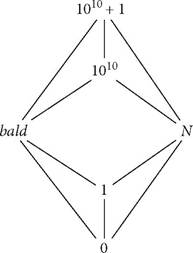
face="Times New Roman">Figure 6.1. 'The proposition that Harry is bald (i) is entailed by the proposition that Harry has at most 1 hair, (ii) entails the proposition that Harryhas at most 1010 hairs, and (iii) neither entails nor is entailed by the proposition that Harry has at most N hairs.
Harry is bald fall in this ordering? The answer, of course, is that it doesn't. It appears below (i.e. it entails) some of the precise propositions, including the proposition that Harry has at most 1010 hairs, and appears above (is entailed by) others, including the proposition that Harry has at most 0 hairs (Figure 6.1). But if it's borderline whether someone with N hairs is bald, and we know that Harry has exactly N hairs we cannot know whether Harryis bald. It's not determinately false (and thus epistemically possible) that Harry is not bald and has N hairs, so the proposition that Harry has at most N hairs does not entail the proposition that Harry is bald. Conversely, if I know Harry has N + 1 hairs I don't know whether he's bald for that would also be to know something borderline. So it would be not determinately false (and hence epistemically possible) that Harry is bald and has N + 1 hairs, establishing that the proposition that Harry is bald does not entail that Harry has at most N hairs.
Despite the fact that certain vague propositions are independent of the precise propositions entailment-wise, they are not probabilistically independent of one another. Suppose that the probabilities representing the degree to which my evidence supports various hypotheses about hair number are initially uniformly distributed over the possible numbers of hair Harry might have.[85]
What are the probabilities of these hair numbers given that Harry is bald? The precise propositions entailed by the proposition that Harry is bald now have probability 1 conditional on his baldness. But what about the precise propositions that neither entail nor are entailed by the proposition that Harry is bald? Deferring a rigorous justification for later, let us just present an intuitive picture. It is natural to think that the probabilities of various hypotheses about hair number conditional on Harry’s baldness will drop smoothly: for each n, if the probability that Harry has exactly n hairs is x then the probability that Harry has exactly n + 1 hairs will be just below (or the same as x once it levels out). Thus if N is the smallest number such that the proposition that Harry is bald entails that Harry has at most N hairs then, although the proposition that Harry has at most N — 1 hairs neither entails nor is entailed by the proposition that Harry is bald, it is probabilistically supported by it, in the sense that its relatively low initial probability will increase so that it is almost 1 on the supposition that Harry is bald. IfI learn that Harry is bald, the probability in some of the propositions about hair number not entailed by the proposition that Harry is bald will increase, and the probability of others will decrease.
Formally, P is probabilistically independent of Q for S if Pr(P | Q ∧ E) = Pr(P | E) where Pr is a rational ur-prior[86] and Pr(∙ | E) represents the degree to which something is supported by Ss total evidence E—her credences if she is rational. Moreover, Q provides evidential support for P relative to background evidence E iff Pr(P | Q ∧ E) > Pr(P | E). The foregoing demonstrates that the vague and precise propositions are not probabilistically independent for a rational agent with my evidence, and that being bald provides evidential support for certain hypotheses about hair number. In my view, this kind of probabilistic dependence is no accident: if you were to take any rational ur-prior and condition it on a maximally strong consistent precise proposition, there is a particular credence it should assign to the proposition that Harry is bald—this will be a small number if you condition on a proposition that entails that Harry has a large number of hairs, and a higher number if you pick maximally strong consistent precise propositions entailing he has lower numbers of hairs. To adopt a prior probability function that violates this constraint is to exhibit a kind of conceptual incoherence akin to believing that there are married bachelors or, perhaps more pertinently, bald people with millions of hairs. This fact explains why your credences about Harry’s hair number and baldness are not probabilistically independent; if the only evidence you have is that described above, every rational ur-prior should agree that on that evidence hypotheses about baldness provide certain levels of evidential support for hypotheses about hair number and vice versa. This can be contrasted with a certain kind of Bayesian permissivism in which all probability functions represent a possible coherent assignment of prior degrees of belief. For this Bayesian there will be rational ur-priors that violate the probabilistic dependence constraints between the vague and the precise. So the thesis I have suggested is inconsistent with this kind of permissivism.
If one were to begin with evenly distributed credences and were to update on the proposition that Harry has less than n hairs, one would have a sharp probability function: Cr(Hk) = 1 for k ≤ n and Cr(Hk) = 0 otherwise, where Hk is the proposition

Figure 6.2. A smooth curve and a sharp curve of n against credence that Harry has n hairs.
that Harry has k hairs. It would look something like the probability function depicted on the right in Figure 6.2, rather than the smooth one on the left. The smooth curve is intuitively what you'd expect to be the correct one, and, I would conjecture, is closer to the curve that corresponds to the credences people usually adopt after having learnt from inexact experience.
6.2