Updating on Vague Evidence
Let us now canvass some of the alternatives to Vague Evidence. If our total evidence is not a vague proposition then either it is propositional and consists in a precise proposition, or it consists in a non-propositional piece of evidence such as an experience.
Views in which evidence consists in a proposition are most naturally paired with the view that one should conditionalize your credences on your evidence: your credence in P after learning E should be the proportion of E that P takes up according to your credences prior to learning E. Your posterior credences can thus be calculated by the ration formula: Cr(E ∧ P)∕Cr(E), where Cr represents your prior credences. One can conditionalize on a proposition, but not on an experience: the latter view is therefore usually paired with another method of updating credences known as Jeffrey conditioning.6.2.1 Conditioning on a precise proposition
Suppose that when I look at a tree in the distance I come to learn a precise proposition. What precise proposition do I learn? Two answers from the epistemological literature naturally present themselves. According to a more externalist conception of evidence, I simply learn something about the height of the tree. This view is in line with the picture outlined above that seeing, hearing, remembering, and so on, that p, all result in one's having evidence that p. According to a more internalist conception of evidence, I don't learn anything about the height of the tree (even though I have seen that it is above a certain height). The most I learn is something about my own experiences which makes various hypotheses about the height of the tree more or less probable.
The latter kind of view relies heavily on the agent having certain kinds of ur-priors.
If prior to receiving any evidence, I was fairly confident that I was a brain in a vat, learning that I've had the experience e of seeing hands will not provide strong support for the hypothesis that I have hands. But it should be noted that even if my priors favour non-sceptical scenarios, I still can't rule out a priori that I’m a brain in a vat. So even after having the experience e of seeing hands in front of me, and conditioning on the proposition that I've had this experience, I will still reserve a small amount of credence for the hypothesis that I'm a brain in a vat having this experience with no hands in front of me.Unfortunately, this moderate kind of scepticism seems to undermine itself. If one should reserve some credence for the hypothesis that one does not have hands, even in the good case where you in fact can see that you have hands, it is hard to see why one shouldn't also reserve some credence for the hypothesis that you are not really experiencing e either. After all, you can be ignorant about what experiences you are having in some cases, such as when you are having one of several similar but indiscriminable experiences (see Williamson [155]), and it is not too much of a stretch to think that in other cases one can be completely mistaken about what experiences one is having. However, the view under consideration is one in which having the experience e confers certainty that you've had the experience e—your credences after experiencing e are the result of conditioning your prior credences on the proposition that you have experienced e—ruling out any kind of uncertainty about what experiences you've had.
A more pressing concern in the present context is that it is not obvious that the proposition that I've experienced e is a precise proposition. After all, one can easily imagine a situation in which one has clearly had the visual experience e of a red ball. But by slowly varying certain parameters—perhaps by considering agents with varying degrees of colour blindness, or by varying the apparent colour of the experienced ball—one can create a sorites sequence ending in a situation in which one has clearly not had experience e; in the cases towards the middle it will be, presumably, borderline whether one has had experience e.
Let us turn to the externalist view that one directly learns something about the height of the tree by looking at it, and that what one learns is precise.
Which propositions, then, are both (i) precise and (ii) about the height of the tree? The maximally strong consistent propositions satisfying (i) and (ii) are propositions that state, for each choice of n, that the tree is exactly ncm tall, and an arbitrary proposition that's both precise and about the tree will be an arbitrary disjunction of these maximally specific propositions. A little reflection reveals that the only propositions like this that are in any way plausible candidates for my total evidence are propositions of the form: the tree is between xcm and ycm tall. For the sake of concreteness, suppose that I learn that the tree is between 300cm and 500cm. For simplicity suppose also that the tree can only have integer heights in cm and that your priors about the tree's height are approximately uniformly distributed over the heights less than 1000cm.[87] (Our conclusions will carry through with weaker assumptions, but for now we are just trying to get some basic features of the view on the table.)
Figure 6.3. 'The result of conditioning uniform priors on the proposition that the tree is between 300cm and 500cm high.
The result of conditioning on the proposition that the tree is between 300cm and 500cm tall can be plotted as a graph of our posterior credence in the possible heights against the possible heights. Plotted this way, the graph will represent a kind of rectangle: the credence I assign to the tree having a height less than 300cm or greater than 500cm is 0, and for each height between 300 and 500 I assign the same credence to the tree having that height (namely, 1/200). See Figure 6.3.
This sharp curve does not seem to be the credences we in fact have, or indeed ought to have, after seeing a tree in the distance.
Assuming the tree is in fact about 400cm I should have comparatively high confidence that the tree is exactly 400cm, less confidence that the tree is exactly 350cm or 450cm, with my credence dropping off smoothly to 0 either side. See Figure 6.4 for a depiction of the intuitive curve.We can dramatize this intuition further by looking at the kind of betting behaviour these distributions would permit. Consider three bets on the proposition that the tree is exactly 299cm, 300cm, and 301cm. If my evidence is the proposition that the tree is between 300cm and 500cm, then I treat the pair of bets on 299cm vs 300cm very differently than I treat the pair 300cm vs 301cm. I should be completely indifferent between the latter two bets, willing to sell and buy either at exactly the same odds, but with the former pair I should reject at any odds the proposition that the tree is 299cm, whilst accepting bets that the tree is 300cm. Our evidence in this scenario is inexact, and simply does not permit the betting behaviour that discriminates sharply between the first pair of bets and the latter. If our credences conformed to Figure 6.4, then our attitude toward neighbouring bets would be pretty similar.
For similar reasons, the view that we learn a precise proposition about the tree will not straightforwardly account for the following scenario. Suppose that Alice and Bob initially have identical evidential probabilities and that they both are looking at a tree in the distance, which, let us suppose, is 400cm high. As expected, their evidence is characteristically inexact. Suppose furthermore that in this situation they both have exactly the same precise evidence; the strongest precise proposition that is part of Alice and Bob's evidence is the proposition that the tree is between 300cm and 500cm (say). However, there is a difference: Alice's eyesight is better than Bob's. While neither Alice nor Bob can rule out that the tree is 301cm or 499cm, Alice's probability distribution forms a high peak at 400cm which quickly subsides remaining quite low at the edges (300cm and 500cm).
Bob's probabilities are muchmore evenly distributed; they increase steadily from 300cm, peaking at 400cm, and decrease steadily until 500cm. This difference is easily explained by a difference in their propositional evidence on my view, but it cannot be straightforwardly explained by a difference in their precise evidence.
What this example shows is that one's evidential probability distribution does not supervene on one's precise evidence. Both Alice and Bob have the same precise evidence, yet they have different evidential probability distributions. In particular, this shows that evidential probability is not determined by conditioning on your precise evidence; thus either the agent's evidential probability is not determined by conditioning on her evidence, or her evidence does not consist only of precise propositions.
In light of these puzzles one might consider a hybrid of the two views I have described above. When one looks at a tree in the distance perhaps one learns both something about the tree and something about your experiences. Because conditioning on a conjunction is the same as conditioning on each conjunct in succession, this is equivalent to taking the credence represented by the rectangular distribution and conditioning it on the proposition that I have experienced e. Since the proposition that you've had e can make the various hypotheses about the height of the tree more or less probable, the resulting distribution will be no longer be rectangular. But because we've ruled out the hypotheses that the height of the tree is less than 300cm and greater than 500cm (hypotheses which aren't ruled out by the proposition that I've had experience e) the curve won't be smooth either: its derivatives will be discontinuous at 300cm and 500cm. In this regard it would be similar to a curve that drew out a semicircle between 300cm and 500cm, but was a straight line, with constant value 0, elsewhere: there would still be sharp corners at 300cm and 500cm.
Although there isn't a clean argument against such a view from betting behaviour in this case, this is intuitively not the kind curve one expects here.[88]6.2.2 Jeffrey conditioning
What if our evidence is not the proposition that we have experienced e, but the experience e itself? If our evidence is not propositional, it no longer makes sense to conditionalize on it. However, one might hope to apply a different method for revising your credences in response to non-propositional evidence, based on a generalization of conditionalization developed by Richard Jeffrey in Jeffrey [73]. We shall see, however, that Jeffrey's generalization of conditionalization does not tell us how we ought to respond to inexact evidence. We shall see, in fact, that the theory of inexact evidence presented here is not an alternative to Jeffrey's theory but a supplementation of it.
To illustrate Jeffrey's theory, suppose that prior to seeing the tree my credences are evenly distributed over the possible heights of the tree, and that after having an inexact experience of the tree my credences about the tree's height change as depicted in Figure 6.4. However, this inexact experience also has a bearing on many other propositions that are not directly about the height of the tree: for example, since I can only climb trees that are not too high, I may become more or less confident that I can climb the tree. How in general should we calculate the effect of an inexact experience on these other propositions?
Intuitively, if I thought it was x% likely that I could climb the tree conditional on the tree being exactly «cm high prior to having the experience, it should remain that likely conditional on it being «cm afterwards: my experience does not directly bear on my tree climbing ability. Thus, for example, if it's initially likely that I can climb the tree conditional on the tree being between « and mcm, and unlikely otherwise, and if it becomes more probable that the tree is between « and mcm after my experience, then I will become more confident that I can climb the tree after the experience.
According to Jeffrey, for each «, we should calculate how likely I thought it was that I'd climb the tree conditional on the tree being exactly «cm before having the experience, multiply that by the probability that the tree is «cm that we assign after having the experience, and add them up. More generally, let us suppose that the experience, e, effects a direct change in your credences about the propositions E1... E«, where E1 ... E« are mutually exclusive and exhaustive propositions (that is, they form apartitio«). Then your posterior credence in some proposition P is given by
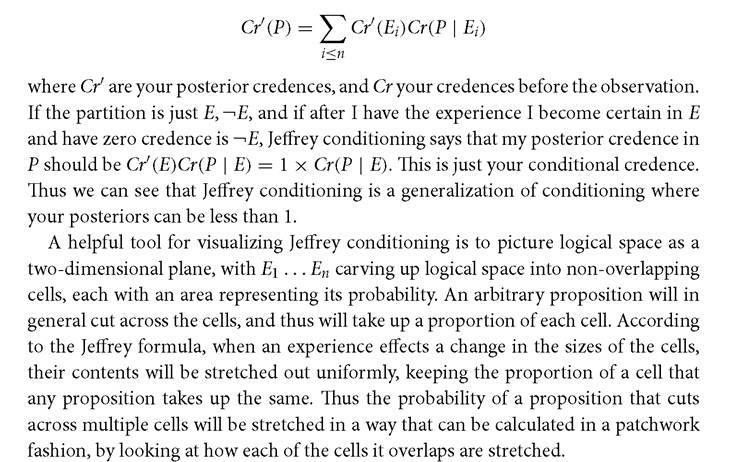
If Ei is the proposition that the tree is «cm then it is straightforward to find an instance of Jeffrey's equation which matches the sorts of smooth curves seen in Figures 6.2 and 6.4, provided none of the Ei have a prior credence of 0 (one simply sets the coefficients Crr(Ej) to the values of the graph). However, we must be clear
style='font-size:9.0pt;line-height:122%'>from the start which problem Jeffrey's extension of Conditionalization is supposed to solve. In Jeffrey's own words:
The problem is this. Given that a passage of experience has led the agent to change his degrees of beliefs in certain propositions B1, B2,..., Bn from their original values, Cr(E1), Cr(E2),..., Cr(En) to new values, Cr1(E1), Cr1(E2),..., Cr'(En) how should these changes be propagated over the rest of the structure of his beliefs? If the original probability measure was Cr, and the new one is Cr1, and if P is a proposition in the agent's preference ranking but is not one of the n propositions whose probabilities were directly affected by the passage of experience, how should Cr1(P) be determined? [Notation has been modified to fit current conventions.] (Jeffrey [73])
It should be noted that formally any partition of propositions can be substituted for E1... En in this equation. For Jeffrey propositions E1,..., En are those propositions ‘whose probabilities [are] directly affected by the passage of experience’. What might this mean? A natural thought is that the propositions, E1... En, are those propositions whose credences are rationally determined by your background credences and the fact that you've had a certain experience. However, if the posterior credences in any partition of propositions is rationally determined by your new experience and your prior credences, all partitions of propositions are. This is, after all, what Jeffrey conditionalization itself says: once your posteriors over a given partition are fixed, the rest of your credences ought to be determined from this by Jeffrey conditionalization.
If we assume that evidence is propositional, and that we update by conditioning on our evidence, then it is possible to state what contribution a piece of evidence should make to two people's doxastic state in a way that depends only on the kinds of prior beliefs they have in propositions that entail their evidence. Within Jeffrey's framework, in which it is often assumed that evidence is non-propositional, it is not so easy to separate out the contribution a piece of evidence makes from the contribution your prior credences make. Given a non-propositional piece of evidence and some prior credences, it would be nice to know what your posterior credences should look like. There are many posterior credences you could have after acquiring a non- propositional piece of evidence that seem completely unreasonable. Indeed, some people go further and suggest there's only one reasonable way to respond to a piece of evidence: if two people with identical priors receive the same evidence they should have the same resultant credences.[89] Unfortunately, for all Jeffrey conditioning says, two people with identical priors and identical evidence could respond in radically different ways. Jeffrey conditioning is in fact extremely permissive. To illustrate: suppose that prior to receiving visual experience e, resulting from observing a tree in the distance, the propositions about the height of the tree and the number of stars are probabilistically independent. Suppose also that after experiencing e, I become certain that the number of stars is odd. It seems that this kind of transition of credences simply isn't supported by the kind of evidence that I've received.[90] Yet this change of credences is completely consistent with the constraints of updating by Jeffrey conditioning, since I can get it by choosing the right partition and coefficients. Even if we insist on using the ‘intuitively correct' partition in this case, there are many permitted transitions that seem irrational: a visual experience showing a tree that's roughly 400cm ought to increase your credence that the tree is 400cm if they were initially uniform, but Jeffrey's condition doesn't rule out a response where you become very confident that the tree is 1000cm, or where you become certain it's an even number of cm tall. I shall refer to a transition between two credences that is permitted by some possible evidence as a realizable Jeffrey conditioning. It is perhaps possible that some experience could have the effects described, and so it's open whether the transitions described above are realizable, but intuitively they are not warranted by the experience described.
What we would like is some correlation between experiences and propositions telling you how much those experiences support those propositions, from which one can determine, given someone's background credences, how much posterior credence they should assign to that proposition—Jeffrey conditioning alone does not do this. This is called the ‘input problem', and as yet there is no particularly satisfactory answer to it (see the exchange between Field [49] and Garber [62] for a failed solution to the input problem). Without a solution to the input problem, Jeffrey conditioning has little content. It just states a relation that must hold between your prior and posterior credences. Furthermore, that relation is very liberal: under simplifying assumptions, if we choose a fine enough partition it can be shown that any transition between two probability functions that preserves certainty is permitted by the constraints of Jeffrey conditioning. This is perhaps too liberal; one might think that there are some changes of credential state consistent with the Jeffrey conditioning constraint that would not be permitted by any possible evidence you could obtain.[91]
Unlike conditionalization, Jeffrey conditioning should not be read as telling you how to respond to your evidence, but should rather be read as telling you how, once you have changed your credence in E to some degree, the rest of your credences redistribute to accommodate this change.[92] As a theory of inexact evidence, Jeffrey conditioning remains silent. I may increase my credence in P when I have no new evidence for p, or even if all the evidence is against P, and still comply with Jeffrey conditioning by redistributing my credences correctly. Similarly, it is in full compliance with Jeffrey conditioning to make no change at all to my credences in P even when there is strong evidence for P. We want to know: when should I change my credences and how. When I see a tree in the distance, for all Jeffrey conditioning says, I may just keep my credences about its height the same even though I have new information.
Jeffrey's theory is thus not really a theory about how you ought to revise your credences in response to inexact evidence after all, nor is it a theory of what inexact evidence is. In order to have a satisfactory theory of inexact evidence, Jeffrey conditioning must be supplemented. In section 6.1, I defended the claim that when your evidence is inexact, your evidence consists of a vague proposition, and that your credences ought to be the result of conditioning your priors on this proposition. This, I claim, is just the sort of supplementation Jeffrey conditioning requires. The following is thus another feature of the role in thought that vague propositions have:
The Evidential Role of Wiith respect to the precise proposιtions,
conditioning on a vague proposition has the effect of a realizable Jeffrey conditioning on a partition of maximally strong consistent precise propositions.[93]
Those who like the ideology of precisifications could state this principle in terms of Jeffrey conditioning relative to each of a number of precisifications. However, for reasons that will become clear in chapter 12, I prefer this more general formulation. Above, I speak of the partition of maximally specific consistent precise propositions; however, in practical contexts, we may simply use a coarser partition. For example, if we are talking about conditioning on the proposition that Harryis bald, we can think of that as Jeffrey conditioning on the partition consisting of each of the propositions that Harry has exactly n hairs, for each n. To determine the coefficients of this Jeffrey update we look at the conditional probabilities we appealed to earlier: the conditional probability of Harrybeingbald conditional on each proposition about hair number.[94] (Indeed, the conditional probability of a vague proposition on each maximally strong consistent precise proposition represents a theoretically important aspect of that vague role of propositions in thought, and will be a central concept in what follows.) So our principle states that conditioning on the proposition that Harry is bald is equivalent to Jeffrey conditioning over the partition of propositions containing, for each n, the proposition that Harry has exactly n hairs.
6.2.3 Conditioningon a vague proposition
Assume that my credences are initially evenly distributed over the possible tree heights. How confident should I be about the possible tree heights after learning the following vague proposition?
The tree is about 400cm tall.
Answering this question is instructive for the view that when your evidence in a subject matter is inexact it consists in a vague proposition. While it is unlikely that the proposition one learns after seeing a tree in the distance is easily expressed by an English sentence, such as the one above, the effect the above proposition has on your credences is representative of the effect a vague proposition of the kind you might learn will have.
We are primarily interested in the shape of the curve that plots the various height hypotheses against our credence in those hypotheses. Our strategy will be as follows: note that by Bayes' theorem the probability that the tree is exactly Ncm tall conditional on it being about 400cm is proportional to the converse conditional probability of it being about 400cm conditional on it being exactly Ncm tall. The constant of proportionality is the prior probability that the tree is Ncm, which by assumption is the same for each N. Thus the curve plotting N against the number Cr(exactly Ncm | about 400) is proportional to, and thus has the same shape as the curve plotting N against Cr(about 4001 exactly Ncm).
Now we proceed in three stages. For stage one, consider a sequence of 1,000 trees of increasing heights starting with a tree that is 0cm and ending with a tree that is 1000cm. What rational credence should we have that the Nth tree is about 400cm? Presumably our credence that the 400cm tree is about 400cm should be 1, and our credence that the 0cm tree and the 1000cm tree are about 400cm should be 0. What about the tree that's 425cm? It is borderline whether this tree is about 400cm, thus we should be uncertain: our credence must lie strictly between 1 and 0. Indeed, intuitively as the distance between N and 400 increases, the credence that the Nth tree is about 400cm should get less and less, in a smooth way much like that depicted in Figure 6.4.
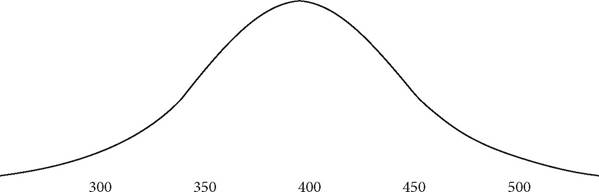
Figure 6.4. A graph of n against the proportion of epistemic states where the tree's height is ncm where it's also about 400cm.
Now instead of 1,000 trees, imagine we just have one tree whose height is unknown to us, and we are instead considering whether the tree is about 400cm conditional on each hypothesis about its height. Conditional on the hypothesis that the tree is Ncm our credence that the tree is about 400cm ought to be the same as our credence that the N th tree in the last paragraph is about 400cm. After all, if I were to learn that our tree was N cm, I'd be in the same epistemic situation as I am towards the Nth tree from the last paragraph. Thus our conditional credences in the proposition that the tree is about 400cm is the curve in Figure 6.4.
Finally, by Bayes theorem (and the fact that we were initially uniformly distributed over possible heights) we can conclude that our credences, after conditioning on the proposition that the tree is about 400cm, is proportional to the curve in Figure 6.4.
Let us try and construct a simple model of this. Note that propositions cannot simply be modelled by sets of possible worlds, for otherwise (given a natural superve- nience assumption) the proposition that the tree is about 400cm will be identical to the proposition that the tree is in the range 400cm ±x for some x. In order to represent this situation, then, we shall model propositions as sets of epistemic possibilities. These can be thought of as certain kinds of maximally strong consistent propositions; all that really matters is that since we do not know whether a tree that is 420cm is about 400cm (because, let's suppose, it is borderline) we require there to be an epistemic state in which the tree is 420cm and is about 400cm, and a state in which the tree is 420cm and it's not about 400cm. For every possible height of the tree, h, and for every epistemically possible cutoff point for ‘being about 400cm’, ±ccm, there will be an epistemic state where the tree's height is h, and the cutoff point for being about 400cm is being within ccm of400cm. The relevant epistemic states can thus be represented by conjunctions of propositions taken from the following two sets: {the proposition that the tree is hcm | h ∈ R} and {the proposition that, necessarily, a tree is about 400cm iff it's between 400 — ccm and 400 + ccm| c ∈ [0,400]}. We can thus represent the epistemically possible worlds as ordered pairs (h, c) where h is the height of the tree, and 400 ± c represents the range between which a tree counts as being about 400cm according to that world. There are therefore many more states than there would be if we had only countenanced precise possible worlds.
The proposition that the tree is about 400cm tall is thus the set of epistemically possible worlds where the tree's height is between the cutoff point for being about 400cm:

Suppose, for mathematical simplicity, that we restrict the possible values c and h may take to some large but finite set, and that my credences are initially uniform over this set: I assign the same credence to the proposition that any given c in this set is the cutoff for being about 400cm, and the same credence to any proposition that a height in this set is the height of the tree. After updating on the proposition that the tree is about 400cm the possible heights of the tree graphed against my posterior credences over the possible precise heights of the tree would form a triangular shape with a point
at 400cm. In reality, however, my credences would not be uniform: I take it that the cutoff point c = 1cm is very unlikely, as is the cutoff point c = 400cm. In reality we should therefore expect my credences to conform roughly to Figure 6.4.
6.2.4 Evidencefor the whereabouts of cutoff points
We observed in chapter 4 that considerations of vagueness-related ignorance indicate that vagueness is a distinctive source of fineness of grain. Thus many theorists are committed to the existence of vague propositions, in this very minimal sense. Once we have accepted the existence of these propositions it is also extremely natural to think that we can sometimes learn them. A standard thought about testimony, for example, entails that when you hear a trustworthy person assertively utter a sentence you often get to know and have as part of your evidence the proposition that that sentence semantically expresses. Thus if a trustworthy person utters the sentence ‘that tree is around 400cm', in normal cases, we get to add a vague proposition to our evidence.[95]
The view that we sometimes update on vague propositions therefore seems quite plausible independently of the theory of inexact evidence defended here. However, there is a somewhat surprising consequence for any view of this kind.[96] According to any view that maintains both that we are ignorant about the vague and the thesis of probabilism, vague propositions can provide one with evidence for the whereabouts of cutoff points. Suppose that I already know that the tree is between 380cm and 420cm, but I am uniformly distributed over those possible heights. IfI then learn that the tree is around 400cm in height, then I rule out states where, for some c, the cutoff point for being about 400cm is being within a margin of ccm of 400cm and in which the tree is not within that margin of ccm of 400. Let us suppose the largest candidate for c is 20. It follows that out of the states in which the cutoff is a margin of 20cm, I do not rule out any of the possible heights of the tree: I already knew the tree was within 20cm of 400cm. Out of the states where the cutoff is 10cm I rule out the states in which the tree is less than 390cm and over 410cm—i.e. roughly half of those states. Finally, out the states where the cutoff is Ocm or close to Ocm I rule out basically all of the heights except for 400cm. In summary, since we are initially uniformly distributed over the possible heights of the tree, this means we end up ruling out far more states in which the cutoff points are low, e.g. the ±lcm cutoff points, than states in which they are high. We should therefore increase our confidence that the cutoff point for being about 400cm is a large margin around 400cm.
The thought behind this argument can be illustrated quite simply using an analogy. Suppose that, instead of being ignorant about cutoff points, someone has rolled a twenty-sided die which has landed on some number, X, whose value you are ignorant about. Suppose also that as before you know the tree is between 380cm and 420cm and each of the forty possible heights is supported equally by your evidence. If someone tells you that the tree is within the unknown Xcm of 400cm it is clear that you should become both more confident that the tree is closer to 400cm and that the die landed on a higher number. You can make the point even more vivid if you imagine that there are 100 trees you know to have a random height between 380cm and 420cm and that the height of each is independent of the height of any other. If someone told you that all of the trees were within the unknown margin Xcm of400cm you can become pretty confident that X is large, since it is antecedently very unlikely that all the trees would be bunched tightly around the 400cm mark.
Now anyone who thinks that we are straightforwardly ignorant about the vague and accepts probabilism must accept the analogous argument that shows that vague propositions provide evidential support for certain hypotheses about the locations of cutoff points.[97] Although there are disanalogies between ignorance about cutoff points and ignorance about dice rolls, the only analogies we need to run this argument are being granted.
It should be stressed that although these experiences provide confirmation for the hypothesis that the cutoff for being around 400cm is on the wider side of things, the change of credence being recommended is not necessarily bringing our credences closer to the truth about the location of the cutoff point. Indeed, this partial confirmation that the cutoff is a large margin on either side of 400cm is only a temporary one, and further precise evidence about the exact height of the tree will bring my credences closer to my prior beliefs about the cutoff points. In addition, since one's evidence can never be borderline, once I have determined all the precise facts I will be as uncertain about the locations of the cutoff points as I was initially, and there will be no way to improve my epistemic position since I already know all the non-borderline facts.
6.3