7.3 Should Our Credences in the Vague Obey the Probability Calculus?
In section 7.2.4 we suggested that Field's principle Iteration, and the wider picture of the relation between attitudes and higher-order vagueness it is a part of, is not particularly attractive.
But this position on the relation between credences and14
This argument is an adaptation of the argument presented in Fara [46].
higher-order vagueness was only one of the distinctive features of Field's theory. The other interesting feature of the theory was Rejection: the view that if one is certain that A is borderline one should fully reject both it and its negation. In a probabilistic setting, this requires that one give up the axiom of finite additivity, which states that one's credence in a proposition and its negation add up to 1.
As we noted in section 7.2.4, Iteration entails Rejection. However, the converse is not true, and it is quite simple to construct models of Rejection that do not validate Iteration. (One can generate models of Rejection as follows. Take any model of the determinacy operator—a reflexive Kripke frame—and take a classical probability function defined over the sets of indices in the model.15 We can then identify the Fieldian credence in the proposition A as the classical probability assigned to the proposition that A is determinate in that model. These models won't in general satisfy Iteration.16) One can, therefore, separate the problematic principle extending vagueness-related attitudes to the higher-order vague from the insight about what vagueness-related attitudes actually amount to, captured by Rejection.
This all suggests that the kernel of Field's account of vagueness-related uncertainty is not susceptible on its own to the paradox in section 7.2.4, which depended essentially on Iteration.
One could get a reasonable theory of degrees of belief by looking at the weaker theory of probability gotten by looking at credence functions generated from Kripke frames in the way outlined above. This theory includes the axiom F2, Rejection, and a principle of subadditivity stating that the probability of a disjunction of pairwise incompatible propositions is less than or equal to the sum of the probability of the disjuncts (see footnote 2).To assess the prospects of the probability calculus, as an account of vagueness- related uncertainty, it is most natural to compare it with this weakened version of Field's theory that takes no stand on Iteration.
7.3.1 Dutch book arguments
The standard way to get a handle on these kinds of questions is to look to rational betting behaviour to provide some constraints on what kinds of credences are acceptable. For example, it is common to assume that your credence in a proposition, p, can accurately be revealed by your dispositions to accept certain kinds of bets. Thus, for example, if an agent has a credence of x in a proposition p, then they would accept any bet that costs less than $x to buy and pays out $1 if p and nothing otherwise. Given this connection between credences and betting behaviour, we can give arguments that certain structural constraints on credences are required by rationality: agents who 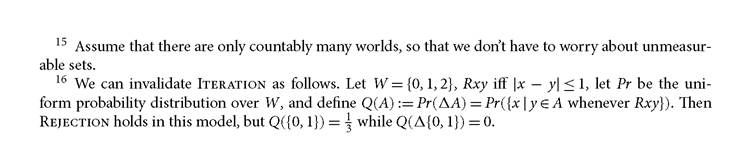
violate the constraints will buy bets that are guaranteed to lose them money no matter what happens—the classic ‘Dutch book argument' for probabilism takes this form, for example. One might hope that such arguments could be extended to cases involving vague propositions and used either to vindicate probabilism or Field's theory, thereby settling our question.
Of course, the assumption that an agent's credences are revealed by their betting behaviour is not always reasonable.
For example, you could imagine an extreme philanthropist who cares only about giving to others, but whose only means of giving is through losing bets. The philanthropist is not necessarily being incoherent when she accepts bets that are guaranteed to lose, nor is she even being irrational: she is achieving what she desires the most.Another type of situation where the assumption isn't plausible: suppose your friend offers you a bet, to be paid out immediately, that we will have created strong artificial intelligence by the year 2214. Here I take it that your betting behaviour does not reveal your credences regarding the existence of AI by the year 2214, because you can be pretty sure that your friend doesn't know the answer and that neither of you will live to find out the answer. It follows that you cannot be certain that your friend will pay you if there will be AI by 2214. In what follows, it is important to bear in mind these exceptions to the credence-betting behaviour link.
On first glance, it looks as though actual betting behaviour closely matches the betting behaviour predicted as rational by Field's theory. When people are offered bets on a proposition they know to be borderline, it seems clear that one shouldn't accept favourable bets on that proposition, nor should they accept favourable bets on the negation of that proposition. If, for example, I know that it's borderline whether Harry is bald and someone offers me a bet that costs a cent and pays out $1 if Harry is bald it seems as though I should reject it, which by the betting-credence connection suggests my credence should be less than 0.01. Similarly, I should reject the symmetrical bet that costs a cent and pays out $1 if Harry is not bald. Thus, assuming the bettingcredence link outlined above, my credence in the proposition that Harry is bald and in its negation is 0.01 in both cases, which is incompatible with probabilism but exactly the kind of situation predicted by Field's theory.
One might hope to go one further and turn this into a Dutch book argument for Field's theory of probability, and in fact Richard Dietz does exactly this (see Dietz [32][110]).However, on closer inspection it seems as though this argument involves exactly the kind of situation that we already set aside as being the kind of case where your betting behaviour does not reveal your credences. A bet on whether Harry is bald is like a bet on whether there will be AI by 2214 in the sense that in both cases we can be pretty confident that the bookie will never know the answer to these questions. You therefore cannot be sure that the bookie will pay you back in a way that corresponds
with the bet you accepted. Your dispositions regarding bets on the proposition that p only reveal your credence that p, if you are certain that you'll get the payoff if and only ifp.
(Note, of course, that if Field is right, then we are not uncertain about whether the payout will correspond with the proposition we are betting on: we assign a credence of 0 both to the claim that it will correspond and to the claim that it won't. However, we are still ignorant in the sense that we know neither that the payout will correspond to p nor that it won't, and so it is like the kind of case we set aside in the respect that matters.)
There are ways to define what it means for something to count as a ‘bet on p, in which it is plausible that you know the payoffs of a bet on a borderline proposition. For example, Dietz defines a bet on p to be something which is cancelled if p turns out to be neither true nor false. The bet pays out ifp is true, you lose ifp is false, and you get refunded otherwise. This manoeuvre merely disguises the fallacy and moves it elsewhere. When Dietz talks about truth, he is not using it in the disquotational way we have been using it—he rather means something like supertruth.
The proposition that p and the proposition that it's supertrue that p are not identical—whenever p is supertrue, p, but not conversely. Consequentlyabet that pays out if and only ifp is not the same as a bet that pays out if and only if it's supertrue that p. It's natural to think that the agent's betting behaviour with respect to Dietz's bets might reveal something about her credence about whether it's supertrue that p. However, why think that such bets will reveal an agent's credences in p? If you thought that the agent's credence in the proposition that p and her credence in the proposition that it's supertrue that p had to be the same, then you could make a case that these two things amount to the same thing. But this is exactly Field's theory of probability, and so a Dutch book that assumes this theory from the get go cannot provide an independent argument for Field's theory, or an independent way of undermining probabilism.Note that a similar move could be applied completely generally to bets made when the bookie is ignorant: bets on p could simply be cancelled when the bookie isn't in a position to verify whether p. Perhaps if this were the agreement, I'd be indifferent about making a bet with my friend about AI in 2214, but clearly the amount I'd be willing to spend on this bet wouldn't say anything about how likely I take it to be that there is artificial intelligence by 2214. IfI were confident that the bet would be cancelled whatever happens, I could bet as I pleased, confident that I'll just get my money back with no loss or gain.
Is the idea of using betting behaviour to make some ground on the debate between probabilism and Field a completely lost cause? To actually get a connection between betting behaviour and credences in a borderline proposition,p, we'd have to somehow set things up so that the agent could be sure that she will get the payoff iff p.
This appears to be impossible when p is borderline; however, it is not entirely obvious that it can't happen.
Consider the following scenario. Suppose that over a period of four years Fred gradually succumbs to madness. At the beginning of the four years he is perfectly sane, and by the end of the four years he is clearly insane. Let us suppose that the law works as follows: that at the time of a person’s death, the beneficiaries of the most recent valid will automatically come to legally own any money and property left in that will, and that a will written by a madman is not valid. We may assume that madness is the only reason Fred’s will might fail to be valid. Now suppose that at some point at which he is bordering on madness, Fred offers you a bet over whether he is currently mad. The bet costs $50 to participate in: if he is mad you’ll get $100 and if not you’ll get nothing. How can you possibly be certain that you’ll receive the $100 just in case he’s mad? It is simple—he writes it into his will. We may assume that when he dies it is indeterminate whether the $100 belongs to you, or to whomever it is promised in the other versions of his will. However, due to the nature of the situation, it is determinately true that you will legally own the $100 if and only if he was mad. Thus you may be certain that the bet is not defective; you are certain that you’ll legally own the money if and only if he’s mad.[111]However, it is natural to think that this type of example involves the other kind of scenario where betting behaviour and credence come apart, discussed in relation to the philanthropist example. If the agent does not care about owning money, then we cannot conclude anything about her credences from her dispositions to accept bets with monetary payoffs. Now you might think that normal people only care about legally owning money because of the things they can buy with it, and thus would have little use for owning money that is only borderline owned. Since in the above example it will be at best borderline whether you own the money if you accept the bet, then it looks as though the assumption that our preferences correspond linearly with money breaks down.
One could respond by pointing out that even if normal people don’t care intrinsically about owning money, you could imagine somebody who did—surely it’s possible to care intrinsically about anything. In chapter 10, I will argue that even this response is limited—I’ll argue that it’s not rational to care intrinsically about the vague. For the time being, however, suffice it to note that to get a Dutch book for probabilism up and running is a tricky task that would have to be quite contrived: credences about borderline matters rarely ever reveal themselves through rational betting behaviour.
The Dutch book argument is hard to get going because it relies so heavily on using physical behaviour as a way of measuring an agent’s credence. However, this does not mean that there are no good arguments in the vicinity. A better argument for probabilism might skip the connection between degrees of belief and physical behaviour, and work directly with the connection between degrees of belief and desire. Arguments that start with assumptions about what desires and preferences are rational, and from this determine that credences ought to be probabilistically coherent, are corollaries of the representation theorems for decision theory. Unfortunately, we do not have the
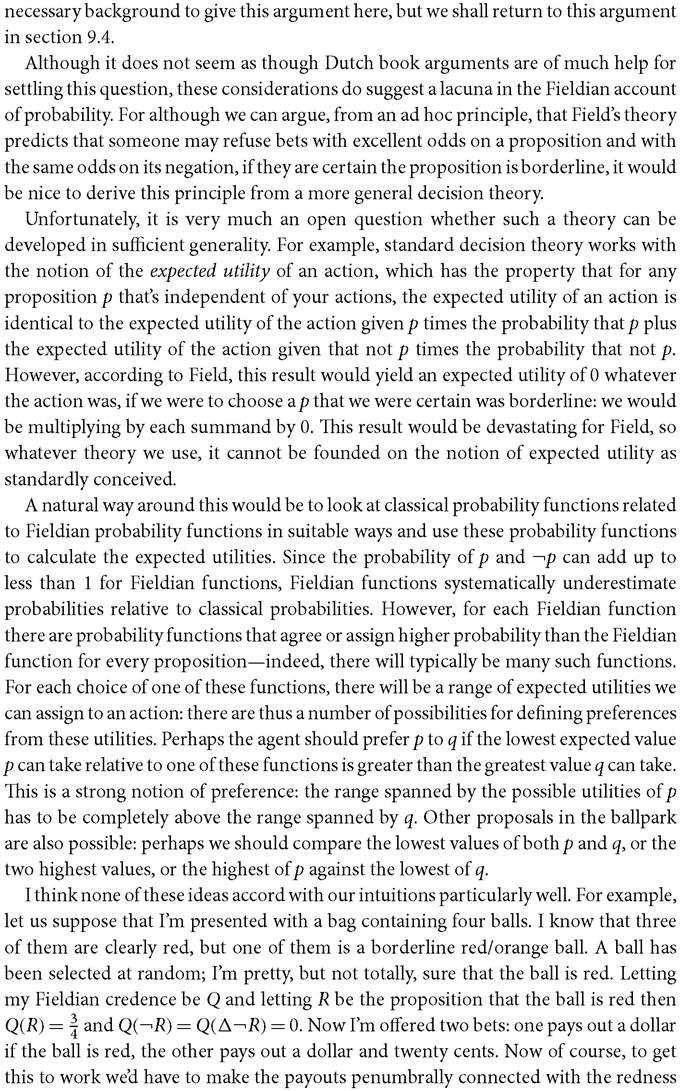
Comparing the two lowest values doesn't do any better. If I'm certain that Harry is bald then my Fieldian credence in that and in its negation is 0. One can then construct classical probability functions related to your credences in the appropriate way that assign the conjunctive proposition that Harry is bald and I win the lottery the probability 0. Thus the proposal predicts that I should prefer it to be the case that I have won ten dollars than for it to be the case that I have won a million dollars and that Harry is bald. A similar problem can be constructed if we compare the two highest values (just replace winning the lottery with something very bad, and winning ten dollars with something bad but not very bad).
Lastly, rather than looking at the highest and lowest values that action can take, you might compare, for each choice of admissible probability function, the expected value of p to that of q. If each admissible probability function agrees about which is better, then one is better simpliciter. Unfortunately, if the functions don't all agree about which is better we get incomparable preferences: two options that aren't just as good as one another, but neither is one better than the other. There has been a longstanding puzzle concerning how we should relate such preferences to our decisions. We have to make a choice one way or the other when we're faced with a decision, so people typically just behave as though they did have a preference one way or another; therefore it's hard to say what the meaning of these incomparable preferences amount to. (See Elga [41] for further discussion of these problems.)[112]
The brief considerations above are quite clearly not supposed to be an exhaustive discussion of all the possible ways of developing a decision theory within Field's framework. It is merely a survey of the approaches that strike me as most promising; their shortcomings give us at least a good reason to suspect that an adequate theory will not be forthcoming.
7.3.2 Comparative probability judgements
As we noted in section 7.3.1, it is not obvious that we can settle the question of probabilism through a straightforward Dutch book argument: both the standard Dutch book argument for probabilism, or Dietz's non-standard Dutch book for Field's theory, require some implausible assumptions—bookies who know borderline propositions, people who care intrinsically about the vague, and so on.
[1] The adequacy of the definition depends on the axioms governing ≤, and in particular, on the axiom that ≤ is connected.
14б VAGUENESS AND THOUGHT
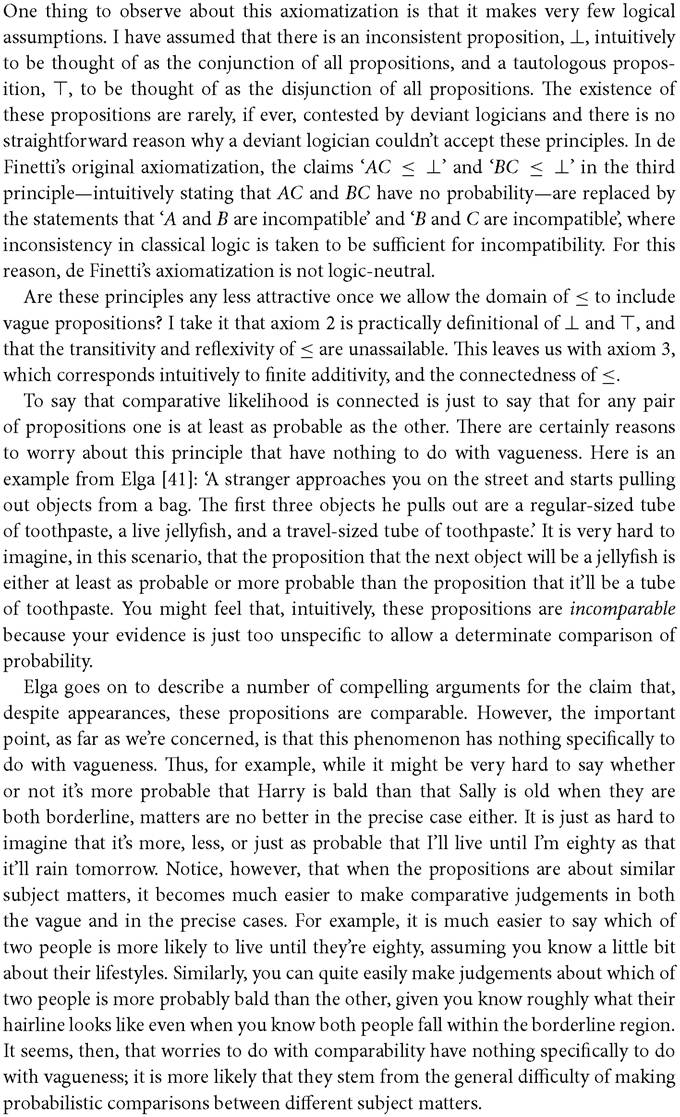
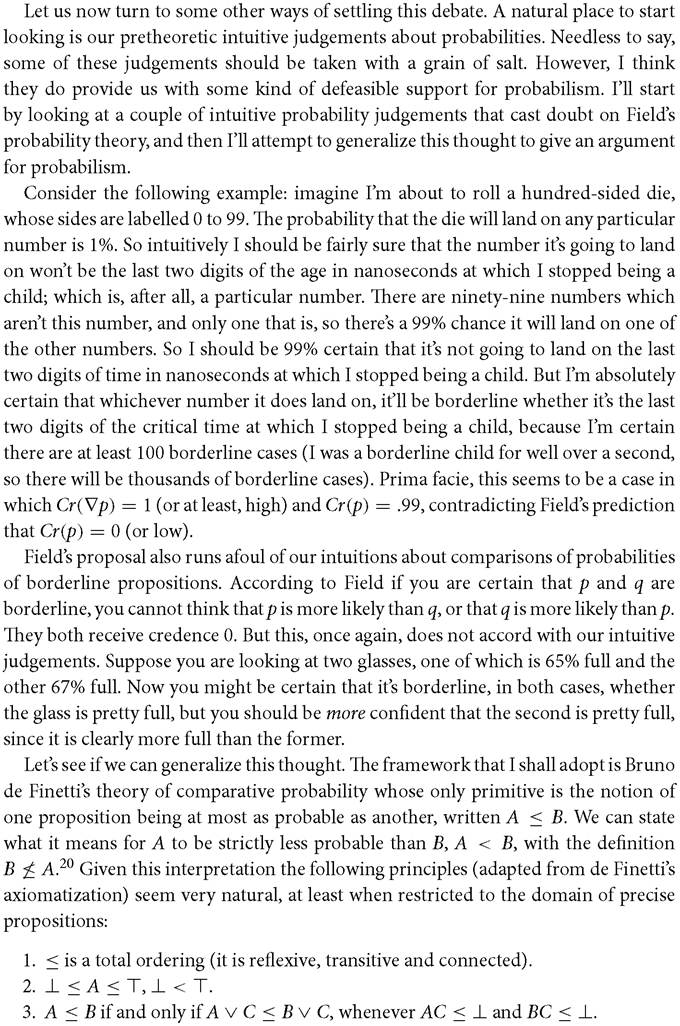
Of course, there are some who insist that probabilism is false for reasons having nothing to do with vagueness; such people are often motivated by the kinds of cases described above involving comparative probability judgements across subject matters. Let us set those sceptics aside for the time being. For the rest of us—who are fine with probabilism in the general case—the connectedness of comparative likelihood seems to be no more controversial in the presence of vagueness as elsewhere.
Axiom 3 states that if AC and BC are maximally improbable (are no more probable than the conjunction of every proposition) then A is no more probable than B if and only if A Unicode MS">∨ C is no more probable than B ∨ C. In Field's theory this principle fails. For someone who knows that Harry is borderline bald, the proposition that Harry is bald is no more probable than the inconsistent proposition ⊥, yet the proposition that either Harry is bald or he isn't is strictly more probable than the proposition that either the inconsistent proposition is true or Harry is not bald—the former has probability 1 and the latter 0.
Field's theory, however, collapses all distinctions of comparative probability between propositions we know to be borderline; as I said above, this strikes me as quite counterintuitive. Suppose, then, that we do acknowledge non-trivial comparisons of probability between propositions we know to be borderline. What kind of general principles governs these comparisons? Axiom 3, I think, is an extremely plausible candidate. Indeed, it seems to me like a fairly small step between acknowledging that non-trivial comparisons can be made between vague propositions to accepting the full generality of 3. If you judge A to be more probable that B, whether or not they are borderline, then you should judge A ∨ C to be more probable than B ∨ C whenever C is incompatible with both A and B.
Let us demonstrate the axiom with an example explicitly involving vagueness. Depending on the outcome of a coin flip, I am going to paint two clay pots, pot A and pot B. If the coin lands heads I'll paint them both the same shade of orange. If it lands tails, I'll paint both A and B two slightly different shades that are both borderline between green and blue. You do not know how the coin has landed, but you do know what shade each pot will be painted in each eventuality, and in particular you know that in fact, if the coin lands tails, A will be painted a shade that is closer to the green end of the spectrum than the shade that B is painted (and you know that both shades are borderline green). Presumably, even before you learn how the coin landed, and, thus, how the pots are painted, you should be more confident that A is green than that B is green. This is, at least, the intuition we began with. Once we have that premise, the following piece of reasoning seems to be valid:
1. You are more confident that A is green than that B is.
2. So, you should be more confident that either A is green or the coin will land heads than that B is green or the coin will land heads.
That is, if you accept the premise in the first place—you take the intuition that it's more probable that A is green than that B is at face value—the conclusion seems reasonable. This is exactly the kind of move that 3 permits.
Now what is quite surprising is that from these three minimal principles governing comparative probability, one is almost in a position to prove that your credences can be represented by a probability function. That is to say, given that we can make comparative judgements of probability, even when we know the things being compared are borderline, then it looks as though we have an argument for a probabilistic account of these judgements—one in which one's credences are given by probability functions.
Note that I say we are only ‘almost' in a position to prove that our credences are represented by a probability function. Indeed, de Finetti conjectured exactly this: that for any ordering satisfying (1)-(3), it is possible to construct a classical finitely additive probability function which agrees with comparative ordering about the relative probabilities of each pair of propositions. Unfortunately, as Kraft et al. [83] showed the answer is ‘no': there are some orderings over small finite algebras that satisfy de Finetti's axioms (and our variants) that are not representable by probability functions. However, the axioms do suffice for representability, provided the structure of propositions is sufficiently rich. To get around this, one can add some assumptions to ensure there are enough propositions, and thus enough comparisons floating about to generate a probability function. Here is one condition that suffices for:[113] [114]
style='font-size:9.5pt; font-family:"Times New Roman",serif'>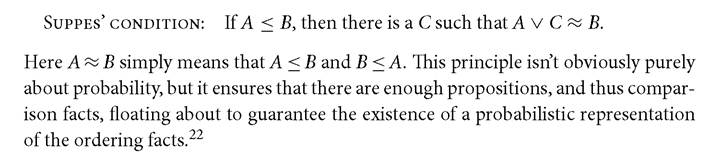
The upshot of all this, I think, is that unlike the Dutch book arguments, the argument from comparative probability judgements provides an argument for probabilism that has purchase even in the presence of vagueness.
7.3.3 Is there anything special about vagueness-related uncertainty?
I have argued for a broadly classical, Bayesian epistemology: a view in which rational credences are governed by the probability calculus, and in which rational credences are given by conditioning on the available evidence. Moreover, we have argued that these basic tenets of Bayesianism hold even when vague propositions are involved. By contrast, we have seen that one prominent alternative to the classical view requires one to adopt a deviant decision theory and conflicts with natural judgements about
PROBABILISM, ASSERTION, AND HIGHER-ORDER VAGUENESS 149 the probabilities of vague propositions. In chapter 9, we will show that the present approach to propositional vagueness is also compatible with a completely classical decision theory as well.
The result of all this is that the kind of uncertainty that vagueness generates is not formally distinctive in the way that Field, and other authors, have argued. When you are uncertain about A because you know that it is borderline whether A, the psychological state you find yourself in is not fundamentally different from the psychological state you find yourself in when you are uncertain about where you’ve parked your car. Given this, it is natural to wonder whether there is anything special about vagueness-related uncertainty. We turn to this question now.