Uncertainty in the Face of Higher-Order Vagueness
size=1 color=black face=Cambria>Iteration encodes an assumption that is pretty pervasive in the philosophy of vagueness.
In Field's case, it amounts to a position concerning what credal stance one ought to take toward the higher-order vague: credally, at least, one ought to respond to higher-order vagueness in exactly the same way one responds to first-order vagueness. Positions like this concerning credences, and other attitudes, are implicitly assumed in much of the literature on vagueness, although rarely acknowledged explicitly. Consider, for example, the case of knowledge: one might think that just as it's impossible to know the borderline, it is impossible to know the borderline borderline, or the borderline borderline borderline, and so on. According to this natural and pervasive thought, higher-order borderlineness is just as much a barrier to knowledge as borderlineness: something is known only if it is determinate at all orders. One natural motivation for such a view is there seems to be something distinctly odd about asserting P whilst simultaneously and deliberately withholding assent from ΔP.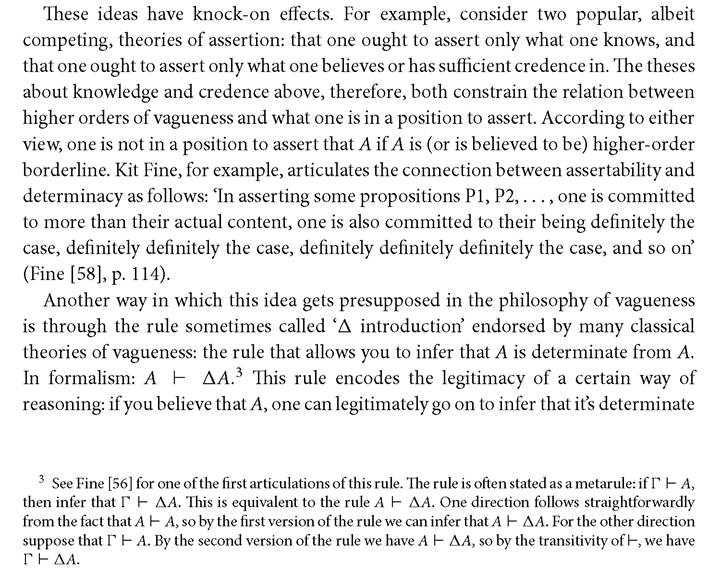
that A. Of course, note that this does not commit us to the idea that every truth is a determinate truth, or to the validity of the conditional A → ΔA—either of these would be disastrous, since they would entail that every proposition is determinate.[104] However, the rule of determinacy introduction does seem to commit us to the idea that when a belief that A is in good epistemic standing (in some sense or other), so is the belief that it's determinate that A.
For otherwise it would just be a bad idea to reason with that rule: to continue calling it ‘logically valid', whilst being unwilling to reason with it, would be to pay lip service to the rule in some sense, but would deny it any important theoretical status.The rule of Δ introduction, then, suggests a more general thesis about committal attitudes: that when one has the attitude toward A, one also ought to have it toward the claim that it's determinate that A.
Determinacy INTROduCTiON (as a constraint on attitudes):
(DI1) If you rationally believe (or have sufficient credence) that A, then you are in a position to rationally believe (or have sufficient credence) that it's determinate that A.
(DI2) If you are in a position to know that A, you are in a position to know that it's determinate that A.
(DI3) If you are in a position to assert that A, you are in a position to assert that it's determinate that A.
As I mentioned above, the rule of Δ introduction seems to be underpinned by the idea that higher-order vagueness imposes the same barriers to rational belief and knowledge as first-order vagueness. To see the connection in full, let us start by considering the cases of knowledge and assertion. The thesis we want to relate says:
(HO) One is in a position to assert or know that A (if and) only if A is determinate at all orders.
Note here that I parenthetically include one half of the biconditional. The parenthetical direction only holds if we are in ‘epistemically ideal circumstances with respect to A’—that we are not ignorant about some of the relevant precise facts, for example. I shall not attempt to spell out what this means precisely, but the idea is clear enough in specific examples: I'm in epistemically ideal circumstances regarding whether Harry is bald if I know how many hairs he has, their colour, distribution, and so on.
The other direction is our primary concern and on the picture we are considering, holds in full generality.We can see how this principle is connected to the cluster of principles associated with Determinacy Introduction as follows. Starting with (DI2), suppose that I'm in a position to know that A. Then by applying (DI2) repeatedly we can infer that I’m in a position to know that it's determinate” that A for any и. So by the factivity of‘in a position to know that’ we can infer that A is determinate at all orders. So (DI2) entails that higher-order borderlineness precludes knowledge. Conversely, suppose that I’m in a position to know that A. So by (HO) it’s determinate at all orders that A. But A is determinate at all orders only if the proposition that A is determinate is determinate at all orders.5 So, at least in epistemically ideal circumstances,6 I’m also in a position to know that A is determinate. A similar argument can be given relating the above principle for assertion to (DIS), although it is slightly more contentious: the analogous argument relies on the factivity of ‘in a position to assert that’ (some philosophers maintain that one can be in a position to assert a falsehood if one has strong enough evidence in its favour).
The principle (Dll) also bears a close connection to Field’s principle Iteration. For clearly if your credence in A is sufficiently high, your credence in ΔA is sufficiently high, since it is simply identical to your credence in A if we accept Iteration. What is perhaps most surprising about the credal version of Determinacy Introduction is that it appears to entail the falsity of probabilism. For example, if you think that logical entailments do not permit a drop in rational credence, then the rule of Δ introduction entails Iteration: your credence in A ought to be identical to your credence in ΔA, since (by factivity and Δ introduction) they entail one another.
But as we demonstrated above, Iteration requires us to relinquish probabilism since it entails Rejection, which contradicts finite additivity. If we conceive of Determinacy Introduction as imposing a constraint on credences, we not only get a connection between our doxastic attitudes toward the vague and the higher-order vague, but we get Field’s distinctive non-probabilistic account of those doxastic attitudes.Although the credal version is more controversial, this account of assertion and knowledge is presupposed in much of the literature on vagueness. It might be tempting to think that we can simply derive this view from the principle that you cannot know or assert things that are borderline: the thought being that higher-order borderlineness is simply a type of borderlineness, and therefore precludes knowledge and assertability because ordinary borderlineness precludes these things. However, this crude way of motivating the view rests on a conflation: borderline borderline does not entail being borderline. Recall from chapter 2 that one of the distinctive features of a classical theory of vagueness is that a non-bald person can be still be borderline bald. 
The same therefore goes for borderline borderlineness: a determinate proposition can still be borderline determinate (and thus borderline borderline if it is borderline whether it is determinate or borderline). The idea that borderline propositions have some ‘bad’ assertion and knowledge precluding status therefore does not, on its own, entail that borderline borderline propositions have to have this status as well. This point is worth stressing, for it highlights the fact that we are making an assumption when we maintain that second-order borderline propositions are unassertable, and this assumption needs to be examined.
The alternative view, which I’ll ultimately suggest is superior, is that borderlineness is the only barrier to knowledge and assertion—when you are in epistemically ideal circumstances with respect to AJ
(FO) One is in a position to assert/know that A (if and) only if it’s determinate that A.
(Again, the parenthetical direction applies only when we have access to all the evidence we could hope to have that’s relevant to the truth of A.) So that we have something to call these two views, let’s call the above principle ‘first-orderism’, and the principle that one is in a position to assert A only if it’s determinate at all orders ‘higher-orderism’.
The credal and doxastic variants of these views correspond to an analogous principle about evidence: must one’s evidence be determinate at all orders or can it merely be determinate? And of course, Field’s theory of credences is a credal version of higher-orderism.To illustrate the alternative, we shall focus on an instance where the two views deliver different verdicts. Consider a sorites sequence of people, starting off with people who are determinately bald, moving on to people who are borderline bald, and eventually people who are determinately not bald. By familiar classical reasoning, there’sgoing to be apoint in thesequenceatwhich thepeoplestopbeing determinately bald and start being borderline bald. At the boundary, it will be borderline whether the people are determinately bald or borderline bald. Let us suppose that Harry is one of these people: it is borderline whether Harry is determinately bald or borderline bald. Let us also suppose we know everything there is to know about Harry’s head—how many hairs he has, their colour, and distribution, and so on. Because it is borderline whether Harry is determinately bald, for all we know Harry is determinately bald. So let us suppose, for the sake of argument, that he is: Harry is determinately bald, but it’s borderline whether Harry is determinately bald.
Now our two views deliver differing verdicts. According to higher-orderism, the kind of view articulated by Fine above, we are neither in a position to know whether Harry is bald or to assert that he is bald since it is second-order borderline whether Harry is bald. First-orderism delivers the opposing verdict: we are in a
See also Bacon [7] where I defend this view in the context of indeterminacy and the liar paradox. position to know and assert that Harry is bald, because we have all the relevant information about his hairline and it is determinate that Harry is bald.
Thus I am in a position to assert that Harry is bald even though he is borderline borderline bald because, as it happens, he's not borderline bald he's determinately bald.It is worth noting that even though I'm in a position to know and assert that Harry is bald according to first-orderism, it doesn't follow that it's determinate that I'm in a position to assert that Harry is bald. Indeed we can give an argument that according to first-orderism, in this particular case, it's borderline whether I'm in a position to assert that Harry is bald. Since we are endorsing (FO), it is safe to assume this biconditional is determinate. By the set-up, it's borderline whether Harry is determinately bald, so the right-hand side of this biconditional is borderline. But then by some fairly uncontroversial reasoning—that if one side of a determinate biconditional is borderline, so is the other[105]—it follows that it's borderline whether I'm in a position to know and assert that Harry is bald.
7.2.1 Vaguenessandassertion
This consequence of first-orderism—that it's often borderline whether one ought to assert—might at first look like a decisive consideration in favour of higher- orderism. Let's consider one type of reason that one might be uncomfortable with this consequence. It seems to imply that we will often find ourselves in tricky normative situations: cases where it's definite that I ought to do one of two or more actions (in our case, assert or refrain from asserting), but indeterminate which of those actions I should execute. When it comes to deciding what you should do, a verdict of ‘it's indeterminate' would be exasperating. You have to do something, assert or refrain; there ought to always be an answer to the question of what you should do.
I think that there is something important to this objection. Note, however, that technically speaking there is an answer to what you should do: by the law of excluded middle,eitherI'm inapositiontoassertorI'm not, so Ishouldassertinthe former case and refrain in the latter. The problem isn't that there isn't an answer to the question of what I should do, it's that it is borderline which of these two cases obtain, and so it's impossible to know which the right thing to do is. I suspect that the real source of discomfort here stems from the idea that the conditions for proper assertion should be always knowable to the asserter. Surely, the objection might go, the conditions for proper assertion should be transparent in the sense that if the conditions for proper assertion obtain, the asserter is in a position to know that they do, and if the conditions do not obtain, the asserter is in a position to know that they don't. Of course, if the
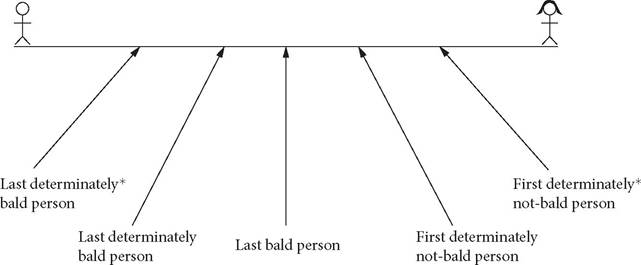
Figure 7.1. 'The cutoff points for baldness, determinate baldness, and determinate* baldness. proper conditions for assertion are that you know the proposition you are asserting then this seems like too much to ask for; Williamson [155], for example, famously argues that we are not always in a position to know that we know when we know. But more generally, whatever the proper conditions for assertion, it seems unlikely that they would be transparent in the way required.[106]
Rather than defending this claim straight on, let me instead provide an argument that whatever your account of knowledge, assertion, or belief is, there will be cases completely analogous to the kinds we have been worrying about: cases where it is borderline what one is in a position to assert, know, or believe. I'll focus once again on the case of assertion. Consider once more the sorites for the property of being bald. As noted above this is not only a sorites for the property of being bald, it is also a sorites for the property of being definitely bald: the sequence begins with people who are definitely bald, and at some point it switches to people who aren't definitely bald, and the boundary is just as vague as the boundary between the bald and not bald. Arguably, this sequence is also a sorites for the property of being definitely bald at all orders (being bald, definitely bald, definitely definitely bald, and so on).[107] In Figure 7.1, moving from left to right, we see that the cutoff for being definitely bald at all orders occurs first, then the cutoff for being definitely bald, and finally the cutoff for being bald. In what follows we shall say that a proposition is determinate* if it is true at all orders.
Now let us suppose that Alice has examined each individual in this sorites, documenting all the facts relevant to whether they are bald, such as hair number and so on. It is clear, I hope, that after acquiring all this information, Alice ought to be in a position to assert that the first member of the sorites sequence is bald. Of course, when we get to the individuals that are borderline bald, and beyond, she is no longer in a position to assert of these individuals that they are bald. As we have seen, it is a matter of controversy where the cutoff point is regarding which individual’s baldness Alice is in a position to affirm: perhaps the cutoff lines up with the cutoff for determinate baldness, as suggested by (FO), or perhaps it lines up with the cutoff for being determinately bald at all orders, as (HO) contends, or perhaps it’s neither of these two options. What I hope should be clear is that irrespective of which theory we endorse, the cutoff regarding when one is in a position to assert is not a determinate matter. The sorites we have described is a sorites for the (somewhat convoluted) property of being an individual whose baldness Alice is in a position to assert, and there is nothing particularly exceptional about this sorites: presumably the cases surrounding the boundary will be borderline cases. Of course, it is worth noting that not every sequence of small incremental changes constitutes a sorites sequence: if we keep adding grains of sand to a scale it will eventually tip, but this is not a sorites because it’s a completely determinate matter at which point the scale tips. When a cutoff point in a sequence is determinate, we can usually find out where the cutoff is. The point along our sorites at which Alice is no longer in a position to assert does not seem to be like the case of the grains of sand on a scale—we cannot find out where the cutoff point is in the same way we can when the cutoff is precise.
It seems, then, that we have completely general reasons for thinking that it’s sometimes borderline whether one is in a position to assert. Indeed it should not be particularly surprising that this property is vague, for vagueness is so pervasive—it would in fact be astonishing if the property being an individual whose baldness Alice is in aposition to assert turned out to be precise.
It follows that whatever theory we adopt there will be cases where it is borderline whether we are in a position to assert; the view that assertion is indirectly regulated by what’s determinate, rather than what’s determinate at all orders, is therefore not alone in having this prediction.[108] It should be noted that similar arguments extend to knowledge, belief, and rational credence; it is presumably vague at which point along this sorites sequence Alice stops being in a position to know or rationally believe, and at which point her evidence stops supporting propositions about the baldness of the sorites members.
7.2.2 The role of borderlineness
A natural question to ask, once we’ve accepted that vagueness concerning what one is in a position to assert or know is inevitable, is what is left to recommend higher- orderism over first-orderism? In order to assess this question properly, we need to get a clearer handle on what borderlineness is in the first place, and how the notion fits into the study of vagueness. The easiest way to introduce the philosophical notion of vagueness is by looking at the kinds of puzzles in which the notion is invoked. Of course the paradigm puzzle is the sorites paradox: the sequence above, for example, begins with clear cases of baldness and ends with clear non-cases. The cases toward the middle, we notice, possess a distinctive feature that appears all over the place in other structurally similar sorites sequences. Philosophers of vagueness have rightly noticed that this feature, whatever it may be, is susceptible to a systematic theoretical treatment; for convenience let us temporarily label that feature ‘X’. Upon further inspection, for example, we notice that whenever a person in the sorites possesses the feature X, the question of whether they are bald is somewhat elusive: if we know all the relevant facts about a person's hairline we usually are in a position to tell whether they're bald, yet in the cases where the feature X is present we seem to be ignorant, and this ignorance is not easy to eliminate. Indeed, we find that a whole cluster of phenomena are connected with this feature X, relating it to belief, assertion, and other rational attitudes.
On one way of conceiving of the study of vagueness, the phrase ‘borderline case' is simply shorthand for whatever that elusive phenomena, X, is—the one that precludes knowledge, assertion, and certainty in that distinctive way. Of course, the distinction between the things that have the knowledge-precluding status, X, and those that don't, itself has borderline cases—this is hardly surprising, since very few distinctions are completely free from vagueness. At any rate, on this way of thinking about the role of borderlineness in the philosophy of vagueness, it is not at all strange that the borderline cases line up perfectly with the cases where the vagueness-related attitudes are appropriate: our handle on borderlineness was primarily given by the vagueness- related attitudes in the first place.
The higher-orderist must have a different conception of the study of vagueness. For according to them, borderlineness is not what causes that distinctive kind of ignorance, or that is associated with the other phenomena listed above. The source of this distinctive ignorance is actually a different and wider phenomena—this wider phenomena, as it happens, can be captured by infinitely iterating the borderlineness operator. It is the complex operator ‘is borderline at some order or other', and not the borderlineness operator, that plays the interesting theoretical role we labelled ‘X'. This leaves the actual role of the borderlineness operator quite mysterious; if its only purpose is to generate the interesting notion by iterating it, why don't we just introduce a name for the interesting iterated operator and do away with borderlineness altogether. The view that borderlineness and only borderlineness is responsible for the distinctive vagueness-related ignorance, I contend, gives a simpler explanation of the phenomenon of vagueness.
Moreover, simply stating that ‘determinacy'/‘borderlineness' is that operator which—when iterated—generates the theoretically central notion, the one we called ‘X’, doesn't narrow things down at all. For example, the determinacy operator Δ yields the notion of determinacy* when iterated, which is for the higher-orderist the more central notion. But so does the operator ΔΔ, ΔΔΔ, and so on. For if a proposition is determinately determinate at all orders, it is determinate at all orders, and conversely if it is determinate at all orders it is determinately determinate at all orders. That is to say, the conjunction ∕∖n ΔnA is logically equivalent to Дn(ΔΔ)nA: every conjunct of the latter is a conjunct of the former, and every conjunct of the former is entailed by some conjunct of the latter (by the factivity of determinacy). So the former entails the latter, and the latter the former. Thus the role of determinacy, if given in terms of determinacy*, is radically undetermined.
This raises a serious question about what borderlineness is. The way that philosophers usually get a handle on it is by looking through paradigm cases, and realizing that there ought to be some general phenomena responsible for this distinctive incurable kind of ignorance that comes along with those cases. If this procedure singles out a different concept, some story about what borderlineness really is, and why it is even needed, is surely in order.
7.2.3 Theforced march sorites
Let us now attempt to apply these conclusions to one of the most puzzling versions of the sorites paradox, the so-called ‘forced march sorites’. This has the usual set-up: we begin with a sequence of increasingly hairy individuals. However, this time, you are going to be marched down the line of people and asked at each point whether you think the corresponding person is bald. At some point, you are going to have to switch from saying ‘yes, this man is bald’ to doing something else: you’re unlikely to switch to saying ‘no’, but you’ll at some point have to do something else such as saying ‘it’s borderline’, ‘I don’t know’, or just remaining silent.[109] The puzzle is that, assuming that it’s definite at each stage whether you are affirming or not (you are not mumbling, for example), this procedure seems to allow us to associate a definite cutoff point of some sort to this sorites sequence. (Note that while classical logic guarantees the existence of cutoff points, it does not guarantee definite cutoff points, so the forced march on the face of it is more troubling than the ordinary sorites paradox).
On its own this is not much of a paradox—a madman might affirm at random, and even if the questionee is trying to be sincere, the cutoff might depend on something as irrelevant as their eyesight. The best version of the paradox arises when we focus on a ‘perfect asserter’: someone who has all the possible information about the hairlines of the sorites members at her disposal, and asserts only when she should. Note that we can give an argument that there could be such things as perfect asserters: imagine that we have a very large class of fully informed questionees, and that for each possible cutoff point there is someone in that class who stops affirming at that point. Because we know, by classical logic, that there's a cutoff point at which you ought to stop affirming, it follows that one of the questionees stops asserting exactly when they ought to. Of course, I've said nothing about why these people stop affirming when they do—they might stop affirming for all the wrong reasons—but asserting for the right reasons is not built into the definition of a perfect asserter: they need only to—in fact—assert when they should, and refrain when they shouldn't.
This version of the paradox, one might think, is particularly troublesome for the view I have endorsed here. Indeed, you might even think the forced march paradox provides a recipe for discovering the locations of seemingly undiscoverable cutoff points. For all you need to do is find a perfect asserter and simply observe the point along our sorites sequence at which she stops affirming. If I'm right, then this would allow us to discover the number of hairs (say) at which people stop being determinately bald: if the asserter is perfect, she is in a position to assert the baldness of all and only the determinately bald people.
This argument, however, does not really get any traction: in order for us to apply this procedure, we first need to find a perfect asserter, and this is a hard task—not because there aren't any, but because it's hard to know of someone that they're a perfect asserter. For example, suppose that as it happens the nth guy is the last determinately bald man in our sorites sequence, and suppose Alice stops asserting at the nth guy, and Bob stops asserting at the n + 1th guy. Even though, as it happens, either Alice or Bob is a perfect asserter, it's borderline which of the two is the perfect asserter. So even if I observe the points at which both Alice and Bob stop affirming, I still can't conclude anything about the location of the last determinately bald person, because I don't know which the perfect asserter is.
In short, the forced march paradox only gets off the ground if you restrict attention to idealized asserters. However, it is exactly because of the vagueness in the notion of‘being in a position to assert' that the forced march does not allow us to associate determinate cutoff points to a sorites sequence.
7.2.4 lang=EN-US>Paradoxes of higher-order vagueness
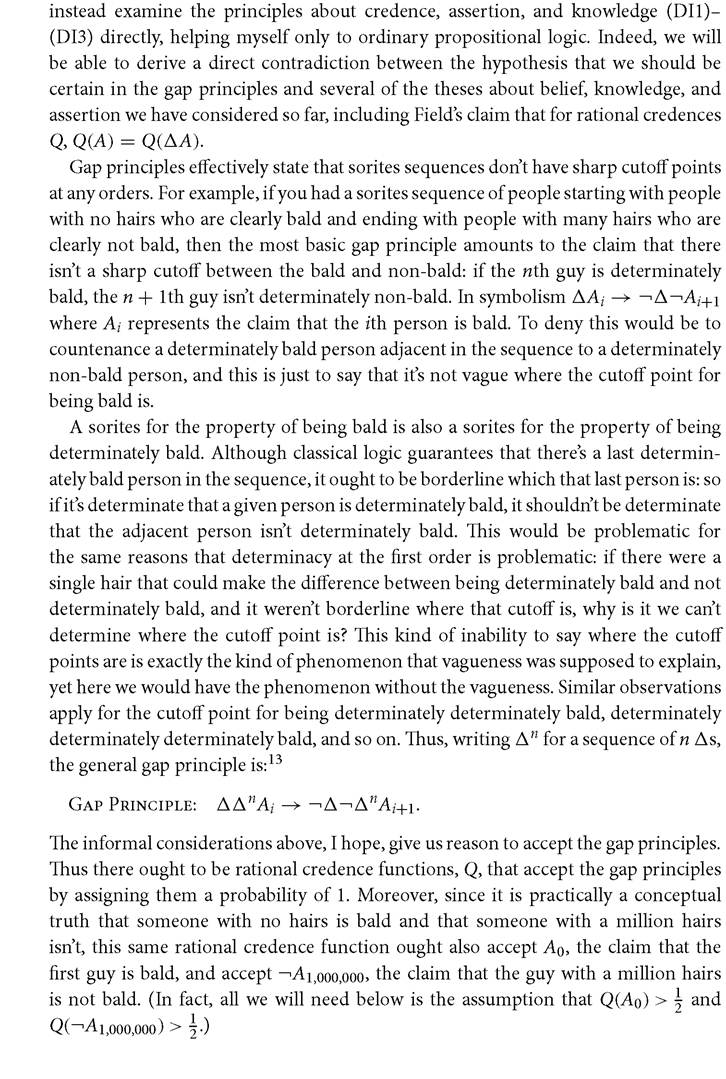
As we noted earlier, there is a tight connection between higher-orderism and the rule of Determinacy Introduction. Rules that preserve determinacy at all orders, like the rule of Δ introduction, are acceptable ways of reasoning because they preserve attitudes like rational belief and knowledge. This observation should give us reasons to be less than optimistic about higher-orderism, since, as we shall see in a moment, the rule of Determinacy Introduction is known to be susceptible to the paradoxes of higher-order vagueness. Delia Graff Fara has shown that it conflicts with some eminently plausible principles capturing the idea that we can't associate precise cutoff points with sorites sequences; Fara calls these principles the gap principles (see Fara [46]). Fara's argument explicitly appeals to the rule of Determinacy Introduction, which raises some questions about how to interpret rules of inference which I think are irrelevant to our present concerns. To circumvent these questions, I shall
[1] Note that if we assumed S4, as Field does, the gap principles are all equivalent to the n = 1 instance.
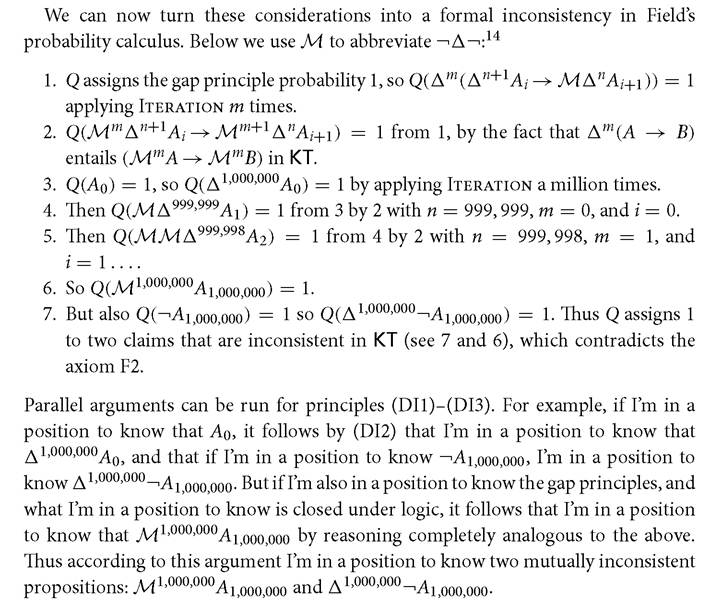
First-orderism, by contrast, is not susceptible to the paradoxes of higher-order vagueness. It is sometimes suggested that the paradoxes of higher-order vagueness are paradoxes for everyone. For example, Zardini [169] formulates a version of Fara's paradox that does not rely on Δ introduction, but instead relies on the premises of Fara's argument being determinate at all orders. In particular, to get Zardinis argument off the ground, one must assume that not only are the gap principles true, but that they are determinate at all orders. According to the first-orderist, the gap principles may be true, and even assertable, but these concessions carry no commitment to the idea that they be determinate at all orders.
More on the topic Uncertainty in the Face of Higher-Order Vagueness:
- Once upon a time, humans did not have to contend with violence beyond the hearth and their face-to-face community.
- Vagueness-Related Uncertainty as a Special Sort ofPsychological Attitude
- Index