Symmetries
The key idea that will be exploited in our account of vagueness is the notion of a symmetry. The notion of a symmetry of a theory is often appealed to in the philosophy of physics.
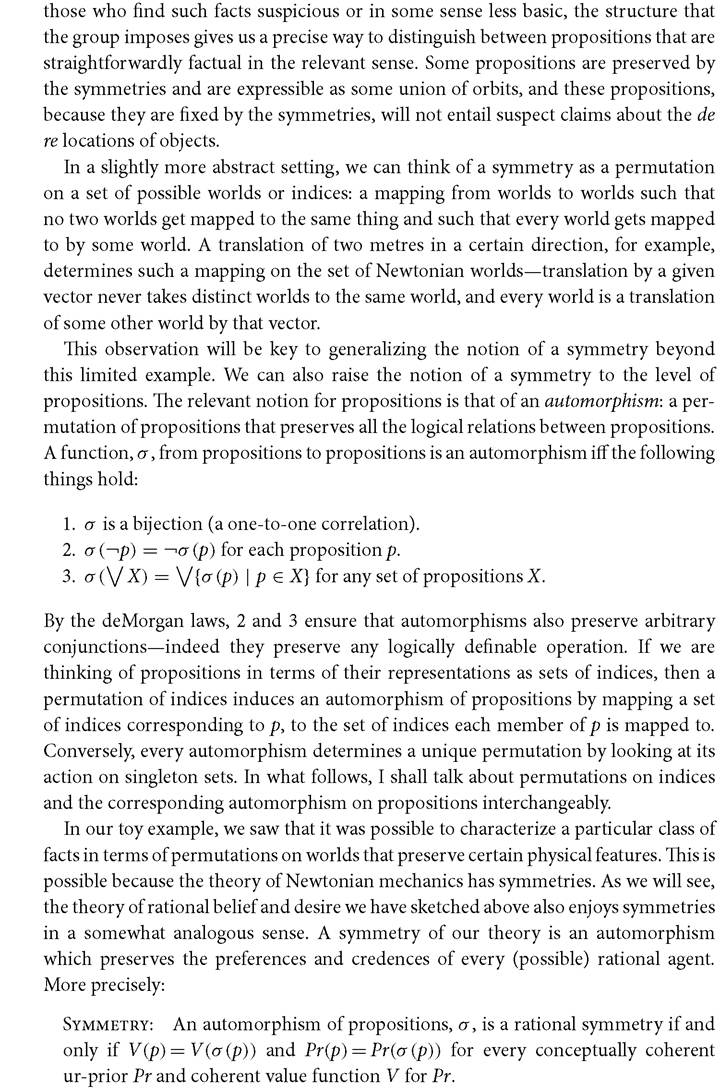
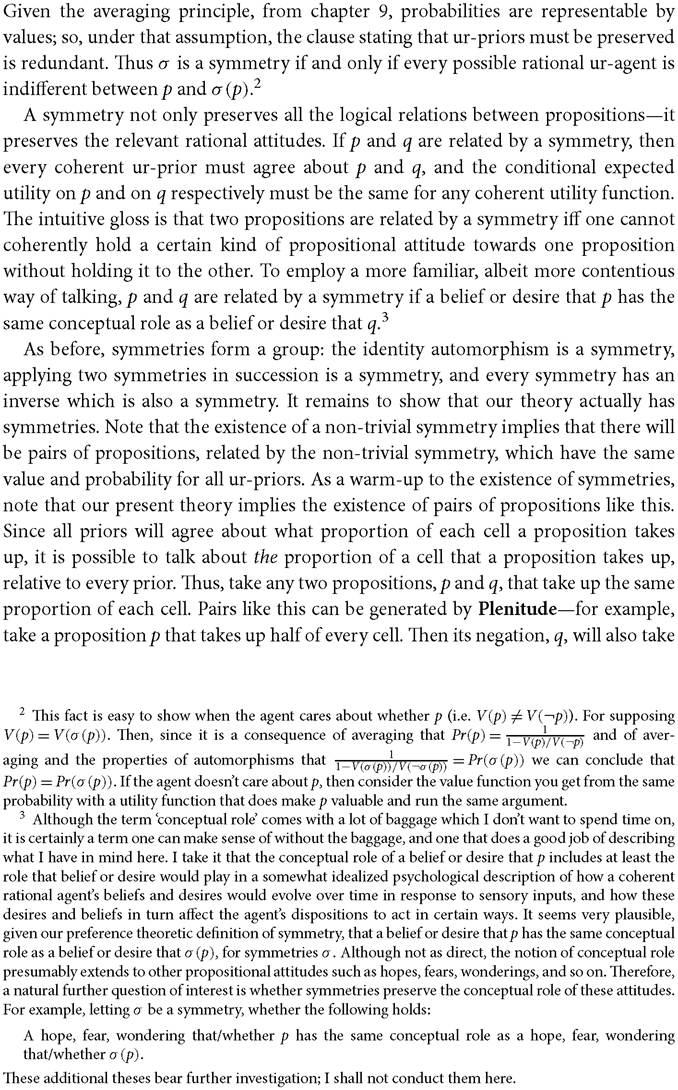
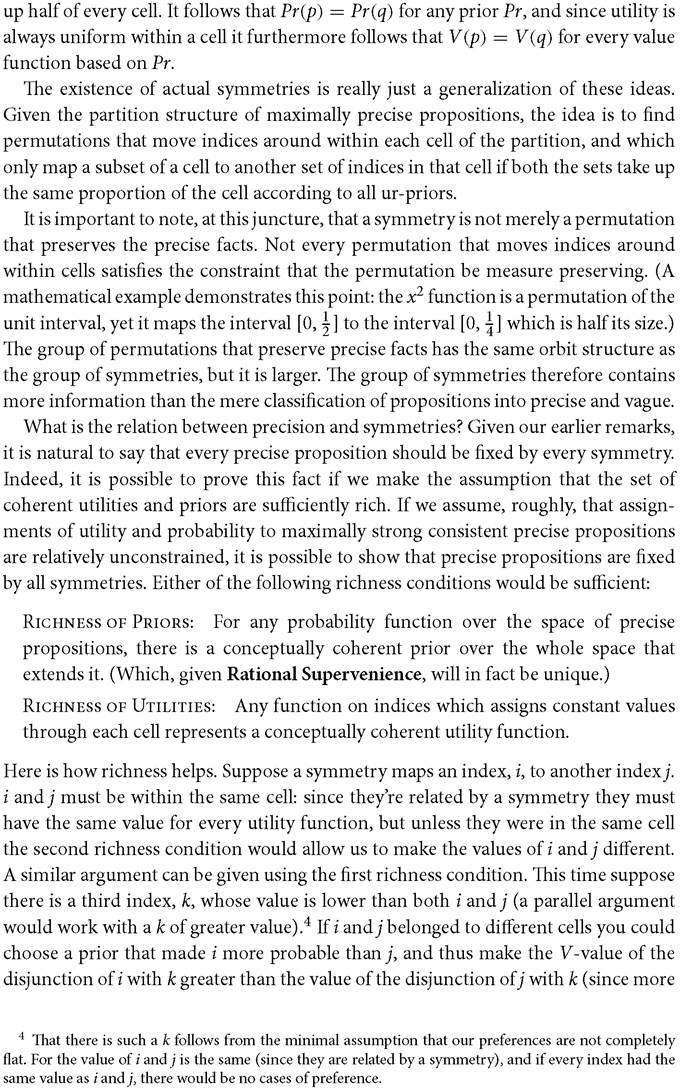
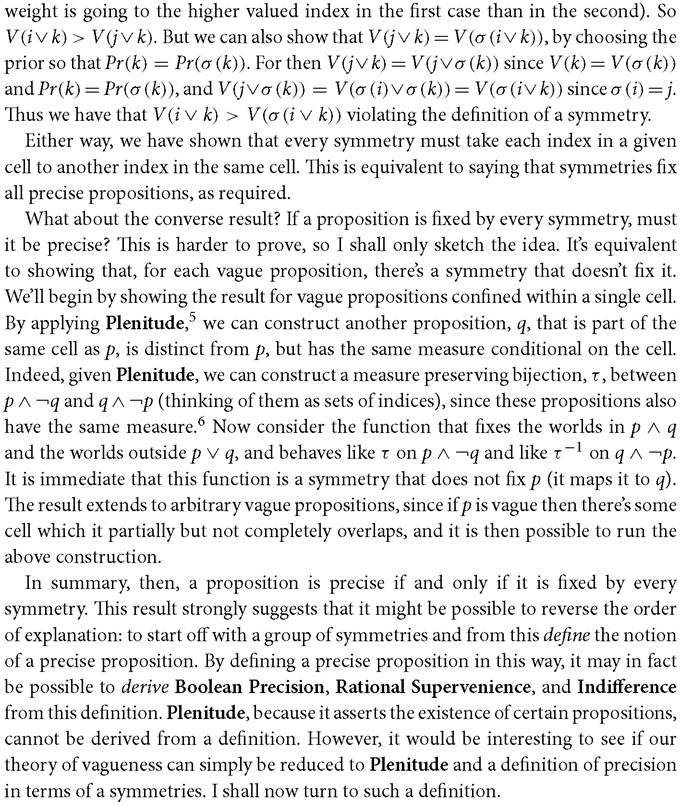
To focus on a classic example, consider Leibniz's observation that uniform translationinaparticulardirection in Newtonianphysicsisasymmetryofthattheory. The result of moving every object two metres in a particular direction will take you to a system that also obeys the laws of Newtonian physics, provided the original system obeys those laws. Moreover, this translation appears to preserve all physically significant facts. The distances between objects, their relative velocities, their shapes and sizes, indeed just about any observable property you can think of seems to be preserved by this symmetry of the theory.The theory has other symmetries as well; spatial rotations and reflections, temporal shifts, time reversal (temporal reflection), and scaling the velocity of every object, as well as arbitrary combinations of these transformations all preserve physically significant properties. Formally, we say that these symmetries form a certain sort of algebraic object called a group.[171] All this means is that the operation of doing nothing is vacuously a symmetry, the result of performing one symmetry and then another is also a symmetry of the same type, and for every symmetry there is another that ‘undoes' it, that is, takes you back to where you started. The symmetry group of a theory often gives us an important insight into the structure of the kind of objects that the theory characterizes; one can represent many things in this fashion—from operations on a Rubik's cube to the symmetries between the roots of a polynomial— and extract important structural insights.
The group in our above example divides the space of possible worlds into equivalence classes, known as orbits, where two worlds belong to the same orbit if they can be related to one another by some symmetry transformation. Thus, for example, two worlds containing only three equidistant colinear particles, stationary relative to one another, might belong to the same orbit because one can get from one world to the other by some combination of translation, rotation, and reflection.
But a world with three particles in a triangular formation would not be in the same orbit, since symmetry operations preserve directly observable properties like colinearity.The result is a picture according to which the space of worlds is divided into equivalence classes (orbits) of worlds which all agree with one another about the physically significant facts and differ only over the positions of those objects in absolute space. The relevant symmetries, therefore, do not preserve all facts—de re facts about which space-time points are occupied are not preserved. However, for
13.1
More on the topic Symmetries:
- Observation
- SPONTANEOUS SYMMETRY-BREAKING
- Bacon Andrew. Vagueness and Thought. Oxford University Press,2018. — 361 p. — (Oxford Philosophical Monographs), 2018
- Index