Vagueness as Primitive
The failure of the modal definition to capture precision, in my opinion, should make one doubtful that the notion can be defined from the determinacy operator at all.
For example, some philosophers adopt a stronger definition of precision in which a completely precise proposition is one that not only couldn’t have been borderline but couldn’t have been borderline at any order. Given plausible assumptions, this characterization is also subject to the problem of degeneracy and the problem of vague propositions that are a posteriori necessarily determinate discussed in sections12.1.3 and 12.1.4.[169] Ifthis is right, then there is a serious lacuna in existing approaches to vagueness.
Following the treatment of determinacy operators in section 12.1.2, we might develop this idea by adding to a simple propositional language a primitive precision operator, written ЦА. Formally, what we would like is some replacement for the supervaluational semantics: something that provides an illuminating analysis of the precision operator, as the supervaluational semantics does for the determinacy operator. We shall turn to this task in chapter 13 where we will introduce the notion of a ‘symmetry, which plays a role somewhat analogous to the role a precisification plays in the analysis of determinacy operators.
For now, we’ll just satisfy ourselves with getting a picture of the structure of precise propositions. We shall begin in the usual manner with a set of indices, to be thought of as maximally strong consistent propositions. Given the assumption that the set of propositions forms a complete atomic Boolean algebra, every proposition can be represented by a set of indices, namely, the indices that entail that proposition.
It is convenient to talk about a proposition and its representation by a set of such indices interchangeably.Given an index i, we wish to know what sets of indices will count as precise at i: which sets of indices have the property that i IF ⅛A when used to interpret A. Note that as before, which propositions count as precise depends on the index— without this feature there could be no higher-order vagueness. Given the assumptions Boolean Precision and Atomicity discussed in section 12.1, we know that the precise
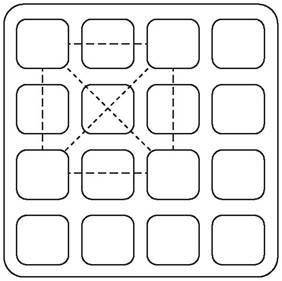
Figure 12.2. Logical space divided into cells of consistent propositions that are maximally strong among the propositions that are precise according to i.
propositions form a complete atomic Boolean algebra. As usual, the best way to specify a complete atomic Boolean algebra is by saying what its atoms are—i.e. by saying which the maximally strong consistent precise proposition are.
We can thus visualize the set of propositions that are precise relative to i by a partition of the set of all indices into lots of little cells, where each cell is a maximally strong consistent precise proposition. This structure is depicted in Figure 12.2. In general, the division of the whole space into cells will depend on the index: if it's borderline whether p is precise, there must be an index in which p is expressed as union of that index's cells, and an index according to which p cannot be expressed as a union of cells. Given the Necessity of the Precise, however, in the special case where i and j are modally accessible indices, they will agree about the cell structure for, otherwise, it could be contingent whether a proposition is precise or not, which is something we wish to rule out.
In Figure 12.2, I have included the modal accessibility relation, represented by the six dotted lines. The cell structure depicted is thus the cell structure for any of the four modally accessible indices at the corners of the dotted lines.Two differences between the present theory and the supervaluationist's are worth highlighting. The supervaluationist framework also gave us a similar partition of the space of world-precisification pairs into cells of maximally strong consistent precise propositions, but in that setting most of the cells were degenerate.[170] The kinds of models we have gestured at above are more general: they include models in which there are degenerate cells, but they also include models like the one depicted in Figure 12.2, where all of the cells are non-degenerate. The other point of contrast is that, in the supervaluationist setting, we also had a second partition of the space
into ‘world propositions': sets of ordered pairs that shared a fixed world coordinate, represented by each of the four quadrants in Figure 12.1. This division doesn't seem to play much role in the supervaluationist account of determinacy and necessity and in, chapter 14, I'll consider some problems for taking the distinction seriously. In the models we have gestured at, this second way of dividing propositions is not available: the world propositions have been eliminated from this second picture.
12.3.1 Determinacyoperators
size=1 color=black face=Cambria>Taking propositional precision as our basic notion does not mean doing away with determinacy operators altogether—these notions are still incredibly useful. Given propositional precision, we can define the determinacy and borderlineness operators as follows:
Determinacy: It's determinate that p if and only if the strongest true precise proposition (i.e.
the conjunction of all the precise truths) entails p.Borderlineness: It's borderline whether p iff the strongest true precise proposition is consistent with p and with —p.
To find the strongest true precise proposition at an index, i, we do the following. Since i determines a division of logical space into cells, the strongest true precise proposition at i is just the cell in that partition that contains i. A proposition is determinate at i just in case that cell is entirely contained within that proposition. We can turn this into a more familiar Kripke semantics by stipulating that an index j is accessible to i iff j belongs to the same cell as i relative to the partition that i determines. Then the above just amounts to saying that a proposition is determinate at i iff it is true at every index accessible to i.
The definition of determinacy is also equivalent to the following slightly simpler formulation: a proposition is determinate if it is entailed by some precise truth. Thus, these definitions can be formalized in the object language, given enough expressive resources: ∆p, for example, just becomes ∃qby the four principles listed below:
Boolean Precision. The precise propositions form a complete atomic Boolean algebra: conjunctions, disjunctions, and negations of precise propositions are precise, and every consistent set of precise propositions is entailed by a consistent precise proposition.
Plenitude. For any function, E, from the maximally strong consistent precise propositions to [0,1], there is a propositionp such that Pr(p | w) = E(w) for every w and conceptually coherent ur-prior Pr.
Rational Supervenience. Ifp is any proposition and w any maximally strong consistent precise proposition, then Pr(p | w) = Pr' (p | w) for every pair of conceptually coherent ur-priors Pr and Pr'.
Indifference. Ifp and q both entail a maximally strong consistent precise proposition, w, then you should be indifferent between p and q.
Let us try and put these ideas together into a coherent account of vagueness. Boolean Precision ensures that we can divide the space of propositions into a partition of maximally strong consistent precise propositions. Along with our assumptions from chapter 12, it also ensures that we can represent propositions using sets of indices. In this isomorphic representation, the partition of maximally strong consistent precise propositions will determine an equivalence relation that clumps the indices into non-overlapping cells, or equivalence classes, of indices that agree about all precise matters.
Although different coherent priors can disagree about the sizes of these cells—in the sense that they can disagree about how probable or improbable they are—Rational Supervenience guarantees that all coherent priors agree about what proportion of each cell is taken up by each proposition. If p takes up half of a cell according to one coherent prior, it takes up half the cell according to all coherent priors (see Figure 8.1). We may think of Rational Supervenience as telling us that every proposition has an evidential role. By those lights, then, Plenitude tells us that every evidential role is occupied by at least one vague proposition. Finally, Indifference ensures that indices in the same cell get assigned the same utility; thus each cell gets to be associated with a potentially different utility, although, within a cell, all the utilities are constant.
This, then, is the structure of rational degrees of belief and rational degrees of desire according to our account so far. The above principles provide us with the beginnings of a theory of vagueness: they relate the notion of precision (and thus vagueness) to other concepts such as the notion of rational belief and rational desire.
However, it is natural to ask if we can reverse the order of explanation to give a definition of precision in terms of these concepts. Is it possible to start with some theses purely about the structure of the coherent priors and utilities and arrive at an independent characterization of the precise propositions?
Our starting point will be the observation that the models of propositional belief and desire described above are closed under certain operations on the space of propositions which leave the structure of belief and desire, and the logical structure of the propositions, completely unchanged. This leads us to the notion of a symmetry, which we move to now.
13.2