The difference principle and inequality surpluses
Part (a) of Rawls' second principle is usually called the “difference principle.” It is a principle that can apply only if a society organized into a state is not a constant-sum game.
To see why, consider a society that is a constant-sum game. We start from a position of equality, since every deviation from equal distribution has to be justified by the difference principle. But if it is a constant-sum game, then any inequalities that gave one person or group more goods or liberties than another would be bound to be unacceptable, since Jane's gain would have to have come from John's loss. If we were starting from equality, giving something to Jane would immediately make at least one person worse off.As Wolff points out, however, we know very well that societies are not like this, because in many of our social practices there is what Wolff calls an inequality surplus. He explains this idea in terms of a very clear case.
Consider a factory in which sixty people work to make shoes. There are six basic tasks involved in the business: tanning the leather, cutting it, stitching, gluing, packing, and selling. Suppose that the net receipts (before wages) each year are $600,000, which is distributed equally to the workers, who therefore get $10,000 a year each.
Let us also suppose that if the tanners and the sales staff were to work harder, sales and profits would rise markedly. The tanners limit the rate of the production of shoes because their work is difficult and tiring, and the sales staff limit profits because they tend to work only hard enough to keep the inventory down below the level where it would fill up the storeroom. If we paid the tanners and the sales staff not $10,000 but $15,000, productivity increases would lead to net receipts of $700,000.
But since the extra tanning and selling are hard work, the tanners and sales people will not do the extra work for less. class=22 style='margin-left:0cm'>After the fifty regular workers are paid their $10,000 each, and the [tanners and the sales staff] are paid $15,000 each, there will be a pot of $50,000 left over, which can be spread around among the fifty regular workers, raising their wages to $11,000 each. That $50,000 is an inequality surplus—it is the surplus income remaining after all the occupants of the roles of an unequally rewarded practice have been paid enough to draw them into the several roles.Since $15,000 is the minimum wage necessary to get the salespeople and tanners to increase their productivity, trying to give the others more than $11,000 in these circumstances will actually lead to a reduction in total productivity. It won't leave enough money to pay the tanners and the sales people what it takes to increase their productivity. In situations where there is an inequality surplus the worst-off will be better off than they would be without the inequality.
Now, as Wolff points out, we can see immediately why Rawls needs to have his assumption that the bargainers are not envious. If one of the stitchers—say, Joe—was envious, he might prefer the original, less productive arrangement, even though he would get $1,000 less, because he was willing, in effect, to pay $1,000 to avoid being in a situation where someone was better off than he. In effect, for Joe, the envious stitcher, the entry in the payoff matrix looks like this:
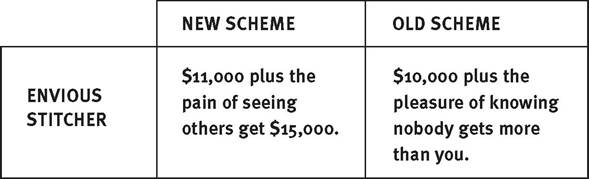
Provided the utility Joe attaches to the payoff in the old scheme is greater than in the new one, Rawls' difference principle would rule out the new scheme if he did not have the requirement that the players were not envious. Because of this requirement that there be no envy, however, Rawls need never consider an objection to inequality of this sort.
Now, many people believe that the existence of inequalities is a large part of what gives rise to the tremendous productivity of modern economies. Rawls is saying, in effect, that provided these inequalities are just what is necessary to create the incentives that produce extra goods, even the worst-off person can be seen to be profiting from them: and if that is true, only envy—which is, after all, a disreputable feeling!—could account for even the worst-off objecting to those inequalities.
6.9