The Interaction of Vagueness and Modality
Recall the supervaluationist truth clauses for □ and Δ relative to a pair consisting of a world x belonging to a set of possible worlds W and a precisification v belonging to a set V: 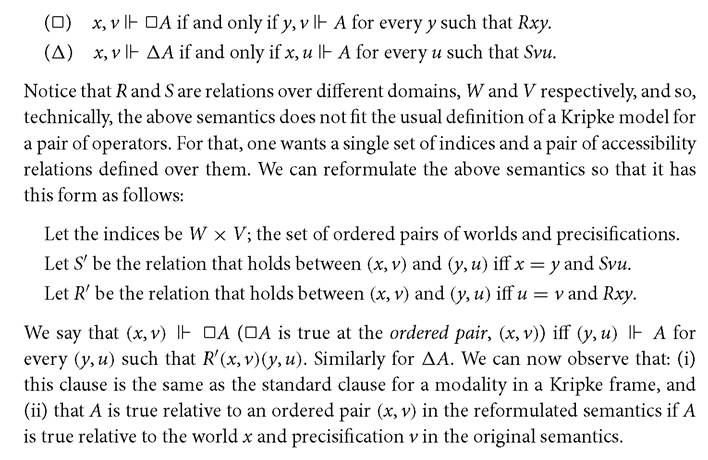
[1] The question of how to measure the strength of a proposition when there are multiple kinds of propositional operators in the language is a delicate question.
One must distinguish between necessary implication, determinate implication, eternal implication, etc., and the various combinations of these notions, such as determinate necessary implication, necessary eternal implication, and so on. This question is solved if we have a maximally broad notion of logical necessity available to us. The L operator we defined from the identity connective in section 11.1 has exactly this feature.According to most treatments of metaphysical modality, a proposition is necessary if it is true at all members of W, so that the □-accessibility relation R becomes the relation that relates every possible world to every other possible world. For this reason, it is omitted altogether from many formal treatments of modality. Note, however, that even if R is the universal accessibility relation over worlds, the corresponding R' relation is not a universal relation over the indices in W × V. Rather, it partitions W × V into equivalence classes by the relation of sharing the same precisification coordinate. Our model thus contains indices that represent metaphysically impossible scenarios: scenarios represented by indices that are not ^-accessible from the true index.
The first thing to notice about this framework is that we don't validate the principle that necessary truths are determinate:2 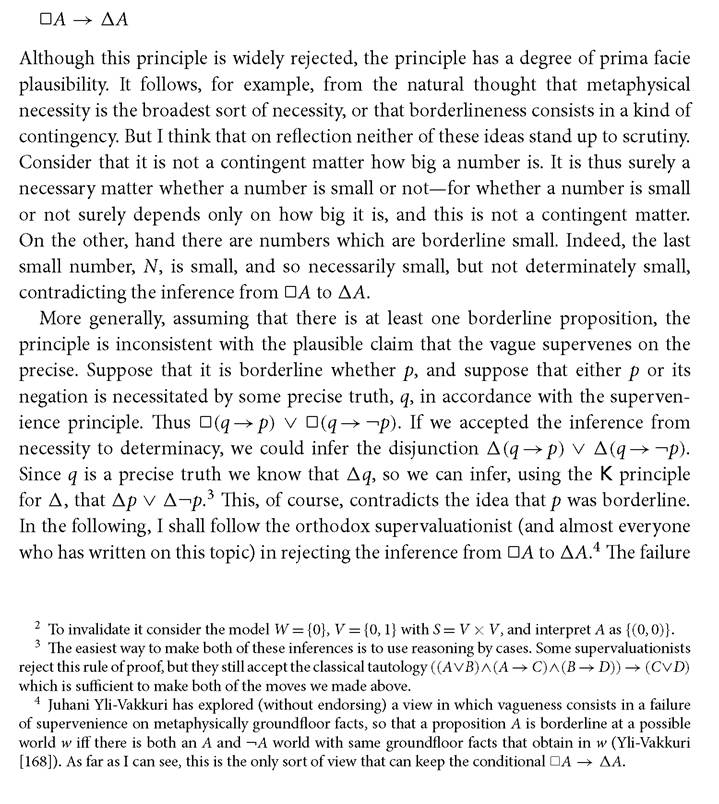
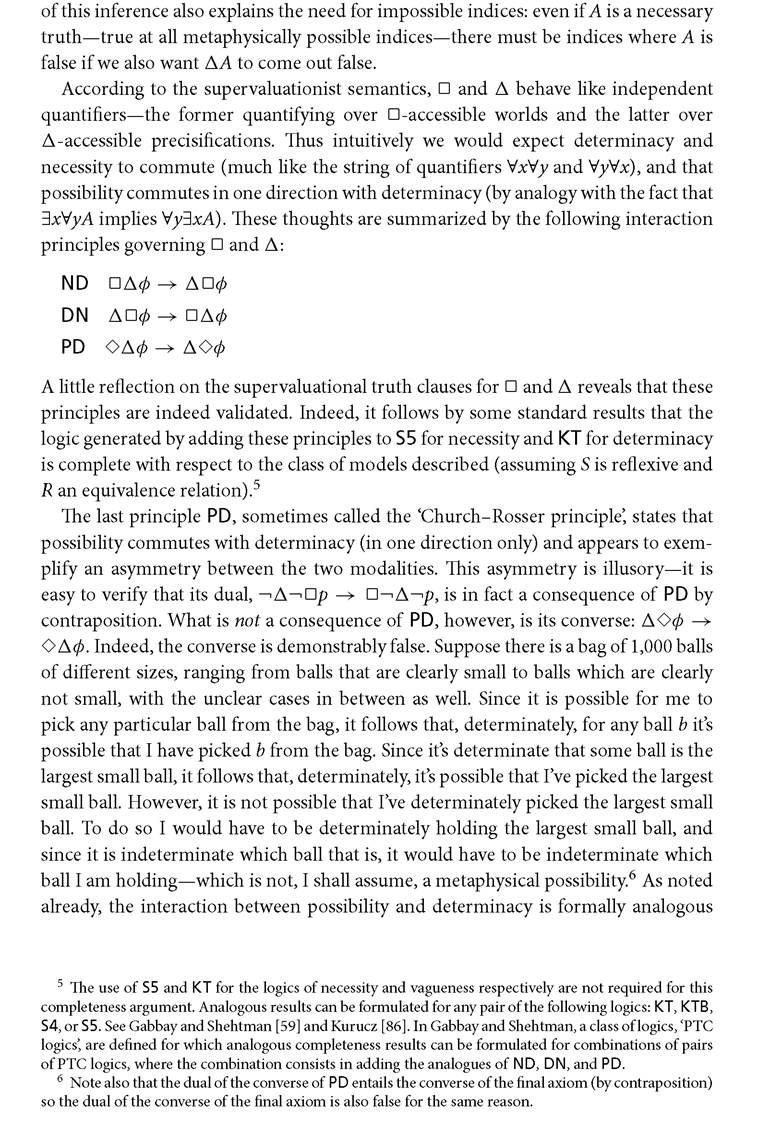
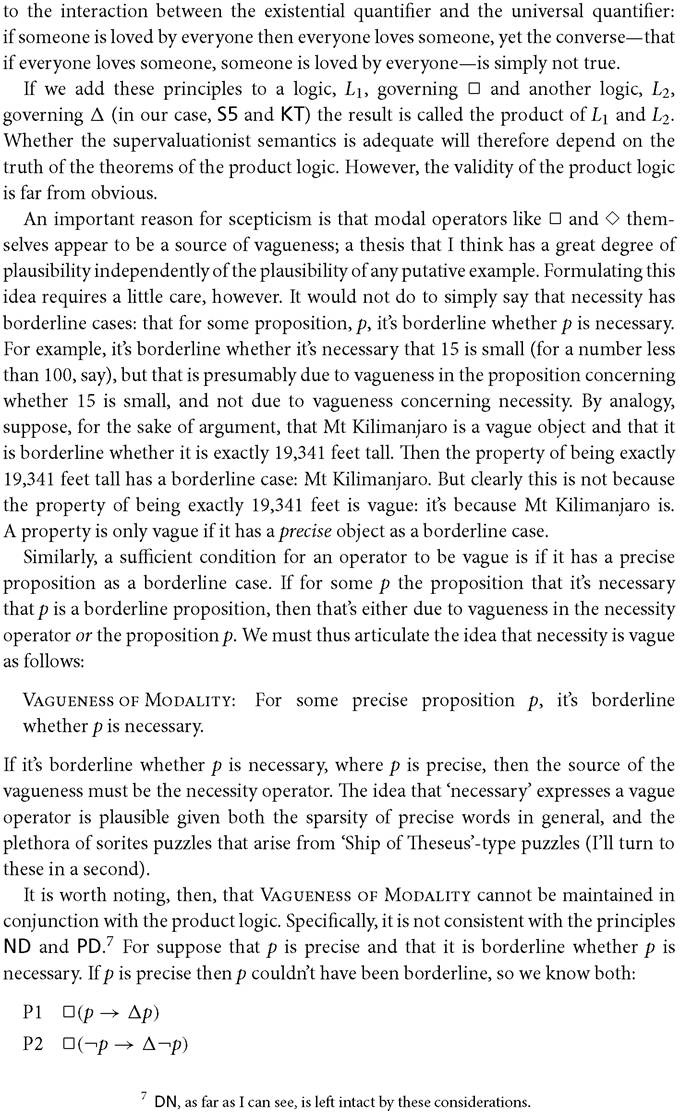
chainy.
Since this is a paradigm sorites argument, the truths at the boundary will not be determinate truths.This much should, I hope, be uncontroversial provided one accepts the moderately essentialist metaphysics implicit in the set-up. The next step is to note that ∃nx(x ∈ X∧ x ≤ c) appears to be stated in purely precise vocabulary: it can be formulated only using identity, (unrestricted) existential quantification, set membership, and mereo- logical parthood, all of which are plausibly precise, and two names: X introduced as a name for a particular set, and c, a name for a particular object. Since the proposition expressed by this sentence is precise, we know that it couldn't be borderline, and thus we have true instances of P1, P2, and P3. Thus, we have a precise proposition that is a borderline case of being necessary.
There are several plausible ways to resist the argument. One might, for example, deny that we succeeded in introducing a precise name for the chain in our example (a similar objection could be levelled at our name for the set of links). This response does not get to the heart of the issue: the premises P1-P3 are just as plausible if we existentially quantify into the position that the name c takes. The existential versions of these premises then rest on the following thought: that there's at least one chain such that it is borderline whether it could have had less n members of X as parts. The contradiction with ND proceeds just as before, except in the scope of an existential quantifier. One might similarly object to the idea that we could introduce a precise name for the set X, but again the premises are no less persuasive when X is replaced by an existential quantifier.
There are, of course, other ways of resisting the argument: one could deny the essentialist metaphysics that we need to get the sorites going, or one could deny that parthood is always precise.
The principle that parthood is precise, for example, is sometimes rejected on the grounds that there are vague objects such as Mt Kilimanjaro: there are rocks and stones that are such that it is borderline whether they are a part of Mt Kilimanjaro. Thus there are pairs of objects such that it is borderline whether one is a part of the other. But to conclude from this that parthood is vague rests on exactly the sort of fallacy we exposed earlier and took care to avoid. We would not analogously conclude that being exactly 19,341 feet was a vague property on the basis that it has MtKilimanjaro as a borderline case of it. To show the vagueness of that property we must find a precise object such that it is borderline whether it is 19,341 feet, and Mt Kilimanjaro is not such an object. By analogy, if there is vagueness in the proposition that x is a part of y, then that is either due to vagueness in x or y or in parthood: one would need to find precise objects x andy that stand in indeterminate parthood relations to establish the vagueness of parthood.Let me finish the discussion of this case by noting that these kinds of piecemeal responses fall far short of a general defence of the principle that modality is completely precise. The endless supply of metaphysical puzzles of this sort will require all kinds of ad hoc manoeuvres: to avoid postulating vagueness in the modal operators, we must postulate it in all kinds of other places. It is odd to imagine someone being willing to postulate vagueness in places one wouldn't normally expect, such as in the parthood relation, but be unwilling to acknowledge the vagueness of‘necessarily’. The vagueness of ‘necessarily’ is antecedently plausible, independently of our examples, since so few of our words express precise things anyway.
It is, of course, possible to modify the supervaluationist semantics in such a way as to invalidate these inferences.
One could, for example, allow the Δ-accessibility relation to be sensitive to the world coordinate, as well as the precisification coordinate. We could similarly allow the □-accessibility relation to be sensitive to the precisification coordinate in addition to looking at the world coordinate. (Formally, this could be achieved by using ternary or quaternary accessibility relations over both worlds and precisifications so that the □-accessibility relation can be sensitive to the precisification coordinate, and the Δ-accessibility relation can be sensitive to the world coordinate.) I will defer a proper treatment of these proposals until section 15.4. However, let me note that many of these sorts of tweaks turn the supervaluational semantics into a notational variant of the general Kripke semantics of two operators: in these variants, the ordered pair structure plays no role in the semantics, and the ordered pairs could be replaced, without loss of generality, with indices that are not ordered pairs; this is exactly the sort of semantics we will investigate in section 15.2.15.2