The Proper Logic of Vagueness and Modality
Let us now apply the framework of chapter 13 to the logic of vagueness and modality. Recall that a proposition p is determinate at an index i iff σ (p) is true at i for every symmetry belonging to G(i).
Recall also that we can reformulate this semantics so that it takes the form of an ordinary Kripke model by introducing an accessibility relation as follows: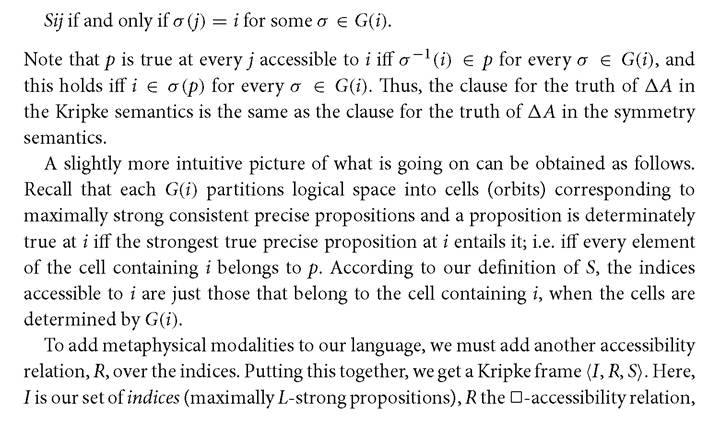
and S the Δ-accessibility relation as defined above in terms of symmetries. R and S range over a single domain of indices, and so are the counterpart of the two relations R' and S' that range over ordered pairs in the supervaluationist case.
In the supervaluational setting, however, the two accessibility relations would shift the world and precisification coordinates independently: R' completely ignores the precisification coordinate, and S' ignores the world coordinate. There is nothing corresponding to this constraint in the present setting. 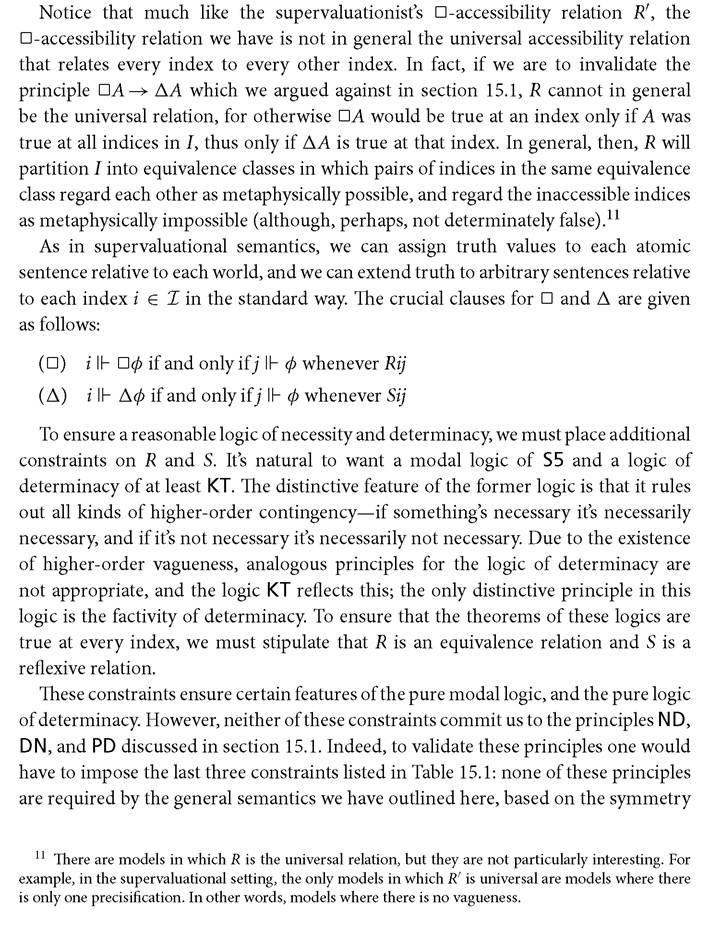
Table 15.1. Interaction principles for vagueness and modality
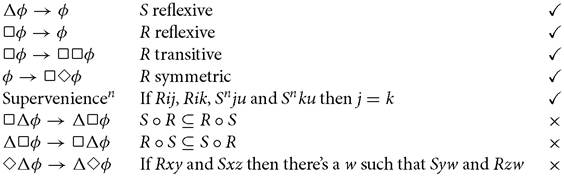
semantics from chapter 13.12 In particular, the problematic combination ND + PD is not required in this sort of semantics.
It is natural to wonder whether there are there any further constraints that need to be imposed governing the interaction of R and S. I shall shortly show that if we want to expand the language to contain quantification into sentence position, and we want to make certain supervenience claims true, then we should additionally impose, for each n, the constraint labelled Superveniencen in Table 15.1.
If you compare the class of models in which R is an equivalence relation and S is reflexive with the subclass of those models in which the supervenience claim constraint is additionally imposed, no extra principles are validated in the propositional modal language containing □ and Δ (and even fl). However, it is presumably going to be a constraint that holds in the intended model, assuming the truth of the supervenience theses, and these constraints will also create new validities when the propositional quantifiers are added, so it is important not to omit these conditions from the model theory. In summary, constraints we are interested in are given by the first five principles in Table 15.1; the last three constraints are not imposed.15.3"Times New Roman"'>
More on the topic The Proper Logic of Vagueness and Modality:
- The disputes we have discussed in chapter 2 do not draw the lines youd initially expect.
- Using logic: Truth preservation, probability, and the lottery paradox
- Bibliography
- A critical balance of Epicurus' theoretical adversaries