Analysing ART processes enabling SHD
Building on the STEHD framework developed in Chapter 2 and taking into account the questions guiding its procedural application (see Table 2.1), the empirical evidence discussed by Agostinucci and Biggeri (2012a) allows us to explore the relationship between the ART Initiative and the enabling processes for SHD in each LDS, as illustrated in Figure 4.3.
It is worth recalling here that achievable functionings (i.e. opportunities to function) and achieved functionings of specific LDSs depend on enabling or disabling factors, which are constituted by the availability and composition of existing resources, barriers, institutions and capacities and by interactions among these factors and different stakeholders. Such elements can be substantially affected by international cooperation initiatives14 (e.g. capacity building strategies), as well as the subsequent choice process (depending on political commitment and social mobilization), which ultimately determines how the LDS performs and effects the activation of dynamic feedback loops.
Figure 4.3 shows how the ART Initiative aims to enhance several dynamic processes of SHD at the local level by working horizontally and vertically with different stakeholders through the use of systematized but flexible instruments. An analogy may help. The ART Initiative acts like a "case manager” for a family. The case manager starts with the context, the family's characteristics, and helps generate an appropriate long-term vision of life, that is, a contextualized project of life. Simultaneously, an endogenous process of change enabling the family to function better in the community is constructed. In theory, if the case manager were supporting these processes appropriately, an "exit strategy” from this supporting role would be
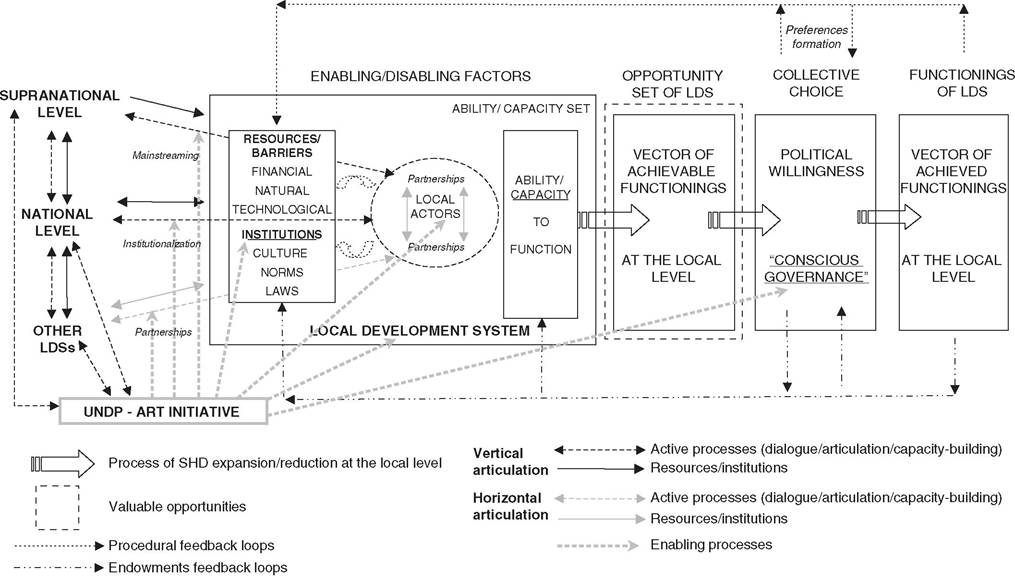
Figtire 4.3 The STEHD framework: UNDP ART processes enabling the SHD territorial dynamics Source: Authors.
easily pursued, allowing the family to move forward and realize their own life project autonomously.
Similarly, ART functions as a catalyst of resources and capacities to foster endogenous processes of territorial SHD based on a local long-term vision of development. Indeed, the introduction of mechanisms and tools for the horizontal and vertical articulation of institutional and non-institutional actors across political and administrative levels facilitates the emergence and consolidation of shared visions and commitments to coordinated actions (Agostinucci and Biggeri, 2012a). At the local level, ART supports the empowerment of local stakeholders through improved institutions, capacities and enabling factors as a basis for “demand-driven” integration between internal and external actions within a territory.
According to the assessment of ART experiences in Morocco, Ecuador and Colombia by Agostinucci and Biggeri (2012a, p. 11), giving “voice” to the territory is the first step of a process that bridges strategic and operational dimensions within and across territories, acting at three levels: (i) harmonization and alignment of external actors with local authorities' mandates and plans; (ii) links between national and local policies and plans; and (iii) dialogue with other territories for partnership building and knowledge sharing, as part of a circular and mutual process feeding local-national-global articulation process. In other words, articulation is the capacity, on one hand, to mobilize endogenous resources and local stakeholder agency and, on the other hand, to integrate them with external resources from territories and levels within structured partnerships (e.g. South-South cooperation). In addition, the institutionalization and mainstreaming of these interactive processes constitute enabling factors to reinforce SHD at the local level.
In this regard, operating in socio-institutional contexts with evolving decentralization frameworks, ART strategies, principles and operating modalities have to continuously interact and adjust their match with governments' priorities.
This alignment can only be pursued by operating in territories where key administrative functions for decentralized governance are concentrated, and democratic governance dynamics (elected bodies, citizen participation and accountable management) is taking place. In addition, the territorial areas that are prioritized by the National Coordination Committee (NCC)15 of each ART Program are small enough to make real participatory processes possible involving different actors of development, but are still big enough to command the necessary resources to manage a local development platform (Canzanelli, 2001 and 2011). This scale makes it possible to build virtuous processes of synergic collective actions involving all stakeholders - governments, local actors and local administration, enterprises and their associations and civil society associations. It also allows programs to effectively reduce their action through “cascade articulation mechanisms” (Agostinucci and Biggeri, 2012a, p. 12), by which lower administrative levels and grassroots organizations are included in territorial processes through their representation in the programs' consultative structures and their participation in the elaboration of territorial strategies.The example of Morocco can help clarify this argument. Although the ART Program has focused on the regional level (as it constitutes the prospective centrepiece of an evolving decentralization framework and the basis of related democratic representation processes), the Provinces (as centres of deconcentrated state authority and political and legal functions of their own) have been involved in the elaboration of regional strategic documents. However, according to Agostinucci and Biggeri (2012a), their participation gradually lost dynamism as it became increasingly less significant for the overall strategy of the program.
Another area of action where the ART Framework Programs spur enabling processes relates to the nurturing of the internal dynamics of LDSs, by directly and indirectly promoting partnerships and strengthening local social capital, such as cooperative behaviour, trust and confidence.
Indeed, the main mechanisms promoted in local communities16 rely on social mobilization and participation. These processes can be successful in strengthening relational capacities, collective action, common views and the resolution of long-term conflict disputes, thus aligning the interests of different stakeholders in the pursuit of the common good and local well-being. For instance, the Local Programming Cycle constitutes a solid methodology for channelling a large and articulated process of bottom-up and participatory consultation involving a broad and diversified range of local actors in the representation of public institutions, civil society organizations, development cooperation partners and donors.17 Moreover, partnerships between territorial development systems contribute to enhance social capital in all the communities involved, mainly due to knowledge sharing and interactive learning processes, and to a holistic view of territories, where high social cohesion is fundamental.However, the effectiveness of implemented actions and initiatives crucially depends on formal regulative frameworks and informal social norms, traditional traits and customs as well as local institutional structure, which shape relations and interactions among actors who have a substantial role in national and local development. In this respect, the ART Initiative promotes an ambitious change of attitude in countries and territories where decisionmaking and planning processes are often still highly centralized at national level, regulative frameworks are only partially applied and informal norms continue to play a crucial role in social interactions. Empirical evidence from Morocco, Ecuador and Colombia (Agostinucci and Biggeri, 2012a) has shown that ART Framework Programs are capable of galvanizing the territorial system and giving value to its features. In particular, the same evidence shows that the these programs have the potential to (i) strengthen the decentralization reforms of national governments, and reinforce institutional and technical capacities locally and nationally; (ii) make territorial communities and local stakeholders aware of the roles they can play in terms of influencing and leading local and national development strategies; and (iii) promote local working groups, as integrated operational tools capable of supporting local governments in their efforts to align international cooperation initiatives with development plans, thereby affecting relational and cooperative behaviour for the provision of local public goods and the promotion of SHD in local communities.
As recognized by Negrotto (2011), ART is not intended as a program to support decentralization policies, because Framework Programs can only indirectly deal with technical support for local governments' functions regarding fiscal policies, spatial planning, sectoral policies and so on. Instead, institution building actions are directed at supporting the leadership and capacities of local stakeholders in formulating and implementing strategic frameworks for territorial development, in association with other national and external actors.18
If building the sustainable capacities of territorial actors, and in particular consolidating local government institutions, constitutes an overriding objective of ART (Negrotto, 2011), the expansion of territorial achievements for SHD depends on the commitment of local actors in accessing the opportunities offered through articulation with other levels and territories. Territorial collective choice in the form of political willingness and "conscious governance” is therefore viewed as the key determinant of results achieved at the local level. Indeed, the enabling processes set in motion by ART impact upon "conscious collective action” (Dei Ottati, 2002, p. 266), by sustaining the capacity of territorial society to identify shared and feasible paths of place-based and people-centred development, and bolstering the ability of local stakeholders to lead the evolution of their territory. Hence, an optimal level of ownership may be reached once national and local governments take effective leadership over the ART methods and approach. This evolution would be expressed in the consolidation and formalization of local institutional arrangements that seek to align development assistance and external resources to national policies and foster harmonization between local and national priorities and actions. At this point, ART Framework Programs may begin to reduce their support as territories increasingly claim ownership of their own development trajectories.
Overall, the vertical and horizontal articulation of multilevel dynamic processes is probably the key feature of the "operating mode” of the ART Initiative (Agostinucci and Biggeri, 2012a). In particular, articulation takes place at different levels: within territories, in the form of dialogue and coordination between institutional and non-institutional actors; and at different institutional levels, linking local and intermediate layers with the national and supranational dimension. In this way, it reaffirms the innovative capacity and value of the ART Initiative in framing and facilitating local and national processes as part of a broader mutually reinforcing relation within the global dimension.
Figure 4.4 summarizes these processes, presenting ART as an enabler of multilevel governance interaction from an SHD perspective. Along the horizontal dimension, dialogue and interactions between actors within and across territories facilitates the systematization of territories' demands and development needs, as well as the exchange of knowledge and experiences for improving processes, practices and functions of LDSs. For instance, building South-South territorial partnership eases learning-by-comparing or joint planning and management (e.g. regarding natural resources or public services) across territories. Indeed, the sharing of good practices among territorial communities (e.g. between local governments in Brazil and Colombia for development and integration in Southern Brazil) is often a key
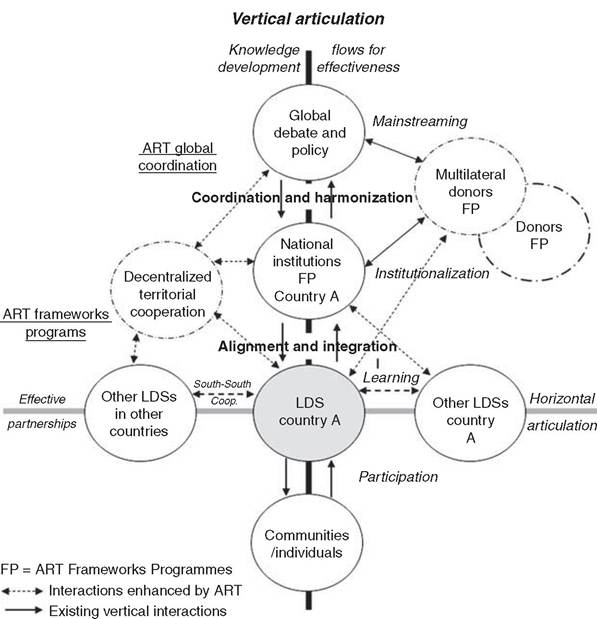
Figure 4.4 The multilevel governance framework of UNDP ART processes Source: Adapted from Agostinucci and Biggeri (2012b, p. 6).
trigger of innovative forms of management, widening local development opportunities and enhancing local governance (UNDP, 2012). Agostinucci and Biggeri (2012a) report on the support offered to "Mancomunidades" (inter-municipal associations) in Mira and other municipalities in Ecuador, where successful articulation across territories and levels has taken place based on the good practices shared with Spanish cooperation counterparts regarding integrated water management. Empirical assessment shows this articulation has allowed different associations to link to each other, in order to jointly adopt institutional and financial innovations (e.g. planning units at municipal level and joint funds for water-basin management) and to elaborate project proposals for national and international partners.
Along the vertical dimension, flows of knowledge and resources for improved policy and aid frameworks at the national and global level and for the provision of effective services at the local level characterize ART's operational approach. The objective of this articulation is twofold: to integrate strategies and plans where actors, competencies and resources from different administrative levels are combined; and to mainstream effective tools for improved coordination, harmonization and alignment of different development cooperation interventions that support local development processes, the achievement of the MDGs and the implementation of the Paris Declaration (Bossuyt and Steenbergen, 2012). In this way, the effects of a complex system of trans-territorial relations and of globalization processes are potentially directed towards strengthening collective efficiency and social outcomes for SHD at the local level.
An important clarification is worth noting at this stage. As the ART Framework Programs operate in national and local contexts with different institutional features,19 their focus and operating modalities should be capable of flexibly adapting to such contextual differences, avoiding the implementation of a single rigid model. Indeed, according to Agostinucci and Biggeri (2012a) and UNDP ART (2012), although mechanisms and tools are inspired by the same principles, there are many different variants that respond to specific circumstances and sets of constraints and opportunities. For instance, in Ecuador, Morocco, Colombia and Sri Lanka, the programs' priority focus has emphasized institutional capacity building and Development Effectiveness (UNDP ART, 2012); in Colombia, together with the REDES Program, a rather unique and unprecedented mix of peace building processes through territorial development has been fostered (Preti, 2010); and in Morocco, institutional capacity building through territorial partnerships with European actors is the mechanism accompanying the formulation and implementation of a new regionalization framework. In addition, the local implementation of program strategies can be directly related to development cooperation initiatives to varying degrees. In the Department of Narino (Colombia), for example, the elaboration of a strategy for international cooperation based on the articulation of local actors and donors with regional and municipal governments is the "entry point” for a massive civic participation process that has gradually overshadowed the structured reference to donors' coordination mechanisms (UNDP ART, 2012).
Moreover, changing context conditions (e.g. political fluctuations and discontinuity) can in some cases significantly affect the continuity of the introduced process. It follows that the possibility of being able to operate within a multilevel operational framework ‘act[s] as a "balancing” factor, compensating context factors with a set of opportunities in terms of potential differentiation of interlocutors, levels of action, and so on' (Agostinucci and Biggeri, 2012a, p. 11).
Nonetheless, both the initiative at global level and the national Framework Programs may face operational difficulties common to most forms of international cooperation. Firstly, the ambitious change of approach to international cooperation implied by ART requires long time horizons in order to become completely accepted by all relevant actors, and to expand individual and collective capabilities in a sustainable way. This may hamper the effectiveness of the ART approach, as stakeholders often expect and demand immediate results in order to commit their resources and efforts to common objectives. Moreover, the economic view of development - in terms of GDP - still shapes local perceptions that the central contribution of international cooperation is essentially to add financial resources to local and national budgets, failing to fully appreciate the importance of a new approach. Thus, ART Programs often foster the implementation of rapidimpact projects and initiatives, in order to facilitate a change of approach with concrete results that can galvanize the participation of local actors in strategic planning and for the achievement of medium-term objectives. If, however, these pilot initiatives do not yield immediate outcomes and results, the stakeholders' commitment may become superficial and opportunistic, instead of evolving to ensure complete ownership of actions in the long term.
Secondly, the creation of working groups and agencies at local level entails the risk, if not continuously and rigorously supported, of exacerbating perverse mechanisms of lock-in and rent seeking, where social groups with relatively strong political or economic power continue to pursue their private interest. These groups may not act as social innovators through transformative participation; instead, they may attempt to legitimize and reinforce existing power relations. Furthermore, inviting local actors to meet and form working groups may paradoxically enhance the social exclusion of groups that are not able to organize and express their collective interests. For instance, if the need for immediate results leads to the involvement of only powerful and organized groups, excluding other agents with potential innovative ideas, resources and knowledge, the level of trust and confidence between local actors - especially when the rent seekers are local authorities - will be seriously undermined. Here, the key issue is to effectively enhance the capacity for representation and the empowerment of socially excluded groups - an example, according to Preti (2010), is the gender equality policy in the Department of Narino, Colombia. In operational terms, a continuous monitoring of local power relations and in-depth political analysis of conflict (together with traditional accounts of territorial resources, development potential and participatory processes) would be fundamental for ART Programs to assess the extent to which community participation is transformative, especially in situations of social and political conflict.
Thirdly, the previous argument also relates to the potential fragility of local working groups, which may rapidly disappear when financial support from international cooperation phases out, especially if the methodology for their set-up is externally imposed and local capacities are not adequately supported. In addition, the affiliation of national and local governments to different political parties may have a crucial influence on the transfer of budget resources and on the devolution of decision-making and planning processes at the sub-national level.
Fourthly, the greater the number of stakeholders involved in these processes, the harder the efforts to coordinate initiatives and actions, and the lower the influence each actor individually can hope to exert on these processes. However, each actor involved in the process usually wishes to be a "prime player”, for reasons of visibility and accountability. Therefore, unless a structured reform of the whole system of international cooperation is undertaken, development actors will continue to have the incentive to implement parallel fragmented sectoral and vertical strategies, often based on paternalistic and assistentialistic approaches.
Finally, local participatory processes may be hampered by structural factors at national and international levels that disable local processes of social, political and economic inclusion. In this respect, the UNDP ART Global Initiative has recently devoted efforts to energize global debate and mainstream a multilevel approach to inclusive development, avoiding uncoordinated and contrasting efforts by actors at different levels. An important feature of ART is the awareness of these potential risks and difficulties, as reported in several operational reports (UNDP ART, 2011; 2012). As ART is characterized by processes of collective learning through trial-and-errors and feedback loops derived from multilevel achievements, such awareness has allowed the search for new place-based solutions to prevent, monitor and counterbalance these risks.
Rigorous empirical analyses and mixed-methods impact evaluations (see Appendix 6.1) in terms of capability expansion would reinforce the understanding of effective outcomes, structural constraints and potential difficulties regarding SHD processes at the local level.
4.5