Comparing traditional aid policies and the ART Initiative
Over the last three decades, a significant shift has occurred in the international aid and cooperation scenario. The debate on international cooperation objectives moved first from inputs to outputs, then from outputs to outcomes and, finally, to processes (Griffin and Knight, 1990; Tarp, 2000; Thorbecke, 2007; Canitano and Biggeri, 2010).
Nowadays, the Paris Declaration and the Accra Agenda constitute the new guiding principles for establishing international cooperation initiatives (OECD, 2011). Despite their internationally agreed relevance, strong difficulties lie in transforming the principles of ownership, harmonization, alignment and accountability into practice.9 In addition, it is increasingly clear that it is not just a question of outcomes (e.g. the MDGs), but rather of understanding the development processes generating final outcomes.The difference between the theoretical approach and operational mechanisms of traditional development aid (multilateral or bilateral), and the ART Initiative are significant, as shown in Figures 4.1 and 4.2 in relation to MDG 7.C ("Halve, by 2015, the proportion of people without sustainable access to safe drinking water and basic sanitation”), as an illustrative example. Nonetheless, it is important to note the two cooperation strategies are not necessarily alternatives, as they could complement and reinforce one another if both were carefully tailored to a place-based SHD perspective.
First, traditional aid strategies of multilateral and bilateral donors, represented in Figure 4.1, deliver inputs (resources, goods and services) for the achievement of the MDG 7C through two main mechanisms. The first and most common in traditional development programs is the provision of bilateral budget support to the national government of the beneficiary country (represented by the grey full arrow in the diagram).
Resources from the national level can eventually be directed to territorial communities and/or final beneficiaries in terms of goods and services (the grey-dotted arrows in the diagram, for example, sustaining the increase of transfers-in-kind and net income). The other mechanism regards a more direct delivery of goods and services, often through local NGOs, within initiatives of humanitarian aid (such as in case of complex emergencies), which is represented by the full arrow directed to the "production” of goods and services.In both cases, the local ownership of interventions is often fairly weak, although formally "guaranteed” - at least partially - by the elaboration of national Poverty Reduction Strategy Papers.10 Alignment, not typically considered in the past, is now officially taken into consideration, while harmonization is pursued through a dialogue among donor partners, which is easily reachable within the budget support strategy. However, significant critiques have been levelled against the traditional approach to international aid policies. So-called "aid fatigue” (Ranis, 2007; Kharas, 2008) is concerned with failures or quasi-failures in terms of processes and results, and not just lack of sufficient resources and missed targets (Severino and Ray, 2009). In addition, the adequacy of aid delivery processes and procedures has been questioned. From an SHD perspective, the "Big plans” promoted by international organizations typically fail to take adequate account of processes, different contexts and participation of local communities. In particular, these strategies have often been adopted without asking whether
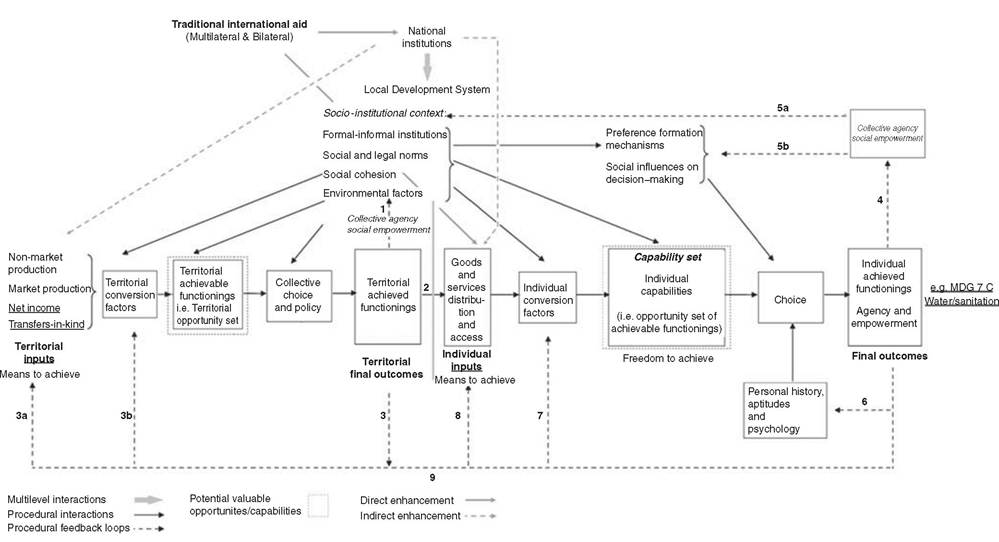
Figtire 4.1 The STEHD framework: Traditional bilateral and multilateral aid strategies
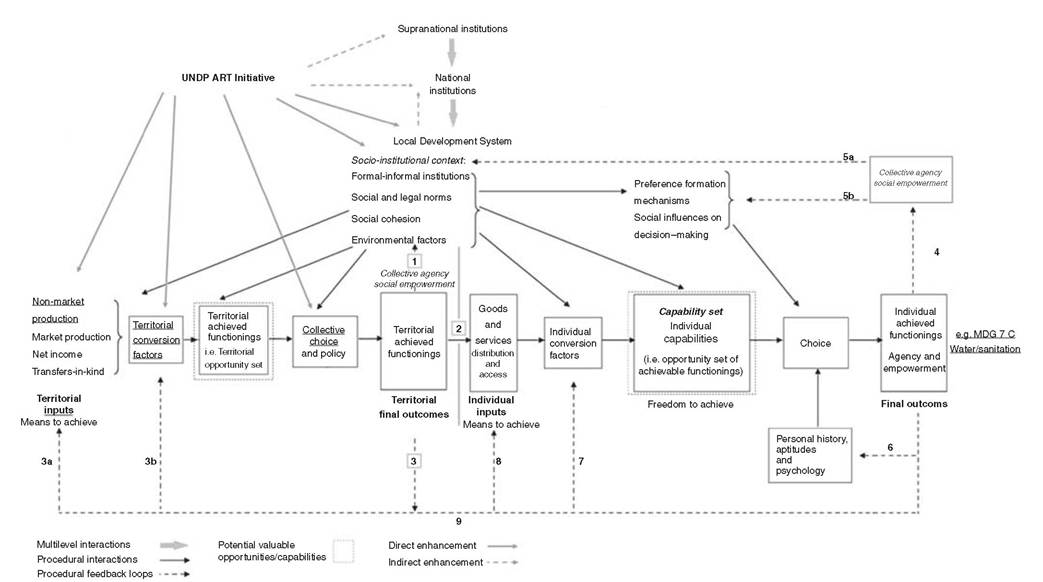
Figtire 4.2 The STEHD framework: The UNDP ART Global Initiative
the actions brought forward would be capable of starting an endogenous empowerment process or were just the product of a standardized recipe far removed from reality on the ground and designed without the participation of local communities (Mosley et al., 1991; Easterly, 2006).11
However, Jolly (2005) and Cornago (2010) argue that the strategic interests and priorities of donors underlying the traditional system of international affairs are being gradually displaced by the recent strong commitment to HD and sustainability.12 In this context, the UNDP ART Global Initiative offers a broader and more complex scope for action, by promoting cooperation practices as an opportunity for partnership-based dialogue around SHD issues as opposed to the “donor-beneficiary” traditional paradigm. As shown in Figure 4.2, ART aims to work with processes rather than inputs, thus facilitating the following:
i) Engagement and support in the design and implementation of decentralization and local governance policies;
ii) Internal dynamics of interaction and dialogue within LDSs nurturing social creativity to find tailored solutions to local problems;
iii) Collective choice mechanisms (e.g.
working territorial groups) for the alignment of interests and local priorities;iv) The enhancement of territorial tangible and intangible factors, allowing the conversion of resources into achievable functionings at the local level;
v) The increase of non-market territorial inputs through the harmonization of different development actors' contributions (e.g. decentralized cooperation) to national and local priorities and through the use of alternative resources (knowledge, coordination, human and relational capital) as a basis for a new approach to local development.
Overall, the reinforcement of these processes can spur feedback loops 1-3 discussed in Chapter 2, thus facilitating further socio-institutional evolutions, the expansion of the territorial opportunity set and the widening of the distribution of, and access to, goods and services for individuals and other agents. In order words, the ART Initiatives builds on the strategic value of decentralized and South-South cooperation as a horizontal and multilevel link among those stakeholders working in a given territory, acting as facilitators and catalysts for intranational and transnational consensus building and supporting the implementation of local and national agendas for the achievement of the MDGs (UNDP, 2012; UNDP ART, 2012; Fernandez de Losada, 2013).
However, despite the relevance of a similar approach and processes, difficulties should be recognized. Various international organizations,13 although acknowledging the growing role and scope of sub-national involvement in international cooperation (Fernandez de Losada et al., 2012; UNDP, 2014), still draw attention to the limitations and constraints of decentralized cooperation patterns. For instance, according to lanni (2011, p. 10), ‘instead of a strengthening effect, the proliferation of initiatives with no proper articulation mechanisms has led to the atomization and segmentation of the territory; combined with low aid effectiveness, this has resulted in a lack of efficacy in development processes.' This suggests it is precisely the lack of a strategic framework at the sub-national level and local coordination mechanisms, that constitute the most binding constraint and disabling factor the ART Initiative is seeks to tackle (Negrotto, 2011).
Nevertheless, understanding how the UNDP ART Initiative engages with and supports the design and implementation of local governance mechanisms and strategies requires a more detailed analysis of the territorial SHD processes it fosters. It follows that making the framework advanced in Chapter 2 and the MLG approach discussed in Chapter 3 operational can provide useful insights for the new agenda of international development cooperation.
4.4