An empirical example of local "meta-organizer": REDASP (SR)14
The general arguments of LEDAs' roles as "meta-organizers" and enabling factors of LED discussed above need to be empirically assessed in each case, given the high idiosyncrasy of LEDA models and the contextual characteristics in each territorial society.
For instance, the opportunity for RDAs in the United Kingdom to sustain innovation-oriented strategic plans fitting the knowledge-driven economy is supported by Morgan's (1997) analysis of the Welsh Development Agency as an "animateur" of innovation by promoting a network, interactive culture and soft infrastructures for localized technological change and innovation.Building on Ferrannini and Canzanelli (2103), we now focus on another noteworthy - but less renowned - case study of the Regional Economic Development Agency for Sumadija and Pomoravlje (REDASP) in Serbia. Specifically, we discuss its capacity to foster economic dynamism and expand firms' capabilities15 in a territorial context of long industrial recession, devaluation of local potentialities and slow transition to a market economy.
The region16 of Sumadija and Pomoravlje is composed of two districts - Sumadija and Pomoravlje - and a number of sub-districts (Figure 5.2) that share similar socio-economic characteristics. Together these districts consist of 526,213 inhabitants (SORS, 2002) and cover an area of 5001 km2 in Central Serbia. The local economy included around 5,247 registered active enterprises in 2009 (SBRA, 2009), of which more than 95% are from SMEs, with a clear dominance in the manufacturing sector (34% of employees according to the NES, 2008). Indeed, this region has long represented Serbia's industrial core (REDASP, 2011), as a result of a long-standing tradition in metal processing and non-metal industries (e.g. the headquarters and main production factories of the state automotive company - Zastava - of the former Yugoslavia were based in the city of Kragujevac), underpinned by its relatively strong geographical position and highly developed communication infrastructure networks.17
These geographical, historical and economic features have not only facilitated market interactions with other Balkan and European countries
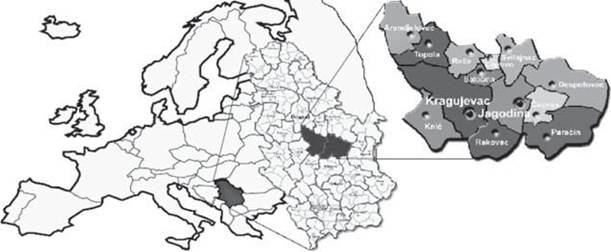
Figure 5.2 The region of Sumadija and Pomoravlje in Serbia Source: http://www.kg-cci.co.rs/.
but have also attracted foreign direct investments (FDI), especially in the automobile industry. For instance, from 2008, the Italian automotive group FIAT started off-shoring part of its production activities to the city of Kragujevac, with a declared total initial investment of around €1,050 billion. In terms of social indicators, the poverty headcount ratio (10.7% in 2002) and the HDI (0.689 in 2006) reflect Serbian averages (Republic Development Bureau, 2006; Bjeloglav et al., 2007), with the worst results for the Roma population, refugees and internally displaced persons. However, the problem of unemployment in these two districts is striking, with rates reaching over 31% in 2007 (NES, 2008), due to the high vulnerability of the local economy to the business circle in the main industrial sectors and the weak territorial embeddedness of foreign companies. Finally, it is worth remembering that Serbia was officially confirmed as a candidate country to join the EU in March 2012, following substantial progresses regarding the stability of the institutions and the functioning of a market economy (EC, 2011b).
REDASP has been operating in this socio-economic context since 2005, following the transformation process of the regional agency for small and medium enterprises “Sumadija” established in 2002. REDASP itself represents a partnership with most of the relevant institutions of the territory - that is, within the private (e.g. Regional Chamber of Commerce, associations of entrepreneurs), public (e.g. local government units) and NGO sectors from the two districts - that aim to create the strategic conditions to stimulate regional economic and social development. Within a portfolio of over 40 projects, REDASP provides a broad range of services for SMEs and human resource development, infrastructure and environment protection, strategic planning, rural development and tourism, and data and information systematization. The complete organizational structure is represented in Figure 5.3.
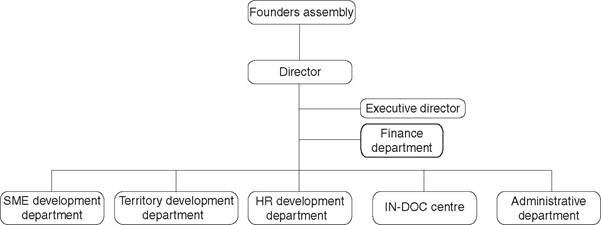
Figure 5.3 REDASP's organizational structure Source: www.redasp.rs.
Nonetheless, a strategic focus is placed on SMEs as the main actors for economic dynamism, not only through technical assistance and dedicated consultancy services (e.g. feasibility studies, business plan, project writing) but also by fostering associative attitudes among entrepreneurs through different cluster initiatives (e.g. in the automotive and flower sectors). In addition, REDASP has facilitated the establishment of new specialized structures for economic animation - the Business Innovation Centre and the Business Start-up Centre in Kragujevac - as well as the creation of a network of Local Economic Development Offices in the 11 municipalities of the region. Finally, the agency has been in charge of designing the Sustainable Development Strategy of Sumadija and Pomoravlje for the period 20112021. A list of relevant projects implemented by REDASP is presented in Appendix 5.1.
Recalling Figure 5.1 helps clarify their REDASP's roles for LED evolution within an SHD perspective. Firstly, the institution of REDASP itself and its strategic planning activities nurture the internal dynamics of LDS by consolidating partnerships, flows and interactive learning among local actors. Secondly, the creation of specialized structures and support of associative attitudes among entrepreneurs help remove barriers to knowledge diffusion and widen the resources at disposal for collective purposes, as well as increase trust and foster the establishment of legal and normative frameworks facilitating partnerships and joint ventures. However, Ferrannini and Canzanelli (2013) find the Guarantee Fund to facilitate SME's access to credit was still in the process of being set up, due to external constraints that have so far limited the wider potential capacity of REDASP to impact upon the key elements of the framework.
Thirdly, REDASP's accreditation to the Serbian National Agency for Regional Development and membership of ILS LEDA facilitate trans-territorial and vertical connections, while the clear and complete structure organization and the high-skilled profile of its staff allows beneficial participation in EU development projects. Fourthly, the high appreciation of its capacity-building activities18 by local stakeholders (Ferrannini and Canzanelli, 2013) crucially contributes to enhance the ability of LDS to function, and its strategic planning activities build and sustain collective choice and governance mechanisms.To dig deeper, the representation of the regional innovation system provided by Ferrannini and Canzanelli (2013) - Figure 5.4 - allows understanding of the complex web of relationships and interconnections among local and external stakeholders that underlie innovation processes and, for the purposes of this chapter, inclusive LED processes.
As argued by Capriati (2013), there is a mutual relationship between innovation dynamics and HD processes: innovation systems ‘can help improve individual capabilities by fostering learning processes' (Capriati, 2013, p. 8) and ‘changes in human development can affect processes of innovation' (ibid.).
Figure 5.4 presents a combination of consolidated horizontal interactions among territorial stakeholders (specifically REDASP, the Regional Chamber of Commerce and the municipalities regarded as the main focal nodes) as well as multilevel vertical connections in terms of initiatives, incentives and flow of resources, with a crucial influence, among others, of the EU delegation in Serbia (Ferrannini and Canzanelli, 2013). Within the LDS, REDASP appears to be connected with almost every other local stakeholder (especially with local municipalities via their Offices for Local Economic Development and the local associations of entrepreneurs) through the promotion of joint initiatives, the channel of information and opportunities and the provision of services.
In addition, it is recognized to act as a catalyst or "meta-organizer" of multiple-way interactions (such as joint action and inter-firm cooperation) within the network. However, a detailed analysis raises concerns regarding the mono-directionality and asymmetry of some linkages and some weaknesses or missing linkages, including the complete detachment of credit institutions, the low availability of university laboratories and local researchers to offer services and assistance to local SMEs and organizations, and the fragile local embeddedness of MNCs (Ferrannini and Canzanelli, 2013). Specific interventions to fill these gaps and to stimulate interactive learning processes to solve economic and social problems of exclusion would thus back, according to Arocena and Sutz (2012, p. 156), ‘the emergence of Inclusive Innovation Systems that seem necessary for development as freedom.'Overall, REDASP shows great potential to boost economic dynamism in an integrated way in the main territorial value chains by working on the main territorial enabling factors. Not only it works on the provision of a wide array of services and instruments to enhance entrepreneurship, absorptive capacities and proactive strategies of local firms (such as spreading information, knowledge and technology transfer, monitoring and counselling, business networking, financial support or training and skills upgrading).
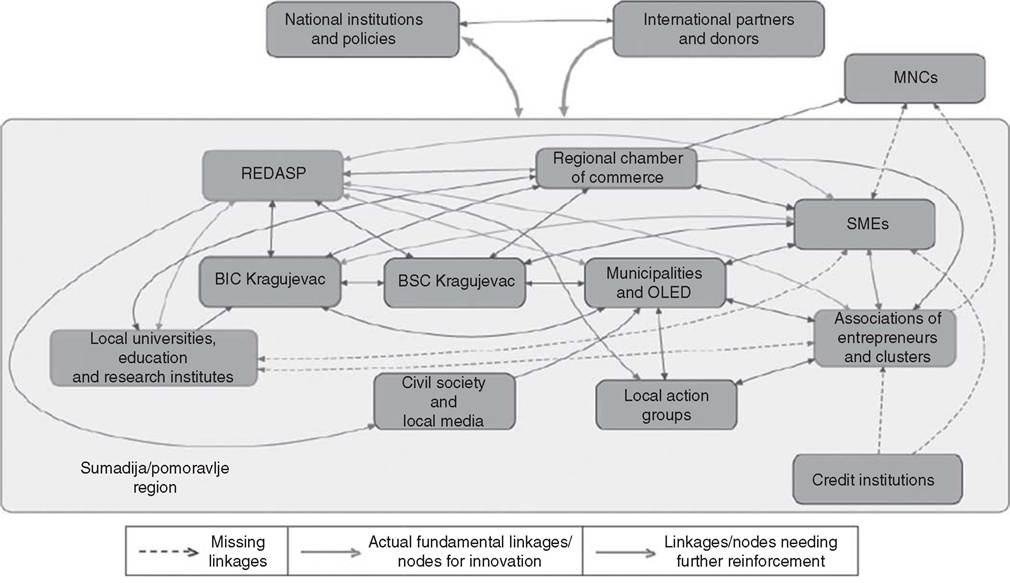
Figtire 5.4 The regional innovation system in Sumadija and Pomoravlje
Source: Ferrannini and Canzanelli (2013, p. 16). This is the b/w reproduction of the original colour image.
REDASP also devotes efforts to nurture trust and encourage continuous processes of collective learning within multi-scalar and multi-local networks (Cooke, 2007; Vale, 2011; Ferrannini and Canzanelli, 2013), taking the lead in governing, developing (through the promotion of new specialized structures) and coordinating the local system (Canzanelli and Loffredo, 2008). In other words, by avoiding the replication of external best practices and blue-print policy approaches and through adapting to territorial specificities, REDASP fosters the dynamism of the LDS in its institutional and relational dimensions, making an old industrial region in South Eastern Europe less of a "liability” and more of an "asset” for EU integration, in response to the dilemma raised by Radosevic (2007).
5.5