LEDAs' enabling processes for local economic development
The objective here is to disentangle the extent to which these agencies act as "meta-organizers” and "animators” of territorial LED processes, and to identify the conditions that foster the dynamic expansion of territorial economic opportunities in line with an SHD perspective.
Figure 5.1 highlights the elements, processes and feedback loops of the STEHD framework affected by LEDAs' actions and performances, given the main questions concerning its procedural application (see Table 2.1).
Firstly, due to their horizontal multi-stakeholder composition, LEDAs hold a central position within the respective LDS, acting as facilitators of interactions and coordinators of associational forms of governance (Cooke and Morgan, 1998). Processes of articulation and dialogue, and flows of resources
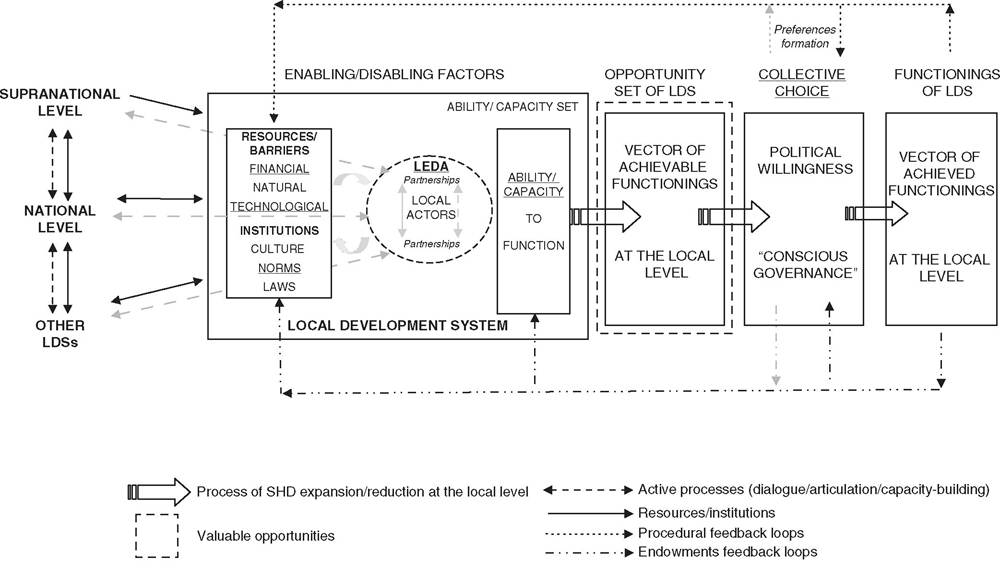
Figtire 5.1 The STEHD framework: LEDA's enabling processes for local economic development within an SHD perspective Note: Grey arrows represent the processes/interactions potentially enhanced by the LEDA.
Source: Authors.
among local actors within LDSs, constitute the cornerstone of LEDAs' constitutions, management and actions. Local partnerships across sectors (public, private, civil society, academia, etc.) are nurtured, consolidated and often institutionalized, building on (i) cognitive, social and institutional proximity among territorial actors, (ii) shared embeddedness in the territorial institutional structure and society as a whole, and (iii) the common commitment to LDSs' sustainable development. Through LEDAs' actions, the diversity of visions can be valorized and long-standing conflicts within territorial societies (e.g. familiar disputes or class conflicts) are often overcome, aligning interests and efforts to pursue shared development trajectories.
For instance, the LEDA in the Vlore Region of Albania (AULEDA) has led the elaboration of the Strategic Plan of Vlore Region 2020 ("Zero Emission Territory”), identifying three scenarios and nine strategic guidelines for sustainable local development, through the involvement and contribution of a wide range of local stakeholders (e.g. from the municipal government to women's associations in the village of Kallarat).Secondly, LEDAs' actions and tools impact upon the territorial endowments of resources and the formal and informal institutional structure, especially concerning financial resources, knowledge diffusion, trust and pro-active behavioural norms. Indirectly, the strengthening of systemic interrelations and partnerships contributes to local trust among stakeholders and the activation of pro-development social capital, opening new possibilities of complementarity and exchange of tangible (e.g. joint ventures) and intangible (e.g. knowledge, ideas) resources.11 On the other side, LEDAs' tools themselves often deal with direct provision of resources (e.g. access to credit for SMEs through Guarantee Funds) and direct nurturing of trust (e.g. clustering activities within sectors), with particular attention devoted to the inclusion of marginalized and vulnerable population groups. For instance, LEDA Morazan in El Salvador and RUEDA in Indonesia have been recognized to have structured sustainable and successful credit guarantee schemes to channel funds to micro, small and medium enterprises and business cooperatives identified by the LEDAs themselves in priority territorial value chains (UNDP ART, 2011 and 2012).
Thirdly, LEDAs can play a crucial role in aligning for LED purposes the horizontal (i.e. with other LDSs) and vertical (i.e. with national and international levels) articulation of dialogue, capacities and resources.
Regarding the former, trans-territorial networking relationships are increasingly fostered and managed by LEDAs rather than local governments, thanks to their detachments from short-term political circles and interests and enhanced accountability.
LEDAs appear to more comprehensively represent a specific territorial society and its background of culture, knowledge and experiences, on which sharing and mutually beneficial learning- by-comparing initiatives are based. For example, the Monte Plata LEDA in the Dominican Republic represented the focal point of an agreement with Cuba's National Centre for Agricultural Health to support the milk value chain in five Dominican provinces, training more than 2,400 persons.Regarding the latter, LEDAs' networking processes on a national and international scale constitute a distinct advantage of their approach to LED as an integrated process across territories. First of all, LEDAs not only take on the role of essential focal points for national governments to implement place-based development policies but also support the design of national policies, based on experience and specific good practices implemented at the local level, through continued advocacy through national networks to upper governments tiers. For instance, the Red ADELCO in Colombia, established in 2008, represents 11 LEDAs, with the objective of maximizing support capacities12 and acting as an effective vehicle for enhancing LEDAs outreach and impact at different levels. Its influence on national policies, by advocating the inclusion of LEDAs as priority instruments within the National Development Plan and by contributing to the formulation of a public policy for revenue generation for a population in extreme poverty and for community-based tourism, represents one example among many others (Agostinucci and Biggeri, 2012a). In addition, LEDAs undertake work to generate synergies with international actors, provide platforms for coordinated initiatives, channel the implementation of donors-funded projects and increase aid effectiveness at the local level.13 Similarly, LEDAs contribute to the internationalization of local economies, facilitating access to commercial partnerships, joint investment opportunities and funding schemes, as later the case of REDASP in Serbia.
Fourthly, LEDAs' actions are often directed at strengthening the LDSs' ability to function by facilitating and implementing capacity building initiatives, often in collaboration with external partners. For instance, LEDAs in Mozambique have facilitated administrative capacity building activities on LED implementation within 22 municipalities through an agreement with the organization of Regions United/FOGAR, while RUEDA in the Southern Province of Indonesia supported the organization of a comprehensive diploma course on governance for elected members of Provincial Councils.
Finally, LEDAs represent, at least theoretically, ideal structures to foster "conscious governance” for LED and to deal systematically with conflicting processes, as in Colombia. They enable articulation between the demands and interests of a society in a coordinated, integrated, inter-sectoral and, above all, transparent way, avoiding power plays and prioritization based exclusively on private interests. In addition, they provide mechanisms for "extra-ordinary concertation” and collective decision-making through the horizontal and heterarchical participation of stakeholders. For instance, Ferrannini (2011) argues that LEDAs' nonpartisan character, territorial approach and public-private-social partnership in the Dominican Republic contributed to the medium-term consistency of decisions and policies and help to diffuse a culture of legality and transparency within the territorial and national civil societies.
In addition, if the STEHD framework is recalled (Figure 2.3), it is worth re-emphasizing that the LEDAs impact upon the agents' (e.g. individuals, firms) expansion of capabilities and choice mechanisms, by shaping, respectively: (i) the access and distribution of inputs (e.g. credit) and individual conversion factors (e.g. skills through professional training); and (ii) the preference formation mechanisms and corresponding social influences (e.g. collaborative attitudes) on decision-making.
Overall, LEDAs potentially act as enabling factors for LED within an SHD perspective, influencing both the expansion of the opportunity set of LDSs and the transformation of opportunities into territorial achieved functionings. In particular, associational and multilevel governance (MLG), institution building, interactive learning and holistic perspectives to LED represent the domains where these agencies can engender a wider long-term impact as enablers of evolutionary SHD processes.
In other words, LEDAs foster the expansion of territorial achievable and achieved functionings over time through three interrelated processes - blending, aligning and gardening - given the features of a specific local system and a realistic assessment of its potential functionings. The first process refers to the blending of existing potentialities with new sources of strengths (von Tunzelmann, 2009, p. 17), such as innovative high-tech sectors within the traditional economic activities of the local economy, combining in a progressive way context-specific accumulated tacit knowledge and know-how with dynamic requirements in advanced sectors (Ferrannini and Canzanelli, 2013). The second process entails ‘orienting heterogeneous functions, resources and spaces in order to achieve mutually compatible outcomes' (von Tunzelmann, 2009, p. 23), as well as aligning the objectives and initiatives of different local stakeholders (e.g. public, private and civil society sectors) within an MLG perspective. The third process involves ‘nurturing the internal dynamics by promoting specific initiatives' (Belussi et al., 2006, p. 18), in the form of “gardening” knowledge flows, cooperation and trust enhancement within LDSs.
On the whole, blending, aligning and gardening are three functions that well-structured LEDAs have the potential to carry out as local “metaorganizers”, eventually representing an institutional and policy innovation themselves (Clark et al., 2010) that leads to more pro-active local development strategies and evolutionary SHD trajectories.
Nonetheless, these processes are not automatically set in motion by every LEDA through existing operating systems within the local economy and society. Key conditions regarding their organizational and operative structure need to be in place to foster the dynamic expansion of territorial opportunities, and to avoid reproducing barriers and constraints (e.g. vicious circles of rent-seeking governance, corruption, negative social capital networks). According to Canzanelli (2001), such complementary conditions primarily include (i) the LEDA's multi-stakeholder composition, functional autonomy and apolitical character; (ii) its focus on the valorization of the endogenous potential of a given territory; and (iii) its own specific mechanisms for financial and technical sustainability. In addition, the agencies' performance is crucially dependent on building and sustaining valuable interactions and on generating trust with other local organizations and social actors (e.g. firms, business networks, universities, local government and trade unions), and aligning their strategies for common objectives (Cumbers and Mackinnon, 2011). According to Ferrannini and Canzanelli (2013, p. 17), it is crucial to sustain the formalization and ‘institutionalisation of the systemic interactions among local actors, in order to avoid the fragility and the risks of rent-seeking deriving from personal relations, together with efforts to break exclusive power relationships supporting major vested interests.'
Canzanelli (2010, p. 22) identifies the following 10 principles for the success of a LEDA:
1. Participation by public and private actors, including those drawn from the economic, social, cultural, and communitarian sectors.
2. An active and proactive executive board, which represents in a balanced way the different members' sectors, and has strong internal cohesion.
3. Actively seeking to enhance territorial and human development.
4. Providing a reference point for local and national government in the implementation of their strategies and plans.
5. Providing services, and realizing initiatives and projects including economic animation and support, business support, territorial marketing, project implementation and financing, and social inclusion.
6. Having sufficient human resources for its activities.
7. Being able to provide services using their own human and technical resources and the resources of local actors.
8. Providing services to disadvantaged people and deprived small, and medium enterprises first, and then to local government, and local NGOs.
9. Having a medium-term financial plan that assures self-sustainability through diversified sources of income derived from the contribution of members, contracts, projects, service sales and credit management.
10. Being networked at national and international level with similar structures.
A crucial element of innovation is captured in the third principle: contemporary LEDAs are gradually broadening their mission from local economic development to SHD at the territorial level, integrating objectives of economic animation, social inclusion and environmental protection within Sen's perspective of the expansion of persons' and communities' capabilities. In general, these principles, if operationalized, may boost the evolution of similar agencies along the trajectory identified by Bellini et al. (2012, p. 3) so that change is ‘more international, more knowledge oriented, more networked, more than just enterprising engines of growth within its region.' Finally, underlying this evolution is the fundamental capacity of a LEDA to tailor its role and organizational arrangements to the specificities of the local context, through a degree of flexibility and adaptation and the dynamic ability to learn, re-invent tools and evolve with the territory, as discussed in the case study presented in the following section.
5.4