Anti-Semitism at Harvard
The most widely canvassed explanation of departure from Harvard is antiSemitism. The presence of anti-Semitism at Harvard is not in doubt.12 A report on personnel problems written just before Samuelson’s move to MIT took the issue seriously: after stating that “no graver reflection could be cast on the academic profession than that any of its members should be willing to compromise time-honored educational and scholarly standards by racial or religious discrimination,” it noted that “comments volunteered in response to the Committee’s questionnaire suggest that discrimination may exist in some departments.”13 Nine junior faculty had raised the issue, alleging discrimination in three departments, one teacher expressing the view that “racial prejudice is so thoroughly ingrained and taken for granted that no one takes much notice of it except in particularly flagrant cases.”14 It appears that, on investigating the issue, the committee was told that some faculty members objected to the appointment of Jewish teachers because they were thought unacceptable to undergraduates.
This concern, the committee contended, was exaggerated and in any case should be challenged; the university should aim to liberate its students from such prejudice.A major reason why anti-Jewish prejudice was so “ingrained” was that Harvard’s mission in the early twentieth century was to train the Brahmins of New England society—the Protestant elite who would go on to positions of power and influence. Forty percent of Harvard’s students came from Massachusetts and 47.3 percent came from families with incomes over $7,500, compared with a national average of 1.5 percent.15 Alongside more serious students there was a significant intake of “frivolous, clubby students,” in line for a “Gentleman’s C,” who despite their lack of academic prowess were important to Harvard.16 However, Harvard sought students who were not just of the right social class but who also had “character,” often represented by athletic ability; and here, competition with Yale and Princeton was strong, especially when President James Conant, appointed in 1933, tried to raise academic standards as part of his attempt to improve the university’s academic standing.
For this reason, Harvard introduced a quota to restrict the number ofJewish students. Traditionally, there had been no need to discriminate against Jews, for their numbers were small, but the influx of German and Eastern European Jews in the 1920s threatened the social mix. Harvard’s problem was that if the number of Jews rose too high—at Columbia, the number of Jews had risen to 40 percent—well-heeled New Englanders might instead choose to go to Princeton or Yale, both of which had significantly fewer Jewish students than Harvard.Conant sought to recruit academic stars, and his public pronouncements presaged modern university practices in which admission is based on merit rather than religion or ethnic origin. However, as Karabel has documented, he continued his predecessor’s policy of favoring upper-class students by appointing as chair of the admissions committee someone who boasted of having handled the “Jew problem” at the private school from which he came.17 Basing admission on factors such as “character” and “leadership” allowed discrimination to continue without inviting awkward external scrutiny.18 Such criteria allowed them to admit those socially acceptable Jews whom, as potential donors, they did not wish to offend. As late as 1940, the head of Harvard’s Eliot House could write to his colleagues asking what they were to do about the “Jew problem,” opining that the number of Jews in his house was 40 percent and rising when they ought to have had no more than 20 percent.19 There were Jews in the Economics Department, but the pressure was to keep this hidden. Frank Taussig, the long-time head of department who had retired just before Samuelson’s arrival, had a Jewish parent, but his family had come from Germany, not Eastern Europe, and his appointment in 1892 was long before the issue ofJews gained prominence. Leontief’s mother was Jewish, though this became known only much later.20 Seymour Harris, born Ginsberg, was known to be Jewish, and though he eventually got tenure, it was not until 1948, twenty-six years after being appointed an instructor.
Typically for someone not wanting his decisions to be defined by his colleagues’ prejudice, Samuelson played down this aspect of Harvard for most of his career, even denying its importance. He noted that, as would be the case for any non-Jew, the reason he went to MIT was simply that he got a better offer.c It was only after his retirement that he spoke more openly about anti-Semitism. In September 1989, responding to a conversation with his long-time tennis partner Henry Rosovsky, who played a major role at Harvard in challenging anti-Semitism, Samuelson expressed the opinion that Harvard economist Edward Mason, whose wartime recruitment of Jews into the Office of Strategic Services had marked a turning point, had been unfairly accused of being anti-Semitic. He went on to provide
c. Even years after the letter to Rosovsky, discussed later, in an article in which he made his contempt for Burbank very clear, Samuelson stated that he chose to go to MIT “without malice” (Samuelson 1998c, p. 1377). He does no more than hint, by referring to his “Protestant wife” (which could as easily imply that he was Roman Catholic as that he was Jewish), that this absence of malice referred to anything other than prejudice against economic theory.
1
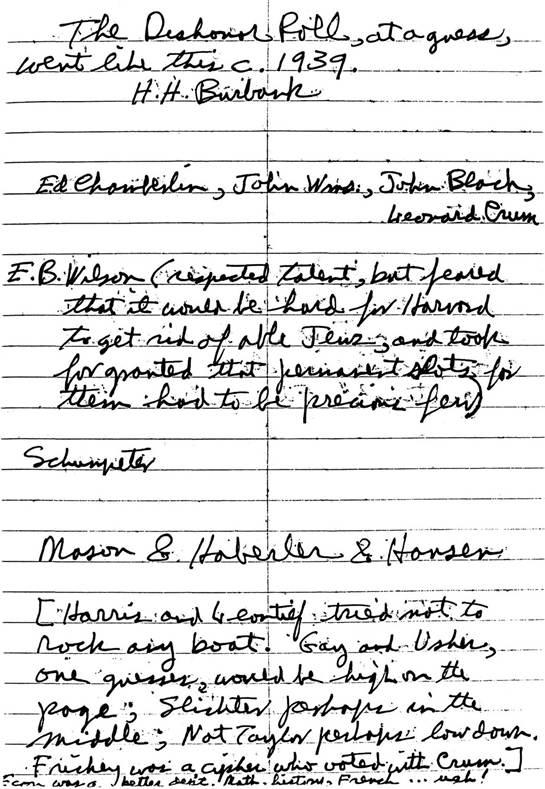
Figure 15.1 Samuelson's letter to Henry Rosovsky.
Note: The bottom line reads, “Econ was a better dept. Math, history, French... ugh. Source: P. A. Samuelson, September 26, 1989, Letter to Henry Rosovsky, PASP 63.
a “Dishonor Roll,” reproduced as figure 15.1, in which members of the Harvard department were ranked in order of anti-Semitic prejudice. At the top was Harold Burbank, department chair from the late 1920s to 1938, followed by Edward Chamberlin, John Williams, John Black, and Leonard Crum. At the bottom, innocent, were Mason, Gottfried Haberler, and Alvin Hansen. In between were Wilson and Schumpeter. Rosovsky’s reply makes it clear that both of them realized that this letter would become part of their archives and eventually be read by historians, but that it would be a considerable time before this happened.d
Samuelson committed an account of anti- Semitism to print in the Festschrift for Mark Perlman.
Perlman was eight years younger than Samuelson, but he was old enough to have experienced overt anti-Semitism, and his father, Selig Perlman, a distinguished labor economist and the economist who “discovered” Hansen, had experienced anti-Semitism at a time when there were even fewer Jews in the academy.21 Mark Perlman was unusual in having published, in 1976, an article on Jewish contributions to economics, and given that Perlman was Samuelson’s equal in vividly recalling and recounting stories about the past, they had presumably shared their experiences.22 In this chapter, Samuelson focused on Harold Burbank, his department chair, of whom he wrote in uncompromising terms.eBurbank suffered fools gladly, but not Jews. On major departmental appointments, he could count on a near majority of cronies. Where patronage appointments in the lower ranks were concerned, he was absolute king. Being myself royally supported by Social Science Research Council and Harvard Society of Fellows stipends, like William Tell I felt no need to cozy up to him. That did not stop Burbank from advising me: “Samuelson, you are narrow. Keynes and Hawtrey are narrow. Don’t take up economic theory until after you are fifty. This is what our great Allyn Young used to say.” Alas, I had already lost my heart, and aspired to become even more narrow; and furthermore, Young had died young, just before his rendezvous with greatness.... I was always a young man in a hurry.
Faced with a plethora of unsavory talent, H. H. B. [Burbank] solved his dilemma by confining the best of them to a ghetto of assistants in statistics and accounting under W. L. Crum and his satellite Edwin Frickey. Because Burbank had almost absolute pitch in his distaste for talent, such names as R. A. Gordon, Abram Bergson, Joe Bain and Lloyd Metzler made this a legion of honor. Metzler, a boy from Kansas
d. It is possibly significant that the letter was, unusually, filed both under “Rosovsky” and “M” (for Mason).
If Samuelson, rather than his secretary, was responsible for this, it may have reflected his concern that the letter should not accidentally be lost.e. It is worth noting that Samuelson’s arrogance on his arrival at Harvard would not have endeared him to Burbank. See chapter 6 this volume.
with a German-sounding name, used to sing hymn duets with Marion Crawford—such as, “Jesus wants me for a sunbeam.” But as has been said, an anti-[S]emite can smell out the last nine of the six Jews who have entered the room.23,f
Supporting evidence that Burbank was not anxious to assist Samuelson’s career comes from correspondence with Wilson. In May 1939, Wilson wrote to Burbank explaining that Samuelson would be difficult to place in an academic position despite having a first-class mind. The problem was that he was not as good a statistician as a mathematical economist, and so, given the paucity of openings in mathematical economics, his only hope of getting a post was to be able to sell himself as a good teacher of general economics.
Wilson wrote at length, drawing on his own experience, to argue that Samuelson should be happy with a position in which he taught elementary economics, which would not make the same demands on his time as more advanced teaching, while getting on with his own research. Wilson pointed out that Burbank had lost a large number of teachers on Ec. A, the introductory course for undergraduates, and advised him to get hold of Samuelson and offer him a division of poor students, telling him that “you would have to place him as a teacher because of the scarcity of positions in mathematical economics and that to place him you needed to know that he had made himself a good teacher even for poor students.”24 Teaching a section of Ec. A would enable Samuelson to demonstrate that he could teach nonmathe- matical students, something he had up to that point not had the opportunity to do. If Burbank would do this, Wilson would square the teaching with the Society of Fellows.
However, despite Wilson’s making a tightly argued case for a student who was now near the end of his fourth year at Harvard, and suggesting that he be made an offer that would be unattractive to many students, Burbank came up with excuses for postponing any action, even though he accepted the thrust of Wilson’s argument:
Samuelson does present a problem. Sooner or later I suppose we will have to break him in. By all means the best place for him is in Economics A, but whether or not I can handle him next year I am doubtful, I will find it necessary to break in at least a dozen new men, and to add Samuelson with his particular problems to this difficult list
f. Note that this list contains Jews and non-Jews. Samuelson wanted to portray Burbank as a fool, as well as a bigot. The four economists all went on to distinguished careers. is a bit more than I care to face, I agree with you that it is unlikely that he will be able to find a post in strictly mathematical economics. He must equip himself for general work.25
Burbank's refusal to accommodate Wilson's request is strongly suggestive of motives that were not stated explicitly. The result was that, before 1940, Samuelson's only teaching experience was statistics, considered by Harvard's anti-Semites to be a “Jewish” subject.26
As Samuelson's letter to Rosovsky made clear, his perception of antiSemitism was not confined to Burbank, and even faculty members who were strongly supportive of Samuelson were to some extent complicit. Samuelson recalled a story told to him by Alfred Conrad, Schumpeter's assistant at the time of his death in 1950, on the way to Schumpeter's funeral:
Alf: Professor Schumpeter, what do you think of Nicky Kaldor?
Joe [Schumpeter]: Oh, these Asiatics. They are only early bloomers.
Alf: I am puzzled. Are you perhaps referring to Kaldor's Hungarian Magyar ancestry?
Joe: My dear Alfred. My figure of speech was to spare your sensibilities. It was my delicate way of referring to Kaldor's Mosaic ancestry.27
As Samuelson made clear, though Schumpeter shared with many other notable economists the belief that there were racially based character differences, he had probably done more than anyone else to place European Jewish emigre economists in academic posts.28
Schumpeter's complex attitude emerges even more clearly in an exchange with the Norwegian economist Ragnar Frisch. In 1932, Schumpeter had written to Frisch, raising doubts about the suitability of Jacob Marschak to be a fellow of the Econometric Society. Marschak was, Schumpeter claimed, “obviously working to create a majority of friends of a certain complexion on the German groups.”29 In response to Frisch's inference that Schumpeter must be objecting to Marschak's socialism, Schumpeter explained his position in detail writing on December 3:
You do me an injustice: I am not so narrow as to object to anyone because he is a socialist or anything else in fact. If I did take political opinion into consideration I should be much in favor of including socialists in our lists of fellows. In fact, I should consider it a good policy to do so. Nor am I or have I ever been an anti-Semite. The trouble with Marschak is that he is both a Jew and a socialist of a type which is probably unknown to you: his allegiance to people answering these two characteristics is so strong that he will work and vote for a whole tail
of them and not feel satisfied until we have a majority of them, in which case he will disregard all other qualifications, this is the nature of a difficulty.30
However, despite believing that Marschak should not become a fellow of the Econometric Society because his commitment to advancing Jews and socialists would interfere with his scientific judgment, Schumpeter had no qualms about actively promoting Marschak's career, for he recognized that he had no future in Germany.
Though guilty of the racial stereotyping of his time, Schumpeter was a strong supporter of Samuelson. When Samuelson sent his friend Wolfgang Stolper a lecture he had written to commemorate their teacher,31 Stolper reminded him that Schumpeter had threatened to resign over Harvard's failure to appoint him. Stolper recalled Schumpeter's having said, “I could understand it if it were anti-Semitism; but it is just that he [Samuelson] is better than they are.”32 Shigeto Tsuru, another fellow student and one of Samuelson's close friends, said that everyone had expected Samuelson to stay on as an assistant professor, and also believed Schumpeter held this view.33 The idea that Samuelson was too good would be consistent with the fact that Schumpeter shared Samuelson's contempt for Burbank's scholarly standards, and given Samuelson's work, it could be seen as tantamount to prejudice against mathematical economics. However, it was common to use such language as a way of disguising anti-Semitic views.
Wilson is an even more significant case because Samuelson was so close to him. In Samuelson's “Dishonor Roll,” Samuelson judged Wilson better than Chamberlin but worse than Schumpeter. His reason was a letter Wilson had written to Talcott Parsons in 1939,34 which Samuelson had seen when Richard Swedberg, a biographer of Schumpeter, had found it in Harvard's archive. This letter stated that a Jew should not be appointed to a temporary position because it would be difficult to get him a permanent one. It argued that “in a social situation,” the question of how to treat people fairly was a complicated one, even though the goals were simple: to recruit the best people to the permanent faculty and to ensure that all young people, including Jews, were appointed to positions appropriate to their talents. The problem was that because of anti-Semitism, at Harvard and elsewhere, Jews would take longer to find positions and therefore would need temporary positions for longer than non-Jews. The resulting large number of Jews in temporary positions, with poor prospects of permanent employment, was a reason why Parsons should not appoint another Jew from Chicago.
Though this made Wilson complicit in anti-Semitism, his arguments verging on casuistry, and though Samuelson was troubled when he saw the letter, he took a charitable view of his mentor.g When Samuelson came to write on anti-Semitism for Perlman's Festschrift, presumably after rereading the letter, he concluded that Wilson was not anti-Semitic but was trying to do the best he could in a bigoted society. His animosity was focused on Burbank, whom he saw not only as an anti-Semite but also as someone with very poor judgment about economics.