Consumer Theory
Samuelson regularly sent drafts of his papers on consumer theory to Wilson. In a letter to Wilson in January 1938, he thanked him for comments on a manuscript, presumably “The Empirical Implications of Utility Analysis,” which was submitted to Econometrica about a month later.32 Samuelson’s letter shows that, encouraged by Wilson, he was pursuing “the Gibbs approach,”’ by which he meant the analysis of finite differences, assuming “certain arithmetic inequalities” or concavity conditions to hold.33 He had derived some results using more traditional, calculus-based methods, but conceded that his final theorem related only “to instantaneous rates of change and does not approach the generality of the Gibbs formulation which makes no continuity or differentiability assumptions.” This was clearly something to which Wilson had objected, for Samuelson defended himself by saying that he had not followed the more general approach because he had been unable to develop a proof.
However, though following the Gibbs approach very closely,f. The Vienna Circle was a group of philosophers who, from 1924 to 1936, worked out what came to be known as logical empiricism, or logical positivism, and whose work proved very important in philosophy.
g. Isaac (2012, p. 108) describes Samuelson’s interpretation as Popperian. However, there is no evidence that he had encountered the work of Karl Popper, and the Popperian pedigree of his use of operationalism is less clear if one remembers that Bridgman placed much emphasis on meaningfulness and that Samuelson was concerned with “pencil and paper” exercises that needed to be related to reality. This creates more ambiguity than Samuelson’s focus on testability might suggest. In the next section, the suggestion is made that the link to Vienna might have come though Felix Kaufmann or Willard Quine rather than Popper.
he recognized that there was a difference between physical and economic systems: a physical system was in a “relative” minimum, whereas in an economic system, entrepreneurs and consumers were “sometimes” believed to be able to select “the actual absolute maximum or minimum out of a number of different relative maxima or minima.”11
When the paper was submitted to Econometrica, the managing editor, Dickson Leavens, asked Wilson to referee it, a procedure that today would be considered to involve a conflict of interest but that was considered acceptable in the 1930s. Wilson replied that he was already familiar with the paper and that no purpose would be served by his reading it again. Though he conceded that it was the type of work for which it was very difficult to make sure there were no mistakes, Samuelson was “a very good man and careful,” and Wilson thought that he had “done a thoroughly good job,” recommending that Leavens accept the paper.34 On the same day Wilson wrote to Samuelson to tell him of his recommendation, and shortly afterward Leavens sent the paper to Ragnar Frisch for approval and publication?
There is evidence that while he was thinking about these problems, Samuelson was also thinking about thermodynamics and lessons that could be drawn for economic modeling. He read the Textbook of Thermodynamics (1937) by Sophus Epstein, a physicist at Caltech, and on November 29 he sent Wilson what he described as “a dangerous excursion... into a field about which I know very little.”35 The paper on a topic related to physics rather than economics was, Samuelson said, provoked both by remarks Wilson had made in his lectures, and by the “confusion and ambiguity” that he had found in
h. Imagine that the line in the following diagram represents a tube full of water, containing an air bubble that always moves upwards. If the bubble starts anywhere to the left of C, it will end up at point A; if it starts to the right of C, it will end up at B.
In contrast to such physical systems, humans may be able to achieve B whatever their starting point. Nowadays it is more common to refer to local and global maxima or minima. A and B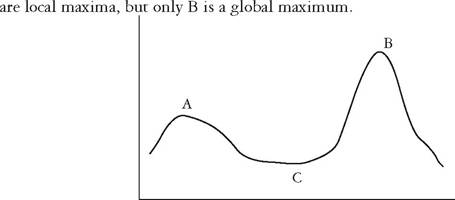
i. Those familiar with refereeing practices in modern economics, where taking two to three months to review a paper is considered normal, may react with disbelief to such speedy consideration of papers.
the work of someone who was, “as far as I can judge,” a competent physicist. In reply, Wilson said that he considered Epstein to be a better mathematical physicist than Einstein, albeit not so original.36 Samuelson’s letter did not name the paper he sent Wilson, but it seems likely to have been a version of “The Le Chatelier Principle of Displaced Equilibrium.”37’’ The Le Chatelier Principle was to play an important role in his thesis.k
Samuelson’s third article on consumer theory, “A Note on the Pure Theory of Consumer’s Behaviour,” which appeared in February 1938, offered a much more tightly focused argument than his first article had done. In it he argued that, starting with the work of Heinrich Gossen in the middle of the nineteenth century, the theory of consumer choice had involved the removal of more and more assumptions. All that remained in the modern theory of the consumer, represented by the work of his contemporaries John Hicks and Roy Allen, was the diminishing marginal rate of substitution—the assumption that indifference curves were convex to the origin."j What Samuelson appears to have noticed in the conversation with Haberler discussed in chapter 9 earlier was that, given certain seemingly reasonable assumptions, convexity of indifference curves can be demonstrated using methods familiar from the theory of index numbers. If convexity were the only substantive proposition in consumer theory, it followed that he had a complete theory of the consumer.
The way Samuelson presented his theory was by pointing out that, because economists no longer believed that utility theory provided a psychological explanation of behavior, it was not clear why they should accept indifference curve analysis: there was no explanation of where the diminishing rate of substitution came from. As a result of this lack of clarity, utility kept sneaking back in, for it provided the missing explanation. Instead of this, Samuelson proposed an alternative set of assumptions on which consumer theory could be based, showing that the last vestiges of utility theory could be eliminated without losing anything that mattered. It was even possible to get rid of indifference curves: if people wanted to use indifference curves, his theory could be read as providing the justification for doing so, but there was no need to do this.
j. The paper is undated, but the style of the typing indicates that it was written around this time. The main caveat is that the extant draft says he had been working on the problem for “many years,” a phrase he might not have used less than three years after he had met Wilson, whom he credited with introducing him to the principle (Samuelson 1947a,
p. 81).
k. It is discussed in chapter 14 this volume.
l. As in figure 9.2.
All that was necessary, Samuelson argued, was to make three assumptions about consumer behavior:
(ι) When faced with his or her income and market prices, an individual will choose the same combination of goods.
(2) This combination will not change if all prices and income change in the same proportion.
(3) Individuals are consistent in that they will never choose bundle of goods x when a different bundle, x', is available if at a different set of prices and income, they choose x' when x is available.m
Samuelson defended this last assumption by claiming that to deny it would be to render invalid all preceding analysis of consumer behavior and the whole of the theory of index numbers.
This was the meaning of his claim that his approach was “close to the modern theory of index numbers.”39Of the three postulates, the third was the most important, in that it could be used to derive properties of consumer demand functions. He did this using finite differences—at the level of generality that, to put it as Wilson's would have done, Willard Gibbs would have desired.n An early draft of the paper shows that Samuelson initially conducted the whole argument in terms of finite differences, and that the discussion of what would happen as these differences shrunk toward zero was added later.40 Though he attached more importance to the case of finite differences: it was generally important to consider what happened when the changes in prices were smaller and smaller, shrinking toward zero, because it enabled him to derive all the results traditionally derived using continuously differentiable utility functions. However, though these results could be derived from utility maximization, Samuelson claimed that there was no benefit in doing so. There was one result that could not be derived from his assumptions, but he denied it was important.o
m. Though he did not use this terminology, confining himself to the language of choice, this amounts to saying that x cannot be preferred to x if x is preferred to x. Using such language would have taken him back toward indifference curve analysis. Samuelson’s notation has been simplified by using a Latin rather than a Greek letter.
n.
His result, ∑∆Xj∆p < 0, where
xt and Pt denote quantity and price of good i and n is
i=1
the number of goods.
o. If demand were derived from maximization of a utility function (if demand functions were integrable), the matrix of cross-substitution effects (the effect of the price of good i on consumption of good j) would be symmetric. However, he was skeptical of attempts
In other words, he had derived every useful proposition that could be derived from the assumption that consumers were rational and consistent.
The novelty of his results lay not in the result he derived, for another Harvard student, Nicholas Georgescu-Roegen, had previously derived this main equation, but in the method by which Samuelson had derived it: from observable choices made by consumers.An issue to which economists had paid significant attention was complementarity—the possibility that demands for two products might move in the same direction in response to price changes.p Samuelson noted his lack of interest in the problem, observing that “in other isomorphic systems, e.g., the equations of analytic dynamics, of the Gibbs's system of thermodynamic equilibrium, it is not felt to be necessary to define similar measures.”41 This remark implied that the mathematical structure of the problem, not the economic significance of the system's components, determines which variables need to be defined. Neither analogy had been mentioned previously, and there was no explanation of why the isomorphism was significant; it was taken for granted. Complementarity had been important historically only because its analysis had led economists to see mistakes in Pareto's reasoning and to see that utility was not needed.q
Samuelson followed this with a methodological remark: “Woe to any who deny any one of the three postulates here!” he wrote, “It is hoped that the orientation given here is more directly based [than other approaches] upon those elements which must be taken as data by economic science.”42 This remark prompts two observations. He was suggesting that, though it was possible to see his work as an extension of traditional theory, he saw it as alternative. This was even clearer in the title of an early draft of the paper, “New Foundations for the Pure Theory of Consumer's Behavior.”43 It is tempting to think that the more bland title of the published version was the result of input from Economica, the editorial board of which included Friedrich Hayek
to test this. Some historians (Hands and Mirowski 1998b, 1998a) have attached much importance to Samuelson's having been at Chicago where Henry Schultz was attempting to test this proposition, but aside from Samuelson's claim that he learned about operationalism from Schultz, there is no evidence that he engaged with Schultz's work when he was there.
p. For example, a rise in the price of postage stamps might cause a fall in demand for both stamps and envelopes. People might write fewer letters or write shorter, lighter letters requiring less postage.
q. He cited no sources to substantiate this claim.
and Lionel Robbins, colleagues of Hicks and Allen.r More significantly, his claim that there were elements that “must” be taken as data by economic science suggests not operationalism, with its implication that scientific propositions should be testable, but Robbins's claim that economic theory could be derived from indisputable propositions.44 The suggestion that disaster might befall anyone who entertained the possibility that consumers might be inconsistent reflects an ongoing tension in his work between his engagement with pure theory and his espousal of operationalism.
Later that year, Samuelson published an addendum to this paper in which, this time using the language of preference (people choose the bundle of goods they prefer out of those they can afford), he demonstrated that the third of his three postulates implied the first two.45 The implication was that he had summarized all that could usefully be said about the theory of the consumer in one postulate that later came to be known as the weak axiom of revealed preference.s
In the papers he wrote, Samuelson argued merely that consumer theory could be analyzed “more directly” using a set of postulates that made no mention of utility.46 In another paper, a version of which was presented to a meeting of the Econometric Society in Atlantic City in December 1937, before being published in Econometrica in October 1938, Samuelson started with the historical argument that the “moral, utilitarian, ethical connotations” had first been removed from the concept of utility, and that subsequently the “hedonistic, introspective, psychological elements” had also been eliminated. This was consistent with his two articles in Economica. However, here, instead of dispensing with the concept of utility, he asked what remained of it:
Does not the whole utility analysis become meaningless in the operational sense of modern science? A meaningless theory according to this criterion is one which has no empirical implications by which it could conceivably be refuted under ideal empirical conditions.47
This was his first published use of the notion of operationalism. However, though he used the language of operationalism and knew Bridgman personally through the Society of Fellows and through his lectures, Samuelson's
r. As with many academic journals from this period, Economical records have not survived, making it impossible to tell who handled submissions or what the refereeing process involved.
s. Note that the name “revealed preference,” by which this theory came to be known, had not yet been invented.
equating meaningfulness with refutability under ideal empirical conditions is closer to the language of the philosophers associated with the Vienna Circle. It may be significant that Samuelson backed up his view that many defenses of utility theory were circular and he implied nothing about observable behavior by citing an article by his friend Alan Sweezy, published in 1934. Sweezy argued not in terms of operationally significant propositions but “empirically significant laws,” supporting it with a quotation from the philosopher Felix Kaufmann: “The principle of marginal utility is, therefore, neither an empirical assertion nor a tautology nor a synthetic judgment a priori, but a heuristic postulate.”48 Sweezy would have been very familiar with Kaufmann’s work; not only did he cite several of his publications but he also had assisted him with the English of the article he quoted.49 Though much less well known than Karl Popper, Kaufmann was a significant figure in bringing Vienna Circle ideas into economics.50 Given Samuelson’s close friendship with Sweezy and that Sweezy had published on the topic he was investigating, it is likely that they had discussed these ideas at some point. It is also possible that he discussed them with Quine.
Samuelson’s starting point in this paper, the aim of which was to show that utility analysis contained “meaningful implications by which it could be refuted,” was to indicate that all that was needed was an ordinal utility index—one that places alternative bundles of goods in an order from best to worst, without saying anything about how much better one bundle is than another. For example, it is possible to observe that someone considers a cappuccino better than a latte, but without being able to say they consider it twice as good, 10 percent better, or a hundred times better.t He started by proving that, so long as the ordering of different bundles of goods was not changed, the utility numbers could be changed without affecting the crucial conditions for utility maximization.u Having established this, he could resort to the theory outlined in his Economica paper, deriving a series of results relating to the properties of demand functions, both for individual consumers and the whole markets, where the demand function for each good depended on the prices of all goods, and not just the good’s own price. Because prices,
t. It may be possible to say that they will pay twice as much for it, but this just shifts the problem to the value of money.
u. Formally, this means that if U = Φ(x1,... xn) is a valid utility function (consistent with the individual’s choices) where U is utility and the %’s denote the quantities of goods consumed, and if F (.) is any increasing function, then U = F [Φ( x1,...χ)] will also be a valid utility function.
quantities of goods, and household incomes were all observable, his results satisfied the criterion of being operational.
Samuelson claimed that he derived all the results found in the previous literature, even in a recent paper by the Columbia economist Harold Hotelling, and some more besides. They went beyond the results in his Economica paper in that using an ordinal utility function enabled him to derive symmetry conditions (that the effect of the price of a cappuccino on the demand for lattes was the same as the effect of the price of lattes on the demand for cappuccinos) that could not otherwise have been obtained. This was the implication of traditional theory that he had dismissed as unimportant in his earlier paper. Perhaps it was because he was aware that he had previously dismissed it as unimportant that he defended his approach by claiming that he had shown how the use of mathematics made it easy to derive results, a conclusion most readers of Econometrica would have found congenial.
In parallel with this paper, Samuelson took up an argument made by Oskar Lange, a Polish economist who had recently immigrated to the United States and had become a professor at Chicago in 1938.51 Lange conceded that observations of behavior could yield no more than an ordinal utility function. However, he argued that it was possible to get more information by asking people to compare changes. For example, a consumer could be asked whether he would prefer to have an extra muffin at breakfast or an extra sandwich for lunch. Lange claimed that, if we could do this, we would be able to obtain a cardinal measure of utility—one in which the numbers attached to a utility function were significant. With such a measure, differences in utility could be made as meaningful as differences in temperature.[xxix] Having a cardinal utility function rather than an ordinal one might be irrelevant for describing behavior, but it could be useful, Lange contended, for judgments about welfare.
Lange's argument provoked controversy as soon as it appeared, but Samuelson believed that Lange's critics had missed the main problems with the paper. Samuelson's first criticism involved reiterating the point he had made briefly in his previous articles— namely, that utility was completely irrelevant to the problem of welfare economics, which was about ethical judgments. Citing Bergson's paper on the subject, Samuelson argued that if one could rank the quantities of goods consumed by all individuals, it was possible to make judgments about welfare; having a cardinal measure of utility added “literally nothing.”52 His second criticism was that the discussion had got into a muddle over the conditions under which it was possible to represent preferences by a utility function. Assuming that consumers could rank differences in utility was irrelevant; the crucial additional assumption needed to get a utility function was transitivity—the assumption that if a consumer preferred A to B and preferred B to C, then she must prefer A to C. If preferences were transitive, they could be represented by a utility function.
Samuelson sent a copy of his paper to Lange, who replied in May 1938 that he agreed with Samuelson’s claim that cardinality of the utility function was irrelevant for welfare economics.53 He admitted that he had previously been wrong about this. As for the other criticism, Lange explained that he was not concerned with whether a utility function would exist (the integrability problem) but, rather, with whether, if it existed, it would be unique. The reason for his choice of assumptions was that he had wanted to show how earlier writers such as Pareto and Bowley had been inconsistent. This remark, and Lange’s observation that, subject to seeing Samuelson’s final draft, he might wish to publish a rejoinder, may be the reason why, when the paper was published in October, its concluding remark was, “I should like to express my agreement with Dr. Lange concerning the inconsistencies in the writings of the earlier mathematical economists.”54 He and Lange might disagree on technical matters, but they were at one in believing that mathematical analysis could cut through the confusions found in the previous literature.
In the fall of 1939, Samuelson sent Lange a draft paper on a topic closely related to the issues they had discussed the previous year. This was intended for a memorial volume for Henry Schultz, who had died in November 1938 in a motor vehicle accident. It seems likely that the paper had not been solicited by Lange because, after thanking Samuelson for sending him the paper, he explained that he did not know whether he would be able to include it in the volume. Not only was it a long paper but, more important, he did not yet know how many other contributions he was going to receive and hence whether the volume could go ahead. He asked whether Samuelson would mind waiting two or three weeks for a decision. In this paper, not published for nearly three years, Samuelson dealt with the problem of what it meant to assume that the marginal utility of income was constant. This was an assumption used by Alfred Marshall in the 1890s, both to derive downwardsloping demand curves from the assumption of diminishing marginal utility
and to derive the “consumer’s surplus” that formed the basis for his welfare economics.™
Inevitably, Samuelson showed his paper to Wilson, who had recently published on the subject. Wilson told him in December that he found it very interesting and hoped it would be published. In his own paper, Wilson had focused on the problem of “independent” goods—goods the utility of which does not depend on consumption of other goods.55,x He encouraged Samuelson to provide “more text and historical discussion” in order to reach “economists who are not really able mathematicians as you are.”56 This was important because Wilson thought there was a lot of confusion and because, though Walras’s definition of independence had become standard, Hicks and Allen had introduced a new definition, and the relationship between the two definitions was not understood.
This was a particular problem when many economists constructed arguments verbally, without going into the underlying mathematics. Wilson even suggested that Samuelson might consider presenting the whole argument verbally, consigning the mathematics, which would frighten people, to an appendix, or at least placing the mathematics nearer the end. This was neither the first nor the last time that Wilson urged Samuelson to make more concessions to less mathematical readers.
Samuelson did not take his mentor’s advice. The version that was eventually published, in 1942, in the memorial volume edited by Lange, contained a brief opening paragraph introducing the problem, but if this was a response to Wilson, it was little more than a token gesture.57 All it said was that because much of the literature on consumer demand was based on the assumption that the marginal utility of income was constant, the literature contained many conclusions that were “of restricted validity” and that there were even “outright contradictions.”58 There was no attempt to explain at
w. If an extra loaf of bread is worth $5 to a consumer, but he has to pay only $2 to obtain it, there is a surplus of $3. If the bread were worth only $2, he would gain nothing from buying it; he would be indifferent to having the bread and having the $2 to spend on something else. If marginal utility—the value of an extra loaf to the consumer—is falling, then the first loaf consumed will be of more value than the second, and so on. Consumer’s surplus is the surplus on all the loaves consumed. Unless the marginal utility of income (money) is constant, a utility of a $1 surplus on different loaves consumed will be different, and the measured surplus (a sum of money) will not correspond to a total of utility.
x. If goods are independent according to this definition, the utility function has the form U = Φ1( x + Φ2( x 2) +... + Φ, (xn) where the functions Φz (xi) denote the utility functions of each good.
the outset what these doubtful results were or why they arose, even though his aim was to show that that previous literature was muddled. Samuelson’s first result, after defining his terminology, was to show that the marginal utility of income depended on the choice of utility index; as the utility index was not unique, this undermined the concept. This led Samuelson to explain that the meaning of constant marginal utility of income—a term important to Marshall—was ambiguous: Was it constant when prices changed? Or was it when income changed?7 As Wilson recognized in his letter to Samuelson, this list of guilty economists included Marshall.