Criticism and Feedback
MIT was not the only university having problems with its teaching materials. In one letter, Samuelson went so far as to joke that “it is the great academic indoor sport to deplore the current status of elementary textbooks and teaching.”43 In February 1946, Alan Sweezy, a friend from Samuelson’s Harvard days, wrote to say that he had heard that Samuelson was working on a textbook.44 “As usual,” Sweezy wrote, “we are worrying about the elementary course” and they wanted to find a better textbook.
He asked when Samuelson’s book might be available and whether the publishers would object to him and his colleagues at Williams College trying out some of his material on their students. Samuelson replied that although he thought the book had been a success, engaging students, and that he would be pleased to show Sweezy chapters for comment, he thought it would be premature to use them for teaching outside MIT because there remained gaps and “rough places in need of revisions.”45 He promised to send copies on March ι, by which time he would have more copies for the new term.Samuelson had already sent copies to Wolfgang Stolper and Erich Roll. Stolper told several publishers’ representatives about it, in the hope that Samuelson would land a “good fat contract,”46 and when, a month later, the McGraw-Hill representative told him that Samuelson had already signed, he replied that he could count on orders of 500 copies a year from Swarthmore. Roll praised the manuscript to Emile Despres, who asked Samuelson for a copy. Returning from government service to a position at Williams, he wrote Samuelson that he was baffled as he contemplated “the problem of teaching in general, and teaching the introductory course in particular.”47 He got the same response as Sweezy and Stolper: he was welcome to comment on material, but it was too incomplete to be used outside MIT.48
By this point, Samuelson had a clear idea of what he was doing; as he explained to Despres, his target was students who were not concentrating in economics, and it followed “automatically” that the course should confront questions that they thought were important? To David McCord Wright, he wrote that “the needs of the student are those of an intelligent citizen.”49 This might have accounted for why the course had been well received, though as he had conceded to Sweezy, the returning veterans who filled the classrooms were more interested in broad questions of economic policy than pre-war students ever were.50 The result was that he “ruthlessly soft-pedaled” value and distribution theory, aside from a bit of supply and demand, cost and profit analysis, and a fairly rigorous analysis of comparative cost.
Instead, he focused on national income problems of policy, along with what he called “preliminary exposition of the elementary facts of life about corporations, trade unions, stock market, etc.”51,4A point he repeated to several of his friends was that he had enjoyed the work— something about which he expressed embarrassment. To Sweezy, he wrote, “I started the job with a certain amount of shame, but I must confess that I have been enjoying the task.”52 Given the consistency with which he made such remarks around this time (March—April 1946), and that that these remarks were expressed to close friends with whom he had no need to cultivate an image, there seems no reason why they should not be taken at face value.53 One element in his feeling of shame could be that he was having to simplify and compromise in the interests of making the book accessible. However, against this we have to set his view that he was tackling real, if difficult, problems that his readers needed to understand. Another possible source of his embarrassment was that Foundations, then making its way through Harvard University Press's production process, developed in detail precisely the theory that he was “soft-pedaling” for his introductory students.
The friends to whom he had sent the manuscript offered feedback. Stolper criticized the manuscript for being too long and detailed, with too many examples, for it left the instructor with nothing to add to the book.54
p. The correspondence with Despres is discussed earlier in this chapter.
q. He had also worked out, very clearly, what he thought was wrong with other textbooks. Hicks had written a book that was “too brief, rather arid, and too little concerned with the economic ‘physiology’—rather than ‘anatomy’ for the non-economic concentrator.” Boulding's book was too analytical. Bowman and Bach was good, but “voluminous, theoretical and rather difficult for elementary courses.” He confessed to a “secret liking” for a book by Bruce Knight, often dismissed as “a work for freshmen and girls at junior colleges,” but he was not enthusiastic about that, either.
This contrasted with the experience of Samuelson’s colleagues at MIT, who liked it because the material had provoked the students so much they never had time to discuss “incidental matters suggested by the readings.” Alan Sweezy strongly criticized the chapter on money and prices.55 He argued that Samuelson had got things the wrong way around, in that he discussed the relationship of the money supply to the price level before explaining what money was. The process of money creation needed to come first. He also argued, in a Keynesian vein, that Samuelson should introduce spending as the factor influencing prices right from the start. He was far more critical of the quantity theory than was Samuelson.
It’s [referring to the velocity of circulation] a pretty useless concept: worse than useless, in fact, since it implies a mysterious process of causation which simply doesn’t exist. Just because we were brought up on it and had to fight our way through to clarity later on is no reason to make the present day student repeat that painful experience. Spending is what actually makes money “circulate” and I think it’s very important to emphasize that simple truth from the beginning and keep it constantly before the student’s eyes.56
It would seem that Samuelson took seriously Sweezy’s criticism that it was wrong to adopt a historical approach to teaching theory, for a few days later he responded to being sent a copy of the new edition of Stigler’s The Theory of Price (1946) by saying that it was “the only book” he could recommend on intermediate or advanced price theory courses because “Up to now we have all been perpetrating the pedagogical crime of making the student repeat the historical meanderings of the developing body of economic thought.”57
Samuelson’s friends pushed him in different directions. Where Stolper had found the book too comprehensive, Sweezy found it too brief. After saying he liked the book on account of its having more “punch and flavor than any elementary textbook he knew” and that touches such as “Fat men fish, lean men hunt, and smart men make medicine” were superb, he said that much of it was too concise.
Points were made once, very clearly, but for elementary students it was necessary to elaborate on apparently simple points: “You have to play with them [seemingly obvious points], turn them over and over, introduce illustrations, repeat what you’ve said with slight variations over and over again.” Samuelson was getting a lesson from someone whose Harvard career had given him much experience in teaching elementary economics. He also urged Samuelson to cut things out so as to spend more time on the big, important ideas.At this point, at the end of February 1946, Samuelson was hoping to finish his revisions by June, so that the textbook would be available for the fall.58 In early April, he had doubts about this schedule, questioning whether he would finish before the end of the summer, saying that the book was consuming most of his leisure time.59 By the end of April he had changed his mind again, saying that the “final version” was almost finished.60 In May, when Fritz Machlup wrote saying he had heard about the book, and perhaps Samuelson would like to consider Blakiston as a publisher, he replied that it was almost finished and that McGraw-Hill would be bringing it out in the fall or the winter.61 Shortly afterward he signed a contract for another book, A Primer of Economics, aimed at intermediate students.62 However, this proved much too optimistic and the process of revising the text dragged on for much longer.
In the midst of this process of redrafting, Samuelson produced a “Second Preliminary Edition,” this time titled Economics: An Introductory Analysis, to be used by students beginning their studies in October 1946.63 This edition was an expanded version of the first draft. With the exception of a single chapter, discussed below, his changes were confined to the reordering of chapters and writing new ones. The most substantial of the changes, shown in figure 25.3, was to bring the three chapters on saving and investment, money and prices, and the banking system forward, to become part II of the revised draft, following on directly from the chapter on national income, which came at the end of part I.
Most significantly, he proposed to begin part II with a chapter on “The Business Cycle,” which shows that he was still thinking in a traditional way, according to which the theory of saving, investment, and income determination is seen as part of the theory of the business cycle.rThe result of the rearrangement was that the traditional material, beginning with supply and demand, became part III, coming after the analysis of the business cycle, now titled “The Economics of Full Employment.” Given that part II began with a discussion of the cycle, he appears not to have accepted the message of Keynes's General Theory that the business cycle could be an addendum to a theory of employment rather than its setting, but he
r. Two points about the 1945 draft are not clear. The first is the reason why the chapters on saving and investment, money, and banking were placed at the end. Was this because Samuelson had not yet worked out where he wanted to fit them in, or was it because they were simply not ready in time to be included earlier in the text? The second is whether some chapters were omitted because they were still unwritten or because they were not needed for the students who were being taught that year.
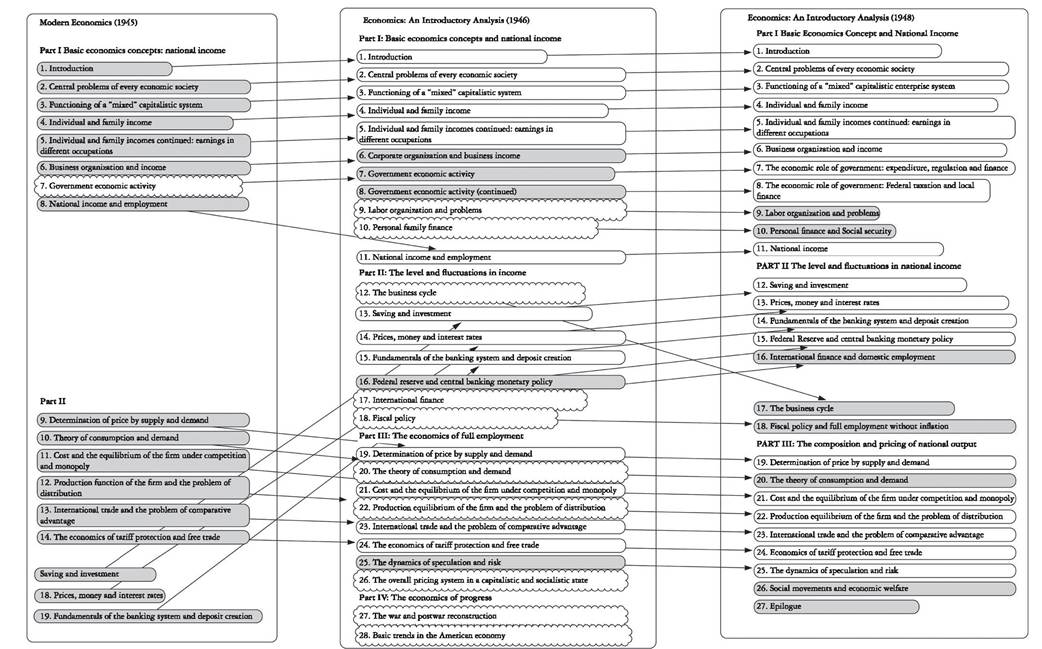
Figure 25.3 Successive drafts of the textbook, 1945-48.
Note: “Clouds" indicate chapters listed but not present in the draft. Chapters that are newly written, or substantially revised, are shaded. Several instances where material has been moved from one chapter to another are not shown.
had accepted the claim made by Keynes in the final chapter of the General Theory that traditional theory applied at full employment.
Though still marked as being “For private circulation only,” an arrangement was reached with Addison-Wesley to print hardbound copies that were placed on sale at the MIT bookstore for $3. When people asked about obtaining copies, Samuelson directed them to the bookstore, sometimes going to the trouble of checking inventory levels himself.64 However, despite being made available in this way, the book was still not finished and revisions continued.
In August, he wrote one friend that the chapter on central banking was only just completed, and solicited comments.65 In September, he wrote to an MIT colleague that he hoped to finish revisions in the fall.66 In October, he told a former student, Dan Vandermeulen, that he had just revised the national income chapter, and that he was about to revise the one on saving and investment. The process of revising the book dragged on into 1947.67However, by then a controversy had erupted over the book that was to involve not only Samuelson and Freeman but also the president of MIT, Karl Compton. This controversy related to the second preliminary edition; this was the one his critics were reading and that he was sending out to colleagues in other universities as late as January 1948.68