Modern Economics
Economics: An Introductory Analysis was published in May 1948. The initial print run was unusually large, at 20,000 copies, but within two months this had sold out, and McGraw-Hill arranged for a further 25,000 copies to be printed.
By August it had been adopted at Yale, Harvard, Princeton, Duke, Columbia, Purdue, and many other universities.1Samuelson’s book could dominate economics teaching because it provided an account of modern economics. The word modern may have been removed from the book’s title, but the opening pages made it clear that modern economics was about explaining “the dizzying ups and downs of business activity.”2 The Great Depression, the aborted recovery of 1937, and the unprecedented expansion of activity during wartime were recent memories, and the theory needed to explain them had been developed only in the previous decade. Economics teaching had to be brought up to date, especially for a generation of students that included returning veterans who would be older, more confident, and less tolerant of irrelevance than most students. Meeting this demand, Samuelson’s book was innovative both in content and in style. Lorie Tarshis’s Elements of Economics, which had appeared the year before, was similar in content, but more traditional in style; once Samuelson’s book appeared, its sales rapidly fell.a
a. Samuelson attributed the fate of the Tarshis book to the attacks on him as a “Keynesian- Marxist,” discussed in chapter 26 this volume, attributing the ability of his own book
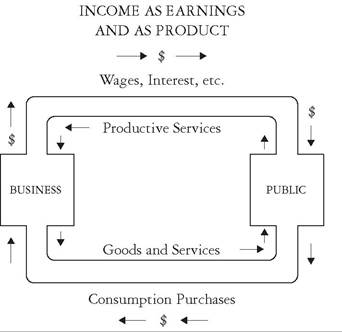
Figure 27.1 Two definitions of income.
Credit line: Samuelson, Economics: An Introductory Analysis, 1948, p. 226, McGraw-Hill. Reproduced with permission of McGraw-Hill Education.
As in the early drafts, and as Clemence and Doody had proposed several years before, national income—a concept that had become central to policymaking during the war—was central to the book.
However, in the published version, Samuelson took his break with the past a step further. The traditional approach was to see fluctuations in economic activity as part of a broader theory of the business cycle. In contrast, Samuelson placed the theory of income determination at the beginning, and though he did include a chapter on the business cycle, it came later. The static theory of income determination became independent of more complicated and arguably less well established ideas about dynamics, as it had in Keynes's General Theory.He explained the theory using a diagram not used in the earlier drafts, depicting the circular flow of income that would become a standard feature of such books. He used two versions of the diagram. The first, reproduced as figure 27.1, was used to explain how national income could be measured in two ways: either as income or as output.
In the following chapter, the interpretation of the diagram was transformed into figure 27.2 with the addition of pipes and a water pump representing the flow of investment into the circular flow, and an exit at the bottom representing
to withstand such attacks to its more scientific style. The attacks were indeed vicious, but there appears to be no hard evidence that they caused any institution to drop the book, and there is some evidence that they were ineffective. It is possible that its sales fell simply because most instructors preferred Samuelson’s textbook.
HOW INVESTMENT DETERMINES INCOME
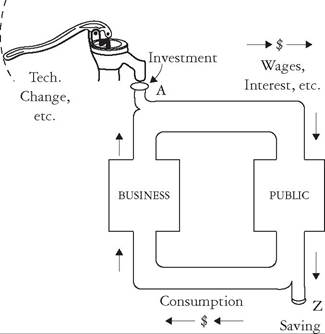
Figure 27.2 Investment and the flow of income.
Credit line: Samuelson, Economics: An Introductory Analysis, 1948, p. 264, McGraw-Hill.
Reproduced with permission of McGraw-Hill Education.
leakage of savings from the system. It was now clearly a hydraulic system, and even if it is not clear how it could physically be constructed (the pump suggests it is driven by gravity, which does not fit with the circular motion), this made it easy to visualize the central feature of the theory he was expounding.
The image's antecedents can be traced to the “Wheel of Wealth” used by Samuelson's Chicago teacher Frank Knight, making it remarkable that the idea of using this diagram did not come to Samuelson until 1947.b However, Knight's schematic diagram was changed into a depiction of something physical. There were precedents for this, notably in the hydraulic models used by Irving Fisher in the early twentieth century and in diagrams used by others in the 1930s, but Samuelson modernized the idea and gave it a centrality to economics teaching that it had not had before. It led directly into his analysis of saving and investment, handled through the saving and investment diagram that adorned the book's cover and that provided a static representation of equilibrium, analogous to the supply and demand diagram that had been a staple of economics teaching for half a century. This simplification of the theory was possible because, despite the Hansenian roots of his analysis, Samuelson had cut himself free from the idea that a dynamic theory of the business cycle had to be the starting
b. See figure 3.1 given earlier in this volume. point for the analysis of problems relating to the level of national income and unemployment.
Samuelson also broke with the past in the style of his writing. Hansen was himself the author of a successful textbook that, although written before the transformation of his thinking in the late 1930s, provides a good illustration of the older generation of textbooks with which Samuelson’s needed to compete.3 Defining economics as “a study of the price and value aspects of human activities and institutions,” it would have struck Samuelson’s engineering students as much drier, less directly related to their immediate concerns or contemporary events. Hansen and his co-author clearly saw the Great Depression as an important event of great interest, but it was placed in the context of over a century of economic controversy. The book’s claim that there were “economic laws,” though quite consistent with everything Samuelson wrote, would have been more likely to evoke skepticism from MIT’s engineers, though Samuelson did talk about the law of scarcity.
Samuelson may have taken some ideas from Hansen’s book—given their closeness it would have been surprising if he had not—but the tone was very different. To see this, consider the treatment of national income in the older book. The Hansen book started with national income, but having provided the statistics, it went on to discuss its distribution across households, the distinction between consumption and investment, and ultimately, the production of different types of goods.4 From there it went into a discussion of alternative methods of economic organization.c In contrast, Samuelson, after explaining the problems that an economic system solved and describing how “a ‘mixed’ capitalistic enterprise system” worked, continued with matters to which his student readers could immediately relate: families, businesses, and government. Equally important, he wrote in a completely different style. Nowhere is this more evident than in two of the chapters not in the previous draft.d
c. A further difference is that, in contrast with Samuelson, national income played no analytical role. There was a discussion of how to control the flow of purchasing power, but this did not come until much later in the book, not linked to the opening discussion of national income. Where Hansen’s book progressed from a discussion of how money was created, moving through the price fluctuations and the business cycle to “the control of purchasing power,” Samuelson reversed the order. He began with saving and investment; it was only after he had explained why the money supply mattered that he turned to explaining how it was created.
d. It is also evident in Samuelson’s decision to play down the emphasis on traditional price theory, with its heavy reliance on analytical diagrams. The result was a book in which such diagrams were less prominent than in modern rivals, such as Boulding’s Economic Analysis (1941, 1948a) or Tarshis’s Elements of Economics (1947).
Samuelson’s remark to Despres that Boulding’s book was weighted too far toward the analytical side makes itIn his discussion of family income, Samuelson emphasized the differences between households and the unequal distribution of income within the United States. The chapter on labor problems developed this point. He began with a history of the American labor movement, the growth of unions, and the differences between craft unions (the American Federation of Labor, or AFL) and industrial unions (the Congress of Industrial Organizations, or CIO). Then, drawing on skills he had no doubt acquired in his high school years when he was focusing on literature and journalism, he did something none of his predecessors would have done: he used a series of fictional stories to explain labor problems and implicitly to show the class structure of American society. He began with the life story of John Kennedy, a carpenter who was a member of the United Brotherhood of Carpenters and Joiners, affiliated with the AFL. He described his terms of employment and his experiences during the housing boom that followed the First World War and the remainder of the 1920s. John Kennedy had been a supporter of La Follette’s Progressive Party, but he had no time for communists and had never met one. In contrast, Shelby White, the auto worker in the United Automobile, Aircraft, and Implement Workers of America (CIO), recognized that the communist minority in his union fought for things he also wanted, but it was necessary to make sure that they did not outsmart him at union meetings.
After giving different perspectives through stories about a labor lawyer, a “philanthropic capitalist,” and a congressman, Samuelson then provided a broader view through the life of a professor of labor economics, Gordon Bruce, age forty-five, at a “Middle Western State University,” several of whose students worked for the Department of Labor and the National Labor Relations Board.5 This professor was very well informed on the labor market, but was nonetheless “a troubled and perplexed man” for he realized that there were no simple solutions.6
If he ever began to list his doubts and fears, Bruce could go on almost indefinitely.
For example, he is concerned over the problem of keeping unions democratic, and he is beginning to wonder whether the trend of collective bargaining toward a wider and wider industrial and national scale will intensify the danger from strikes and inevitably call forth strong, almost totalitarian government action which will infringe on individual freedom. But that is his job, to worry over allclear that this was a conscious decision (P. A. Samuelson, March 2, 1946, Letter to Emile Despres, PASP 28 [Sub-committee on the problem of economic instability]). matters connected with labor. When called upon to summarize his attitude toward the labor problem, he is still reasonably optimistic.7
This last case study is significant because Bruce is clearly the subject with whom Samuelson most closely identified. The economist does not have an easy life mediating between competing claims of labor and capital, needing to balance factors ranging from curbing industrial power to maintaining individual freedom. Samuelson ended the chapter with the remark, “It goes without saying that this viewpoint [in the previous quotation] is condemned alike by the typical conservative farmer and the small-town editor, and by the left-wing agitator. That too he has come to expect as part of his job.”8 Though this would not have been evident to his student readers, Samuelson was alluding to problems he had faced in writing the book.
The chapter “Personal Finance and Social Security” illustrates the way in which Samuelson linked the core ideas about national income to problems that students could relate to. “Not everyone,” he wrote, “will come into firsthand contact with the workings of the gold standard or of Federal Reserve banking policy; but everyone will encounter, each day of his life, the problem of acquiring income, spending it upon consumption goods, and investing his savings so as to afford maximum protection against the vicissitudes of life.”9 He presented evidence on how spending patterns varied with household income, and from there it was a short step to more abstract concepts such as the marginal propensity to save, central to the theory he was shortly to present. Students' interest was maintained by relating the discussion to wartime experience, pointing out how many consumers had benefited from the war and the connection between liquid assets and saving. Explanations of government bonds, the cost of owning a house (funded by a loan), and life insurance led into a short but strongly argued defense of social security, presented as a form of insurance.
Leaving all humanitarianism aside, a social security program is simply a cheap and sensible way of providing the individual care that would have to be provided or financed some other way. Private insurance is not a subtraction from national output and income; neither is social insurance. The statement is sometimes encountered that “a poor country like England cannot afford a Beveridge Plan calling for cradle to grave security against the chief vicissitudes of life—against the expenses of unemployment, old age, sickness, pregnancy, and large families.” Such a statement is not good economics. These contingencies have to be met in any case, and the question is whether they should be budgeted in a systematic, efficient, and sensible way, or be left to fall upon the individual or upon haphazard charity.
Ideas that would, in a traditional textbook, have been dry and remote were related to students' own experiences and to current policy problems. He had changed not just the content of an introductory textbook, he had also adopted a new style, as even most persistent critics recognized. His style might be criticized as being taken to the point of flippancy, but it changed the way textbooks were written.e