The Disintegration of Classical Political Economy in the Age of Ricardo
3.2.1. The Ricardians, Ricardianism, and the classical tradition
As we have already mentioned, from 1815 to 1848 Ricardo dominated English economic thought. This does not mean that a dominant Ricardian orthodoxy had formed, nor that the economists of the period were agreed about the foundations of economic science.
On the contrary, it was a period of ideological turbulence, lively debates, theoretical and political oppositions, and incurable conflicts. The central position of Ricardo in this period, at least in Great Britain, was due only to the fact that no economist could ignore his thought; or rather, that nobody was able to define his own position without referring to Ricardo’s, including those who accepted his authority, those who rejected and criticized it, and, finally, those who tried to use it for ends that Ricardo himself would have repudiated.If we are allowed to be schematic and synthetic, it is possible to group the English economists of the period into three large groups: the Ricardians, the Ricardian socialists, and the ‘anti-Ricardians’. We must immediately point out that we are not dealing with three schools of thought, but only with three different attitudes that unite economists of rather heterogeneous ideas. We will discuss the third group in the next section, and the second in Chapter 4.
The first group was composed of the true followers of Ricardo: economists who, although not forming a school of thought, tried, however, each in his own way, to propagate Ricardo’s ideas and to build a sort of scientific orthodoxy on them. One was James Mill, a personal friend and a great supporter of Ricardo, who proposed his own version of the law of markets. It is also worth mentioning a textbook presentation of Ricardian economics by John Ramsay McCulloch, the methodological work of Thomas De Quincey, and an attempt at a mathematical formulation made by William Whewell.
Here we must also mention Robert Torrens, an economist who disagreed with Ricardo on various rather important questions, but whose theoretical position was not substantially different. A major dispute concerned the theory of value. Torrens criticized the labour theory of value immediately after the publication of Ricardo’s Principles; and his criticism played an important role in adding to Ricardo’s theoretical uncertainty. He insisted on the uselessness of a theory of absolute value. Value, he maintained, is basically exchange value and depends on the costs of production; which are nothing more than the capital advanced to sustain production, including that used to pay labour. The values of the goods depend on capital, and are determined in such a way to allow the payment of a uniform rate of profit on capital.
Perhaps it is true, as some people argue, that Ricardianism only constituted an incident in the normal evolution of orthodox economic theory, an exception, a particular phenomenon, restricted historically to the first half of the nineteenth century and geographically to England. Or perhaps it is true, as others maintain, that it represented a deviation, a new budding, from the main trunk of the development of economic ideas; a trunk whose roots go back to The Wealth of Nations or, rather, to one of the two basic components of Smith’s thought, the theory of competitive equilibrium. The branch from which Ricardianism budded was impeded in its development as an ideology of capitalist accumulation, but, instead, was later to blossom as socialist economic theory. Perhaps both points of view are right; they are not, in fact, incompatible.
There is, however, a third historical interpretation of Ricardianism that does not seem acceptable to us; an interpretation which reduces it to a normal phase in the evolution of orthodox economics. It does not seem reasonable because it tends to reduce Ricardo’s theory to the theory of rent, interpreted as a first application of the principle of decreasing marginal productivity of factors.
On the other hand, if this interpretation were correct, why did the English forerunners of neoclassical economics, whom we shall discuss shortly, have to attack Ricardo’s ideas in order to be able to assert their own?It is easier to understand the matter if we cross the Channel to consider what was happening on the Continent. There were important forerunners of neoclassical theory also in France and Germany, but they did not need to bring about a revolution against the dominant economic thought in their respective countries to assert their own ideas. In fact, the most important of these precursors, Cournot and Dupuit in France and von Thiinen and Gossen in Germany, are not considered as being opponents of classical economics. The reason is that, in England, with Ricardo, the macroeconomic component of the classical tradition prevailed, the one based on the theory of surplus, whereas in the rest of Europe, with Say, Soden, and Lotz, the microeconomic component dominated, the one based on the theory of the individualistic competitive equilibrium. Thus the Continental forerunners of neoclassical theory, in developing the empiricist, mechanistic, and individualistic premisses of Smithian liberalism, were able basically to remain within orthodoxy and tradition.
These four great economists, however, were almost completely ignored by their contemporaries. The main reason for this was that they took the Continental classical tradition to its extreme logical conclusions and purified it from its ‘classicity’, and therefore were not acknowledged by those who were faithful supporters of the classical tradition. In effect, these four ‘forerunners’ were working in the opposite direction from that attempted by Ricardo; they tried to free the individualistic and microeconomic components of the Smithian approach from the theory of surplus, the equilibrium approach from the theory of conflict; but they were ahead of their times. We will discuss them in sections 3.2.3 and 3.2.4.
3.2.2. The anti-Ricardian reaction
It was probably the socialist utilization of Ricardo’s theory of value and distribution that induced many economists to reject it en bloc. These economists formed a heterogeneous group, one which it has only been possible to define in negative terms, as the ‘anti-Ricardian reaction’. However, they made more original theoretical contributions than did the Ricardians— contributions that make them the precursors of the later neoclassical theoretical system.
In regard to value, the anti-Ricardian attack was initiated by Samuel Bailey, who criticized the idea itself of ‘absolute value’. According to Bailey, it is only possible to speak of ‘relative value’, a concept that does not denote anything positive or intrinsic, but just the quantitative relationship between two goods which are made objects of exchange. Now, if it only consisted of this, it would not have been a decisive criticism. In the Ricardian theoretical system absolute value, as well as the invariable measure of value, are not essential, and it is possible to dispose of them without losing any of the arguments that Ricardo considered particularly important in regard to the distribution of income. However, Bailey also hinted at another idea, one that was much more dangerous: that the value of a good is nothing more than the valuation given to it by the economic agents, and that, as a consequence, ‘value’ only denotes an effect produced in the mind. This meant that it was not absolute value in itself that created problems, but rather the theory that aimed at explaining value in objective terms, i.e. in terms of the production conditions of goods. This path was followed by other critics of Ricardo.
Nassau William Senior, for example, stated that value depends on the conditions both of supply and of demand. He treated the former in terms of the limitation that supply places on the satisfaction of demand, while he linked the latter to the utility of the demanded goods.
Senior also came close to the idea of decreasing marginal utility when he declared: ‘not only are there limits to the pleasure which commodities of any class can afford, but the pleasure diminishes in a rapidly increasing ratio long before those limits;... two articles of the same kind will seldom afford twice the pleasure of one’ (p. 11).The principle of decreasing marginal utility was in the air; all the anti- Ricardian economists were pondering it. Longfield, whom we will discuss later, approached it with his analysis of the influence that the ‘intensity of demand’ can have on prices. Richard Whately and William Forster Lloyd, the two successors to Senior in the chair of economics at Oxford, also got very close to it. The former even proposed reducing economics to ‘catallactics’, the science of exchange. The latter went so far along this path that he should be given credit for having invented the principle of marginal utility. In effect, the formulation of the principle Lloyd gave in A Lecture on the Notion of Value (1834) was fairly clear and well defined; value depends on ‘a feeling of the mind, which shows itself always at the margin of separation between satisfied and unsatisfied wants’ (p. 9), so that the demand for goods depends on the satisfaction they procure, and will vary in relation to the quantities the subject already holds.
All these attempts to explain value in subjective terms were motivated by the need to reject the labour theory of value. The latter, in the hands of the Ricardian Socialists, had become a fearful political instrument, in that it seemed to imply that labour is the only source of value and therefore, since profit is a residue, it also seemed to demonstrate the exploitation of labour. Hidden behind the rejection of the objective theory of value was a rejection of the residual theory of profit. In fact, it was not that hidden. Samuel Read was explicit in the formulation of this anti-Ricardian research programme. Just as explicit was George Poulett Scrope in his condemnation of the labour theory of value as the basis of the theory of exploitation.
Profit, according to him, must be considered as a legitimate income, in that it is necessary to remunerate the capitalist for the period of time during which capital is employed.This was the road also taken by Senior: to try to explain profit as a premium for the sacrifice sustained in putting capital at the service of production. Here is the famous theory of‘abstinence’, mother of all the neoclassical theories of capital. Senior began by postulating that labour and land are the only original productive forces. He also maintained that the utilization of capital increases the productivity of those primary factors. But a sacrifice must be made in order to supply capital, and this represents a third productive requisite: abstinence, the postponement of pleasure caused by the act of saving. Profit is its remuneration. The rate of profit will therefore depend on the average period of capital anticipation.
Here we have, in fact, two different explanations. One is of a psychological nature, and treats the remuneration of capital as depending on the sacrifice sustained in supplying it; the other, of a technological nature, makes the remuneration of capital depend on the contribution by investments to the increase in the productive efficiency of the other factors. Senior favoured the first explanation. The second was developed further by Samuel Mountifort Longfield who suggested that the use of machines ease the operations of the worker; so that profit, being the sum paid for the use of the machines, should be regulated by the efficiency with which the machines ease productive activity, that is, by the efficiency of capital.
Several decades had to pass before a clear distinction could be made between the psychological and the technological theory; it was only after the marginalist revolution that it was possible to integrate them into a unitary view capable of explaining the supply of capital in psychological terms and the demand in technological terms.
3.2.3. Cournot and Dupuit
It was Say who carried the classical tradition forward in France. As we have already mentioned, he had freed himself both from the labour theory of value and from the theory of labour commanded, theories that he replaced by an explanation that relied heavily on the forces of demand and the influence of utility as the main determinants of prices.
Augustin Cournot followed Say in his rejection of every theory of value intended as a search for the causes of value. He even rejected (and this is what differentiates him from Say) a utility theory of value—a rejection motivated above all by the measurement difficulties connected with utility. However, he is linked to Say by the importance he attributed to demand in the explanation of prices. Cournot was the first scholar to be interested in the firm as such, to study its behaviour in different market situations and to pose the problem of the determination of the scale of production. It is not surprising, therefore, that his great work received no attention for several decades (which induced him to abandon economic research). In Recherches sur les principes mathematiques de la theorie des richesses (1838) he made the first rigorous formulation of a demand function (which he called the loi du debit); a function which he used to determine the price and quantity produced under monopoly.
It is the theory still found today in microeconomic textbooks. The monopolist faces a demand function of the type D = f(p), where p is the price of the good. By multiplying the demand by the price, the total revenue, R = pf(p) is obtained; and from this, differentiating with respect to price, the marginal revenue function, R0= f(p) + pf(p). Cournot proved that the monopolist’s profit, given by the difference between revenue and costs, is at its maximum when the marginal revenue is equal to the marginal cost.
By introducing a second entrepreneur into the model, Cournot also laid the foundations of the theory of duopoly, even if the results he obtained in this case are less general than those obtained in his theory of monopoly. In order to explain the behaviour of the two agents, Cournot constructed two ‘reaction curves’. The reaction curve of a duopolist shows the quantity he offers in relation to each level of quantity offered by the other. Assuming that the market-demand curve is given, that each of the two agents, at each price level, takes the level of production of the competitor as given, and that the costs of production are zero, Cournot proved that there is a unique equilibrium point, at which the decisions of the duopolists are compatible.
Cournot’s duopoly model is illustrated in Fig. 4. The supply of duopolist A, Sa, is shown on the horizontal axis, the supply of duopolist B, Sb, on the
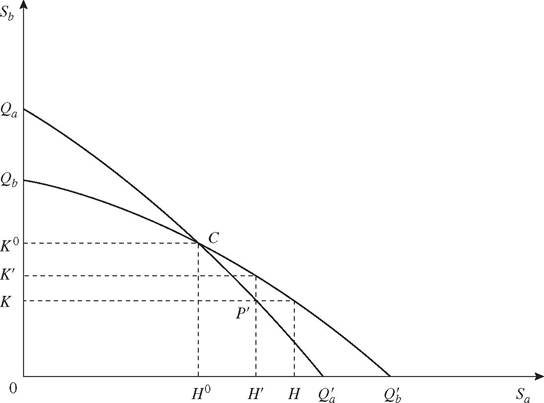
Fig. 4 vertical axis. QaQ0 a is the reaction curve of the first duopolist, QhQ1'h that of the second. If A offers the quantity H, B will offer K. But then A will modify his own decisions and offer H. B, however, corresponding to H, will offer K'. The process will go on until it reaches point C, towards which the process will converge even if it begins from a point to its left. This is a stable equilibrium, known today as the ‘Nash-Cournot equilibrium’.
Two important observations should be made. The first concerns whether such an equilibrium exists. In general, the marginal costs curves of the duo- polists and the market-demand curve may be such that the reaction curves do not meet in the positive quadrant or that they are parallel. By assuming zero costs, Cournot avoided this inconvenience. Under such a hypothesis, in fact, the equilibrium conditions depend solely on the two marginal-revenue curves; but these are equal, since the goods supplied are homogeneous; in this case the two reaction curves are symmetrical and intersect in the positive quadrant. The second observation concerns stability. In equilibrium, the expectations of each duopolist about the behaviour of the other are confirmed. This is so in the sense that, if A expects B to produce exactly K0 and B expects A to produce exactly H0, Cournot’s equilibrium is that which emerges from such a duopoly situation. But if the firms have expectations that do not coincide with (H0 K0) an adjustment process needs to be considered. The essential characteristic of the process of approaching the equilibrium point, according to Cournot, is as follows: each firm makes a series of mistaken assumptions about the behaviour of the other, but the size of these errors gradually diminishes in intensity until a situation is reached in which the expectations of reciprocal behaviour become correct. At this point the adjustment process stops. This is the sense in which the Nash-Cournot equilibrium is stable.
Another French forerunner of neoclassical theory is Jules Dupuit who, in De Iutilite et de sa mesure (1844) and other papers published in journals, tackled precisely the problems avoided by Cournot. He endeavoured to study the social benefits derived from public goods such as canals or bridges, and, above all, to evaluate the net social gains generated by variations in tolls and rates. Dupuit was not perfectly aware of the problems he had raised regarding the measurement of utility and the possibility of making interpersonal comparisons of utility; but his analytical contribution was nevertheless remarkable. He constructed a demand curve, interpreting it in terms of utility. Then he defined marginal utility and distinguished it from total utility. He assumed that the authority which supplies a good lowers the charge for it as the quantity supplied increases, so that the marginal utility of the good falls together with its price. The public benefit is measured by the sum of the intra-marginal utilities. ‘Relative utility’, given by the difference between total utility and marginal utility multiplied by the quantity of the good offered, will increase as the price decreases. In this way Dupuit proved that, if marginal utility is decreasing, the social benefit increases with the increase in the quantity offered. The reasoning is very similar to that which West, Malthus, and Ricardo had used to account for the increase in rent payments in relation to the increases in agricultural production. It is not by chance that, a few decades later, Marshall renamed ‘relative utility’ as ‘consumer rent’.
Dupuit also conceptualized ‘producer surplus’, which, given an increasing cost curve, is the difference between the total revenue of the firm and the overall marginal costs. The total social benefit will be given by the sum of the two surpluses, that of the consumer and that of the producer. It is to Dupuit that we owe the invention of costs-benefits analysis.
3.2.4. Gossen and Von Thunen
Also in Germany in this period, economists were working on the problems of value and utility. We have already mentioned the tendency of Smith’s early German followers, such as Soden and Lotz, to distinguish between ‘positive’ value, which is linked to the utility of goods, and ‘comparative’ value, which is equivalent to Smith’s ‘exchange value’. There were basically two problems that two generations of German economists grappled with: how to determine exchange value on the grounds of ‘positive’ value, and how to explain the formation of the latter in purely subjective terms. From the point of view of the history of ideas, the solution of the problem was impeded by the Smithian origin of the notion of ‘exchange value’. In fact, Smith maintained that this kind of value is a relationship between two quantities of goods, and therefore that it is an objective variable.
The solution was reached by Hermann Heinrich Gossen in 1854. In Entwicklung der Gesetze des menschlichen Verkehrs, und der darausfliessenden Regeln fur menschliches Handeln, Gossen argued that ‘absolute value’ does not exist, and that value depends on a relationship between a subject and an object. This relationship is based on utility. Gossen worked on the presupposition that the goal of an economic agent is to obtain maximum pleasure. He also formulated two laws that still today form the basis of the neoclassical theory of consumer behaviour. The first law establishes the principle of decreasing marginal utility: the pleasure obtained from a good decreases as the amount consumed increases until, eventually, satiety is reached. The second law is more important. In fact, it is a theorem derived from the assumption of maximizing behaviour and from the law of decreasing marginal utility. It states that the individual will choose to demand the various goods in such proportions that the satisfactions per unit of value they give him are equal at the moment at which he stops consuming them; or, rather, that the individual will continue to exchange two goods until the values of the last units he possesses of them become equal.
Even if his explanation was a little imprecise, it remains true that Gossen had in mind what today is known as the theorem of equality of the weighted marginal utilities. Gossen also attempted to extend this theory to the labour supply by introducing the concept of ‘disutility’. Finally, it is worth mentioning that Gossen was the first economist who used the metaphor of Robinson Crusoe to explain the consumer’s rational behaviour, a metaphor which will successively play an important role in the neoclassical theoretical system.
Another important forerunner of neoclassical theory was Johann Heinrich von Thtien. In the first part of Der Isolierte Staat (1826), he put forward a theory of the location of productive activities based on the implicit use of the notion of ‘opportunity cost’. Besides this he developed the theory of differential rent, proving that the level of production of a good, given demand, will be determined in such a way as to make the price equal to the production cost of the most disadvantaged firm. The surplus earned by the producers with lower costs is the rent.
In the second part of Der Isolierte Staat (1850), von Thuinen extended this reasoning to labour and capital, formulating for the first time a complete theory of distribution based on the marginal productivity of factors. He argued that an increase in the utilization of capital and labour increases both the production and the costs, and that it will continue so long as the marginal productivities of factors are higher than their prices.
Von Thuinen considered capital as a homogeneous factor of production, consisting of the quantity of past labour employed in the production of the means of production. He measured it in ‘labour years’. He assumed that its use would raise the productivity of current labour, but at a decreasing rate. He calculated the returns of capital by differentiating a certain function at the point at which the derivative vanishes. This is the income function of the producer of capital, whose income is determined, in this way, at its maximum level. The result reached was notable at the analytical level, even though its theoretical relevance was limited by the particular hypotheses and the special form of the function with which von Thuinen worked.
From those particular hypotheses, von Thuinen also derived a special formula for the ‘natural’ wage, w*, namely, w* = ap, in which a represents the subsistence level of consumption and p labour productivity. He was so strongly convinced of the importance of the formula that he wanted it inscribed on his tomb. Apart from the strangeness of the formula, von Thunen’s concept of ‘natural wage’ deserves to be remembered above all for its originality: wages do not depend on the supply and demand of labour, nor only on the subsistence needs of the workers; they are a geometrical average of the needs and productivity of labour, and represent what must be paid to the worker in order to leave him indifferent between the choice of remaining a worker and that of becoming a capitalist-farmer (in the hypothesis that such a possibility of choice exists and land is not scarce). Von Thunen’s natural wage is a normative concept. It is a ‘just’ wage in a precise sense: it is what allows the agricultural wage-earner to obtain the maximum returns from his own savings (equal to w* — a) and, at the same time, what allows the independent farmer to maximize the earnings of his own investments. In other words, according to von Thtinen, if the natural wage, w*, prevailed, the worker would be a wage-earner out of free choice and not because he was forced to by need.
3.2.5. The Romantics and the German Historical School
The most ambitious attempt to criticize classical political economy did not come from any of the pre-neoclassical ‘heretics’ but from the Historical School, which, by putting Smith, Richardo, Say and all their followers in the same bag, criticized the idea itself that an autonomous economic science was possible.
In order to understand the sense of the historicist opposition to political economy, we must begin from its philosophical roots. While classical economics had its origins in the eighteenth-century Enlightenment, German historicism descended directly from early nineteenth-century Romanticism. It was especially in Germany that Romanticism had been accompanied by an irrationalist and organicist Weltanschauung. In economics it grew together with the first aristocratic and reactionary opposition to capitalist development; and with Fichte, Gentz, and Muiller it opposed laissez-faire economics and political liberalism, both for the political consequences they implied and for the philosophical premisses from which they came. The individualist and rationalist connotations of those premisses were thoroughly rejected. On the contrary, the members of this school exalted the ideas of the organic unity of the nation, of the superiority of collective over individual goals, and of the historical and geographical specificity of the institutions of each country. This theoretical position has left us the bare bones of an interesting ‘State’ theory of money, which, if purified of the mystical elements that hampered it in those times, turns out to be in certain respects more modern than many classical theories, especially in its recognition of the conventional and institutional nature of the means of exchange.
Georg Friedrich List can be associated with this stream of thought, although he did not share its reactionary political attitudes and its irrationalist philosophical premises. In Das nationale System der politischen Oekonomie (1841), List accepted a great many of the analytical premisses of classical theory. However, he rejected en bloc its free-trade implications, for which he substituted a strongly mercantilist point of view and a theory of economic growth that gave great importance to the functional interdependence of industries and the need for uniform growth in the agricultural and industrial sectors. List not only did not reject capitalism, but tried to construct a theoretical system that, especially in its implications for trade policy, was intended to be used to foster German capitalist growth. The famous infant-industry protection strategy was brought to Europe by List who, as a political exile in the United States, had been the secretary to Henry Clay, the true inventor of that strategy. In common with the Romantics, List held the idea of the superiority of the nation’s interests over those of individual citizens.
The major impact of Romantic philosophy in the field of economics occurred with the Historical School, a school that attempted to attack directly the epistemological foundations of political economy. Though there is certainly a connection between the German Historical School and Romanticism, there are many differences between them. For example, unlike the Romantic economists of the preceding generation, such as Gentz and Miiller, the members of the Historical School were not all politically conservative. In fact, some criticized political economy and liberal thought from a left-wing standpoint.
The origin of the German Historical School goes back to Grundriss zu Vorlesungen Uber die Staatswirtschaft nach geschichtlicher Methode (Compendium of Lectures on Public Economics according to the Historical Method) (1843) by Wilhelm Roscher. The other two founders of the school, Bruno Hildebrand and Karl Knies, pushed the criticism of classical political economy much further forward than Roscher had dared to do. These three authors are the main exponents of the so-called ‘Old Historical School’. This expression distinguishes them from the historicists of the following generation, who formed the ‘Young Historical School’; its principal exponent was Gustav Schmoller, of whom we will speak in the next chapter. Here we present the fundamental arguments of the historical school, without dwelling on differences of opinion among individual members (which were, however, quite marked).
The basic historicist criticism of political economy touched upon its attempt to establish universal economic laws. With specific reference to the Smithian approach, the historicists denied that economic laws had the same properties as ‘natural laws’. They did not deny the possibility of discovering certain economic regularities, and they also admitted that such regularities could be called ‘laws’; but they did not believe that these were universally valid, nor that they were independent of the historical and geographical conditions in which they operated.
The historicists were more interested in what they called ‘laws of development’, that is, the regularities followed by the historical evolution of peoples and nations; but here, too, they avoided constructing universal laws.
Above all, they denied the possibility of discovering economic laws by deduction. Only the inductive method was allowed: the laws of development had to be constructed by induction and analogy on the basis of the greatest possible quantity of empirical and historical data. It is clear that this type of criticism impinged not only on the theoretical tenets of Smith and Ricardo, but more generally on the simple idea that economics is a science of the same type as the natural sciences and therefore, as was to emerge later in the Methodenstreit at the end of the century, it refers to the neoclassical as well as to the classical approaches.
Beyond the problem of methodology there is, however, a fundamental, pre-analytical contrast between the two basic orientations. The followers of the German Historical School did not accept the idea that social behaviour depends only on the personal interests of the single individuals, or the idea that individual choices are solely based on the rational pursuit of selfinterested goals. They had an organic vision of society, and upheld the presupposition that social agents are motivated by complex and multiple goals which are not all reducible to the rationality of economic calculation. Here, there is also the idea of a definite interdependence among the diverse dimensions of social action, and the conviction, therefore, that it is necessary to avoid the separation and excessive specialization of the single social sciences. From this point of view, economics was considered as only a branch of historical research.
3.3.