The Theories of Economic Harmony and Mill’s Synthesis
3.3.1. The ‘Age of Capital’ and the theories of economic harmony
After the defeat of the 1848 revolutions and the violent repression which ensued, the workers’ movement went into hibernation and remained there for two decades.
This was exactly what the industrial middle class needed. Reassured on the social front, firmly in possession of the reins of State in the principal capitalist countries, and also having laid favourable technological and cultural preconditions for economic growth, capitalism attempted its great jump forward. Hobsbawn called the twenty-year period from 1850 to 1870 the ‘Age of Capital’. If Great Britain had become the ‘the workshop of the world’, as the famous Crystal Palace exhibition in London in 1851 wished to demonstrate, there were several countries who were quite successful in their attempt to imitate the ‘first industrial nation’.Thus a certain variety in the types of industrial capitalism was created. The process of expansion involved, besides England and France, other countries, such as Belgium, Sweden, and Germany, as well as the United States. In the latter, the necessity to supply a vast and rapidly growing market led to an early take-off of the formation of large-scale firms in the mass-production sector. Germany saw the birth of the mixed banks, financial intermediaries capable of supplying stable and consistent flows of finance to the new firms and, at the same time, of favouring the control of the market by the formation of cartels. In both countries industrial concentration increased, while limited companies began to be the preferred organizational form of large-scale firms.
Besides the ‘intensification’ of capitalist accumulation there was also fast geographical expansion. ‘This was the period when the world became capitalist, and a significant minority of ‘‘developed’’ countries became industrial economies’ (Hobsbawn, The Age of Capital, p.
29). Titanic civil-engineering projects were completed, such as the opening of the Suez Canal and the creation of national railway networks. New States and empires were founded. Finally, we should not forget that this period was dominated by a strong movement in favour of free trade, not only in Great Britain, where, after 1846, protectionism was almost completely abandoned, but also in other European countries, among which several monetary and trade agreements were created that served to encourage the growth of international trade.Optimism spread with the growth in wealth, and the widespread social peace on which it was based allowed for important social and political reforms to be passed. The trade union movements, in return for their acquiescence or collaboration with national efforts, did achieve some conquests. For example, the ten-hour working day became law in England in 1850, whilst the recognition of the right to strike was passed in France in 1864. By and large, democratic and progressive forces were advancing all over the world. Serfdom was abolished in Russia in 1861 and slavery in the USA in 1862. Never before had capital exercised such a widespread hegemony in economic, social, political, and even cultural fields. The economists, for their part, were not to be found lacking, and did their job by producing theories of economic harmony.
We will mention here only the best-known of these economists: Frederic Bastiat, Henry Charles Carey, Francesco Ferrara, John Elliot Cairnes, and Henry Fawcett. These economists did not make very important contributions to the evolution of economic theory, but they had great success in this period and exercised significant influence in their respective countries. It is easy to understand why. They were almost all supporters of the doctrine of the harmony of interests among the social classes; and, as that harmony was best realized, according to them, when competition was as perfect as possible, they were outspoken free traders, arch enemies of State intervention, and castigators of socialism.
In regard to the theory of value, they tried in various ways to reconciliate the explanations based on labour and utility but did not produce significant results.Carey, though, is a special case. He began to construct his own theoretical system in the 1830s, following a Smithian orientation and professing clear free-trade convictions. However, his influence in Europe was only felt, for example, on Bastiat and Ferrara, after the 1840s. In this period Carey had abandoned his earlier free-trade beliefs, replacing them by strong protectionist and nationalist propaganda. In Europe, only a few of his German admirers followed him along this line. Bastiat was especially influenced by his doctrine of harmony of interests, while Ferrara developed his theory of ‘reproduction cost’. The latter consisted in reducing the value of a good to the effort sustained in producing it, but the theory was not formulated in a very clear way, especially in relation to one fundamental question: if that effort should be considered in terms of subjective sacrifice or, rather, in terms of the objective cost of production.
Ferrara made interesting contributions to the economic-harmony approach, and should be remembered, if for no other reason than that he may have been the connecting link between Galiani and Pareto. Ferrara developed a theory of substitutes according to which the value of a good, in relation to the value of one of its substitutes, depends on the comparison the consumer makes between the two utilities. The value emerging from such a comparison is the one at which the individual is prepared to exchange the two goods. Then, by using this idea to correct Carey’s reproduction-cost doctrine, Ferrara also tried to explain, by means of the theory of exchange, the phenomena both of production and distribution. Production was considered as an exchange between the product and the productive efforts. The costs of the goods, which in competition is equal to their value, is determined by the sacrifice sustained in producing them, valued in relation to the result of the production itself: this presupposes a comparison between the disutility the individual has to bear to give up something of his own and that which he must bear if he renounces something of others’.
This argument makes no use of the criterion of marginal variations, but the role of the hypothesis of substitutability, both in consumption and production, is clear. Even if the reference to classical theory in the work of Ferrara is explicit and marked, it is easy to see that here we are on the threshold of the marginalist revolution.It is worth nothing that Pareto considered Ferrara ‘the best of Italian economists’. He believed that Ferrara’s theory of reproduction cost had reached ‘the ultimate level of perfection’, only lacking in its analytical formalization. He considered it an anticipation of his own theory of ofelimity.
3.3.2. John Stuart Mill
The dominant economist of the ‘Age of Capital’ was John Stuart Mill, philosopher, politician, social reformer, and economist. In economics Mill attempted a heroic task: a re-examination of the debates of the first half of the century with the intent of unifying its principal theoretical results. It was, above all, this effort towards theoretical ‘harmonization’ that determined the notable success, in the following thirty years, of his main work, Principles of Political Economy (1848).
Mill had tried to reconstruct the Smithian tradition by uniting two incompatible approaches: the macroeconomic theory of surplus and the theory of individualistic competitive equilibrium. All the debates that took place in the thirty years before the publication of Mill’s Principles arose precisely from the difficulties in keeping those two approaches together. In fact, after the 1870s, they separated completely and for ever. On the one hand, the Ricardian branch developed into Marxist economics; on the other, the anti-Ricardian branch developed into neoclassical economics. Mill, who does not seem to have understood what was happening, was accused of eclecticism and superficiality by both parties, and was forgotten; but he does not deserve oblivion.
His work is important because it is located at a central crossroads of nineteenth-century European culture.
In his work several currents of thought and theoretical problems meet. This characteristic places it in the middle of the long transition process from classical to neoclassical economic thought, and gives the impression of eclecticism. But the indications of the direction in which to seek solutions are always fairly clear, even if they are often obscured by references to authors who were moving in the opposite way. All Mill’s difficulties were derived, apart from the complexity of the arguments tackled, from his fear of breaking with tradition. His theoretical difficulties arose from a combination of perceiving the new and lacking the courage to break with the old. He himself, in his Autobiography (1861), defined his own work as the constant effort to ‘construct bridges and clear roads’ in the theories of his predecessors.In his youth Mill was a member of the Utilitarian Society, and collaborated in the Westminister Review, the Society’s publication. The Society was made up of young radicals who fought for the most extensive realization of liberal and democratic principles. The philosophical bases of this radicalism were made up by Bentham’s utilitarianism, with all that it implied in terms of individualism, rationalism, the justification of laissez-faire in economics and of liberalism in politics. Bentham’s influence on Mill, however, was tempered by the opposing influence of Romantic thought, Coleridge’s in particular. The results were, on the one hand, a need to base action and political thought on a strong philosophy of history and, on the other, a refusal to reduce human choices and behaviour to the economic dimension alone.
In the essay Utilitarianism (1863), Mill rejected two of the fundamental assumptions of Bentham’s philosophy: the one according to which the reasons for human action can all be reduced to self-interest and to the selfish search for the maximum pleasure; and the other that the single individual is the only judge of his own interest. The first argument permitted Mill to link himself with the traditional English and Scottish ‘moral-sense’ philosophers.
Mill maintained that an increase in personal pleasure could also be derived from participation in the happiness of others. In this way he justified, from a utilitarian perspective, the rationality of behaviour motivated by feelings of humanity and solidarity. The other argument was still more important, in that it allowed relevant, if not substantial, departures from the laissez-faire principle. In fact, in some cases he accepted State intervention in the economy—for example, in education, in the regulation of the working day, and in assistance to the poor. In these cases Mill maintained that the publicauthorities knew the interests of individuals better than they themselves, a clear anticipation of the modern ‘merit goods’ doctrine.
More generally, however, utilitarianism had been interpreted by placing at its base the criterion of the maximization of the welfare of the maximum number of people; and Mill’s reformism pushed ahead to the point of maintaining that such an objective should be pursued even at the cost of reducing the welfare of some individuals. He derived this argument from the natural-law component of another philosophical tradition, one that linked him to Locke. In fact, he justified private property with the same argument as Locke had used, the right of individuals to possess the products of their own labour. But he criticized the abuses of this right, and especially the glaring inequality in the distribution of property, which he explained in terms of historical and institutional influences. Any interventions aimed at the correction of such defects were therefore considered legitimate. For example, he proposed progressive death duties.
Mill did not consider such conclusions to be in conflict with the laws of economics. In fact he admitted, as had done Smith and Ricardo, the natural character of the laws of production, but denied, as did the socialists and the historicists (for example, Richard Jones, an interesting English historicist of whom we will speak in the next chapter), the natural character of the laws of distribution. Thus, while he exalted competition and the market, which would allow the natural laws of production to operate in the best possible way, he was not against the encouragement of profit-sharing schemes, and co-operative work, as well as the development of small farming communities. Under the influence of Harriet Taylor, whom he married in old age, Mill made substantial, pro-social changes in the second edition of the Principles (1849).
Mill considered himself a friend of the working classes, as well as of other categories of outcasts and oppressed, and thought that history was working for the final realization of a society he defined as ‘socialist’; but he did not consider himself a socialist. In fact he fought, in his own way, against the socialism of his times, so much so that he felt the need to demonstrate the fallacy of the socialist doctrines from the point of view of economic science. In order to understand these aspects of Mill’s thought, we need to enter the heart of his political economy and, in particular, his theories of profit and wages.
3.3.3. Wages and the wages fund
There were traces of the wages-fund doctrine already in Smith’s work. However, the theory was developed, above all, by Ricardo’s followers, who tried to use it to overcome some difficulties of the Ricardian theory of the natural wage. The use of the population principle to account for the tendency of the market wage to adjust towards its natural level posed two crucial problems which seemed to undermine the idea itself of a natural wage as a centre of gravitation. First of all, it was necessary to define the subsistence wage in physiological terms, otherwise it would have been impossible to explain the ability of a fall in the market wage to adjust the growth of the labour supply by means of variations in the death rates. But all the classical economists, including Smith and Ricardo, admitted that the subsistence wage also depended on the habits and customs of the working population, that is, on social and institutional factors, besides the biological ones. Second, if it is admitted (as was the normal practice), that habits and customs could also change as a result of changes in the level of income, the natural wage could vary, in the long run, as a function of the market wage. Therefore it could not be considered as a centre of gravitation for the latter.
Even if we ignore these two problems, however, the adjustment mechanism which enabled the natural wage to regulate the oscillations of the market wage would require extremely long periods, definable over generations. In this way, the natural wage loses its relevance. What sense did the classical exercises in comparative statics have if the states that could be compared presupposed periods of a quarter of a century or more? On the other hand, if these exercises referred to the time span of the duration of a productive cycle, generally assumed to be a year, then the wage and its changes could not be anything but those determined by the market. We shall see in the next chapter, when we consider Marx, which was the only coherent way out of this problem—coherent, that is, with the classical approach.
The path taken by the Ricardians was that of abandoning the concept of the natural wage and relegating the subsistence wage to the simple role of a minimum limit of the market wage. The path was opened by McCulloch and followed, with variations, by Torrens, Cairnes, and others. In order to explain the theory in the simplest way, we will refer to an economy which produces one consumer good and one capital good by means of labour and capital. Let L be the labour force, L* its full employment level, wr the real wage, wr its minimum subsistence level, and K capital. We will take the price of the consumer good as numeraire.
As production requires time, it is necessary, at the end of every productive cycle, to ‘set aside’ a part of the product to sustain the workers during the successive cycle: this is the wages fund. Let us define it as W = wrL. Its size depends on three factors: the amount of profits, the capitalists’ propensity to save, and the techniques in use. The classical economists took as given, at each moment, the last two factors. Then, if the distribution of income is known, it is possible to determine the wages fund, let us say, at level IW. It follows that wages and employment level are inversely related:
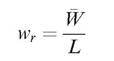
This relationship is represented in Fig. 5 by curve W, together with a very simple labour supply function, L, corresponding to the one implicitly used by the classical economists.
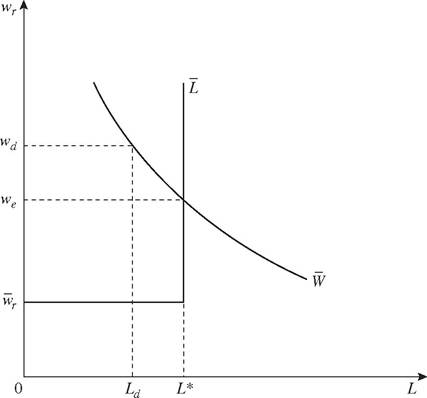
Fig. 5
As can be seen in Fig. 5, there is only one wage-level that guarantees full employment (and the full utilization of capital), and this is we. The Ricardian economists tended to interpret we as a market wage, and to consider it as determined by the forces of supply and demand. But such an explanation runs up against a series of logical difficulties. If the technique is given, the capital: labour ratio, K/L, is known. At the moment in which the productive process terminates, the structure and level of output are known. If it is decided to set aside a certain wages fund, W it is also automatically decided how to share out the investments between technical capital and wages funds. Thus K/W will also be known. Therefore the level of employment and wages are both determined, and independently of the labour supply. If the latter, by chance, were equal to the ‘demand’, then the wage level would be we, but it would not be a market wage. However, if the supply and demand of labour, let us say L* and Ld, do not coincide, then the wage rate will be wd; but neither is this a wage determined by the forces of supply and demand. In fact, the market would tend to bring wages towards we. This point cannot be reached, however, because, given IW and K/ W, K is also given; and given K/L at the level K∕Ld, an increase in employment beyond Ld is impossible owing to a lack of capital.
The wages-fund theorists, including Mill, vaguely realized this difficulty and often tried to avoid it by letting K/L vary. This was a new path that would eventually have led to the neoclassical theory of wages. But large steps had to be taken; in particular, it was necessary to interpret IW as a demand schedule for labour and make it depend on a production function in which the substitutability between labour and capital was admissible. The Ricardian economists were not equipped for such a leap.
Let us return to Mill; and, in order to avoid these difficulties, let us assume that, by chance, L* = Ld and we = wd. Now we can see how Mill used the theory. In the ‘short run’ the trade unions can do nothing to modify wages, which depend solely on the techniques in use and the capitalists’ investment decisions. In fact, an increase in the wages above we would lead to a reduction in employment (and in the utilization of capital). But then, if competition exists, the excess in labour supply will bring the wages back to their ‘equilibrium’ value. The workers, according to Mill, will only be able to influence wages in the ‘long run’. Over time, JW and L shift to the right. Wages increase if W moves more than L. Therefore they would grow faster the higher the rhythm of accumulation and the lower the rate of population growth. This explains why Mill suggested that his trade union friends should preach less revolution and more contraception.
Later on, however, Mill changed his mind. The criticisms levelled against him by William T. Thornton, and by other economists, made him understand the anti-trade union use that could be made, and, in effect was being made, of his theory. But his recantation was not complete. It was presented in a review of Thornton’s book published in the Fortnightly Review in May 1869, and it consisted of the rejection, not of the theory itself, but of two of the hypotheses that qualified it. Mill admitted that it was not necessary to take as given the distribution of income and the propensity to save of the capitalists. Thus wages could increase if the consumption of luxury goods and/or the profit share decreased. However, a real limit to the increase of the wages would still remain, a limit represented by the fact that this increase could lead entrepreneurs to bankruptcy.
3.3.4. Capital and the wages fund
More than for the explanation of wages, Mill’s theory of the wages fund is important for the explanation of profit and of the role played by capital in the production process. From the point of view of the history of economic thought, this aspect of Mill’s theoretical system is important for the role it played in the transition from the classical to the neoclassical approach.
In the Essays on Some Unsettled Questions in Political Economy, Mill tackled some of the problems of the Ricardian theory of value. In this work he argued that value did not only depend on labour; and that this was so because the value of the means of production and wage goods depends, in turn, not only on the wages advanced to produce them but also on the profits earned by the capitalists. From this, Mill derived a theory of value based on the cost of production which differed from Ricardo’s above all in abandoning the search for an invariable measure of value. The theory was along rather similar lines to those followed by Torrens. However, it still contained the Ricardian rejection of the additive theory of prices, and this is what really counted.
The decisive turn occurred in the Principles, when Mill, precisely in order to oppose the socialist theories of exploitation, was forced to abandon Ricardo. In fact he maintained that the workers do not have a right to the whole product, because it is not only labour that contributes to the creation of the value of goods, but also the abstinence necessary to render capital available. Labour is only one of the requirements of production, and this cannot be undertaken without the aid of machinery and the advance of the wages fund. Capital is the other requirement of production, and it is the result of the abstinence from consumption on the part of the capitalists.
But in our analysis... of the requisites of production, we found that there is another necessary element in it besides labour. There is also capital; and this being the result of abstinence, the produce, or its value, must be sufficient to remunerate, not only all the labour required, but the abstinence of all the persons by whom the remuneration of the different classes of labourers was advanced. The return for abstinence is profit. (p. 280)
Mill explicitly referred to Senior:
As the wages of the labourer are the remuneration of labour, so the profits of the capitalist are properly, according to Mr. Senior’s well-chosen expression, the remuneration of abstinence—they are what he gains by forbearing to consume his capital for his own uses, and allowing it to be consumed by productive labourers for their uses. For this forbearance he requires a recompense. (p. 245)
Here we have an extension of the ‘wages fund’ concept to include all capital. The primary requisite of the production process, according to Mill, is still labour (although sometimes land is also taken into consideration). Capital is nothing else but the wages fund set aside in preceding periods in order to sustain the workers who produce the means of production. These advances create a profit. Ricardo would not have disagreed with all this. But, according to him, capital does not contribute to the creation of value, and profit is not the remuneration of a productive service. Mill’s theoretical jump consisted of the use of the abstinence theory to explain profit. In fact this was subdivided into various components: a management salary, a risk premium, and a remuneration for abstinence. The last was taken to coincide with interest. Mill, in this way, was able to speak a Ricardian language and say that the profit, net of these three components, is a residue. However, he did say something that Ricardo would never have admitted when he stated that interest remunerates a productive contribution.
This theory is similar to Senior’s. Mill, however, included in abstinence not only the sacrifice connected to the renunciation of a given flow of income but also the sacrifice inherent in the renunciation of the consumption of capital stock already accumulated. In this way interest is explained as the remuneration, not of savings, but, more precisely, of capital.
Obviously, the economists of the Austrian school would have greatly appreciated such an interpretation of the theory of the wages fund. In effect, some of them considered the neoclassical theory of capital, at least in the version based on the notion of ‘production period’, precisely as an extension of the wages fund theory. What prevented Mill from taking the wages fund doctrine to its extreme logical consequences? Basically he lacked two ideas, which are, in fact, the core of the Austrian theory of capital: first the hypothesis that it is possible to combine labour and capital in different proportions; second, the hypothesis that the productive contribution of capital decreases with the increase in the period in which the wages fund is kept invested.
Of course, Mill can also be considered a forerunner of the English neoclassical school besides the Austrian one. Apart from the possibility of linking Jevons’s theory of capital to the wages fund approach, another line of ancestry unites Mill to the neoclassical school, and it is that which links him to Marshall. In regard to the role played by the forces of demand and production in determining prices, Mill, as usual, started from Ricardo in distinguishing between two categories of goods: those which are absolutely limited in supply, and those for which the supply is susceptible to indefinite mutiplication without increases of costs. The value of the goods of the first type depends solely on the forces of demand, while the value of those of the second type depends solely on the cost of production. However Mill admitted that there is a third type of goods, one for which the supply is susceptible to multiplication but not without increases of costs. The value of these goods would still depend on the cost of production, but now only in the most unfavourable existing circumstances. Mill was thinking about something similar to a ‘generalization’ of the role played by the decreasing returns of land, but he did not go deeper into this question. The step that still had to be made was to show that the ‘most unfavourable circumstances’ of the production process depend on the quantity produced. This, on the one hand, would have presupposed the hypothesis of variable returns of the productive factors and, on the other, would have implied that price depends both on forces of demand and on conditions of production.
We should like to conclude this brief exposition of Mill’s thought by presenting his theory of the falling rate of profit. This will serve to give an idea of how his reformism was linked to a strong and optimistic philosophy of history, as well as to show that there was at least one thing in which Mill remained basically a classical economist: his ability to link the abstract theories to extremely important historical and political problems.
Mill believed, as did Smith, Ricardo, and Marx, that the rate of profit was governed by an inevitable tendency to fall, in the very long run. Unlike the others, however, he evaluated the ‘phenomenon’ optimistically. He had his own peculiar idea of the final goal of capital accumulation:
In contemplating any progressive movement... the mind is not satisfied with merely tracing the laws of the movement; it cannot but ask the further question, to what goal?... When the progress ceases, in what conditions are we to expect that it will leave mankind? (p. 452)
The answer is:
I cannot... regard the stationary state of capital and wealth with the unaffected aversion so generally manifested towards it by political economists of the old school. I am inclined to believe that it would be, on the whole, a very considerable improvement on our present condition. (p. 453)
The basic cause of the tendency towards the stationary state was to be found in the increase in wealth caused by capitalist accumulation. Such an increase would mean that the sacrifice of consumption connected to capital accumulation would become progressively less painful. Therefore, the remuneration for abstinence would gradually diminish. In the end, a society would be created in which there would exist so much wealth that there would no longer be any need for or stimulus towards further capital accumulation. Thus the vision of socialist society would have been realized: with zero interest, nobody would earn more than the product of their own labour. This would not lead to the abolition of private property, but only to the final realization of its ‘natural’ distribution. In fact, natural law would justify private property by the right of the individual to the possession of the product of his own labour. This law would only be realized when the capitalists’ gains disappeared.
Mill did not criticize private property, nor the capitalist regime of the times in which he lived, but only its imperfections and abuses. He did not, however, consider these ‘imperfections’ unfounded: they were historically justified. Certainly, it was necessary to correct some of the excesses and injustices of the capitalist system which he observed. But, for the rest, he thought it was enough to leave history to take its course. There is certainly a good reason why Mill has been considered as one of the fathers of Fabian, or, rather, cunctator, socialism.
3.4.