The New Welfare Economics
8.3.1. Robbinss epistemological setting
Welfare economics emerged, after the marginalist revolution, as a test bed for economic applications of neoclassical theory. But it dealt only with special aspects or situations of secondary importance in the economic system.
Keynes tenaciously opposed welfare economics, mainly because of its inability to provide far-reaching policy suggestions for State intervention at the aggregate level; he even tried to modify its fundamental questions. Lionel Robbins was one of the first economists to perceive the importance of the Keynesian criticism of Pigou, the undisputed authority on the subject at that time, and at the beginning of the 1930s was working at the attempt to go beyond the theoretical approach which had emerged from the Cannan- Marshall-Pigou line of thought. The work of conceptual and epistemological reorganization undertaken by Robbins in this period helped the neoclassical theoretical system to resume its dominant position after the ‘interlude’ represented by the Keynesian revolution. The exposition of his results will allow us to answer the question we raised at the end of Chapter 6: why did the passage from cardinalism to ordinalism occur only during the 1930s if—as we have seen—all the necessary theoretical presuppositions were already available at the beginning of the century?The point of attack of Robbins’s work was his famous redefinition of the scope of economics. If, as he argued in the Essay on the Nature and Significance of Economic Science, ‘the unity of subject of Economic Science’ must be found in ‘the forms assumed by human behaviour in disposing of scarce means’ (p. 15), then the utility concept most suited to the study of economic welfare must be that of ‘individual preferences’. Since utility, by its very nature, cannot be observed, let alone measured, Robbins argued that it deprives of scientific foundation every assertion about the effects of redistributive measures on collective welfare.
If utility is interpreted in terms of preferences, the egalitarian version of utilitarianism loses all cogency: interpersonal comparisons are arbitrary—or, rather, impossible—in positive terms, as the motivations underlying individual choices can be the most diverse and disparate. There is no way of comparing the satisfactions of different people; Robbins stated: ‘of course, in daily life we do continually assume that the comparison can be made. But the very diversity of the assumptions actually made at different times and different places is evidence of their conventional nature’ (p. 124). The finesse of the argument should not be missed: there is no ‘fact’ to which such comparisons refer; they are only expressions of more or less widely shared values in a given community, and ‘can be justified on the grounds of general convenience [or] by appeal to ultimate standards of value’. In conclusion, they ‘cannot be justified by appeal to any kind of positive science’ (p. 125).
There was a widespread opinion, among the economists gathered together by Robbins at the LSE, that the notion of ‘individual preferences’ was epistemologically safer than that of ‘levels of welfare’. Logical positivism had had a dramatic impact on Anglo-American social science, and the entry point in England had been the LSE. At the beginning of the century, positivist epistemology had not yet begun to disturb the sleep of the economists. It was not until the philosophical setting achieved by the Vienna Circle that economists, too, began to speak of ‘observability’ as a demarcation criterion between science and fiction, and of neutrality with respect to value judgements as a separation criterion between science and ethics.
Preferences can be made operational by means of a definition in terms of choice: the assertion ‘the state of things x is preferred to the state of things y’ is completely defined by the assertion ‘the state x will be chosen by a subject if only x and y are available’. The doubt did not even cross the minds of Robbins and the other authors who followed this orientation that the definiens, as a conditional proposition, can perform its function only after the concept of preference has been defined.
I may well prefer health to illness, but I certainly cannot choose to be well or ill. They did not notice that preferences, apart from absolute ones, have a holistic nature and therefore that the ordinalist practice of defining what is preferred in terms of what would be chosen is not immune to criticisms of an epistemological type.It was on these presuppositions that Robbins was able to speak of a ‘new’ welfare economics free of any ethical assumptions. It is interesting to note, however, that, if the declared aim was that of rendering utilitarianism neutral in regard to value judgements (whatever the subjects thought had value had to be accepted), the new system produced a side effect which is only apparently paradoxical. The preferences of a person are the product not only of biological needs but also of a socialization process. Therefore, they are determined by, and tend to reflect and reinforce, existing social relations. This means that a theory which requires the maximum satisfaction of the preferences chosen in a given social context contributes to reinforce that social context, and is therefore a theory strongly distorted in a ‘conservative’ sense.
8.3.2. The Pareto criterion and compensation tests
There were voices of dissent but they were not many. However, the ordinalist approach of Robbins, Hicks, and Allen defeated any resistance. It is not difficult to see why. The first reason was that a central argument of the theoretical debate of the 1930s, apart from Keynesian matters, had returned to being price theory. This was a secondary consequence of Sraffa’s criticism of the Marshallian system. Before that time, the problem of satisfying people’s needs was seen rather as one of production and distribution. Material welfare increases if the distribution of the social dividend changes in favour of poor people, up to the point of levelling out the marginal utilities of all the people. Such a levelling process was also seen as a requirement for efficiency.
Thus, the defence of egalitarian economic policies was viewed as based on considerations both of efficiency and of equity, two objectives considered to be complementary and not antagonistic. It is clear that, from this approach, economists must focus on the notion of utility as ‘satisfaction of needs’. If it is assumed that the needs of individuals are comparable, then utilities must also be comparable.Thus, even though it was already known at the end of the nineteenth century that assumptions of measurement and comparison of individual utility were superfluous for a theory of prices, there was a fairly widespread opinion that they were necessary to tackle the problem of how to improve the welfare of mankind. But once the objective of economic investigation had been redefined by placing the theory of prices at its centre, the ordinalist analytical apparatus turned out to be quite sufficient. With an elegant use of Occam’s razor, Hicks and Allen demonstrated, in particular, that a psychological concept such as that of marginal utility can be profitably replaced by a ‘behavioural’ one: that of ‘marginal rate of substitution’.
The second reason for the success of the ordinalist programme was directly related to welfare economics, and was the ‘discovery’, in the 1930s, of the virtues of the Pareto optimality criterion, the most valuable being that there is no need for any interpersonal comparisons of utility; and this seemed to allow certain economic recommendations even when comparisons are impossible. The main recommendation was that ‘the best policy is no policy’. The Pareto criterion seemed to have translated into a scientific proposition the central tenet of liberal thought. It is true, as was immediately realized, that there may be many social optima, perhaps an infinite number, and therefore that ‘scientific’ criteria are also needed to make a choice between them. But this did not cause much concern: the ‘compensation tests’ proposed by Hicks, Kaldor, Scitovsky, and Samuelson, the real theoretical novelty of the 1940s on this front, seemed to fill the gap.
Underlying the idea of the compensation tests is the notion of ‘potential welfare’, i.e. a type of welfare that takes into account all the possible redistributions which are feasible in a certain situation. Let x and y be two social alternatives—for example, to build a park (x) and not to build it (y). And let S(x) and S( y) indicate the set of alternatives accessible from x and y respectively. It is said that x is Hicks-Kaldor superior to y, in symbols xHKy, if there is an alternative z belonging to S(x) such that z is Pareto superior to y, in symbols zPy. The existence of such a state of affairs makes it hypothetically possible that each person is better off after alternative x has been chosen. In the example, it is possible to devise a compensation scheme based on taxes and subsidies such that those who gain from the construction of the park can compensate those who have lost out, so that, in the end, nobody is worse off and some are better off.
Unfortunately, two serious difficulties afflict the compensation tests. The first concerns their logical coherence. We will show this diagrammatically. Let u(x) be a utility vector belonging to S(x). With only two individuals, A and B, u(x) is represented in a diagram in which the co-ordinates represent the utility of one individual, uA, and the utility of the other, u b. The frontier of the shaded area in Fig. 10 is known as the utility frontier relative to x. On this frontier two points are represented: u(x) = {uA(x), uB(x)} and u(w) = {uA(w), uB(w)}, where w denotes an alternative that belongs to S(x). Clearly, B prefers w to x, so a movement from x to w implies that B must compensate A in some way. On the utility frontier relative to y are the points u(y) = {uA(y), uB(y)} and u(v) = {ua(v), ub(v)}, where v is an alternative accessible starting from y. In terms of Fig. 10, which alternative is Hicks-Kaldor superior? Given x, it is possible to reach the alternative w, and both individuals prefer w to y.
Therefore, wPy and xHKy. On the other hand, given y, it is possible to reach v, and both the subjects prefer the alternative v to x, so that vPx and consequently yHKx. The proposed criterion is logically inconsistent. Analogous problems arise from the criterion proposed by Scitovsky.The second difficulty mentioned above concerns the sense in which an increase in ‘potential welfare’ is important for actual welfare comparisons. Even if whoever draws advantage from a certain measure is also able to
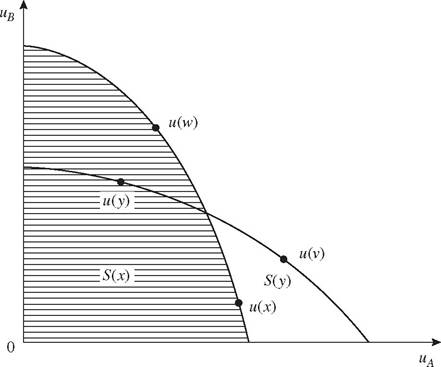
Fig. 10 compensate whomever loses, why would this constitute an improvement? Perhaps because it is maintained that compensation must be paid? This does not really seem the right answer. In fact, if compensation is not paid, then the highest potential welfare situation can be well judged worse whenever greater consideration is attributed to the damage of those who lose rather than to the advantage of those who gain. If, instead, the compensation is paid, then, after the payment, everybody finds themselves just as well off as before and at least one is better off; a situation which clearly denotes a Pareto improvement. In this case, however, there is no need for any compensation test: the Pareto criterion is sufficient. This is the conclusion brought about by the criterion proposed by Samuelson. In other words, it is possible to conclude that the compensation tests either do not convince (when the compensation is not paid) or are redundant (when the compensation is paid). Yet it was not until the 1950s that the problem was fully realized. In this context, William Gorman produced a key paper in which he revealed the paradox of the compensation tests: they are logically coherent, and therefore acceptable, only when they are not needed.
In the meantime, ground was gained by that vast programme of research, based on the theory of choice value, which still today provides the main frame of reference for theoretical work. The apodictic assertion advanced by Edgeworth in Mathematical Psychics, ‘the first principle of Economics is that every agent is activated by self-interest’, was still taken as true, but now it was interpreted as meaning that a person follows his own interest when it maximizes his utility. And as utility was now called on to represent choices (one alternative has more utility than another if, being able to choose between the two, the agent would opt for the first), the interpretation was advanced that what an individual chooses coincides with what is in his interest. We will see the results of this line of research in Chapter 10.
8.4.