‘Air, Water, and Earth’ and ‘Admiration, Hope, and Love’: Nature and Mind
The most famous passage in Ruskin's critical book of economics, Unto This Last, reads as follows:
THERE IS NO WEALTH BUT LIFE. Life, including all its powers of love, of joy, and of admiration.
That country is the richest which nourishes the greatest number of noble and happy human beings; that man is richest who, having perfected the functions of his own life to the utmost, has also the widest helpful influence, both personal, and by means of his possessions, over the lives of others.... The maximum of life can be reached by the maximum of virtue. (vol. 17, 105)In this passage relating to economic and social issues there is no explicit reference to the concept of beauty, but the words of ‘love, of joy, and of admiration', defined here as the ‘powers of life', are similar to ‘joy, admiration, and gratitude', defined above in Ruskin's ideas of art as the perceptions of Theoretic (Theoria) beauty. As mentioned above, this conception of beauty is distinguished from sensual pleasure and is classified into Typical Beauty and Vital Beauty. In vol. 2 of Modern Painters, Ruskin explains the source of the usage ‘love, joy, and admiration' by adding a footnote on the word ‘admiration' (vol. 4, 29). The words are taken from Wordsworth's following poem:
We live by Admiration, Hope and Love; And, even as these are well and wisely fixed, In dignity of being we ascend.
(Wordsworth, The Excursion, bk. 4, lines 763-5)
It is important to recognize the intrusion of the notions of art and beauty into the critical discourse of economics as essential to his argument. It follows that Ruskin's thesis of ‘No Wealth but Life' cannot be discussed without regard to his thoughts on art and beauty. The mind of ‘love, joy, and admiration' as the condition of true beauty is allegorically applied to economics as the condition of true wealth.
However, the thesis of ‘No Wealth but Life' is one-sided because it relates only to the subjective conditions of Life (Mind), not to the objective conditions (Nature).
For Ruskin, the concept of Nature contributing to Life is also the basis of his thoughts on art and economy. Later Ruskin gives a bird's-eye view of the integration of art and economy by the identification of six elements as useful and essential to Life. The following passage in one of his open letters addressed to the labour class, Fors Clavigera, is an important key to understanding the entire structure of his thought:There are three Material things, not only useful, but essential to Life. No one ‘knows how to live' till he has got them. These are, Pure Air, Water, and Earth. There are three Immaterial things, not only useful, but essential to Life. No one knows how to live till he has got them. These are, Admiration, Hope, and Love.... These are the six chiefly useful things to be got by Political Economy, when it has become a science. (Letter 5, 1871, vol. 27, 90-1)
Here the immaterial things ‘Admiration, Hope, and Love', which Ruskin inherited from Wordsworth, appear again together with the material things ‘Air, Water, and Earth', both as contributing elements to Life.
In his early art discourse, first, ‘Air, Water, and Earth' are major components of landscape painting, as exemplified in the analysis of Turner, and we call them in a lump ‘Nature' as the objects of artistic Beauty. Second, ‘Admiration, Hope, and Love' are major components of ‘Mind' as the source of artistic Beauty. This pair of concepts (i.e. Nature and Mind) makes up the world of Beauty in Ruskin's early years.
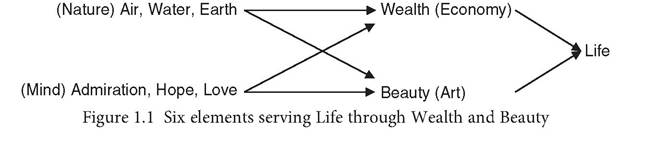
In his later years, the same pair of concepts is applied to economic discourse on the world of Wealth. First, ‘Air, Water, and Earth' are Nature to be protected either by or despite economic activity; second, ‘Admiration, Hope, and Love' are nothing but Mind to be accepted as the moral source of honourable Wealth. The parallelism of Nature and Mind between art (Beauty) and economy (Wealth) is noteworthy.
Figure 1.1 illustrates the interactions between Wealth (economy) and Beauty (art), on the one hand, and Nature and Mind, on the other. Two human values, Wealth and Beauty, contribute to human Life through the engagement of Mind with Nature. Balance between Wealth and Beauty should be sought through social mechanism in order that Life might be best served.
In the same open letter Ruskin elaborates on each concept of ‘Admiration, Hope, and Love':
Admiration - the power of discerning and taking delight in what is beautiful in visible Form, and lovely in human Character; and necessarily, striving to produce what is beautiful in form, and to become what is lovely in character.
Hope - the recognition, by true Foresight, of better things to be reached hereafter, whether by ourselves or others; necessarily in the straightforward and undisappointable effort to advance, according to our proper power, the gaining of them.
Love - love both of family and neighbour, faithful, and satisfied. (vol. 27, 91) The concepts of ‘Admiration, Hope, and Love', defined as the ‘powers of life' in the thesis of ‘No Wealth but Life', are expounded here as the powers of perceiving as well as creating what is valuable. Six elements in Nature and Mind are to be taken seriously in both art and economy for the betterment of life. Ruskin argues that economics, which should be a ‘science of life', is in fact concerned with the distorted world of selfinterest and market transaction, entailing the destruction of ‘Pure Air, Water, and Earth', on the one hand, and leaving and even accelerating the extinction of ‘Admiration, Hope, and Love', on the other. Economics has become a ‘science of death' rather than a ‘science of life'. As a result, art itself suffers from corruption.
1.5