‘Ruskin’s Triangle’: Wealth, Life, and Beauty
‘Beauty’ is a term of aesthetics. In his early years, Ruskin challenged the current notion of beauty (imitation of nature for the purpose of sensual pleasure) and claimed that ‘Beauty is Life’.
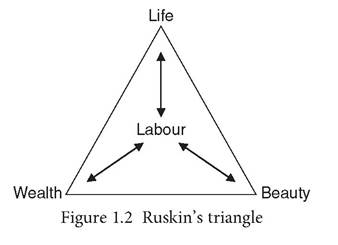
‘Wealth’ is a term of economics. In his later years, Ruskin challenged the current usage of wealth (accumulation of useful commodities for the purpose of self-interest) and insisted that ‘Wealth is Life’. Thus, the trinity of Wealth = Life = Beauty is established. Ruskin’s link between economics and aesthetics is the romantic notion of Life.Referring to Figure 1.2, the equilateral triangle is called ‘Ruskin’s triangle’ apex and with Wealth and Beauty at the other two angles. This corresponds to the right half of Figure 1.1. Although Ruskin explicitly claims in the aphoristic form only the economic thesis ‘No Wealth but Life’, he consistently holds the comparable aesthetic thesis ‘No Beauty but Life’, which is just what he means by Vital Beauty. He means that beauty exists only in life and that art for the sake of art without relevance to life does not produce beauty. Thus, ‘Ruskin’s triangle’ integrates his aesthetic and economic theses and represents the integrated thesis that ‘There is neither Wealth nor Beauty but Life.’
Before we deal with Ruskin’s economic discussions, it is necessary to clarify the meanings of Life from his perspective of art because they are imposed upon his economic discourse. Three points are important: Life as a stock of capability, Life as a composition, and labour as the Life’s agent as well as the aim of Life.
1.5.1 Life as a Stock of Capability
The concept of Life is interpreted as a ‘stock’ of the being. Unlike the utilitarian doctrine, Ruskin’s conception of Life is not a series of
behaviours producing a ‘flow’ of pleasure, but a ‘stock’ of capability, functions, and character of human beings.
His statement in the famous thesis that ‘Life includes all its power of love, of joy, and of admiration’ proves Life to be a stock of powers, especially moral powers.Moreover, for Ruskin, the concept of Life is a normative one. The desirable life is prescribed as the maximum degree of virtue or excellence of ‘being’, not as the maximum net sum of pleasures and pains produced by ‘doing’, as the utilitarian ethics claims. The pleasure of art is produced by the exertion of the overall capability of artists and transmitted from artists to observers. Underneath art lies an ethical value for evaluating the ‘stock’ of human beings, which is the ethics of virtue as distinct from the utilitarian ethics of good.
1.5.2 Life as a Composition
An aspect of his concept of Life depends on the metaphor of ‘composition’ in painting. In vol. 5 of Modern Painters, Ruskin takes up the third subject matter of art, that is, ‘ideas of relation’, by interpreting it as ‘composition’ or association between various parts of the whole of the object in question: ‘Composition may be best defined as the help of everything in the picture by everything else’ (vol. 7, 205). True ‘composition’ must be the mutual ‘help’ conducted with the highest energy of each component. Originally ‘composition’ was a concept in art, but his interpretation of it in the context of ‘ideas of relation’ in the fifth volume published in 1860 is largely affected by his growing concern with social issues.
In the case of inanimate things, the removal of one part may not injure the rest. But in the case of animate objects such as plants, animals, human beings, and a society conceived as an organism, each portion in the structure is functionally interdependent upon other portions and insufficiency or absence of some portions injures the rest. The full exertion of functions and capabilities in organisms is defined as a condition of Vital Beauty. The notion of ‘composition’ also aims at the value of Unity, which is one of the types of Typical Beauty as the latent divine attributes in creatures.
The powers which cause the several parts of creatures to help each other Ruskin calls ‘Life’. Intensity of Life depends on intensity of helpfulness. The absence of help means corruption and ultimately leads to death. He submits the ‘law of help’:
A pure or holy state of anything, therefore, is that in which all its parts are helpful or consistent. They may or may not be homogeneous. The highest or organic purities are composed of many elements in an entirely helpful state. The highest and first law of the universe - and the other name of life is, therefore, ‘help’. The other name of death is ‘separation’. Government and co-operation are in all things and eternally the law of life. Anarchy and competition, eternally, and in all things, the laws of death. (vol. 7, 207)
Although the notion of ‘composition’ is primarily related to painting, generally it means the ‘relations’ among multifarious elements in an object of art. A work of art is an expression of ideas concerning how to design the composition for various objects. Ruskin’s hostility to anarchistic market competition was metaphorically derived from the idea of ‘help’ in the composition of living organisms. Competition severs the social bonds of mutual ‘help’ which should be the basic condition of Life.
1.5.3 Labour as Life’s Agent as well as the Aim of Life
Ruskin substantiates the vague notion of Life by the concept of ‘labour’. He writes in Unto This Last:
Labour is the contest of the life of man with an opposite; - the term ‘life’ including his intellect, soul, and physical power, contending with question, difficulty, trial, or material force. Labour is of a higher or lower order, as it includes more or fewer of the elements of life: and labour of good quality, in any kind, includes always as much intellect and feeling as will fully and harmoniously regulate the physical force. In speaking of the value and price of labour, it is necessary always to understand labour of a given rank and quality, as we should speak of gold or silver of a given standard.
(vol. 17, 94-5)Life as a durable stock fights against the external or internal obstacles by the use of labour based on human powers as a whole, including ‘reason’, ‘feeling’, and ‘will’. The relationship between Life and labour is bilateral. On the one hand, labour (or work) is an agent of Life. For Ruskin, labour is not only a negative factor causing pains, but also a positive factor realizing a desirable Life. Hence, the concept of labour sometimes takes the place of the vague notion of Life and opens the way to the production of Beauty and Wealth through the use of Mind and Nature. These activities of labour explain what is happening in the left half of Figure 1.1. On the other hand, the concept of labour serves as the standard that evaluates the contribution to Life. Therefore, it is convenient to locate labour at the centre of the ‘Ruskin’s triangle’ in Figure 1.2 and to explain Ruskin’s ideas in terms of the interactions (shown by several arrows) between labour, on the one hand, and Wealth, Beauty, and Life, on the other.
In economic activity, Wealth is a means of contest for labour. Labour is not only toil and trouble that must be tolerated in producing Wealth, but a major force for creating Wealth for Life through both production and consumption. Labour must contribute to Life by selectively disposing of and producing Wealth to promote Life. In artistic activity, on the other hand, labour is a producer as well as consumer of Beauty, both causing the quantitative and qualitative improvement of Life.
In both economic and artistic activities, labour must be directed to the production of the pleasures of Life which are the source of Beauty. The desirable allocation of labour for life-promoting Beauty in artistic activity is a metaphorical model for the desirable allocation of resources for lifepromoting Wealth in economic activity. Ruskin's underlying idea of labour in both activities is that labour must be pleasant and creative. He writes on work and pleasure in ‘Pre-Raphaelitism': ‘It may be proved, with much certainty, that God intends no man to live in this world without working: but it seems to me no less evident that He intends every man to be happy in his work' (vol.
12, 341). Ruskin insists that activities of art and economy must represent the pleasures of labour in contributing to Life. This is what labour as the aim of Life really means.To summarize: The pair of Nature and Mind with their six components is essential to Ruskin's ideas of Life. All elements or components contribute to Life through the enjoyment of the values of Beauty (art) and Wealth (economy). The contribution to Life is always carried out by the medium of labour located in a social framework. A society conceived as an organic whole consists in the institutions for organizing and managing labour as the agent of Life. More exactly, labour is located in the social framework of mutual ‘help' and ‘cooperation', as suggested by the ‘composition' in painting. In this sense, moralistic labour is at the centre of gravity in ‘Ruskin's triangle' and the target of life-availing reform.
1.5