Booms and slumps
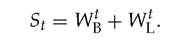
Let and W∣j denote the wealth of entrepreneurs and workers at the beginning of period (t + 1). Total savings from the previous period t is by definition equal to:
Total investment demand in the (high-yield) production activity by entrepreneurs, is equal to:


Moreover, in this AK model, the rate of return on the high-yield production technology remains equal to σι at all levels of investment.
Thus entrepreneurs who always seek to maximize their end-of-period wealth (which allows them to maximize consumption and savings), will try to invest up to their investment capacity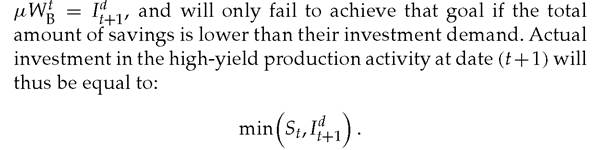 Consequently, investment in the low-yield (home) activity will be equal to the residual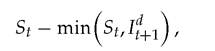
and in particular it will be positive only due to the limited borrowing capacity of entrepreneurs. In the absence of credit constraints, entrepreneurs would always be able to absorb the total amount of savings and thereby maximize their end-of-period revenues.
During periods when investment demand is higher than aggregate savings, all savings are invested in the high-yield production activity, so that the growth rate of the economy is the AK (or Harrod-Domar) rate, defined as the ratio between output in two successive periods4:
g = (1 - α)σ.
We refer to these periods as "booms." In contrast, during periods when investment demand is less than aggregate savings, the fraction,

of aggregate savings is invested in the low-yield activity at rate σ2 so that the growth rate is lower than g, equal to:

We refer to such periods as "slumps."
3.3