Comparison Between Alternative Seasonal Adjustments
When we deal with consumer data in general, we need to make seasonal adjustments. We used two main alternative methods of adjustments on our data. The first
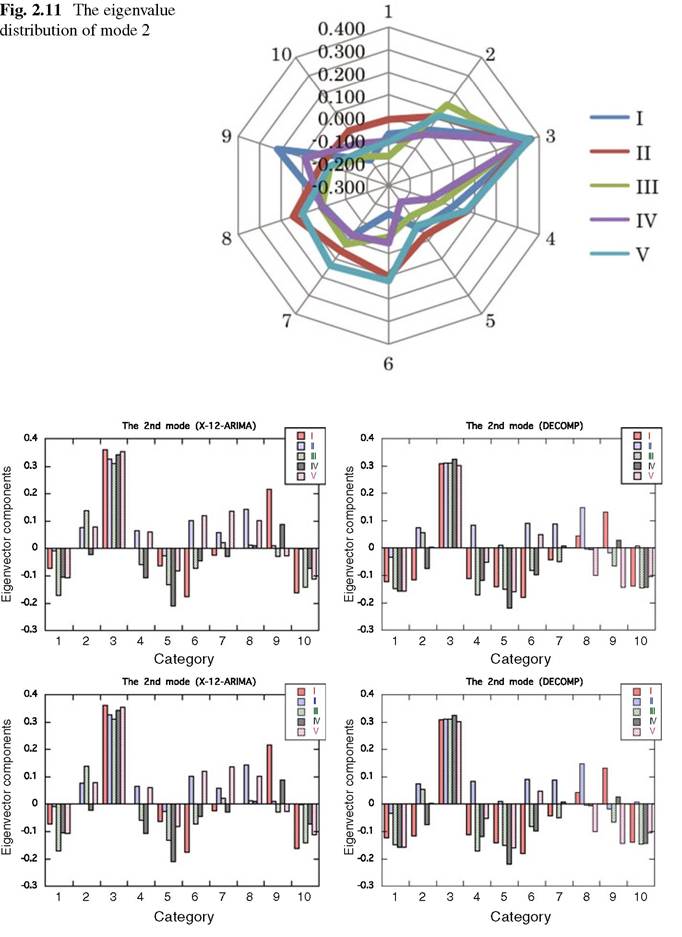
Fig.
2.12 Comparison between X-12-ARIMA and DECOMP
Table 2.4 Mode 1 (eigenvalue A1 = 4.24)
| I | II | III | IV | V | |
| 1 Food | 0.288 | 0.275 | 0.281 | 0.283 | 0.335 |
| 2 Housing | -0.069 | -0.070 | -0.024 | 0.034 | 0.018 |
| 3 Fuel, light and water charges | 0.088 | 0.193 | 0.189 | 0.161 | 0.128 |
| 4 Furniture and household utensils | 0.137 | 0.091 | 0.067 | 0.153 | 0.030 |
| 5 Clothing and footwear | 0.086 | 0.264 | 0.058 | 0.161 | 0.176 |
| 6 Medical care | 0.049 | -0.059 | 0.115 | 0.109 | -0.032 |
| 7 Transportation and communication | 0.098 | 0.083 | -0.056 | 0.169 | 0.005 |
| 8 Education | 0.005 | -0.088 | 0.035 | -0.160 | 0.071 |
| 9 Culture and recreation | 0.141 | 0.171 | 0.071 | 0.043 | 0.171 |
| 10 Other | -0.056 | 0.096 | 0.094 | -0.019 | 0.122 |
Note: The data used are from Jan 2000 to Feb 2012
Table 2.5 Mode 2 (eigenvalues A2 = 3.54)
| I | II | III | IV | V | |
| 1 Food | -0.073 | -0.009 | -0.171 | -0.104 | -0.108 |
| 2 Housing | 0.002 | 0.076 | 0.139 | -0.023 | 0.079 |
| 3 Fuel, light and water charges | 0.362 | 0.327 | 0.310 | 0.342 | 0.355 |
| 4 Furniture and household utensils | 0.000 | 0.065 | -0.058 | -0.106 | 0.061 |
| 5 Clothing and footwear | -0.064 | -0.027 | -0.133 | -0.210 | -0.081 |
| 6 Medical care | -0.175 | 0.102 | -0.073 | -0.046 | 0.121 |
| 7 Transportation and communication | -0.025 | 0.059 | 0.021 | -0.028 | 0.137 |
| 8 Education | 0.001 | 0.143 | 0.012 | 0.010 | 0.101 |
| 9 Culture and recreation | 0.217 | 0.010 | -0.028 | 0.089 | bgcolor=white>-0.026|
| 10 Other | -0.162 | -0.002 | -0.141 | -0.072 | -0.111 |
Note: The data used are from Jan 2000 to Feb 2012
was X-12-ARIMA,[35] developed and used by the U.S. Census Bureau.
It is also a standard seasonal adjustment method used by the Statistics Bureau in Japan. The X- 12-ARIMA program draws on experimental evidence, with a number of degrees of freedom for users to optimize the procedure. However, we allowed the program to determine a best-fit model by itself. The second was DECOMP,[36] developed by the Institute of Statistical Mathematics, Japan. The basis of the two is quite different. In our application, surprisingly, the derived results are very similar for the principal components, and show that the largest eigenvalue is dominated by FOOD, and the second by FUEL, LIGHT, & WATER. In other words, the first component is constructed by the explanatory category dominated by FOOD, and the second by the category dominated by FUEL, LIGHT & WATER. These results are shown diagrammatically in Fig. 2.12.2.4
More economic literature on Economics.Studio
More on the topic Comparison Between Alternative Seasonal Adjustments:
-
Distribution of productive forces -
Economic theory -
General economic issues -
History of economic scientists -
Macroeconomics -
World economy -
-
Conflictology -
Ecology -
Economy -
Finance -
History -
Law -
Medicine -
Philosophy -
Religious studies -