Country size and trade in history
To what extent the size of countries respond to the economic “incentives” that we discussed above? Is there a sense that in the long-run the size of countries responds to economic forces? Our answer is yes, even though, of course, the determination of borders is driven by a highly complex web of politico-economic forces.
The point of this section is simply to highlight the relationship between country size and trade in a brief historical excursion. We certainly we do not aim to discuss the entire history of state formation and their size. For a more extensive discussion we refer the reader to Alesina and Spolaore (2003), and to the voluminous literature cited therein.4.1. Thecity-states
The city-states of Italy and the Low Countries of the Renaissance in Europe represent a clear example of a political entity that could prosper even if very small because they were taking advantage of world markets. Free trade was the key to prosperity of these small states. A contemporary observer described Amsterdam as a place were “commerce is absolutely free, absolutely nothing is forbidden to merchants, they have no rule to follow but their own interest. So when an individual seems to do in his own commercial interest something contrary to the state the state turns a blind eye and pretends not to notice”.[369] The other reason why city-states could afford to be small is that the state did not provide many public goods, so that not much was lost in terms of tax burden from being small. Thus, the combination of a small states who provided very few public goods and complete freedom of trade allowed for the city state to reach unprecedented level of wealth based on trade.
4.2. Theabsolutistperiod
The emergence of centralized states from the consolidation of feudal manors was driven by three main forces. One is technological innovations in military technology that increased the benefits of scale in warfare.
Secondly, there was a need to enforce property rights and to create markets above and beyond the maritime commerce of the city-states. Finally bellicose rulers needed vast populations in order to extract levies to finance wars and luxurious courts. Territorial expansion and fiscal pressure went hand in hand and city-states could not survive in this changed world. Italian city-states lost predominance. The Low Countries survived longer because of their role as Atlantic traders. While the small city-states blossomed on trade, as Wilson (1967) writes regarding France “by the second half of the sixteenth century primitive ideas about trade had already given rise to a corpus of legislation... aimed at national self-sufficiency”. Similarly, English policy turned quite protectionist in the early seventeenth century. From the small and open city-states with low taxation, the western world became organized in large countries, pursuing inward looking policies. So economic predominance switched from small open economies with cheap governments to large relatively closed economies with a heavier burden of taxation to service war.Outside the core of Europe, absolutist regimes were based on heavy taxation raised without the parenthesis of city-states. This is the case, for instance of the Ottoman Empire, but also of India and China. The Ottoman Empire for instance, was largely based on extracting rents from its population. In India the level of taxation was extraordinarily high for that period. In the sixteenth century the estimated tax revenue of the central government was about 20% of GNP.
4.3. The birth of the modern nation-state
The nineteenth century marks the birth of the nation-state in modern forms, both in Europe and North America. It also marks the beginning of industrialization and the growth take-off, which likely transformed the relationship between country size and economic performance, raising the importance of scale effects. The liberal philosophers of these times viewed the “optimal size” of a nation-state as emerging from the trade-off between homogeneity of language and culture and the benefit of economic size.
In fact, following the work of Adam Smith, they were well aware that with free trade a market economy can easily prosper even without a heavy central government. Nevertheless, the view was that there existed an minimum size that made an economy viable. For instance, certain regions, like Belgium, Ireland and Portugal were considered too small to prosper, but free trade was regarded as a way of allowing even relatively small countries to prosper. Giuseppe Mazzini, an architect of the Italian unification, suggested that the optimal number of states in Europe was 12. His argument was precisely based on the consideration of a trade-off between the economically viable size of country and nationalistic aspiration of various groups. A famous political economy treaty of the time argues that it was “ridiculous” that Belgium and Portugal should be independent because there economies were too small to be economically viable.[370]The unification of Germany can in fact be viewed along similar lines. The German nation-state started as a customs union (the Zollverein) which was viewed as necessary to create a sufficiently large market. As Merriman (1996, p. 629) notes, before the customs union “German merchants and manufacturers began to object to the discouraging complexity of custom tariffs that created a series of costly hurdles... many businessmen demanded an end to these unnatural impediments faced by neither of their French or British rivals”. Clearly market size was a critical determinant of the birth of Germany. The external threat of a war with France was a second one, as emphasized by Riker (1964). The establishment of a common market free of trade barriers was also one of the motivating factor behind the creation of the United States.
4.4. The colonial empires
In the period between 1848 and early 1870's the share of international trade in GDP quadrupled in Europe.[371] From 1870 to the First World War trade grew much more slowly despite a drastic reduction of transportation costs, as documented in Estevadeordal, Frantz and Taylor (2003).
In fact the extent of the reduction of trade amongst European powers in the half-century between 1870 and 1915 is a matter of dispute amongst historians. Bairoch (1989) has probably the most sanguine view on one side of the argument when he writes that the introduction of new large tariff by Germany in 1879 marks the “death” of free trade. While many historians may find this view a bit extreme, it is fairly noncontroversial that without the sharp reduction in trading costs international trade would have probably greatly suffered in this period, which was certainly associated with an increase in protectionism.The last two decades of the nineteenth century witnessed the expansion of European (and North American) powers over much of the “less developed” world. One motivation of this expansionary policy was certainly the opening of new markets. As reported by Hobsbawm (1987, p. 67), in 1897 the British Prime Minister told the French ambassador to Britain that “if you [the French] were not such persistent protectionists, you would not find us so keen to annex new territories”. Needless to say, the British were just as protectionist as the French and the British navy was heavily used to protect trade routes. Similar considerations apply to the expansionary acquisitions of the United States in the late nineteenth and early twentieth centuries, namely Alaska, Hawaii, Samoa, Cuba and the Philippines. At the same time, in response to European protectionism, the United States also turned protectionist in this period.
In summary, from the point of view of the colonizers, Empires were a brilliant solution to the trade-off between size and heterogeneity. Large empire guaranteed large markets, especially necessary when protectionism was on the rise, but at the same time, by not granting citizenship to the inhabitants of the colonies, the problem of having a heterogeneous population with full political rights was reduced.
4.5. Borders in the interwar period
Figure 1 shows all the countries created and eliminated in five years periods from 1870 until today.[372] The dip at the beginning of the figures highlights the unification of Germany.
This figure shows that in the interwar period after the Treaty of Versailles, borders remained essentially frozen, despite the fact that many nationalistic aspiration had been left unanswered by the peace treaty. In fact, a common view amongst historians is that the Treaty of Versailles vastly mishandled the border issue. Nevertheless, borders remained virtually unchanged, in a period in which free trade collapsed. No decolonization occurred. Amongst the new country creations, at least one, Egypt (independent in 1922) is merely an issue of classification: it was largely independent from Britain, but its status switched from a protectorate to a semi-independent country. Leaving aside the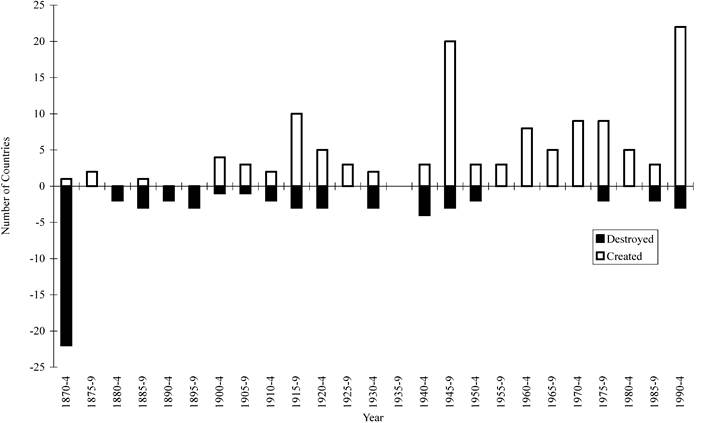
Figure 1. Countries created and destroyed (5-year periods, excludes Sub-Saharan Africa).
Vatican City, the only other countries created between 1920 and the Second World War were Ireland (1921), Mongolia (1921), Iraq (1932), and Saudi Arabia (1932).
The interwar period was characterized by a collapse of free trade, the emergence of dictatorships, and by a belligerent state of international relationships. The Great Depression completed the gloomy picture and precipitated the rise of protectionism. These are all factors that, according to our analysis, should not be associated with the creation of new countries, in fulfillment of nationalistic aspirations. In addition, these elements (lack of democracy, international conflicts, protectionism) would make colonial powers hold on to their empires and repress independent movements. In fact, all the colonial powers were adamant in refusing self-determination of colonies during this period. This combinations of events, protectionism and maintenance of large countries and empire, stands in sharp contrast with what happened in the aftermath of the Second World War.
4.5. Borders in the post-Second World War period
In the fifty years that followed the Second World War, the number of independent countries increased dramatically.
There were 74 countries in 1948, 89 in 1950, and 193 in 2001. The world now comprises a large number of relatively small countries: in 1995, 87 of the countries in the world had a population of less than 5 million, 58 had a population of less than 2.5 million, and 35 less than 500 thousands. In the same 50 years, the share of international trade in world GDP increased dramatically. The volume of imports and exports in a sample of about 60 countries has risen by about 40 percent.We should stress that the increase in international trade in the last half-century, as documented in Figure 2, is not the simple result of an accounting illusion. In fact, if
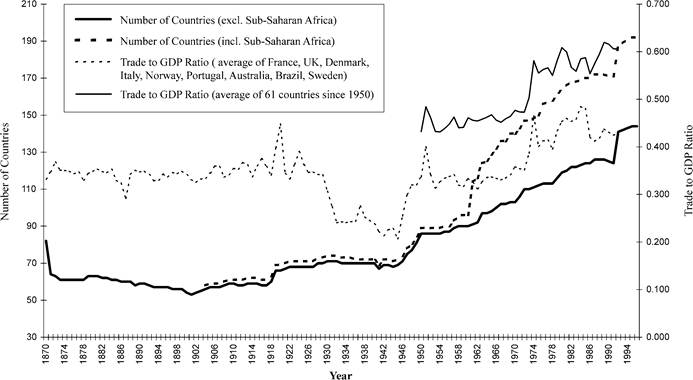
Figure 2. Trade openness and the number of countries.
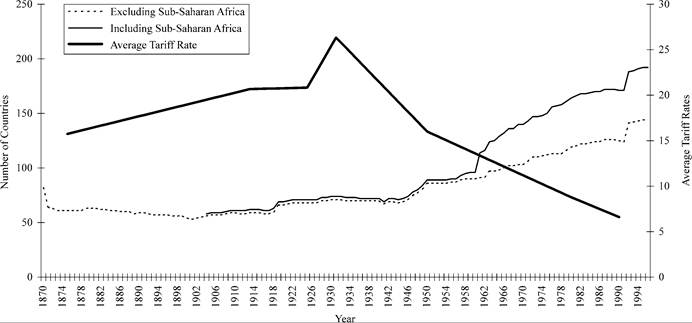
Figure 3. Average tariff rate and the number of countries (unweighted country average of average tariff rate for Austria, Belgium, France, Germany, Sweden, USA).
two countries were to split, their resulting trade to GDP ratios would automatically increase, as former domestic trade is now counted as international trade. But Figure 2 only features the average trade to GDP ratio for a set of countries whose borders did not change since 1870. Furthermore, Figure 3 uses average tariffs on foreign trade for a selection of countries with available data, a more direct reflection of trade policy, to display a similar historical pattern. Obviously, such policy measures are not subject to the accounting illusion either.
The correlation between the number of countries and trade liberalization is captured by Figures 4 and 5 which plot the detrended number of independent countries against the detrended trade to GDP ratio, including Sub-Saharan Africa from 1903 onward, and without it from 1870 to 1905.[373] In both cases the correlation is very strong. Since both variables are detrended, this positive correlation is not simply due to the fact that both variables increase over time. In Figure 2, note the sharp drop in the number of countries between 1870 and 1871, due to the unification of Germany. While 1871 is on the “regression line”, 1870 is well above it, suggesting that there were “too many” countries before the German unification, relative to the average level of openness.
Not only have the recent decades witnessed an increase in the number of countries, but many regions have demanded and often obtained more autonomy from their central governments. In fact, decentralization is very popular around the world. The case of Quebec is especially interesting. The push for independence in Quebec was revamped by the implementation of the North American Free Trade Agreement (NAFTA). The freer trade in North America, the easier it would be for a relatively small country, like Quebec, to prosper. As we discussed above, at least for Canada, national borders still
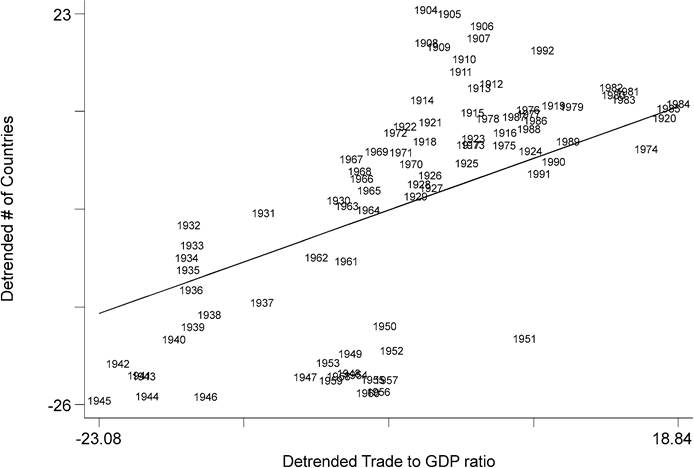
Figure 4. Scatterplot of the detrended number of countries plotted against the detrended trade to GDP ratio (with Sub-Saharan Africa - 1903-1992).
matter, so that trade among Canadian provinces is much easier than trade between Canadian provinces and U.S. states. As shown by McCallum (1995), two distant Canadian provinces trade much more with each other than U.S. states and Canadian provinces bordering each other, even though distance is a strong determinant of trade flows. This implies that there might be a cost for Quebec in terms of trade flows if it were to become independent and such arguments were made by the proponents of the “no” in the selfdetermination referendum of 1996. As the perceived economic costs of secession fall with greater North American economic integration, the likelihood of Quebec gaining independence can be expected to increase. In fact, the development of a true free-trade area in North America might reduce these costs and make Quebec separatism more attractive.
4.6. The European Union
Fifteen European countries have created a union which has several supranational institutions, such as the Parliament, a Court system, a Commission and a Council of Ministers and have delegated to them substantial policy prerogatives. We have argued that more economic integration should have lead towards political separatism. How does the European Union “fit” into this picture?
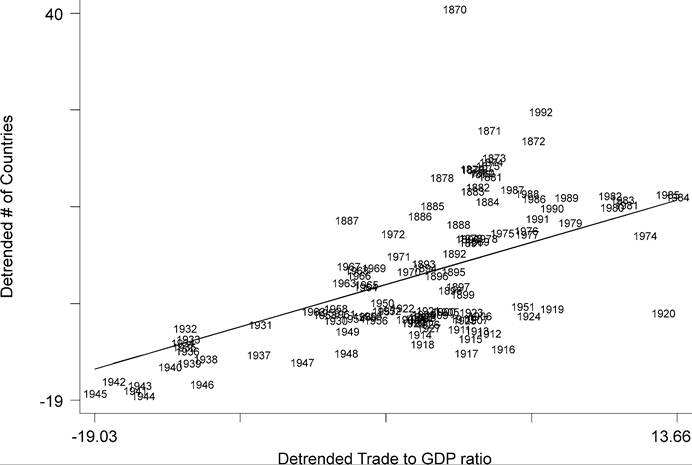
Figure 5. Scatterplot of the detrended number of countries plotted against the detrended trade to GDP ratio (with Sub-Saharan Africa - 1870-1992).
First of all, the European Union is not a state, not even a federation since it does not have the critical determinant of what a state is: the monopoly of coercion over its citizens. Thus, the European Union does not satisfy the Weberian notion of what constitutes a “sovereign state”. The newly proposed draft Constitution for Europe states clearly in its article 2 that the European Union is indeed a union of independent countries and not a Federal State. Secondly, as economic integration is progressing at the European level, regional separatism is more and more vocal in several member countries of the Union, such as the U.K., Spain, Belgium, Italy and even France. So much so, that many have argued that Europe will (and, perhaps should) become a collection of regions (Brittany, the Basque Region, Scotland, Catalonia, Wales, Bavaria, etc.) loosely connected within a European confederation of independent regions. In fact, ethnic and cultural minorities feel that they would be economically “viable” in the context of a truly European common market, thus they could “safely” separate from the home country. This argument is often mentioned in the press. For an example pertaining to Scotland, see the Financial Times, September 16, 1998:.. the existence of the European Union lowers the cost of independence for small countries by providing them with a free trade area... and by creating a common currency which will relieve the Scots of the need to create one for themselves”.
One way of thinking about the EU is as a supranational union of countries that have merged certain functions needed to guarantee the functioning of a common market and take advantage of economies of scale. Whether or not the attribution of responsibilities and policy prerogatives between the EU and the national government is appropriate or not is an intricate subject which is beyond the scope of this paper.[374]
5.