Exporting inequality: Spillovers between social contracts
The model also allows us to think about spillovers between national policies or institutions, operating via technological and organizational diffusion. The basic idea is illustrated in Figure 7, which shows how the social contract in Country 2 can, over time, be affected by technological or even purely political shifts in Country 1, propagated along the channels indicated by the solid lines on the diagram.
As seen in the previous section, firms operating in countries with more laissez-faire fiscal, educational or labor market policies have greater incentives to develop and adopt low-complementarity production processes. Suppose now that the cost of imitating, adapting or copying a more flexible technology or organizational form, once it has been developed and implemented elsewhere, is lower than the cost of innovation; in terms of the model, it is m < M. This lower marginal cost may for instance reflect, as in Acemoglu (1998), an imperfect international enforcement of property rights over technological or organizational innovations. As we shall see, redistributive institutions in one country will then be significantly affected, perhaps even completely undermined, by technological or political changes occurring in another.[401]
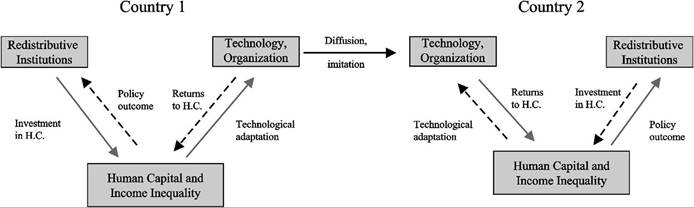
Figure 7. International spillovers between social contracts.
5.1. A shift in one country’s technological frontier
I shall focus here on parameter configurations that satisfy the following conditions:

which imply in particular that M > M' > m.As shown as part of Proposition 10, these conditions also ensure that the technology oL allows for both social contracts τ and τ, and conversely that oL is an equilibrium technology under both social contracts (no firm wants to switch to oH).
Proposition 10. Assume that conditions (45)-(47) are satisfied, and consider two countries, Ci and C2, that both start in steady state, with the same technology of. Suppose now that the cost of flexibility in country Ci declines from M to M'.
(1) If both Ci and C2 were initially in the more egalitarian of the two regimes compatible with of nothing happens, in the sense that (τ, yl, D(τ, yl)) remains a stable steady state for both countries.
(2) If C1 was initially in the more inegalitarian regime (τ, Yl, D(τ, Yl)), the long run outcome is for both countries to switch to the technology oh, and for country C2 to also adopt the more unequal social contract τ: the unique steady state for the two countries is now (τ, yh, D(τ, Yh)).
The intuition is as follows. Even as M declines to M', firms faced with the skill distribution D(τ,yl) resulting from τ do not find it profitable to switch technology. Given the higher dispersion D( r_, γf) that prevails under τ, however, if country C1 starts in this regime all firms there will eventually switch to technology oH.[402] Next, given the lower cost of flexibility m to which firms in C2 now have access through imitation, oL is no longer viable there even under τ. And, in turn, with the higher income inequality that results in the long run from technology oH, the only politically sustainable social contract is τ.
These results make clear how technological change (a shift in the frontier) has significant effects only when it is mediated through specific institutions - namely, which social contract C1 had adopted; and, conversely, how under such conditions it will then affect institutions in other countries, namely here in C2.
5.2. A shift in one country’s political institutions
I consider now a second scenario, namely the transmission of a political shock.
Having seen earlier how the mere fact of being in different institutional steady states (say, for historical reasons) can lead to very different technological trajectories, I shall assume here that C1 and C2 both start in the egalitarian steady state (τ, yl, D(τ, yl)), with the same technology ol. Let C1 now experience an increase in the political influence of wealth, from λ to λ'. This may reflect a rising importance of lobbying and campaign contributions, an exogenous decline in unionization, or a lower electoral turnout by the poor. It may even simply represent the political outcome during a particular period in which the electorate stochastically shifted to the right.[403] I shall assume here the following conditions:I
I
Proposition 11. Assume that conditions (48) and (49) are satisfied. Consider two countries, C1 and C2, that both start in the egalitarian steady state, (τ, yl, D(τ, Yl)), with the same technology σL. Suppose now that the political influence of wealth in country C1 rises from λ to λ'. The unique long run outcome is for both countries to switch to the technology σ∏ and the more unequal social contract τ, thus ending up at the steady state ( τ, Yh, D(τ~, Yh)).
As a result of the initial political shift, redistribution τ1 (fiscal, educational, or via labor-market institutions) in country C1 declines. This leads over time to a rise in human capital inequality ∆1, to which firms respond by adopting more flexible, wage- disequalizing technologies, switching from σL to σH and further precipitating the shift from τ to τ. Their counterparts in C2, which would not have developed such technologies by themselves, now find it profitable to copy them from C1. This results in a rise in income inequality γ2∆2 in C2 (and, over time, in human-capital inequality ∆2 itself) that ultimately leads to the unraveling of the Welfare State in that country as well.
6.