Endogenous institutions and endogenous technology
Combining the main mechanisms analyzed in previous sections yields a model where the distribution of human capital, the technologies used by firms and the policy implemented by the state are all endogenous - as they are in reality.
The dynamical system governing the economy’s evolution remains recursive: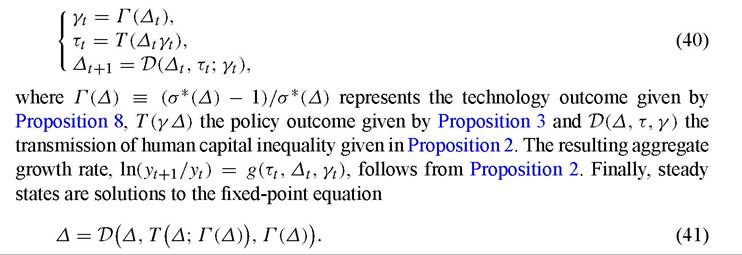
This structure makes clear the presence of important multiplier effects: a transitory shock affecting inequality (e.g., more idiosyncratic uncertainty v2) or the political system (a higher λ) will be amplified through technology decisions, the policy choice, and the intergenerational transmission mechanism, and may thus have considerable longterm consequences.44 Most importantly, in accounting for changes in inequality one can no longer treat technological and institutional factors as separate, competing explanations: both are jointly determined, and complementary. The model thus shows how, in the words of Freeman (1995), one needs to think of “the Welfare State as a system'”.
To demonstrate these points I shall assume from here on a piecewise-linear technological frontier. Flexibility is free up to cl, then has a marginal cost of M > 0, up to a maximum level ch > cl,
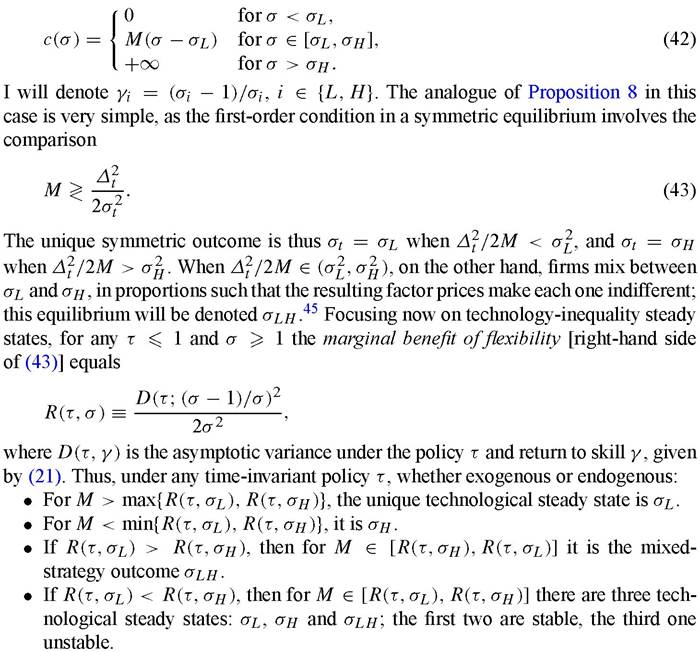
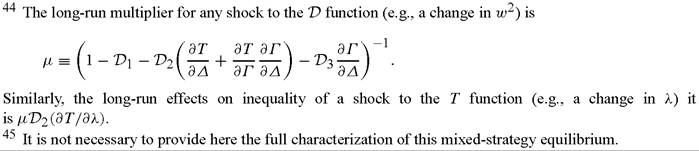
Furthermore, since R(τ, σ) is decreasing in τ, we have the proposition.
Proposition 9. More skill-biased technologies appear first in, and less skill biased technologies disappear first from, countries that have less redistributive fiscal, educational or labor market institutions. For any M > 0:
(1) If σ∏ is a steady-state equilibrium technology under a constant redistributive policy τ, this remains true under any less progressive policy τ' < τ.
(2) If σ^ is a steady-state equilibrium technology under a constant redistributive policy τ', this remains true under any more progressive policy τ > τ'.
These results are illustrated in Figures 5 and 6 for two cases where: (i) R( r_, σ∏) < R(τ, σb), implying that for each M there is a unique technology compatible in the long-run with each policy τ ∈ {τ, τ};46 (ii) R( r_, aL) < R(τ,oh), implying that for either policy τ ∈ {τ, τ} there is a range of M’s where multiple technologies are sustainable. The message is essentially the same in both cases, showing how a world-wide shift in the set of feasible technologies can result in different evolutions of both production processes and the skill premium across countries. in particular, the model can help explain why skill-biased technical change and reorganization occurred first, and to a greater extent, in the United States compared to Europe - and within Europe, more so in England than on the Continent.47
Indeed, consider two countries, C1 and C2, that are initially identical in all respects, including both using the technology σc, except that one is in a laissez-faire equilibrium, τ = τ, and the other in a welfare state, τ = τ. Suppose now that the technological frontier gradually flattens (M declines), meaning that flexibility becomes cheaper to achieve. As shown on Figures 5 and 6, the more skill-biased technology σ∏ becomes (all or part of) another feasible equilibrium in C1 before it does in C2; similarly, σc first ceases to be viable (by itself or as part of a mixed equilibrium) in the laissez-faire country, while it is still sustainable in the more redistributive one.
Going further, there are in fact reciprocal interactions between the economy’s technology response and policy response to shocks. Proposition 9 and Figures 5 and 6 show  through which the wage-compression policies of continental European countries may have caused technological progress there to be less skill-biased than in the United States.
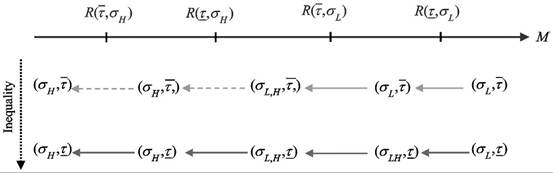
Figure 5. The response of technology and policy to a decline in the cost of flexibility [case (i)]. Under each range of M appears the unique (σ, τ) suchthat (σ,∆ = D(τ; 1 — 1∕σ)) isa stable steady state given τ and M. The subset reached via solid lines corresponds to the stable steady states in (σ, ∆, τ) jointly, when policy is endogenous as well.
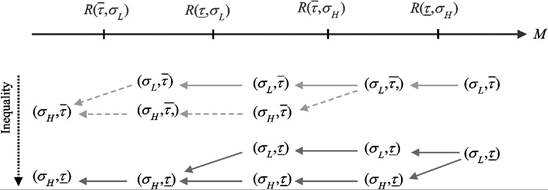
Figure 6. The response of technology and policy to a decline in the cost of flexibility [case (ii)]. Under each range of M appear the values of (σ, τ) such that (σ,∆ = D(τ; 1 — 1∕σ)) is a stable steady state given τ and M. The subset reached via solid lines corresponds to the stable steady states in (σ, ∆, τ) jointly, when policy is endogenous as well.
that feasible new technologies are not implemented unless institutions are sufficiently inegalitarian. But, conversely, the occurrence of technical change alters these same institutions, as seen in Proposition 7.
Indeed, suppose that
where λ and λ were defined in (22) and (23). These inequalities imply that: (i) under the technology aL, both social contracts τ and τ are political steady states; (ii) under σ∏, τ is a political steady state, while τ is one if and only if we also have λ < λ (γ∏; B).
When this last inequality holds, the set of stable politico-economico-technological steady states (with endogenous τ, ∆ and σ) is the same as described on Figures 5 and 6. When λ > λ(yh ; B), however, the more redistributive social contract τ is not politically sustainable under the amount of inequality that results, in the long run, from the technology σ∏. Therefore one must remove from the set of steady states on each figure the “branches” corresponding to this outcome; these are indicated by the dashed lines. The remaining solid lines then indicate that only certain politico-technological configurations can be observed in the long run: (a) for low values of M, e.g. for M < R(τ,aL) on the first figure, the only feasible social contract is τ, together with the technology σ∏;
(b) on the secondfigure, for M ∈ (R(τ,σL),R(τ~, ol)) only the egalitarian social contract and the egalitarian technology, or the inegalitarian social contract and inegalitarian technology, are mutually compatible.
5.