Technology and the social contract
I shall now extend the model to analyze how technology and redistributive institutions both affect inequality and respond to it, and consequently how they influence each other - as described on Figure 1.
Of particular interest are the following questions. First, how does technical change impact the sustainability of welfare-state and laissez- faire social contracts? Second, what types of societies are likely to be leaders or early adopters in developing or implementing flexible, skill-biased technologies or organizational forms? More generally, how do the skill distribution among workers and the production side of the economy shape each other, through human capital investments and technology choices? Finally, what happens in the long run when technological and institutional factors evolve interdependently - within a country, and possibly even across countries?3.1. Exogenous technical change and the viability of the welfare state
I first examine here how technical or organizational change that increases the return to human capital affects redistributive institutions. This policy response represents an additional channel through which technological evolutions affect the income distribution, in addition to their direct impact via the wage structure.
Figure 3 illustrates the effects of an increase in γ, the coefficient on human capital in the production and earnings function (1). As will from now on be made explicit in the notation, this affects both of the key curves describing the inequality-redistribution nexus:
(i) The intergenerational-transmission locus ∆ = D(τ; γ) shifts up, and becomes less steep: for any given human capital inequality ∆t and policy τ there is more inequality in incomes γ∆t, hence also in investments, and consequently more inequality of human capital (and of course income) in all subsequent periods.29
(ii) The policy locus τ = T(γ∆) shifts down over [0, ∆ ), and up over (∆, +∞): since what matters for the political outcome is income inequality γ∆ [see (17)], an increase in γ for given ∆ has the same U-shaped effect on redistribution as an increase in ∆ for given γ - initially lowering τ, then raising it.
Figure 3 directly yields a local analysis of the more egalitarian, welfare-state equilibrium - and more generally, of any steady state that occurs along the declining portion of the T locus.30
1
l t
j j l
i
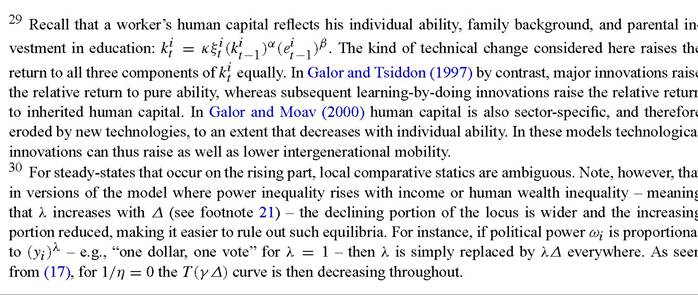
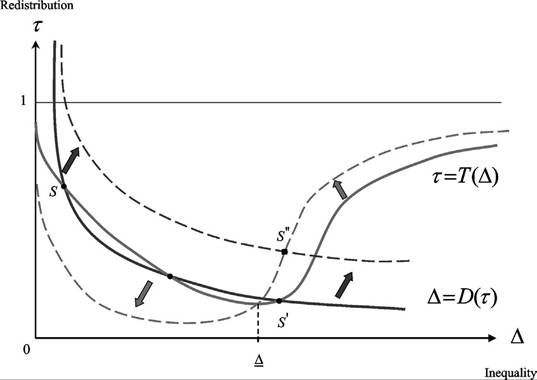
Figure 3. The effects of an increase in the returns to human capital, γ = (σ — 1)∕σ.

The policy response thus amplifies the direct effect of skill-biased technical progress on disposable incomes - and, over time, on the distributions of human capital and earnings. Figure 3 also suggests that it can have, in the long run, much more drastic consequences for redistributive institutions: starting from a situation with multiple steady states, an increase in γ tends to undermine the sustainability of the “WelfareState” equilibrium. Similarly, we shall see that starting from a configuration with a single “Welfare-State” it can make a second, “Laissez-Faire” equilibrium appear. Such a global analysis is potentially quite complicated, however, since in general there may be more than two stable equilibria, and some may also occur in the upward-sloping portion of the τ = T(γ∆) locus, where the policy response has a dampening rather than an amplifying effect on inequality. To demonstrate the most interesting insights, I shall therefore impose some simplifying assumptions. First, I restrict voters to a choice between only two policies:
• A generous “Welfare State” social contract, corresponding to a relatively high rate of redistribution τ ∈ (0, 1).
• A more “Laissez Faire” social contract, corresponding to a relatively low rate of redistribution τ ∈ (0, τ).
Once again, τ can be interpreted as corresponding to either fiscal redistribution, wage compression through labor market regulation, or education finance progressivity.
To further simplify the problem I abstract from labor supply distortions (1∕η = 0) and assume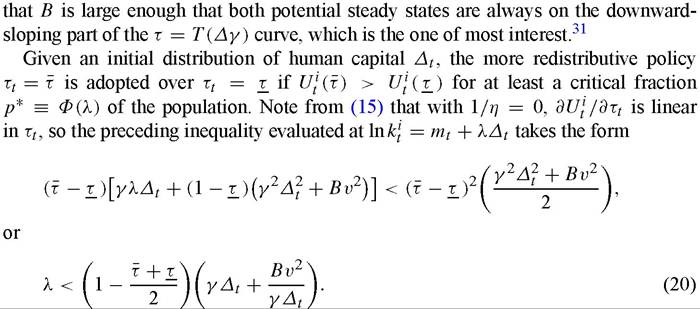
We first see that the political influence of wealth must not be too large, compared to the aggregate welfare gain from redistribution relative to laissez faire (net of the deadweight loss, which I am here abstracting from). Second, preexisting income inequality raises the hurdle that public policy must overcome, as the ex-ante benefit term Bv2 is divided by γ∆t. This effect impedes the adoption of more redistributive institutions (τ = τ) where they had not previously been in place, because of the greater divergence of interests that results over time from a more laissez-faire system (τ = τ). Pushing in the other direction - namely, intensifying the demand for redistribution as inequality rises - are the effects of skewness and initial credit-constraints, reflected in the additive term γ∆t. As a result of these offsetting forces, the right-hand side of (20) is U-shaped in γ∆t.To focus on the long-run, let us now replace human capital inequality ∆t with its asymptotic value under a technology γ and a constant policy τ - namely, by (11),

which is the long-run inequality in human capital resulting from a constant policy τ and technology γ. Given γ, the policy-inequality pair (τ, D(τ, γ)) is thus a politico- economic steady state if

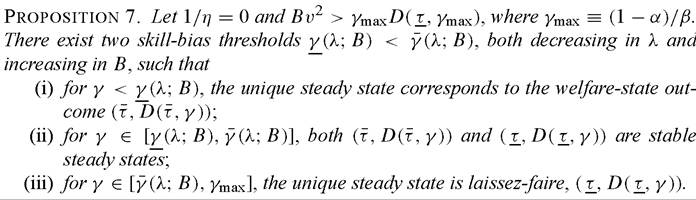
31 The required condition appears in Proposition 7. It is thus not inevitably the case that skill-biased technical progress leads to a retrenchment of redistributive institutions; the model allows for the reverse case, for steadystates that occur on the rising part of the T locus.
The case on which I focus, however, appears to be the most relevant for recent trends, and in any case is the more robust, since: (i) when multiple steady states exist, there is always at least one the declining part; (ii) in simple and plausible variants of the model, the T locus is decreasing throughout (see footnote 30).Conversely, the laissez-faire configuration (r_, D( r_, γ)) is a politico-economic steady state given γ if
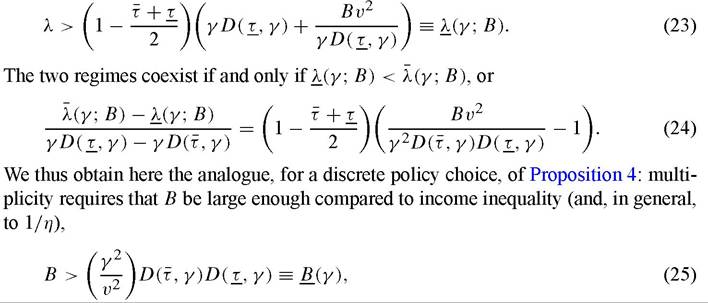
and that the wealth bias λ be neither too high nor too low, given the technology γ: λ ∈ [λ, λ], defined by (22)-(23).32 Now, furthermore, we shall see that (under appropriate conditions) the skill bias γ must also be neither too high nor too low, given λ. This result is illustrated in Figure 4.
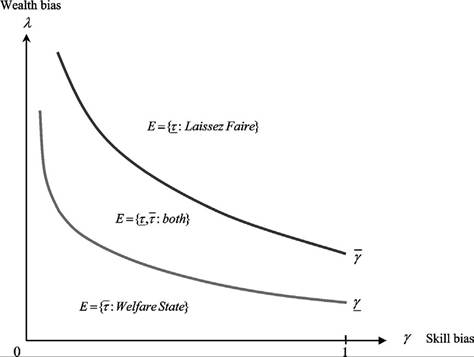
Figure 4. Technology, political influence, and the social contract. E denotes the set of stable steady-states.
32 Note also that as B increases both λ and λ rise, but (24) shows that the interval [ λ, λ] widens. When (25) does not hold, on the other hand, we have λ < λ. For λ ∈ [λ, λ ] there is a unique steady state, but for λ ∈ [λ,λ ] the economy can instead be shown to cycle between the two regimes, as in Gradstein and Justman (1997). This feature reflects the restriction of policy to a binary choice.
 I
I
These results have a number of important implications.
First, they confirm that the Welfare State becomes unsustainable when technology becomes too skill-biased; and, conversely, that multiple social contracts can coexist only when γ is in some intermediate range.[396] We see here again at work the general insight that sources of heterogeneity that are predictable on the basis of initial endowments - a greater variance of abilities w2, as discussed earlier, or greater skill bias γ, as here - push equilibrium institutions towards less redistribution.
Second, Proposition 7 also reveals interesting interactions between the production and political '“technologies'”. As seen on Figure 4, in a country with relatively little wealth bias the welfare state is - for better of for worse - much more “immune” to skill- biased technical change than in one where λ is high. Similarly, a given change in the political system will have very different effects on redistributive institutions, depending on how skill-biased the technology is. Finally, the “surest way” to set out on a course of persistently high inequality and inefficiently regressive (or insufficiently progressive) institutions is to start out with both a production structure that generates high wage inequality, and a political system marked by a high degree of bias. As demonstrated by Engerman and Sokoloff (1997), such were the initial conditions found in the plantationbased and natural-resource based colonies of Central and South America in the 16th and 17th centuries - in contrast to those of North America, where agriculture was not subject to significant increasing returns to scale and initial institutions were much less oligarchic.
Third, our result can also be related to that of Acemoglu, Aghion and Violante (2001), who show that skill-biased technical progress may cause a decline in unionization. While their model is quite different, it shares the two key features emphasized in previous sections. First, relatively rich agents - namely skilled workers - are pivotal, in the sense that it is their willingness to leave or avoid the unionized sector that limits the extent of wage compression. Second, in making this mobility decision - voting with their feet - they trade off redistributive losses (unions redistribute towards unskilled workers, who are a majority in the unionized sector) against ex-ante efficiency benefits: unions provide insurance through wage-sharing and/or a safeguard against the “holdup” by firms of workers’ specific human capital investments; even when they play no such role, leaving the unionized sector involves mobility costs.
Consequently, when skill- biased technical change makes the interests of the two classes of workers too divergent, redistributive institutions - here, union participation - will decline. Moreover, this can happen inefficiently.[397] [398]3.2. Skills, Ieehnologyandineomeinequality
I now turn to the reverse mechanism and examine how inequality itselffeeds back onto the nature of technical change, making γ endogenous. Recognizing that individuals do not produce in isolation, I model production interactions with a simple specialization structure where workers perform complementary tasks.35 Final output is produced by competitive firms, using a continuum of differentiated intermediate inputs

where xt(s) denotes the quantity of input s, zt(s) an i.i.d. sectoral shock, and At a TFP parameter. Workers specialize in a single good, which they produce using their human capital and labor. Since they face downward-sloping demand curves each selects a different task, s(i) — i, and produces xlt — kltllt units, where Γt is endogenously chosen. The unit price for his output is thus
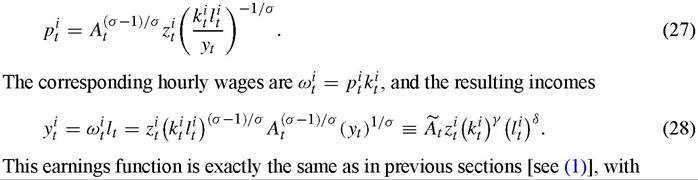
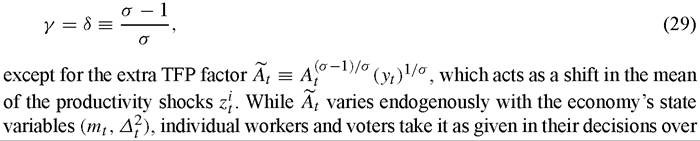
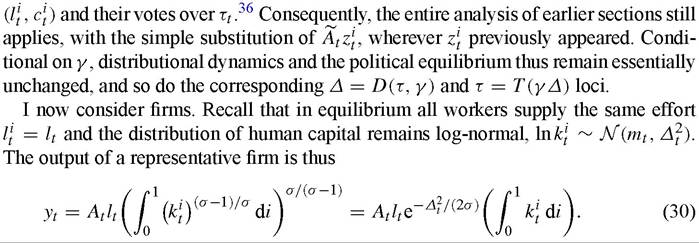
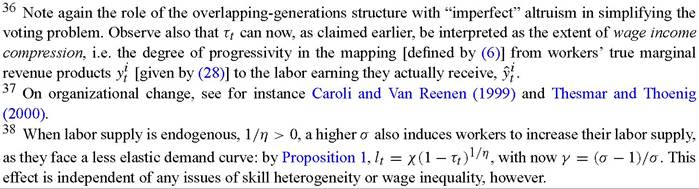
Keeping average human capital constant, the loss e-^/^) makes apparent the productivity costs imposed by (excessive) heterogeneity of the labor force: poorly educated, insufficiently skilled production and clerical workers drag down the productivity of engineers, managers, scientists, etc. We also see that a production technology with greater substitutability between the tasks performed by different types of workers reduces these costs of skill disparities [Benabou (1996a), Grossman and Maggi (2000)]. Indeed, this greater flexibility allows firms to more easily substitute towards the more productive workers, and correspondingly reduce their dependence on low-skill labor. This may be achieved by internal retooling, reorganization, or by outsourcing certain activities to competitive subcontractors.37 One can also think of a higher σ as a more discriminating search technology, resulting in more assortative matching between workers - that is, in a more segregated production structure [Kremer and Maskin (1996, 2003)].38
Naturally, production processes with less complementarity between workers of different skills result in greater inequality of wages and incomes, as they have the effect of uncoupling their marginal products,

3.3. Technological choice and endogenous flexibility
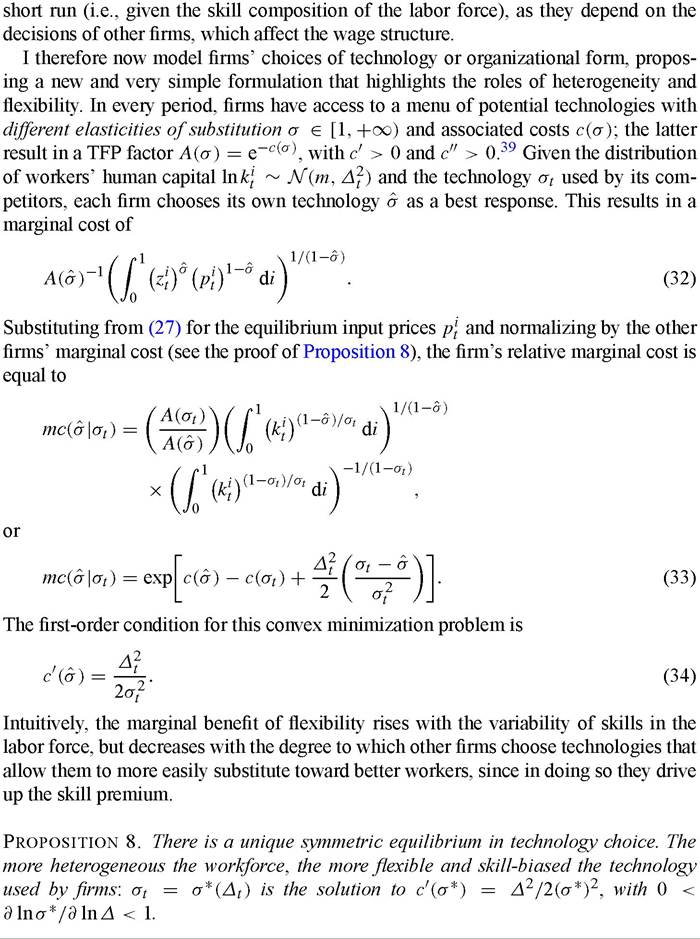
More flexible technologies and production processes require costly investments or reorganizations. Moreover, their benefits to an individual firm are endogenous even in the
[1] I thus abstract here from the intertemporal (investment) aspects of innovation that would be part of a more complete (but also more complicated) model of technological change; see, e.g., Acemoglu (1998), Kiley (1999), Lloyd-Ellis (1999) or Aghion (2002).
This result has several interesting implications.
A first one is the magnification of wage inequality: the return to human capital ∂ ln ωlt∕∂ ln klt = (σt - 1)∕σt is higher where the labor force is more heterogeneous, further amplifying wage differentials across educational levels. This simple prediction could be tested empirically across countries and/or time periods.[399]
A second implication is the potential for “immiserizing technological choices'”. Proposition 8 states that σ increases with ∆; conversely, because of credit constraints, human capital heterogeneity itself rises over time with γ = (σ — 1)∕σ, and in the long run ∆ = D(τ,γ), which is increasing in γ. Could these two mechanisms reinforce each other to the point of resulting in multiple steady states even under a fixed policy - whether activist or laissez-faire - and even though, once again, there are no nonconvexities in the model? The idea is that a high degree of skill bias results in very low wages for unskilled workers, severely limiting the extent to which they can invest in human capital (for themselves or their children). This, in turn, leads firms to again choose a very flexible, skill-biased technology in the next period, and so on. Conversely, a less skilled-biased technology and a less dispersed distribution of human wealth could be self-sustaining. To examine this possibility, note first that
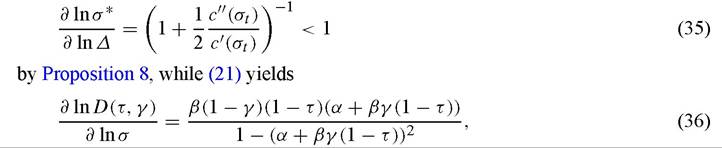
where, as usual, γ = (σ — 1)∕σ.Ifthe product of these two derivatives is everywhere less than 1, there is a unique equilibrium. If it exceeds 1 for some value of σ,on the other hand, there may be multiplicity. It is easily verified that ∂D(τ, γ)∕∂ lnσ < 1 if and only if

The first term is always less than one (or else inequality explodes; moreover, this can never occur when τ is endogenously chosen), but the second need not be, especially if τ < 0. We can thus conclude that the kind of '“technology-inequality trap” described above becomes a real possibility under regressive or insufficiently progressive policies. In particular, education systems that result in significant resource disparities between students, such as private financing or local (property-tax based) school funding as in the United States, are fertile ground for the joint emergence of highly skill-biased production processes and a persistently skewed skill distribution. Furthermore, as we shall see further, endogenizing τ only increases the likelihood of such outcomes, since the degree of redistribution tends to fall with inequality.
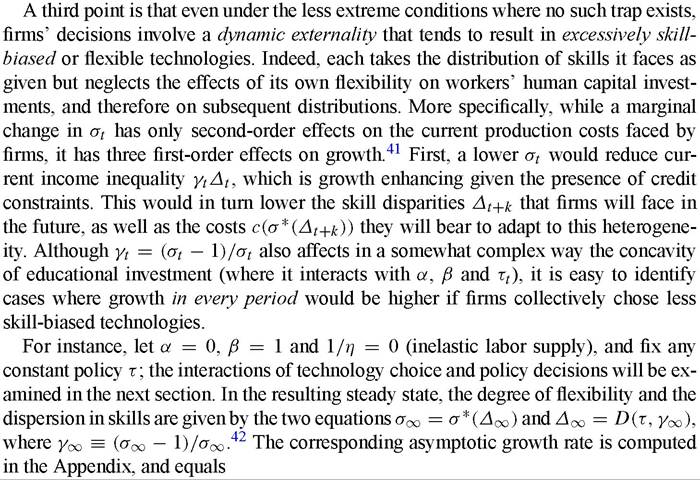
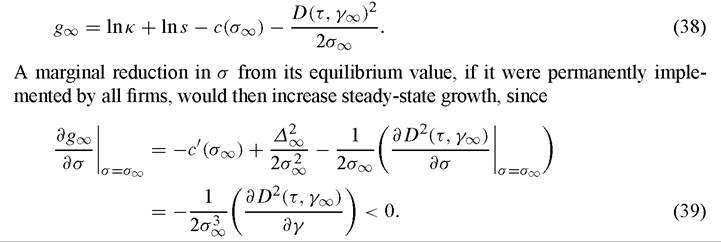
In this expression the first two terms cancel out by the first-order condition (34), while the last one reflects the dynamic externality. The above result holds more generally for any equilibrium path that is either near the steady state, or such that σt converges to its long-run value from above (see the Appendix).

Inefficient choices of technology or firm organization arise in a number of models where market imperfections create an excessive role for the distribution of financial or human wealth to shape the structure of production, with the result of exacerbating inequality and making it more persistent. In Banerjee and Newman (1993) and Legros and Newman (1996), for instance, the moral-hazard problem affecting entrepreneurship combines with an unequal wealth distribution in forcing too many agents to work for low wages in large firms, rather than setting up their own. In Vindigni (2002) an extreme example of the technology trap studied above occurs, as firms’ decisions (choosing the arrival rate of exogenously skill-biased innovations) can permanently confine some dynasties of workers below the fixed income threshold required to invest in human capital.[400] In Grossman (2004), a high variance of human capital in the labor force increases the incentives of the most skilled agents to work in sectors where individual productivity is observable, rather than in those where output is team-determined; because they fail to internalize the spillovers they would have on team productivity, the resulting occupational segregation is inefficiently high.
4.