A general concept of an economic system
Even in primitive and undifferentiated societies human life manifests in activities - actions - of different kinds: familiar, ecclesiastical, agricultural, educational, artisanal, political, artistic, and so on.
The realization of these activities requires inputs - goods and labor services - whose production requires skills and specialized capabilities. Human activities are carried out in economics units, which can be production units or households, being the case that there may be overlapping A general concept of an economy 83 among these. An economic unit is self-sufficient if it produces all the inputs and services required to exist and reproduce itself. But even from remote times economic units are not self-sufficient, since they require inputs from other units in order to perform their activities. This leads to a social division of labor and the interconnection of economic units, which in this form integrate systems. An economic system is a family of interrelated economic units providing goods to the others and receiving inputs from them.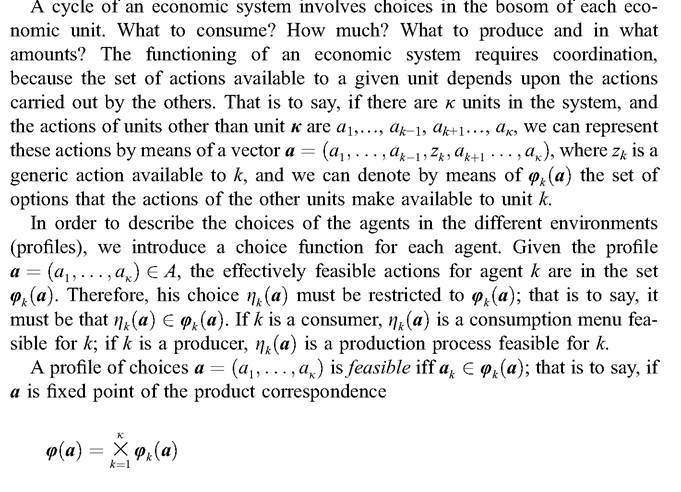
(cf. Nash 1950). Notice that this is not an equilibrium condition, but rather one of feasibility.
Every economy must be seen as an organisches Ganzes, an organic whole, in which four facets are articulated, even though economic theory eventually abstracts from them in order to consider only one aspect (as it is done, for example, by consumer theory):
(1) Production: the production of goods by means of goods and labor power, with nature as a resource.
(2) Distribution: the allocation of products as a prerequisite for production, as production means (according to the division of labor) or as goods for final consumption.
(3) Exchange: the exchange of goods or labor among the individuals after allocation has taken place, for instance by means of barter or money.
(4) Final consumption: the use of natural goods and products of human labor in order to sustain the different types of labor capabilities.
Production in a determinate society in a given moment consists of the implementation of certain production processes at a certain level of operation. A production process can be represented as a combination
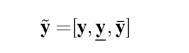
of labor inputs (represented here by means of vector y), production means, tools and raw or prime materials (y), and products (y) A production process represented in this way is said to be in stock version. It is sometimes convenient to represent production processes in flow version, namely as
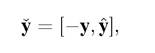
where y = y — y is the vector of net outputs. If we assume that there is a number λ of types of goods, and a number ν of trades, vector y has dimension ν and vectors y and y will have dimension λ. The household consumption menus, which I shall denote below by means of letters x with or without subindexes, shall also be of dimension λ, even though some goods are useful only in production.
A production technology set is a collection Y of production processes. Some agents have at their disposal technologies that can operate. Let χ = {1,..., χ} be the set of such agents. The set of production possibilities for agent j 2 χ is denoted by Yj. Hence, the available technologies for society in a given moment are represented by means of a list Y1,., Yχ. The production processes that are going to be operated must be chosen by someone, which involves allocating labor power, as well as production means, to different production processes. In an extreme case, there is a central planner in the other, all agents are independent producers.
The form of distribution is determined by the production mode; it is a set of actually operating rules that determines who receives what out of production; that is to say, who is or are the immediate owners of the outputs of production.
In private ownership economies, for instance, the owner of the production means is also the owner (by default) of the products emanating from the production processes that he operates. But there can be and there have been economies with different allocation rules. The map we are aiming at must make room for all the different modes of production, with their respective distribution systems.Marx distinguishes the allocation that results from exchange from distribution properly speaking. Exchange takes place, for instance, when the owner of the product of a production process sells it in the market, or when the worker who gets paid in kind trades part of his payment for other goods. It is logically possible the existence of societies in which there is no exchange, if all agents are content with what distribution assigns to them (perhaps this took place in some primitive societies). These societies would lack a market properly speaking.
Final consumption is distinguished from productive consumption even though, actually, it is part of it, because it is necessary in order to reproduce the labor
A general concept of an economy 85 power. Marx believed that the proleratiat was doomed to the consumption of a subsistence basket rigidly determined, but this restriction is not necessary. In modern capitalist societies nothing prevents the attribution to each consumer of a preference relation and the possibility of choosing different menus within his budget restrictions. I shall represent the family of consumption menus available to consumer i by means of symbol Xi, where i is an element of set ι = {1,..., ι}.
The hierarchy of ends and needs of agent i induces a preference ordering over Xi, merely a binary relation over Xi, that does not have to be connected or transitive. There is a minimum consumption required to guarantee the subsistence of consumer i, represented by a vector si distinct of 0; that is to say, a feasibility condition of the system is that i can choose a menu xi such that s ≤ xi for every i 2 ι.
Arrow and Debreu (1954) chose to omit any menu not satisfying this condition but I don’t find convenient to do that here. Nevertheless, I will introduce in Chapter 10 an analogous notion, the worker’s subsistence basket.The total resources of the economy at the beginning of the productive cycle can be represented by means of a л-dimensional vector ω, where λ is the number of types of goods produced in the economy. Debreu (1959: 74-5) characterizes ω in the following manner:
The total resources of an economy are the a priori given quantities of commodities that are made available to (or by) its agents. Quantities made available to (resp. by) the agents of the economy are represented by positive (resp. negative) numbers... They include the capital of the economy at the present instant, i.e., all the land, buildings, mineral deposits, equipment, inventories of goods,... now existing and available to the agents of the economy. All these are a legacy of the past; they are a priori given.
The use of words like ‘commodities’ or ‘capital’ in this quote is due to the fact that Debreu was thinking mainly on capitalist economies. In some economies it would not be correct to call ‘capital’ the means of production or ‘commodities’ the goods, but it is easy to introduce the pertinent corrections to the definition. Besides, it is importante to take into account also the available labor-power. In order to start the productive cycle it is required to allocate not only material inputs, machinery or tools, but also labor-power to the production processes that are going to be operated. That is why it is also required another vector of total labor resources, let us call it l, that represents the amounts of labor hours (of all kinds) available in the economy. I shall suppose that there are ν kinds of labor, so that labor is heterogeneous.1
Debreu (1959) characterizes an economy as a structure

But a more complete characterization of an economy requires also the specification of l, the distribution rules, and the choices of the agents.
Debreu (1959: 789) specifies the distribution rules by means of concept of share and price of the‘good’ labor (salary). But that presupposes the existence of money and prices in the economy, and there might be economies where no such institutions exist.
A distribution rule is a stipulation (it does not have to be formal or belong to an explicit juridical system) that establishes who are the immediate owners of the goods integrating the total social resources (and, in a slave-based economy also part of the labor power). As the goods can be pooled, the rule stipulates what part of the total resources do correspond to each pool. A pool is an element of the power set of ι having more than one element. If M is the family of all nonempty subsets of ι, a distribution rule is a function ω : M → Rl that assigns to each individual (singleton) and to each pool M 2 M a share of the total resources. The rule must satisfy the following conditions:

The producers are individuals (singletons of M) or organized groups (pools) for the production of some family of goods. In order to unify the notation, from now on the producers will be ι + 1,., ι + χ and a generic agent (consumer or producer) will be denoted by k. Thus, κ = {1,..., ι, ι + 1,..., ι + χ} and κ will be equal to ι + χ. Ak shall denote the set of possible actions for agent k 2 κ, whether he is a consumer or a producer. The set A1 ? ■ ■ ■ ? Aκ of all profiles of actions of the agents will be denoted by A. It will be convenient to think of the agents ι + 1,..., ι + χ as individuals or pools and redefine ω as a function dividing the total resources among the elements of κ. In other words, we shall convene that ι + 1,., ι + χ is a numeration of the individuals and the pools and suppose that ω has as domain the set κ.
The conditions that ω must satisfy are reformulated as follows:
From now on we shall write ω(k) as usual, as ωk.
Given the initial social endowments of material resources and labor-power, ω and l, the initial distribution ω determines the consumptions available to the consumers and the process that the producers can operate.
6.2.1 Definition
A feasible social choice is a list a of actions of the agents such that 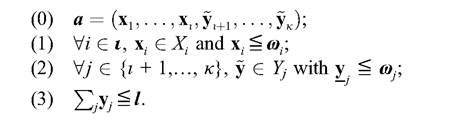
Axiom (1) stipulates that the initial endowment of agent i is enough to feed his family. Axiom (2) expresses that the initial endowment of producer j is enough to operate a production process within his technological possibilities. Axiom (3) expresses that the production processes chosen do not require more laborpower than that socially available.
The problem is that the said processes can be insufficient in order to reproduce the system, or even to guarantee the subsistence of the whole labor-power. It can also happen that there is a disequilibrium in the economy, so that too much of a good is produced and too little of another which is essential. This opens the problem of economic coordination. There have been several forms of coordination, beside the market, and it is important to stress here that no one is feasible that does not allow the reproduction of the system. That requires the transmission of information and may require some form of exchange of the goods, or reallocation of the labor power.
An economy is reproducible if production can reconstitute, at least, the wealth available at the beginning of the cycle, in the sense clarified by the following definition.
6.2.2 Definition
A reproducible social choice is a feasible social choice

such that
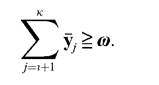
There may be reproducible social choices but it can happen that the choice realized by the agents within the restrictions imposed by the prevalent allocation of resources is not reproducible. In such a case exchange - the market - becomes a drastic economic need.
There are empirically countless forms in which exchange can be carried on but, as the Philosopher said, there is no science of the particular. Exchange can be realized by means of barter, familiar agreements, the use of a general equivalent (as the cocoa seed in Prehispanic Mexico), etc. At the present level of generality, the only thing that matters is to highlight that exchange has the effect of a reallocation of the initial endowments represented by ω. If we designate by means of letter Ω the set of all possible allocations; that is to say 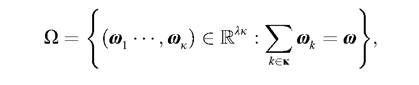
then we can represent the result of the social exchange process by means of a transformation τ: Ω → Ω.
Exchange can be seen as a reallocation of originally distributed goods. This reallocation is realized by means of barter, or the money form if it exists, and generates a market. Hence, in societies where the only way of allocating is distribution there is no market.
We can formulate in a compact way the general concept of an economy in the following terms:
6.2.3 Definition
An economy is a structure

such that
(1) For each i 2 ι, Xi is a set of nonnegative λ-dimensional vectors representing possible consumption menus for consumer i during the period in which the economic process is going to be studied. Any of these menus guarantees the subsistence of the consumer (and his family). ≥i is the consumer’s preference relation. It is usually assumed to be connected and transitive, but these conditions may fail to hold.
(2) For each j 2 χ, Yj is the production technology set for agent j. This agent may be an individual consumer or a conglomerate or pool of consumers. The elements of Yj are vectors of the form [y, y, y] that represent production processes, where y is a vector of dimension ν that represents the labor power employed in the process, y is vector of dimension λ representing the means and objects of labor of the process, and y is a vector, also of dimension λ, representing the product that emanates from the process.
(3) t is a vector of dimension λ that represents the total material resources of the economy at the beginning of the cycle under study.
(4) l is ν-dimensional vector representing the total labor-power available at the beginning of the cycle under study. 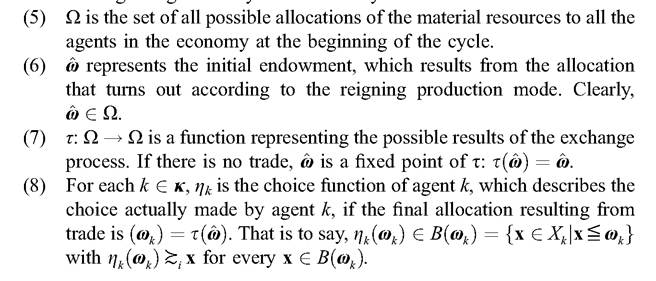
The clauses of this definition of an economy are not restrictive and have full generality. The definition is applicable to any economy: it is not restricted to modern or capitalist economies. It provides a map, an outline that allows the fixation of the Subjekt, topic, target system or dgp of any economic theoretization, through the fleshing out of the terms. This is, roughly, what Marx called “raising from the abstract to the concrete” (vom Abstrakten zum Konkreten aufzusteigen).
Note
1 Debreu (1959) introduces the labor resources as ‘services’ in the vector of total resources, as he introduces labor services within the consumption vectors.
7