Institutions matter
We now argue that there is convincing empirical support for the hypothesis that differences in economic institutions, rather than geography or culture, cause differences in incomes per-capita.
Consider first Figure 1.This shows the cross-country bivariate relationship between the log of GDP percapita in 1995 and a broad measure of property rights, “protection against expropriation risk”, averaged over the period 1985 to 1995. The data on economic institutions come from Political Risk Services, a private company which assesses the risk that investments will be expropriated in different countries. These data, first used by Knack and Keefer (1995) and subsequently by Hall and Jones (1999) and Acemoglu, Johnson and Robinson (2001, 2002) are imperfect as a measure of economic institutions, but the findings are robust to using other available measures of economic institutions. The scatter plot
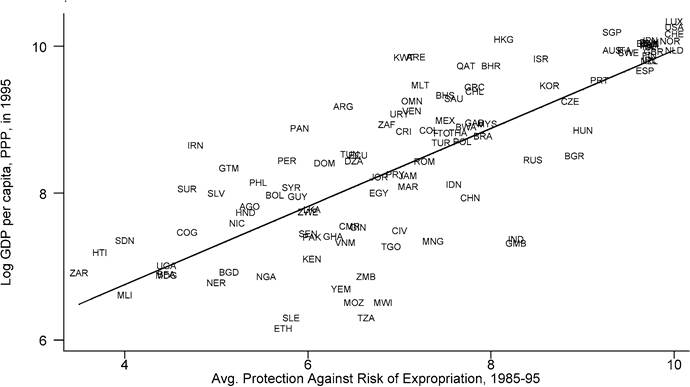
Figure 1. Average protection against risk of expropriation 1985-95 and log GDP per capita 1995.
shows that countries with more secure property rights, i.e., better economic institutions, have higher average incomes.
It is tempting to interpret Figure 1 as depicting a causal relationship (i.e., as establishing that secure property rights cause prosperity). Nevertheless, there are well-known problems with making such an inference. First, there could be reverse causation - perhaps only countries that are sufficiently wealthy can afford to enforce property rights. More importantly, there might be a problem of omitted variable bias. It could be something else, e.g., geography, that explains both why countries are poor and why they have insecure property rights. Thus if omitted factors determine institutions and incomes, we would spuriously infer the existence of a causal relationship between economic institutions and incomes when in fact no such relationship exists.
Trying to estimate the relationship between institutions and prosperity using Ordinary Least Squares, as was done by Knack and Keefer (1995) and Barro (1997) could therefore result in biased regression coefficients.To further illustrate these potential identification problems, suppose that climate, or geography more generally, matters for economic performance. In fact, a simple scatterplot shows a positive association between latitude (the absolute value of distance from the equator) and income per capita. Montesquieu, however, not only claimed that warm climate makes people lazy and thus unproductive, but also unfit to be governed by democracy. He argued that despotism would be the political system in warm climates. Therefore, a potential explanation for the patterns we see in Figure 1 is that there is an omitted factor, geography, which explains both economic institutions and economic performance. Ignoring this potential third factor would lead to mistaken conclusions.
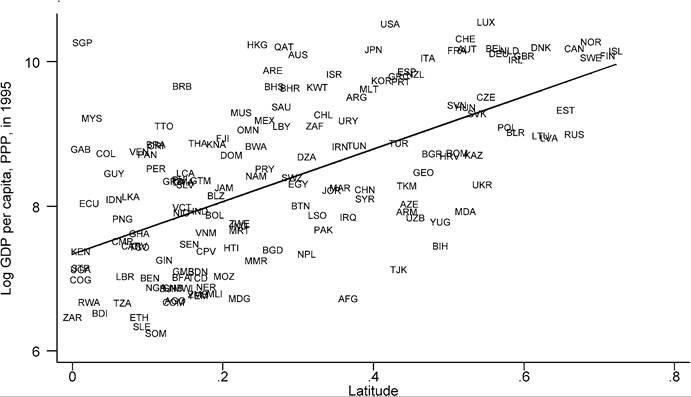
Figure 2. Latitude and log GDP per capita 1995.
Even if Montesquieu's story appears both unrealistic and condescending to our modern sensibilities, the general point should be taken seriously: the relationship shown in Figure 1, and for that matter that shown in Figure 2, is not causal. As we pointed out in the context of the effect of religion or social capital on economic performance, these types of scatterplots, correlations, or their multidimensional version in OLS regressions, cannot establish causality.
What can we do? The solution to these problems of inference is familiar in microeconometrics: find a source of variation in economic institutions that should have no effect on economic outcomes, or depending on the context, look for a natural experiment. As an example, consider first one of the clearest natural experiments for institutions.
3.1. The Korean experiment
Until the end of World War II, Korea was under Japanese occupation.
Korean independence came shortly after the Japanese Emperor Hirohito announced the Japanese surrender on August 15, 1945. After this date, Soviet forces entered Manchuria and North Korea and took over the control of these provinces from the Japanese. The major fear of the United States during this time period was the takeover of the entire Korean peninsular either by the Soviet Union or by communist forces under the control of the former guerrilla fighter, Kim Il Sung. U.S. authorities therefore supported the influential nationalist leader Syngman Rhee, who was in favor of separation rather than a united communist Korea. Elections in the South were held in May 1948, amidst a widespread boycott by Koreans opposed to separation. The newly elected representatives proceeded to draft a new constitution and established the Republic of Korea to the south of the 38th parallel. The Northbecame the Democratic People’s Republic of Korea, under the control of Kim II Sung. These two independent countries organized themselves in very different ways and adopted completely different sets of institutions. The North followed the model of Soviet socialism and the Chinese Revolution in abolishing private property of land and capital. Economic decisions were not mediated by the market, but by the communist state. The South instead maintained a system of private property and the government, especially after the rise to power of Park Chung Hee in 1961, attempted to use markets and private incentives in order to develop the economy.Before this “natural experiment” in institutional change, North and South Korea shared the same history and cultural roots. In fact, Korea exhibited an unparalleled degree of ethnic, linguistic, cultural, geographic and economic homogeneity. There are few geographic distinctions between the North and South, and both share the same disease environment. For example, the CIA Factbook describes the climate of North Korea as “temperate with rainfall concentrated in summer” and that of South Korea as “temperate, with rainfall heavier in summer than winter”.
In terms of terrain North Korea is characterized as consisting of “mostly hills and mountains separated by deep, narrow valleys; coastal plains wide in west, discontinuous in east”, while South Korea is “mostly hills and mountains; wide coastal plains in west and south”. In terms of natural resources North Korea is better endowed with significant reserves of coal, lead, tungsten, zinc, graphite, magnesite, iron ore, copper, gold, pyrites, salt, fluorspar, hydropower. South Korea’s natural resources are “coal, tungsten, graphite, molybdenum, lead, hydropower potential”. Both countries share the same geographic possibilities in terms of access to markets and the cost of transportation.Other man-made initial economic conditions were also similar, and if anything, advantaged the North. For example, there was significant industrialization during the colonial period with the expansion of both Japanese and indigenous firms. Yet this development was concentrated more in the North than the South. For instance, the large Japanese zaibatsu of Noguchi, which accounted for one third of Japanese investment in Korea, was centered in the North. It built large hydroelectric plants, including the Suiho dam on the Yalu river, second in the world only to the Boulder dam on the Colorado river. It also created Nippon Chisso, the second largest chemical complex in the world that was taken over by the North Korean state. Finally, in Ch’ongjin North Korea also had the largest port on the Sea of Japan. All in all, despite some potential advantages for the North,[260] Maddison (2001) estimates that at the time of separation, North and South Korea had approximately the same income per capita.
We can therefore think of the splitting on the Koreas 50 years ago as a natural experiment that we can use to identify the causal influence of a particular dimension of
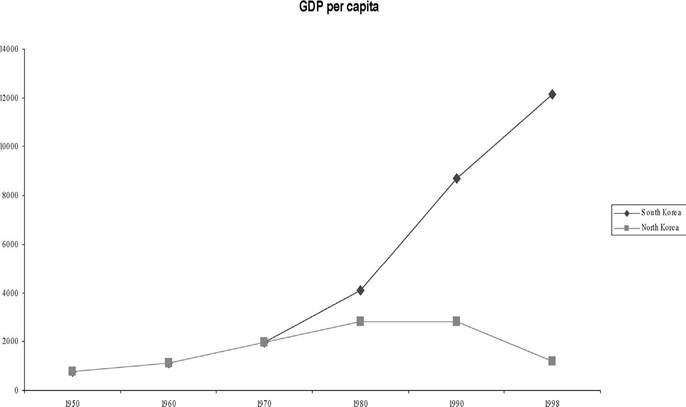
Figure 3.
GDP per capita in North and South Korea, 1950-98.institutions on prosperity. Korea was split into two, with the two halves organized in radically different ways, and with geography, culture and many other potential determinants of economic prosperity held fixed. Thus any differences in economic performance can plausibly be attributed to differences in institutions.
Consistent with the hypothesis that it is institutional differences that drive comparative development, since separation, the two Koreas have experienced dramatically diverging paths of economic development (Figure 3).
By the late 1960's South Korea was transformed into one of the Asian “miracle” economies, experiencing one of the most rapid surges of economic prosperity in history while North Korea stagnated. By 2000 the level of income in South Korea was $16,100 while in North Korea it was only $1,000. By 2000 the South had become a member of the Organization of Economic Cooperation and Development, the rich nations club, while the North had a level of per-capita income about the same as a typical sub-Saharan African country. There is only one plausible explanation for the radically different economic experiences on the two Koreas after 1950: their very different institutions led to divergent economic outcomes. In this context, it is noteworthy that the two Koreas not only shared the same geography, but also the same culture.
It is possible that Kim Il Sung and Communist Party members in the North believed that communist policies would be better for the country and the economy in the late 1940s. However, by the 1980s it was clear that the communist economic policies in the North were not working. The continued efforts of the leadership to cling to these policies and to power can only be explained by those leaders wishing to look after their own interests at the expense of the population at large. Bad institutions are therefore kept in place, clearly not for the benefit of society as a whole, but for the benefit of the ruling elite, and this is a pattern we encounter in most cases of institutional failure that we discuss in detail below.
However convincing on its own terms, the evidence from this natural experiment is not sufficient for the purposes of establishing the importance of economic institutions as the primary factor shaping cross-country differences in economic prosperity. First, this is only one case, and in the better-controlled experiments in the natural sciences, a relatively large sample is essential. Second, here we have an example of an extreme case, the difference between a market-oriented economy and a communist one. Few social scientists today would deny that a lengthy period of totalitarian centrally planned rule has significant economic costs. And yet, many might argue that differences in economic institutions among capitalist economies or among democracies are not the major factor leading to differences in their economic trajectories. To establish the major role of economic institutions in the prosperity and poverty of nations we need to look at a larger scale “natural experiment” in institutional divergence.
3.2. The colonial experiment
The colonization of much of the world by Europeans provides such a large scale natural experiment. Beginning in the early fifteenth century and massively intensifying after 1492, Europeans conquered many other nations. The colonization experience transformed the institutions in many diverse lands conquered or controlled by Europeans. Most importantly, Europeans imposed very different sets of institutions in different parts of their global empire, as exemplified most sharply by the contrast to the economic institutions in the northeast of America to those in the plantation societies of the Caribbean. As a result, while geography was held constant, Europeans initiated large changes in economic institutions, in the social organization of different societies. We will now show that this experience provides evidence which conclusively establishes the central role of economic institutions in development. Given the importance of this material and the details we need to provide, we discuss the colonial experience in the next section.
4.