The Reversal of Fortune
The impact of European colonialism on economic institutions is perhaps most dramatically conveyed by a single fact - historical evidence shows that there has been a remarkable Reversal of Fortune in economic prosperity within former European colonies.
Societies like the Mughals in India, and the Aztecs and the Incas in the Americas were among the richest civilizations in 1500, yet the nation states that now coincide with the boundaries of these empires are among the poorer societies of today. In contrast, countries occupying the territories of the less-developed civilizations in North America, New Zealand and Australia are now much richer than those in the lands of the Mughals, Aztecs and Incas.4.1. The reversal among the former colonies
The Reversal of Fortune is not confined to such comparisons. Using reasonable proxies for prosperity before modern times, we can show that it is a much more systematic phenomenon. Our proxies for income per capita in pre-industrial societies are urbanization rates and population density. Only societies with a certain level of productivity in agriculture and a relatively developed system of transport and commerce can sustain large urban centers and a dense population. Figure 4 shows the relationship between income per capita and urbanization (fraction of the population living in urban centers with greater than 5000 inhabitants) today, and demonstrates that in the current era there is a significant relationship between urbanization and prosperity.
Naturally, high rates of urbanization do not mean that the majority of the population lived in prosperity. In fact, before the twentieth century urban areas were centers of poverty and ill health. Nevertheless, urbanization is a good proxy for average income per capita in society, which closely corresponds to the measure we are using to look at prosperity.
Figures 5 and 6 show the relationship between income per capita today and urbanization rates and (log) population density in 1500 for the sample of European colonies.[261]
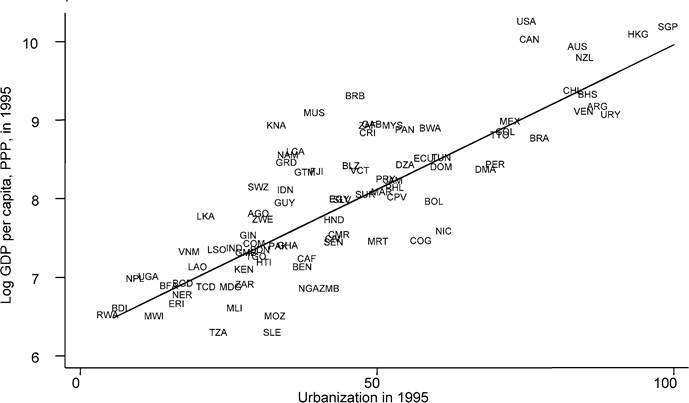
Figure 4. Urbanization in 1995 and log GDP per capita in 1995.
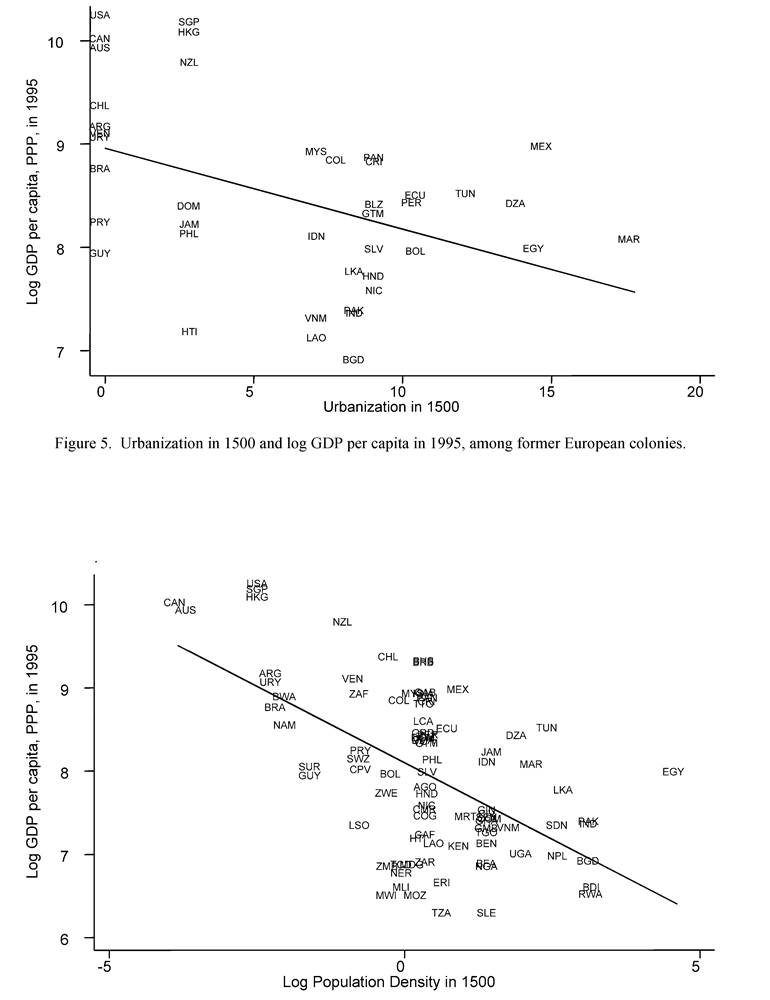
Figure 6. Log population density in 1500 and log GDP per capita in 1995, among former European colonies.
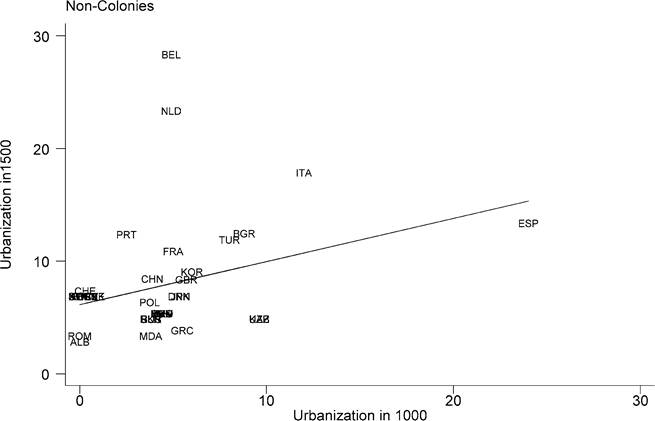
Figure 7. Urbanization in 1000 and 1500, among non-colonies.
We pick 1500 since it is before European colonization had an effect on any of these societies. A strong negative relationship, indicating a reversal in the rankings in terms of economic prosperity between 1500 and today, is clear in both figures. In fact, the figures show that in 1500 the temperate areas were generally less prosperous than the tropical areas, but this pattern too was reversed by the twentieth century.
The urbanization data for these figures come from Bairoch (1988), Bairoch, Ba- tou and Chevre (1988), Chandler (1987), and Eggimann (1999). The data on population density are from McEvedy and Jones (1978). Details and Iiirther results are in Acemoglu, Johnson and Robinson (2002).
There is something extraordinary about this reversal. For example, after the initial spread of agriculture there was remarkable persistence in urbanization and population density for all countries, including those which were to be subsequently colonized by Europeans. In Figures 7 and 8 we show the relationships for urbanization plotting separately the relationship between urbanization in 1000 and in 1500 for the samples of colonies and all other countries. Both figures show persistence, not reversal. Although Ancient Egypt, Athens, Rome, Carthage and other empires rose and fell, what these pictures show is that there was remarkable persistence in the prosperity of regions.
Moreover, reversal was not the general pattern in the world after 1500. Figure 9 shows that within countries not colonized by Europeans in the early modern and modern period, there was no reversal between 1500 and 1995.
There is therefore no reason to think that what is going on in Figures 5 and 6 is some sort of natural reversion to the mean.
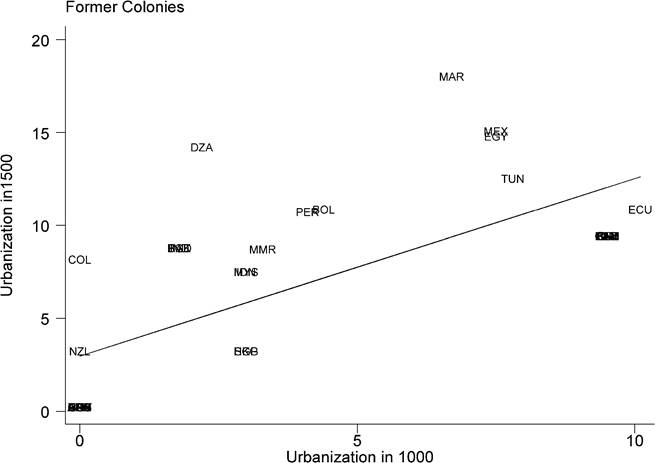
Figure 8. Urbanization in 1000 and 1500, among former European colonies.
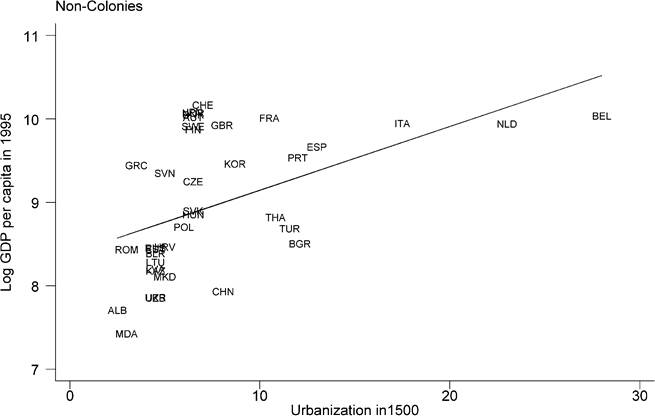
Figure 9. Urbanization in 1500 and log GDP per capita in 1995, among non-colonies.
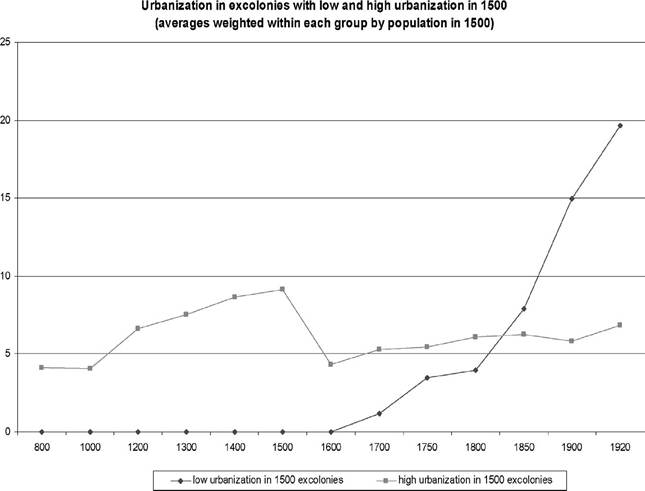
Figure 10. Evolution of urbanization among former European colonies.
4.2. Timingofthereversal
When did the reversal occur? One possibility is that it arose shortly after the conquest of societies by Europeans but Figures 10 and 11 show that the previously-poor colonies surpassed the former highly-urbanized colonies starting in the late eighteenth and early nineteenth centuries, and this went hand in hand with industrialization. Figure 10 shows average urbanization in colonies with relatively low and high urbanization in 1500. The initially high-urbanization countries have higher levels of urbanization and prosperity until around 1800. At that time the initially low-urbanization countries start to grow much more rapidly and a prolonged period of divergence begins. Figure 11 shows industrial production per capita in a number of countries. Although not easy to see in the figure, there was more industry (per capita and total) in India in 1750 than in the United States. By 1860, the United States and British colonies with relatively good economic institutions, such as Australia and New Zealand, began to move ahead rapidly, and by 1953, a huge gap had opened up.
4.3. Interpretingthereversal
Which of the three broad hypotheses about the sources of cross-country income differences are consistent with the reversal and its timing? These patterns are clearly
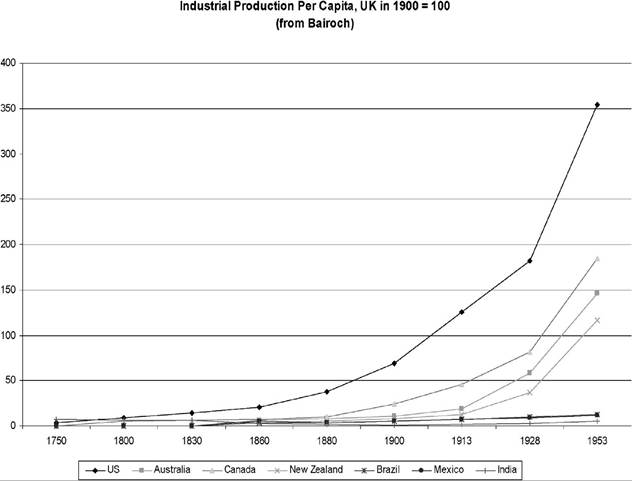
Figure 11.
Evolution of industrial production per capita among former European colonies.inconsistent with simple geography based views of relative prosperity. In 1500 it was the countries in the tropics which were relatively prosperous, in 2003 it is the reverse. This makes it implausible to base a theory of relative prosperity today, as Sachs (2000, 2001) does, on the intrinsic poverty of the tropics. This argument is inconsistent with the historical evidence.
Nevertheless, following Diamond (1997), one could propose what Acemoglu, Johnson and Robinson (2002) call a “sophisticated geography hypothesis” which claims that geography matters but in a time varying way. For example, Europeans created “latitude specific” technology, such as heavy metal ploughs, that only worked in temperate latitudes and not with tropical soils. Thus when Europe conquered most of the world after 1492, they introduced specific technologies that functioned in some places (the United States, Argentina, Australia) but not others (Peru, Mexico, West Africa). However, the timing of the reversal, coming as it does in the nineteenth century, is inconsistent with the most natural types of sophisticated geography hypotheses. Europeans may have had latitude specific technologies, but the timing implies that these technologies must have been industrial, not agricultural, and it is difficult to see why industrial technologies do not function in the tropics (and in fact, they have functioned quite successfully in tropical Singapore and Hong Kong).[262]
Similar considerations weigh against the culture hypothesis. Although culture is slow-changing the colonial experiment was sufficiently radical to have caused major changes in the cultures of many countries that fell under European rule. In addition, the destruction of many indigenous populations and immigration from Europe are likely to have created new cultures or at least modified existing cultures in major ways [see Vargas Llosa (1989), for a fictionalized account of just such a cultural change].
Nevertheless, the culture hypothesis does not provide a natural explanation for the reversal, and has nothing to say on the timing of the reversal. Moreover, we discuss below how econometric models that control for the effect of institutions on income do not find any evidence of an effect of religion or culture on prosperity.The most natural explanation for the reversal comes from the institutions hypothesis, which we discuss next.
4.4. Economic institutions and the reversal
Is the Reversal of Fortune consistent with a dominant role for economic institutions in comparative development? The answer is yes. In fact, once we recognize the variation in economic institutions created by colonization, we see that the Reversal of Fortune is exactly what the institutions hypothesis predicts.
In Acemoglu, Johnson and Robinson (2002) we tested the connection between initial population density, urbanization, and the creation of good economic institutions. We showed that, others things equal, the higher the initial population density or the greater initial urbanization, the worse were subsequent institutions, including both institutions right after independence and today. Figures 12 and 13 show these relationships using the same measure of current economic institutions used in Figure 1, protection against expropriation risk today. They document that the relatively densely settled and highly urbanized colonies ended up with worse (or ‘extractive’) institutions, while sparsely- settled and non-urbanized areas received an influx of European migrants and developed institutions protecting the property rights of a broad cross-section of society. European colonialism therefore led to an institutional reversal, in the sense that the previously- richer and more-densely settled places ended up with worse institutions.7
To be fair, it is possible that the Europeans did not actively introduce institutions discouraging economic progress in many of these places, but inherited them from previous civilizations there.
The structure of the Mughal, Aztec and Inca empires were already very hierarchical with power concentrated in the hands of narrowly based ruling elites and structured to extract resources from the majority for the benefit of a minority. Often high agricultural productivity is needed to stimulate the demand for industrial goods. Though obviously such an explanation is not relevant for explaining industrialization in Singapore or Hong Kong, it may be relevant in other places.7 The institutional reversal does not mean that institutions were necessarily better in the previously more densely-settled areas (see next paragraph). It only implies a tendency for the relatively poorer and less densely- settled areas to end up with better institutions than previously-rich and more densely-settled areas.
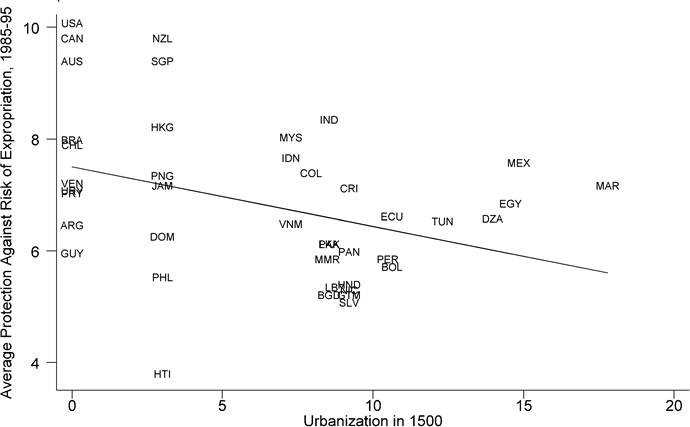
Figure 12. Urbanization in 1500 and average protection against risk of expropriation 1985-95.
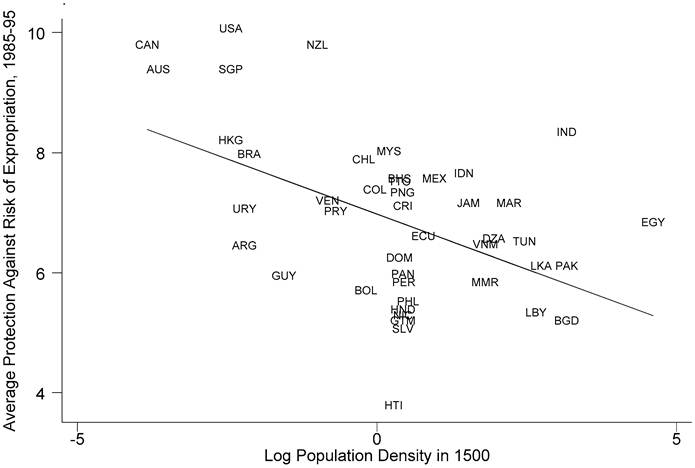
Figure 13. Log population density in 1500 and average protection against risk of expropriation 1985-95.
Europeans simply took over these existing institutions. Whether this is so is secondary for our focus, however. What matters is that in densely-settled and relatively-developed places it was in the interests of Europeans to have institutions facilitating the extraction of resources thus not respecting the property rights of the majority, while in the sparsely-settled areas it was in their interests to develop institutions protecting property rights. These incentives led to an institutional reversal.
The institutional reversal, combined with the institutions hypothesis, predicts the Reversal of Fortune: relatively rich places got relatively worse economic institutions, and if these institutions are important, we should see them become relatively poor overtime. This is exactly what we find with the Reversal of Fortune.
Moreover, the institutions hypothesis is consistent with the timing of the reversal. Recall that the institutions hypothesis links incentives to invest in physical and human capital and in technology to economic institutions, and argues that economic prosperity results from these investments. Therefore, economic institutions should become more important when there are major new investment opportunities. The opportunity to industrialize was the major investment opportunity of the nineteenth century. Countries that are rich today, both among the former European colonies and other countries, are those that industrialized successfully during this critical period.
4.5. Understanding the colonial experience
The explanation for the reversal that emerges from our discussion so far is one in which the economic institutions in various colonies were shaped by Europeans to benefit themselves. Moreover, because conditions and endowments differed between colonies, Europeans consciously created different economic institutions, which persisted and continue to shape economic performance. Why did Europeans introduce better institutions in previously-poor and unsettled areas than in previously-rich and densely-settled areas? The answer to this question relates to the comparative statics of our theoretical framework. Leaving a full discussion to later, we can note a couple of obvious ideas.
Europeans were more likely to introduce or maintain economic institutions facilitating the extraction of resources in areas where they would benefit from the extraction of resources. This typically meant areas controlled by a small group of Europeans, and areas offering resources to be extracted. These resources included gold and silver, valuable agricultural commodities such as sugar, but most importantly people. In places with a large indigenous population, Europeans could exploit the population, be it in the form of taxes, tributes or employment as forced labor in mines or plantations. This type of colonization was incompatible with institutions providing economic or civil rights to the majority of the population. Consequently, a more developed civilization and a denser population structure made it more profitable for the Europeans to introduce worse economic institutions.
In contrast, in places with little to extract, and in sparsely-settled places where the Europeans themselves became the majority of the population, it was in their interests to introduce economic institutions protecting their own property rights.
4.6. Settlements, mortality and development
The initial conditions we have emphasized so far refer to indigenous population density and urbanization. In addition, the disease environments differed markedly among the colonies, with obvious consequences on the attractiveness of European settlement. As we noted above, when Europeans settled, they established institutions that they themselves had to live under. Therefore, whether Europeans could settle or not had an exogenous effect on the subsequent path of institutional development. In other words, if the disease environment 200 or more years ago affects outcomes today only through its effect on institutions today, then we can use this historical disease environment as an exogenous source of variation in current institutions. From an econometric point of view we have a valid instrument which will enable us to pin down the casual effect of economic institutions on prosperity.[263]
We developed this argument in Acemoglu, Johnson and Robinson (2001) and investigated it empirically. We used initial conditions in the European colonies, particularly data from Curtin (1989, 1998) and Gutierrez (1986) on the mortality rates faced by Europeans (primarily soldiers, sailors, and bishops), as instruments for current economic institutions. The justification for this is that, outside of its effect on economic institutions during the colonial period, historical European mortality has no impact on current income levels. Figures 14 and 15 give scatter plots of this data against contemporaneous economic institutions and GDP per-capita. The sample is countries which were colonized by Europeans in the early modern and modern periods and thus excludes, among others, China, Japan, Korea, Thailand.
Figure 14 shows the very strong relationship between the historical mortality risk faced by Europeans and the current extent to which property rights are enforced. A bivariate regression has an R2 of 0.26. It also shows that there were very large differences in European mortality. Countries such as Australia, New Zealand and the United States were very healthy with life expectancy typically greater than in Britain. On the other hand mortality was extremely high in Africa, India and South-East Asia. Differential mortality was largely due to tropical diseases such as malaria and yellow fever and at the time it was not understood how these diseases arose nor how they could be prevented or cured.
In Acemoglu, Johnson and Robinson (2001) we showed, using European mortality as an instrument for the current enforcement of property rights, that most of the gap between rich and poor countries today is due to differences in economic institutions. More precisely, we showed (p. 1387) that if one took two typical - in the sense that they both lie on the regression line - countries with high and low expropriation risk, like Nigeria and Chile, then almost the entire difference in incomes per-capita between
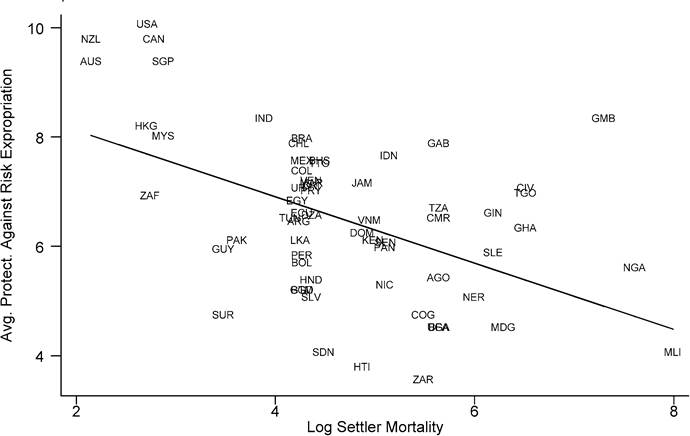
Figure 14. Log mortality of potential European settlers and average protection against risk of expropriation 1985-95.
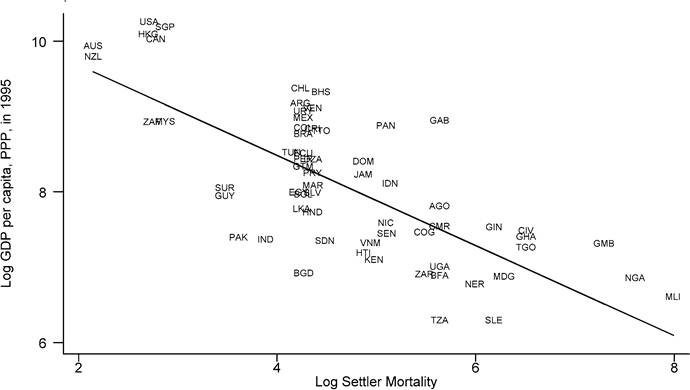
Figure 15. Log mortality of potential European settlers and log GDP per capita in 1995.
them could be explained by the differences in the security of property rights. We also presented regression evidence that showed that once the effect of economic institutions on GDP per-capita was properly controlled for, geographical variables, such as latitude, whether or not a country is land-locked and the current disease environment, have no explanatory power for current prosperity.
These ideas and results provide an interpretation of why there are strong correlations between geographical variables such as latitude and income per-capita. Basically this is because Europeans did not have immunity to tropical diseases during the colonial period and thus settler colonies tended, other things equal, to be created in temperate latitudes. Thus the historical creation of economic institutions was correlated with latitude. Without considering the role of economic institutions it is easy to find a spurious relationship between latitude and income per-capita. However, once economic institutions are properly controlled for, these relationships go away. There is no causal effect of geography on prosperity today, though geography may have been important historically in shaping economic institutions.
What about the role of culture? On the face of it, the Reversal of Fortune is consistent with cultural explanations of comparative growth. The Europeans not only brought new institutions, they also brought their own cultures. There seem to be three main ways to test this idea. First, cultures may be systematically related to the national identity of the colonizing power. For example, the British may have implanted a ‘good’ Anglo- Saxon culture into colonies such as Australia and the United States, while the Spanish may have condemned Latin America by endowing it with a Hispanic or Iberian culture [the academic literature is full of ideas like this, for recent versions see Veliz (1994), North, Summerhill and Weingast (2000) and Wiarda (2001)]. Second, following Landes (1998), Europeans may have had a culture, for example a work ethic or set of beliefs, which was uniquely propitious to prosperity. Finally, following Weber (1930), Europeans also brought different religions with different implications for prosperity. Such a hypothesis could explain why Latin America is relatively poor since its citizens are primarily Roman Catholic, while North America is relatively rich because its citizens are mostly Protestant.
However, the econometric evidence in Acemoglu, Johnson and Robinson (2001) is not consistent with any these views. Once we control properly for the effects of economic institutions, neither the identity of the colonial power, nor the contemporary fraction of Europeans in the population, nor the proportions of the populations of various religions, are significant determinants of income per capita.
These econometric results are supported by historical examples. For instance, with respect to the identity of the colonizing power, in the 17th century the Dutch had perhaps the best domestic economic institutions in the world but the colonies they created in South-East Asia ended up with institutions designed for the extraction of resources, providing little economic or civil rights to the indigenous population.
It is also be clear that the British in no way simply re-created British institutions in their colonies. For example, by 1619 the North American colony of Virginia had a representative assembly with universal male suffrage, something that did not arrive in Britain
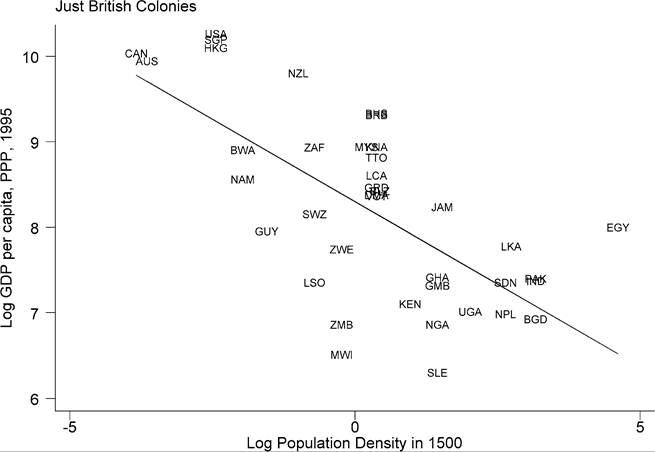
Figure 16. Log population density in 1500 and log GDP per capita in 1995, among former British colonies.
itself until 1919. Another telling example is due to Newton (1914) and Kupperman (1993), who showed that the Puritan colony in Providence Island in the Caribbean quickly became just like any other Caribbean slave colony despite the Puritanical inheritance. Although no Spanish colony has been as successful economically as British colonies such as the United States, it is also important to note that Britain had many unsuccessful colonies (in terms of per capita income), such as in Africa, India and Bangladesh.
To emphasize that the culture or the religion of the colonizer was not at the root of the divergent economic performances of the colonies, Figure 16 shows the reversal among the British colonies (with population density in 1500 on the horizontal axis). Just as in Figure 6, there is a strong negative relationship between population density in 1500 and income per capita today.
With respect to the role of Europeans, Singapore and Hong Kong are now two of the richest countries in the world, despite having negligible numbers of Europeans. Moreover, Argentina and Uruguay have higher proportions of people of European descent than the United States and Canada, but are much less rich. To further document this, Figure 17 shows a similar reversal of fortune for countries where the fraction of those with European descent in 1975 is less than 5 percent of the population.
Overall, the evidence is not consistent with a major role of geography, religion or culture transmitted by the identity of the colonizer or the presence of Europeans. Instead,
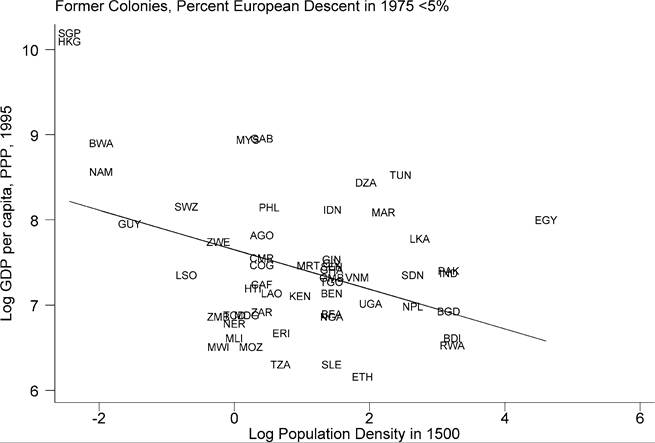
Figure 17. Log population density in 1500 and log GDP per capita in 1995, among former European colonies with current population less than 5% of European descent.
differences in economic institutions appear to be the robust causal factor underlying the differences in income per capita across countries. Institutions are therefore the fundamental cause of income differences and long-run growth.
5.