A.1 Interactions in Traditional Game Theory and Their Problems
Even in traditional game theory, noncooperative agents usually encounter various kinds of interactions in generating a set of complicated behaviors. In the course of finding curious results, experimental economists are often involved in giving game theorists new clues for solving the games.
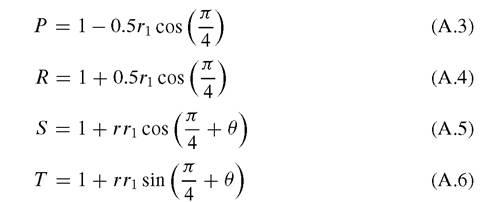
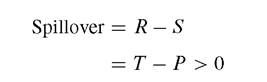
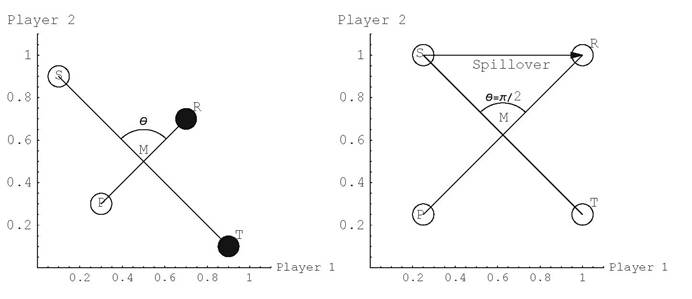
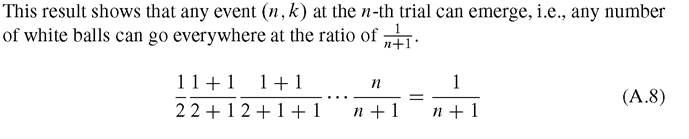
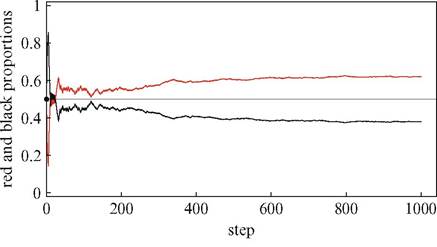
Their concerns are limited to informational structures outside the essential game structure, e.g., using an auxiliary apparatus such as “cheap talks”, i.e., negotiations without costs. Traditional game theory is allowed to argue actual interactions extensively, but may run into difficulties, because the treatment of the information is merely intuitive and not systemic.We exemplify one limitation in the case of a Nash equilibrium. If we are faced with multiple Nash equilibria, the concept of correlated equilibria may be activated. As Kono (2008,2009) explored, however, this concept really requires the restrictive assumption that all players’ mixed strategies are assumed to be stochastically independent. Without this, a selection of equilibria may be inconsistent.[82] [83] Plentiful realistic devices for strengthening traditional game theory cannot necessarily guarantee the assumption of stochastic independence of mixed strategies. So traditional theory may often be linked to evolutionary theory to argue realistic interactions. A general framework for encompassing various contexts/stages can be systematically proposed by focusing on the concept of information partition, often used in statistical physics or population dynamics. It is easy to find such an application in the field of socio- and/or econo-physics. We can then argue that a player changes into another as the situation alters. Table A.1 Coordination game Table A.2 Avatamsaka game The exchangeable agents change with the situation/stage. The cluster dynamics change with the exchangeable agents. The exchangeable agents emerge from the use of a random partition vector in statistical physics or population genetics. The partition vector provides us with information about the state. We can therefore argue the size-distribution of the components and their cluster dynamics with the exchangeable agents. We can link the cluster dynamics with the exchangeable agents. We then define a maximum countable set, in which the probability density of transitions from state i to state j is given. In this setting, dynamics of the heterogeneous interacting agents give the field where an agent can become another. This way of thinking easily incorporates the unknown agents, as Fig. 1.9 shows (Aoki and Yoshikawa 2006). A.1.1 A Two-Person Game of Heterogeneous Interaction: Avatamsaka Game Aruka (2001) applied a famous tale from Mahayana Buddhism Sutra called Avatamsaka. Now I would like to illustrate the Avatamsaka game. Suppose that two men sat down face to face at a table, tied up except for one arm, then each was given an over-long spoon. They cannot serve themselves, because of the length of the spoon. There is food enough for both on the table. If they cooperate to feed each other, they can both be happy. This defines Paradise. Alternatively, one may provide the other with food but the second might not reciprocate, which the first would hate, leading to Hell. The gain structure will not depend on the altruistic willingness to cooperate.2 The payoff matrix of the traditional form will be (Tables A.1 and A.2): The properties of the two games may be demonstrated by the relationships between R, S, T, P: Here we call the “Risk Aversion Dilemma” and the “Risk Seeking Dilemma”. Selfishness cannot be defined without interactions between agents. A.1.2 Dilemmas Geometrically Depicted: Tanimoto’s Diagram Tanimoto’s (2007) geometrics for the two-person game neatly describe the game’s geometrical structure. Given the payoff of Table A.1, his geometrics define the next equation system: Thus it is easily verified that spillovers of the Avatamsaka game are positive: Each player’s situation can be improved by the other player’s strategy switching from D to C, whether he/she employs D or C (see Aruka 2001, p. 118) (Fig. A.1). Fig. A.1 Tanimoto’s geometries and the positive spillover. See Tanimoto (2007) A.1.2.1 The Path-Dependent Property of Polya’s Urn Process The original viewpoint focuses on an emerging/evolving environment, i.e., path dependency. We focus on two kinds of averaging: Self-averaging: Eventually, players’ behavior could be independent from others’. Non-self-averaging: The invariance of the random partition vectors under the properties of exchangeability and size-biased permutation does not hold. In the original stage, consider an urn containing a white ball and a red ball only. Draw out one ball, and return it with another of the same color to the urn. Repeat over and over again. The number of balls increases by one each time, so after the completion of two draws, The total number of balls after the second trial = 2 C 1 C 1 = 4 The total number of balls after the n-th trial = n C 2 After the completion of n trials, what is the probability that the urn contains just one white ball? This must be equivalent to the probability that we can have n successive draws of red balls. Fig. A.2 The elementary Polya urn process. http:// demonstrations.wolfram.com/ PolyaUrnSimulation/ Comparing this process with the market, it is clear that in the stock or commodity exchanges, for instance, any sequence of trades must be settled at the end of the session. Any trade, once started, must have an end within a definite period, even in the futures market. The environment in the market must be reset each time. In the market game, a distribution of types of trader can affect the trading results, but not vice versa. On the other hand, the Avatamsaka game in a repeated form must change its own environment each round. A distribution of types of agents can affect the results of the game, and vice versa. Agents must inherit their previous results. This situation describes the path dependency of a repeated game (Fig. A.2).
Player A Player B Strategy 1 Strategy 2 Strategy 1 (T,T) (ST) Strategy 2 (TS) (PP)
Player A Player B Cooperation Defection Cooperation (1,1) (0,1) Defection (1,0) (0,0)