Introduction
This chapter examines the recent advance of a unified growth theory that is designed to capture the complexity of the process of growth and development over the entire course of human history.
The evolution of economies during the major portion of human history was marked by Malthusian Stagnation. Technological progress and population growth were miniscule by modern standards and the average growth rate of income per capita in various regions of the world was even slower due to the offsetting effect of population growth on the expansion of resources per capita. In the past two centuries, in contrast, the pace of technological progress increased significantly in association with the process of industrialization. Various regions of the world departed from the Malthusian trap and experienced initially a considerable rise in the growth rates of income per capita and population. Unlike episodes of technological progress in the pre-Industrial Revolution era that failed to generate sustained economic growth, the increasing role of human capital in the production process in the second phase of industrialization ultimately prompted a demographic transition, liberating the gains in productivity from the counterbalancing effects of population growth. The decline in the growth rate of population and the associated enhancement of technological progress and human capital formation paved the way for the emergence of the modern state of sustained economic growth.
The transitions from a Malthusian epoch to a state of sustained economic growth and the related phenomenon of the Great Divergence, as depicted in Figure 1, have significantly shaped the contemporary world economy.[72] Nevertheless, the distinct qualitative aspects of the growth process during most of human history were virtually ignored in the shaping of growth models, resulting in a growth theory that is consistent with a small fragment of human history.
The inconsistency of exogenous and endogenous growth models with some of the most fundamental features of process of development, has led recently to a search for a unified theory that would unveil the underlying micro-foundations of the growth process in its entirety, capturing the epoch of Malthusian Stagnation that characterized most of human history, the contemporary era of modern economic growth, and the underlying driving forces that triggered the recent transition between these regimes and the associated phenomenon of the Great Divergence in income per capita across countries.
The preoccupation of growth theory with empirical regularities that have characterized the growth process of developed economies in the past century and of less developed economies in the last few decades, has become harder to justify from a scientific viewpoint in light of the existence of vast evidence about qualitatively different
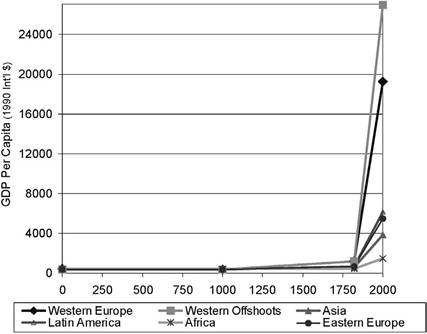
Figure 1. The evolution of regional income per capita over the years 1-2000. Source: Maddison (2003).2
empirical regularities that characterized the growth process over most of human existence. It has become evident that in the absence of a unified growth theory that is consistent with the entire process of development, the understanding of the contemporary growth process would be limited and distorted. As stated eloquently by Copernicus: “It is as though an artist were to gather the hands, feet, head and other members for his images from diverse models, each part perfectly drawn, but not related to a single body, and since they in no way match each other, the result would be monster rather than 3
man. [73] [74] The evolution of theories in older scientific disciplines suggests that theories that are founded on the basis of a subset of the existing observations and their driving forces, may be attractive in the short run, but non-robust and eventually non-durable in the long run.[75] The attempts to develop unified theories in physics have been based on the conviction that all physical phenomena should be explainable by some underlying unity.[76] Similarly, the entire process of development and its foundamental forces ought to be captured by a unified growth theory. The transition from stagnation to growth and the associated phenomenon of the great divergence have been the subject of intensive research in the growth literature in recent years.[77] It has been increasingly recognized that the understanding of the contemporary growth process would be fragile and incomplete unless growth theory could be based on proper micro-foundations that would reflect the various qualitative aspects of the growth process and their central driving forces. Moreover, it has become apparent that a comprehensive understanding of the hurdles faced by less developed economies in reaching a state of sustained economic growth would be futile unless the factors that prompted the transition of the currently developed economies into a state of sustained economic growth could be identified and their implications would be modified to account for the differences in the growth structure of less developed economies in an interdependent world. Imposing the constraint that a single theory should account for the entire intricate process of development and its prime causes in the last thousands of years is a discipline that would enhance the viability of growth theory. A unified theory of economic growth would reveal the fundamental micro-foundations that are consistent with the process of economic development over the entire course of human history, rather that with the last century only, boosting the confidence in growth theory, its predictions and policy implications. Moreover, it would improve the understanding of the underlying factors that led to the transition from stagnation to growth of the currently developed countries, shedding light on the growth process of the less developed economies. The establishment of a unified growth theory has been a great intellectual challenge, requiring major methodological innovations in the construction of dynamical systems that could capture the complexity which characterized the evolution of economies from a Malthusian epoch to a state of sustained economic growth. An alternative methodology for the observed phase transition was rather difficult to establish since a unified growth theory in which economies take off gradually but swiftly from an epoch of a stable Malthusian stagnation would necessitate a gradual escape from an absorbing (stable) equilibrium - a contradiction to the essence of a stable equilibrium. Ultimately, however, it has become apparent that the observed rapid, continuous, phase transition would be captured by a single dynamical system, if the set of steady-state equilibria and their stability would be altered qualitatively in the process of development. As proposed in unified growth theory, first advanced by Galor and Weil (2000), during the Malthusian epoch the dynamical system would have to be characterized by a stable Malthusian equilibrium, but eventually, due to the evolution of latent state variables the dynamical system would change qualitatively, the Malthusian equilibrium would vanish endogenously, leaving the arena to the gravitational forces of the emerging Modern-Growth Regime, and permitting the economy to take off and to converge to a modern-growth steady-state equilibrium. The observed role of the demographic transition in the shift from the Post-Malthusian Regime to the Sustained Growth Regime and the associated non-monotonic evolution of the relationship between income per capita and population growth added to the complexity of the desirable dynamical system. As elaborated in this chapter, unified growth theory explores the fundamental factors that generated the remarkable escape from the Malthusian epoch and their significance for the understanding of the contemporary growth process of developed and less developed economies. It deciphers some of the most fundamental questions that have been shrouded in mystery: what accounts for the epoch of stagnation that characterized most of human history? what is the origin of the sudden spurt in growth rates of output per capita and population? why had episodes of technological progress in the pre-industrialization era failed to generate sustained economic growth? what was the source of the dramatic reversal in the positive relationship between income per capita and population that existed throughout most of human history? what triggered the demographic transition? would the transition to a state of sustained economic growth have been feasible without the demographic transition? and, what are the underlying behavioral and technological structures that could simultaneously account for these distinct phases of development and what are their implications for the contemporary growth process of developed and underdeveloped countries? Moreover, unified growth theory sheds light on the perplexing phenomenon of the Great Divergence in income per capita across regions of the world in the past two centuries: what accounts for the sudden take-off from stagnation to growth in some countries in the world and the persistent stagnation in others? why has the positive link between income per capita and population growth reversed its course in some economies but not in others? why have the differences in income per capita across countries increased so markedly in the last two centuries? and has the transition to a state of sustained economic growth in advanced economies adversely affected the process of development in less-developed economies? Unified growth theory suggests that the transition from stagnation to growth is an inevitable by-product of the process of development. 2.