Introduction
Over the last decade, a fairly complete picture of the evolution of international income levels has emerged. Figure 1 plots the path of income per capita relative to the leader for four major regions of the world going back to 1700 using data from Maddison (1995).
In 1700, the living standard of the richest country was less than three times the living standard of the poorest country.[248] This is the nature of the disparity prior to 1700 as well, as no single country experienced sustained increases in its living standard over the pre-1700 period. After 1700, huge differences in international incomes emerged, as some countries experienced large and sustained increases in their living standards well before others.England was the first country to develop, that is, to realize sustained increases in per capita income. The exact date at which England began to develop is subject to debate. Some historians, such as Bairoch (1993), place this date at around 1700. Western European countries and countries that were ethnic offshoots of England began to develop shortly thereafter. At first, the increases in income experienced by these early developers were irregular and modest in size. For example, Bairoch (1993) reports that it took England nearly 100 years to double its income from its 1750 level. However, after the start of the twentieth century, these increases have been larger and relatively regular with income doubling every 35 years in these countries - a phenomenon Kuznets (1966) labels modern economic growth.
Countries located in other regions of the world started the development process later. For these countries, the gap in income with the leader continued to widen prior to the time they started modern economic growth. For Latin America, the beginning of the twentieth century is the approximate start of modern economic growth.
For Asia, the middle of the twentieth century is the approximate start of modern economic growth. For Africa, modern economic growth has yet to start: although per capita income has increased in the majority of African countries since 1960, the increases have been modest and irregular in the period that has followed. As a result, Africa has continued to lose ground relative to the leader in the 1960-2000 period. Because of these later starting dates, the disparity in international income levels increased to their current levels.Some countries and regions have dramatically reduced their income gap with the leader subsequent to starting modern economic growth. For example, in the post-World War II period, Western Europe has managed to eliminate much of its income gap with the United States, the leader since 1890. Asiais another region that has been catching up with the leader in this period. The catch-up in Asia, in fact, has been dramatic because of the growth miracle countries of Japan, South Korea, and Taiwan that doubled their income in a decade or less. Latin America, in contrast, is an example of a region that has not eliminated its gap with the leader since starting modern economic growth. Latin American per capita income has remained at roughly 25 percent of the leader for the last 100 years.
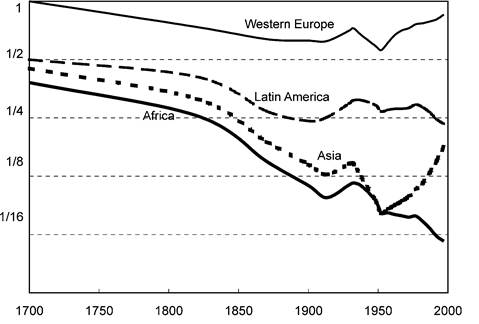
Figure 1. Evolution Ofinternational incomes: 1700-1990 (fraction of leader). Source: Maddison (1995).
A theory of the evolution of international income levels must account for these facts. The theory must generate an initial period with living standards at the pre-1700 level followed by a long transition period to modern economic growth. The theory must generate different starting dates for the transition to modern economic growth across countries. Namely, it must identify some factor or set of factors that differ across countries and that delay the start of the transition by as much as two centuries.
The theory must also account for the sizable and persistent differences in living standards that characterize the experience of some countries that have been experiencing modern economic growth for as long as 100 years. Finally, the theory must be consistent with growth miracles, namely, the large increases in relative income experienced by some initially poor countries in a relatively short period after 1950.There are well-tested theories of some of these phenomena, but not a comprehensive theory that accounts for all of them. This essay unifies these well-tested theories and examines whether the unified theory can account for all of these phenomena.[249] A well- tested theory of the first phenomenon, namely, the pattern of an initial period of stagnant living standards followed by a transition to modern economic growth, is provided by Hansen and Prescott (2002). The Hansen and Prescott theory is a combination of two long-standing and successful theories: the classical theory of the pre-1700 period and the neoclassical theory of the post-1900 period.
The classical economists, in particular, Malthus (1798) and Ricardo (1817), developed a theory that accounts well for the constant living standard that characterized the pre-1700 era. The main feature of this theory is an aggregate production Frnction characterized by fixed factors, the most important of which is land. With this traditional production function, increases in knowledge lead to increases in output that are completely offset by increases in population. As a result, living standards do not increase. Economists have also had for a long time a good theory of modern economic growth that has characterized the United States and much of WesternEurope since 1900. Solow (1970) developed his growth model specifically to account for this post-1900 pattern of growth. The main feature of this theory is also an aggregate production function, but one with no fixed factor of production. With this modern production function, improvements in technology that lead to more output being produced with the same resources are not offset by increases in population.
As a result, living standards rise.Hansen and Prescott (2002) unify the classical and modern growth theories by allowing people to use both the traditional production function and the modern production function. They show that when total factor productivity (TFP) associated with the modern production function reaches a critical level, the economy moves resources out of the traditional sector and into the modern sector. This is the date at which the transition begins. The transition is found to last a long period, roughly a century. The model thus gives rise to a pattern of economic development characterized by a long initial period of economic stagnation, followed by a long transition, followed by modern economic growth, as observed in Western Europe and countries settled by Western Europeans.
The Hansen and Prescott theory is not a theory of the evolution of international income levels because it does not address the issues of different starting dates of the transition to modern economic growth, sizable income differences for countries experiencing modern economic growth, and growth miracles. Some factor that differs across countries must be added to the Hansen and Prescott theory to make it a theory of the evolution of international income levels.
Parente and Prescott (2000) develop a theory that accounts for the sizable differences in living standards for countries experiencing modern economic growth and that accounts for growth miracles. More specifically, they develop a theory of country-specific TFP and then introduce this factor into a model in which only the modern production function is available. Their theory of country-specific TFP, which they refer to as a theory of relative efficiency, is based on policy differences. More specifically, they show how various policies that constrain choices of technology and work practices at the level of the production unit determine the aggregate efficiency at which a country uses its resources in production.
The development of a theory of relative efficiencies is essential. Despite the fact that there is ample empirical evidence that countries differ in relative efficiencies, a theory of international income levels that takes countries’ TFPs as exogenous is sterile, because it offers no policy guidance.In this chapter, we augment the Hansen and Prescott theory of economic development with the Parente and Prescott (2000) theory of relative efficiencies and show that the resulting unified theory is a theory of the evolution of international income levels. In this unified theory, a country begins its transition to modern economic growth when the efficiency with which it uses resources in the production of goods and services in the modern sector reaches a critical point. Countries reach this critical level of efficiency at different dates not because they have access to different stocks of knowledge, but rather because they differ in the amount of society-imposed constraints on the technology choices of their citizenry. After a country reaches this critical point it begins to grow, and its income gap with the leader eventually stops increasing. This gap only decreases if there is a subsequent increase in the efficiency at which the late starter uses resources in the modern production function. A large increase in a late starter’s relative efficiency is the result of improvements in its policies and institutions.
We show that plausible differences in efficiencies delay the start of the transition to modern economic growth by more than two centuries, as observed in the data. We also show that sizable differences in living standards persist between countries that have been experiencing modern economic growth for as long as 100 years. Lastly, we show that a large increase in a late starter’s relative efficiency can give rise to a growth miracle, as observed in Japan, South Korea, and Taiwan. Thus, the unified theory accounts for the way international income levels have evolved.
The chapter is organized as follows. Section 2 starts with a review of the classical theory of the pre-1700 income level followed by a review of the neoclassical growth theory of modern economic growth. It then concludes with a review of how Hansen and Prescott (2002) combine these two theories into a single theory of economic development. Section 3 deals with the second component of the theory, namely, differences in efficiencies. It reviews the Parente and Prescott (2000) theory of relative efficiencies. Section 4 presents the unified theory of international income levels. In Section 4 a model based on the unified theory is developed and calibrated to the U.K. and U.S. development experiences over the last three centuries. The calibrated model is used to examine the effect of differences in efficiencies across countries on the start of the transition to modern economic growth and the effect of an increase in a country’s efficiency on the subsequent path of its per capita GDP Section 5 examines the development experiences of individual countries and groups of countries over the last three centuries within the context of the theory. Section 6 concludes the chapter.
2.