Introduction
The Dream
Imagine a place of great beauty, where every detail — from the bench you sit on, to the lamp that illuminates your street — is crafted with the essence, artistry, and finest materials of your region.
How were societies able to afford such grand architecture hundreds of years ago, while today’s cities are adorned with grey concrete and glass? Do you dream of going to work without commuting through traffic? Consider a place where space is abundant and used wisely — where you could enjoy the sights without worrying about car pile-ups, stop-and-go highways, and busy streets.Good infrastructure always seems to be in short supply, and governments often have difficulty funding it. When it is built, the value of the land near the infrastructure rises in value, and its owners reap the benefits, but the rest of the community doesn’t gain. In fact, it makes it more expensive and less accessible to you. Wouldn’t you too like to benefit from these projects in some way? Do you wonder why your community can never seem to afford adequate infrastructure no matter how much the economy grows?
We allow space to be taken from us and monopolized. We no longer control our skylines nor how our buildings look. Space is taken and used inefficiently. Land is not treated as precious, despite its scarcity. Is a single-storey parking lot the best use for prime real estate when it could accommodate more levels? How about vacant homes used by speculators, or held empty by banks; could those not be put to better use? Those who were lucky enough to be born in years past managed to monopolize space at a lower price; space that their children now cannot afford. Meanwhile, our tax dollars are being used to build infrastructure near other peoples’ homes, while a few lucky homeowners benefit and see their property values soar. Those same people lose their incentives to work as they earn more from speculating on property.
Imagine being rewarded for your hard work, instead of having your income taxed away — and often squandered — by your government. If you work, and are contributing to your family and to society, why should you have to worry about your earnings; shouldn’t you have ample to live, eat, and enjoy life? If you’re struggling with low wages and high prices, does it make you feel underappreciated by your workplace and society at large? If you’re a higher income earner, who worked hard to achieve such a salary, is it not unfair that the government takes half your wages? Shouldn’t your efforts be recognized?
And why, despite revolutionary communications technologies, are we wasting so much time each day on inconsequential tasks? Commuting to work, following trivial rules, and endless bureaucracy are monopolizing precious time. Why are our working hours growing longer while our national wealth and productivity grows with new technology? Finally, we ask why, despite our modern production techniques, are goods built to lower standards, with planned obsolescence?
We think it’s time for something new.
Who are the New Physiocrats?
The New Physiocrats are a political-economic framework and certification body. We are a movement established on a new way of economic thinking, what we refer to as the “New School of Economics.” We completely transcend left and right wing politics, and we are not a compromise between the two. We stand for natural fairness and justice, as opposed to artificially engineered outcomes that are imposed upon us. We support individuals doing what they enjoy, and what they do best; respecting individuality, not equity of outcomes. We ensure that individuals are fully compensated for their efforts. We believe in maintaining and promoting the cultures, traditions, and architecture of each region, so that the world has variety for us to enjoy.
We guarantee dramatically rising purchasing power for all citizens with our program, not only through the vagaries of good policy, but also through direct cash payments.
With fascinating, innovative policies, we promise opportunities for all, not just a select few. We pledge to do so while simultaneously providing the absolute best environment for entrepreneurs and business, and while preserving and restoring our natural environment. We believe in eliminating waste and misuse of our physical space, so that we all have plenty to live in. We believe in maximizing our free leisure time, so that there is vastly more for everyone. We believe in long-term thinking, not strictly short-term decision making. And what’s even more unique? We accomplish this through a series of automatic mechanisms that are built in to our new system, as opposed to tiresome bureaucracy and political squabbling.This is not a platform that can be implemented piecemeal — it is a sum of its parts. Each piece of the platform machinery depends on another. Remove one, and the others stop. Implement them all, and a new, bright vision for the world, and for our lives, can begin.
The Decline of Current Market-based Models
Each economic school of thought over the past half-century failed to produce its stated outcomes. In periods before that, those that did achieve success proved they could not deliver sustainable results.
These goals included: providing a high standard of living for the entire population, eliminating poverty, full employment, complete capacity utilization, high growth rates, eliminating boom-bust cycles, efficient allocation of resources, and social cohesion. Policies implemented to achieve these outcomes at times produced positive results, but they were limited.
Mercantilism (the pursuit of trade surpluses above all else) stifled healthy competition, limited consumer choice, and resulted in imperial wars over resource acquisition. Marxism, in its various forms, requires no introduction. Severe misallocation of resources, a lack of incentives, and curtailed liberties sealed its fate in history. Asian corporatist economies, Anglo-Saxon market economies, and Nordic social democracies were arguably the most successful.
However, even these models reached their limits, and their flaws were exposed. The Asian model suffered through bouts of serious resource misallocation and bad loans — hallmarks of state-directed growth. Japan was the poster child for these issues with its lost decades, and China eventually faced its own challenges. Anglo-Saxon economies struggled with stagnating median incomes, financial crises, widening inequality, and a loss of their national unity. A lack of national identity led to regional independence movements. The Nordic model invited the indolent, and those with sinister intentions, to take advantage of its generous welfare state; and left its hardest working contributors under a burden of painfully high taxes on their labor.These market-based models (including the Asian, Anglo-Saxon, and Nordic variations), combined with increased global trade were all largely successful in creating wealth and innovation. They were typically combined with a degree of income redistribution, regulation, and purposeful market distortions, to varying degrees of success. There was a difficult balancing act; redistribution versus incentives for productivity, regulation versus innovation, free trade versus concerns over current account balances, and environmental/consumer/labor protection versus growth. There was no common ideology, direction, higher purpose, or unifying theme in these models — pragmatism was an advantage — but in most instances, it did create a high and rising standard of living for a large segment of the population. However, it eventually became apparent that there were limits to this progress.
None of the models successfully handled cyclical turndowns, or even periodic wrenching economic adjustments. Capacity, particularly labor, had rarely been fully utilized in most economies. Poverty, unemployment, and underemployment left many citizens suffering and without a sense of purpose. One of the oddities in some economies was an increase in total working hours despite rising productivity, in addition to low labor market participation, resulting in an unequal distribution of free leisure time.
The majority of the models eventually either handicapped innovation and entrepreneurialism, or did not spread its benefits to a broad enough swath of the population to keep them placated.The increase in world trade that had produced so much wealth and efficiency has benefitted many but passed many others by. In addition to the documented shifts in the labor market, global trade also turned the world’s cultural mosaic into a monoculture, beyond what the globalization of media achieved on its own. Traditional cottage industry, artisanal crafts, and small-scale workshops were displaced by larger, more efficient, global operations. Although these outcomes were a net productivity gain to the economy, the dangerous rise in nationalist sentiment reminded us of the hidden cultural value of the traditional small-scale enterprise and traditional lifestyles, and what was being lost in the pursuit of economic growth. Enterprises that became too big to fail held economies hostage, not allowing for needed economic corrections.
Free trade without free movement of labor meant that people could not freely chase jobs that were relocated as a result of the trade policies. Free trade with free movement left many people with a fear of losing their sense of national and regional identities. Specialization and comparative advantage were real, but they began to feel more like a narrower range of employment options in each domestic market. Meanwhile, those who were willing to follow their jobs abroad had their movement constrained by arduous work visa regimes. Resource-rich countries that experienced the benefits of specialization during high commodities prices, were later shocked by price swings, as their current accounts were perilously reliant on an increasingly narrow range of exports.
There was no question that the free trade model offered many benefits, efficiencies, and new opportunities. Low prices were a godsend for many, and savvy entrepreneurs found vast opportunities. However, eventually the increasing returns to scale reached their limits, competition reached its apex until export subsidies and distortions resulted in fewer competitors.
Not all participants were playing by the same rules. At some point, people began to question what they sacrificed and what they received in return.Polls understated the discontent of a forgotten underclass, concealed in labor force participation statistics that don’t appear in headline unemployment figures. By the mid to late 2010s, a new breed of leaders emerged to collect their votes. These were leaders willing to use the heavy-handed measures that society demanded. People stopped believing in the benefits of restrained, indirect policies, became disillusioned with the old economic models, and were more willing to engage in policy experimentation. However, even these new leaders did not have a coherent model, ideology, or effective policy toolset to implement the desired changes. Moderates ruinously ignored the importance of culture and tradition leaving sinister, cunning politicians to address them. Some of the new leaders were reckless, and others channelled the public’s discontent into darker, negative forces.
The most skilled and successful in society, those who were most needed to support any economic system, were bogged down by increasingly heavy income taxes. Their incentives to generate output eventually dwindled. Innovators became less innovative, productivity growth continued to slow, and as professionals found solace instead through passive investing and real estate speculation, the market no longer sought out essential data to allocate resources effectively. The talented class fled to seek employment elsewhere, along with overtaxed, overregulated businesses, which shifted their profits and operations offshore. No matter how low interest rates fell, new growth was harder to spur. The continuous monetary infusions by central banks were channelled into real estate more than ever before, and only resulted in asset price gains. Real-estate hoarding and speculation — while adding little societal value — became once again the road to personal wealth for many, while new home buyers were priced out of the market or saddled with increasingly large mortgages. Old habits would die hard, and lessons from the late-2000s crisis were quickly forgotten.
These challenges were the new reality, and this is why society cried out for a new school of economic thought. So without further ado: Welcome to the New School of Economics.
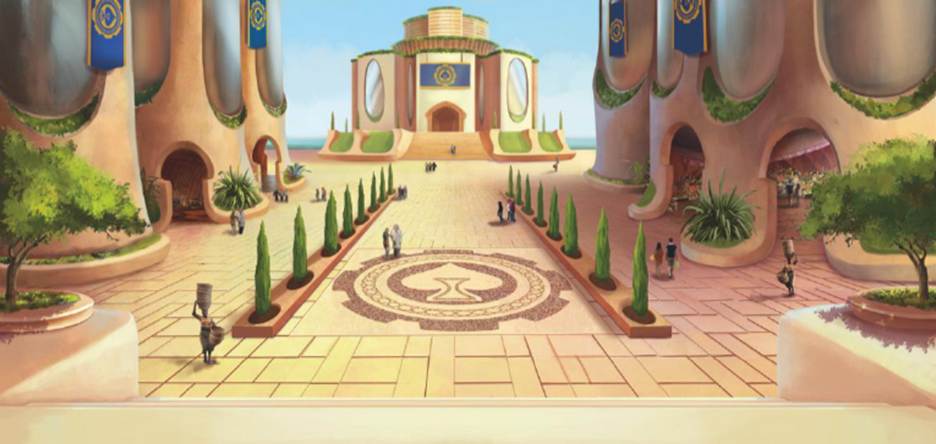
A digital rendering of how a new Nigerian capital city would appear under a New Physiocratic regime. Stay tuned and view our homepage (www.newphysiocrats.org ) for variations of these renderings, to illustrate how cities would appear in other countries. Thanks to Kristina Dancheva for the illustration.