The New School of Economics draws upon principles of nature, biology, and human society in its most natural state; forces that must be respected and channelled not fought against.
Learning from economic history, tradition, and the accumulated knowledge of the Stoics, Physiocrats, and Georgists, the New School of Economics rediscovers long-known principles that guide economies, human behavior, and aspirations.
It then analyses modern economic history and our most recent crises, and uses these lessons to form a comprehensive platform to address economic, political, and social ills like no other platform can.Although the Stoics (until the 3rd century BC), the Physiocrats (18th century), and the Georgists (19th century) all play leading roles in New Physiocratic philosophy, we see the original Physiocrats as our forefathers of policy. The word Physiocracy translates as “Government of Nature.”
Many historical figures have observed the unique role that land (physical locations) plays in society and the economy, and how it can be utilized in policy to achieve justice. However, it was the original Physiocrats of 18th century France who developed the first comprehensive economic model, and it was a model which saw land at the core of production. Adam Smith later expanded on this in the Wealth of Nations by including land as one of the three factors of production; a factor later buried by more recent schools of economic thought. Henry George, the father of a movement now known as Georgism, contributed the most to spread this message. While encompassing a diverse range of views, we consider these economists (who highlighted land as a factor of production) as an extension of the original Physiocrats. After being buried in the history books, the New School of Economics resurrects the key findings of the original Physiocrats, and builds on its observations. It is from them who we derive our name, the New Physiocrats.
Out of movements such as Georgism (and the Physiocracy movement that preceded it) grew an economic platform from some of this knowledge, it has proven impractical for the modern world and never developed into a comprehensive ideology.
This is despite how economists from both the left and right have wholeheartedly endorsed Georgist policies, in particular the land value tax. These movements defined space (specifically land) as a product of nature, and as something to be treated as the commons, while ignoring all other factors. As our knowledge grew, we discovered the relationship between space and time. As our societies evolved, our understanding of what comprised the natural commons changed. The demands of society changed as well. Yet these political movements did not. And because they didn’t adapt to our modern conditions, they were long forgotten.The New School of Economics expands on this old knowledge, modernizes it for the context of today’s society and economy, and formulates a complete ideology inspired by nature and biological reality. The political manifestation of the New School is our organization: the New Physiocrats.
Under the program of the New Physiocrats, products of nature, which our labor never built or earned — summarized as time and space — must be treated as the commons, as should products of culture, health, and society. So should products created by society itself, such as the legal system. However, earnings from human labor and creativity must be left in the hands of their creators. We earn what we create, and it should not be taken away from us. In fact, what we earn from our creations must be encouraged and magnified.
Since previous generations of economic models, we have learnt much about the unavoidable and beneficial behavior of nature, and of ourselves. We have observed the interplay between time and space. We have seen how species improve over time by allowing only the best traits to survive. We’ve observed how all the components of an ecosystem work together symbiotically to create a natural balance. Participants in an ecosystem all have completely different strengths, different interests and needs. Yet in nature, they are each using their position to the best of their advantage, and in doing so, strike a certain balance and harmony that keeps the ecosystem alive.
It is a system based on merit; and merit is a core principle of the system we advocate. It is not always pretty, but it is an unavoidable force. It is also a force that can be channelled to the benefit of all. This is the lens through which the New Physiocrats view the economy, society, and government. A market that operates more effectively than any in history; one which minimizes distortions, functions in accordance with these rules of nature, and allows each individual to pursue their strengths and interests, is a central element of this vision. However, an economy which achieves these aims has yet to be realized anywhere, and can only do so by applying the New Physiocratic principles in their entirety.These concepts of nature must also apply to government. Today’s democracies theoretically evolve in the same way as an ecosystem, or a market. When different needs arise from society, new parties can form, or new segments can form in existing parties, to capture the new voting blocs. The parties, which don’t respond to these needs in time, die off. Yet in reality, democracies often fail to represent the interests of both individual segments of society, and the country as a whole. Byzantine political rules, gerrymandering, and corruption all work against the system. Furthermore, in democracies that are more representative of the populations they rule, the system can also work to the country’s detriment. Conflicting interests in government either work against each other to get nothing accomplished, or favor interests with the loudest voices and the most lobbying power.
The New Physiocrats see countries and societies (and by extension their governments) like an ecosystem in itself. Each segment has its own conflicting requirements and interests, and its own strengths. Yet each has its own unique, irreplaceable function. Only by voicing the interests of each segment, reconciling their differences, and by having a mechanism in which to do so (within democratic framework), can the ecosystem progress as a whole.
This mechanism is what makes the New Physiocrats’ system of government different from the rest.Finally, the New Physiocrats observe the empirical evidence from other countries and regions to decide on the most effective policies that are in line with the ideology and maximize positive outcomes. They also learn from the successes, failures, and crises of other countries and develop innovative, streamlined solutions to mitigate problems. The New Physiocrats have a deep respect for history and tradition, viewing it as a distillation of millennia of lessons; yet it does take them at face value, and views them analytically and with an open mind.
Our goals can be summarized as democratizing the products of nature and society, while maximizing the private ownership of the products of our labor. We define nature as both time and space, with space including not only land, but also visual space, air, and other products of the environment. We realized this was the first step to modernizing Physiocratic ideology, to create a generation of New Physiocrats.
This translates into a system that ensures our time and space is used effectively, to guarantee that everyone can easily afford a place to live, can enjoy the great beauty of our landscapes and architecture, have clean air to breathe, and maximize their free time; unimpeded by bureaucracy, commuting, lengthy legal battles, and long working days. Conversely, products of our own efforts, are ours to keep. Although some dues are owed to the system that enables our efforts, our labor must be fully compensated.
It is impossible to predict where and when the next economic shock, or the next economic opportunity might arise. The New Physiocrats do not attempt to do the impossible task of prediction and planning. Instead, this platform, of the New Physiocrats, aims for preparedness and flexibility. It’s a system that maximizes economic diversity and policy tools so that countries can deal with these changes as they emerge.
It also employs automatic mechanisms, which provide individuals and business with their share of the nation’s financial success, to amass large savings in the event of shock, and to better feel the rewards and consequences of their elected policies.With these principles in mind, we envision a system where products of nature (such as land) are taxed, and where taxes on labor (income) are minimized, or even subsidized. It is also a system where we have a say in how our spaces (cities and landscapes) look, and where we have an abundance of free time to pursue our own interests and desires. We envision a system in which we see the results of sound economic policy immediately, through automatic cash transfer mechanisms, rather than waiting indefinitely for our efforts to bear fruit.
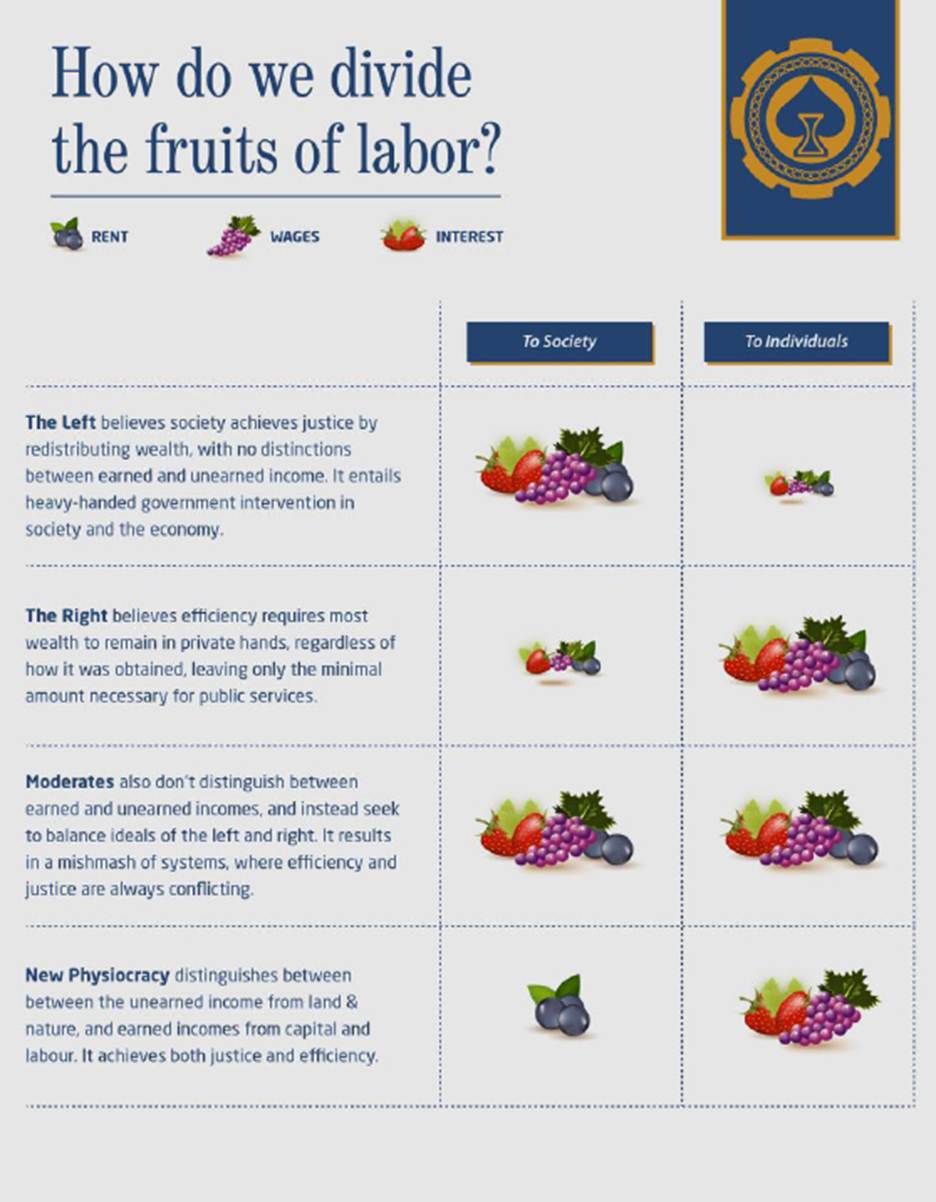
Rent, in the economic sense, is defined as income made as a result of special privilege (such as licenses, patents, and monopolies) granted over natural opportunities. This includes the monopolization of locations; land ownership.