Key Ideas for the New Economics
The Polya urn process provides us with potentially rich applications to analyze many important problems. In the above, we have examined some particular variations of the Polya urn process.
However, one of major challenges to generalize our stochastic arguments depends on how to deal with the unknown agents. Without improving such an analytical modeling, we could not deal with how mutants will emerge. So our new economics need to learn how to formulate the unknown agents in the Polya urn process. This idea will generalize the framework of economic science.5.4.1 The Economics of the Master Equation and Eluctuations
The stochastic evolution of the state vector can be described in terms of a master equation, such as the Chapman-Kolmogorov differential equation system. The master equation leads to aggregate dynamics, from which the Fokker-Planck
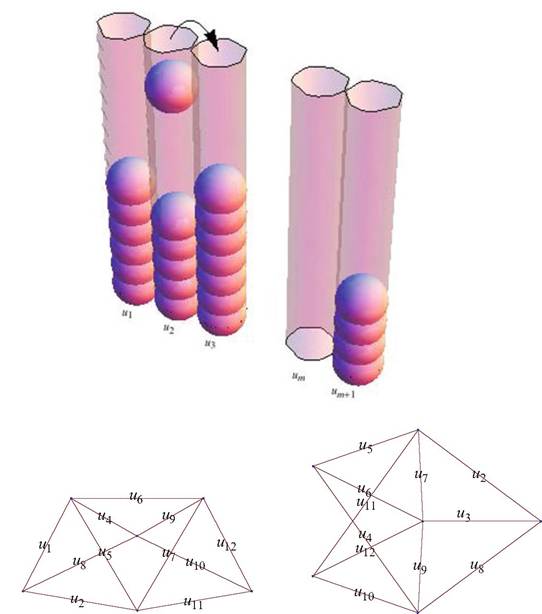
Fig. 5.14 The equivalence between a network connection and a Polya urn process
equation can be derived. We can therefore explicitly argue that there are fluctuations in a dynamic system. These settings can be connected with some key ideas, making it possible to classify agents by type in the system, and to track the variations in cluster size (Aoki and Yoshikawa 2006).
In Aoki’s new economics, there are exchangeable agents in a combinatorial stochastic process, like the urn process. The exchangeable agents emerge by the use of random partition vectors, as in statistical physics or population genetics. The partition vector provides us with information about the state. We can then argue the size-distribution of the components and their cluster dynamics with the exchangeable agents.
Suppose a maximum countable set in which the probability density of transition from state i to state j is given.
In this setting, the dynamics of the heterogeneous interacting agents gives the field where one agent can become another. Unknown agents can also be incorporated.5.4.1.1 A K-DimensionalPolyaDistribution
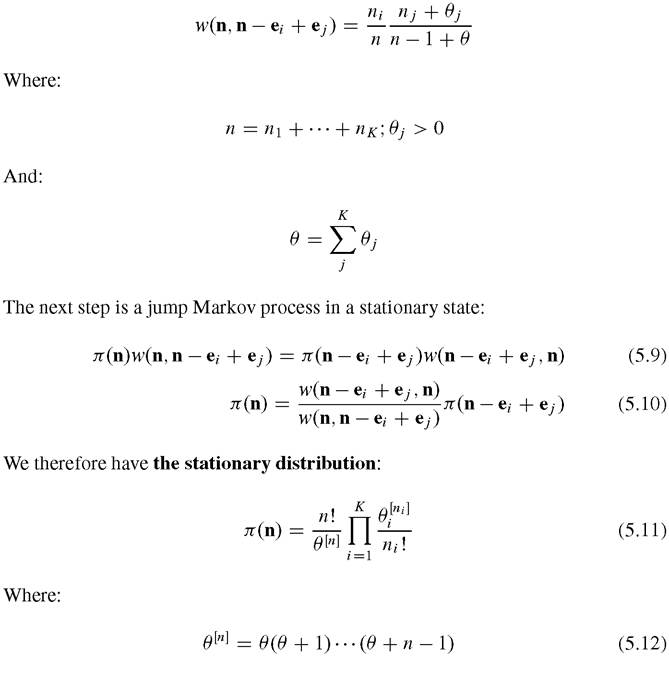
We make a K-dimensional Polya distribution using parameter θ. We then have a transition rate:
5.4.2 A General Urn Process
Suppose that balls (or agents) and boxes (or urns) are both indistinguishable.
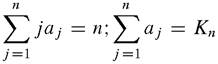
We then have a partition vector:

ai is the number of boxes containing i balls. The number of balls is:

The number of categories is:
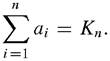
Kn is the number of occupied boxes.
The number of configurations is then:

5.4.2.1 A New Type Entry in an Urn Process
Let a be a state vector. Suppose that one new type agent enters an empty box. We then have the equation:

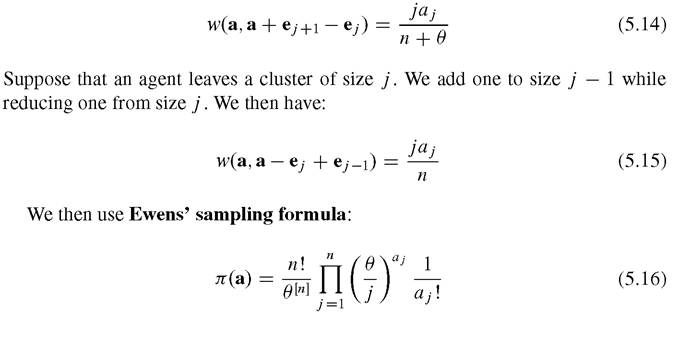
Where:
The probability that the number of clusters is k


In this case, the boundary conditions will be:
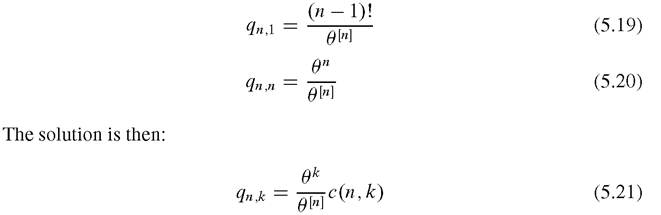
where

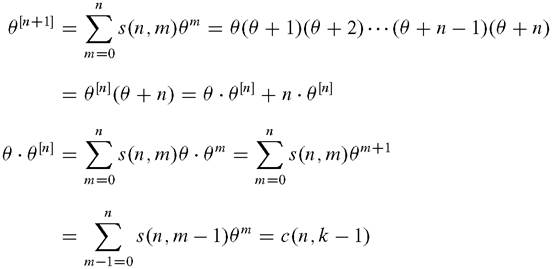

The final equation is called the signless Stirling Number of the first kind.
5.4.3 Pitman’s Chinese Restaurant Process
We suppose that there are an infinite number of round tables in the Chinese restaurant that are labeled by an integer from 1 to n. The first customer, numbered 1, takes a seat at table number 1. Customers No. 1 to No. k in turn take their seats at their tables from No. 1 to No. k. The cj customers take their seats at the j-th table (Pitman 1995; Yamato and Shibuya 2000, 2003).
The next arriving customer has two options: either a seat at the k-th table, with the probability:
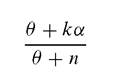
or at table j, one of the remaining tables j = 1, ∙ ∙ ∙, k, with the probability:
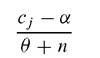
Two parameters, θ and a, are used, so we obtain the solution:

Where:
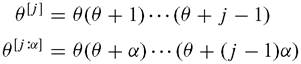
Ewens’ sampling formula Ewens (1972) gives the invariance of the random partition vectors under the properties of exchangeability and size-biased permutation. The Ewens sampling formula is the case with one parameter, a special case of two- parameter Poisson-Dirichlet distributions:
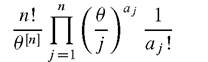
In the case of the two-parameter Poisson-Dirichlet model, we will be faced with a non-averaging system as the limit.
Summing up, we should be keen to incorporate these ideas into the standard framework of economic science, As Aoki and Yoshikawa (2006,2007) challenged.