Some Instances of Technological Innovations in the Complex Market Economy
Mainzer recommended considering fluctuations of a minimum quantity in a critical situation. Symmetry breaks down by itself. The minimum quantity then evolves by itself. This is crucial for the whole universe.
It is reasonable to look to biological evolution to understand the evolution of technology. These views led to the idea of creative coincidence in human history. This idea may also be applied to technological innovation, when its application suggests that a new idea will replace an old through Schumpeter’s famous creative destruction.[61]5.3.1 Redundancies and the Depth of Logic Contained in a Complex System
The redundancy of a DNA sequence is the result of largely random evolution over millions of years. The algorithmic complexity of DNA will therefore lie between random and perfect regularity of structure. Because of its redundancy, the algorithmic complexity of a DNA sequence s is reduced, and can be described by a shorter program s*, which is a more compact source of information that requires effort to implement the complete description of s. Genetic information is therefore an example of a sequence with a high logical depth (Mainzer 2007, p. 156).
There are two important ideas here: high and low complexity and logical depth.
High/low complexity: Define the probability Ps, by a program that produces a random sequence s as output. By l we denote the length of program delivered. For binary sequences of length l there are 2l possible combinations. Then 2~l is the probability that the program p of length l is chosen, which is equally likely among the sequences of this length. Ps can now be the sum of all probabilities 2~l, for all random programs of output length l. We can then prove that Ps = 2_K(s) in respect of the algorithmic complexity K(s) of the sequence s.
It follows that sequences with low complexity are more likely to occur than those with high complexity. We can then assume that in the sets of two sequences, the shorter sequence is the most likely to occur. The shorter programs contribute more to total Ps over all programs with output s (Mainzer 2007, p. 157).Logical Depth: With the algorithmic probability Ps for a randomly generated program’s output, we now have a measure of the logical depth of s. A sequence s has logical depth when the largest proportion of Ps is contributed by short programs that require a large number of computational steps to produce s. For example, DNA sequences that have evolved over millions of years, with many redundancies and contingencies, can generate an entire organism through compact programs that require an enormous number of computational steps, and therefore have considerable logical depth.
5.3.2 Innovation and Techno-Culture
A complex system with a greater logical depth may add some elaboration at each stage. A degree of redundancy is essential for generating innovation, so that a series of small changes will often lead to much greater innovation. In other words, a greater logical depth in engineering may lead to more elaboration with high precision and accuracy. These elaborations in essence are indifferent to a pecuniary motive or any market mechanism. It is clear that this approach underlies the traditional Japanese techno-culture.
5.3.2.1 Economy in Modern Technology
Proposition 5.1. Technology is not a subclass of the economy; it is a superclass.
This idea was put forward by Brian Arthur in his book The nature of technology. He suggested that the economy arose from its technologies, including the productive methods and legal and organizational arrangements that we use to satisfy our needs. We can say that technology creates itself from itself. Early technologies used earlier primitive technologies as components. These new technologies in time become possible components - building blocks - for the construction of further new technologies.
Some of these in turn go on to become possible building blocks for the creation of still newer technologies.Over the last ten years or so, there has been a change in the nature of innovation. Before then, it generally took a long time to create a basic and usable piece of technology from a basic principle, so companies used their technology for as long as possible, improving its efficiency but not changing it radically. Now, however, it is much easier to turn a new basic principle into stable technology, but there are correspondingly greater numbers of possible new technologies, making selecting the right one much more difficult.
5.3.3 A Creative Coincidence Connected with Hayabusa's Return and JAXA's Evolution
On June 14, 2010, the Japan Aerospace Exploration Agency (JAXA) celebrated the return of Hayabusa, a planetary exploration spacecraft. It returned from the asteroid 25143 Itokawa, named in honor of Professor Hidao Itokawa (1912-1999).
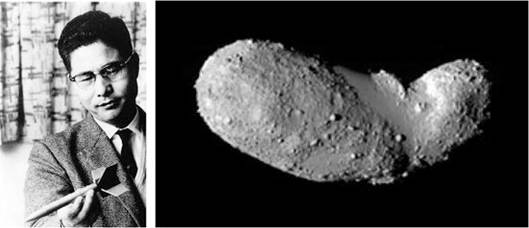
Fig. 5.10 Professor Itokawa and the asteroid Itokawa. Source: http://www.jaxa.jp/article/special/ hayabusa_sp3/index_e.html
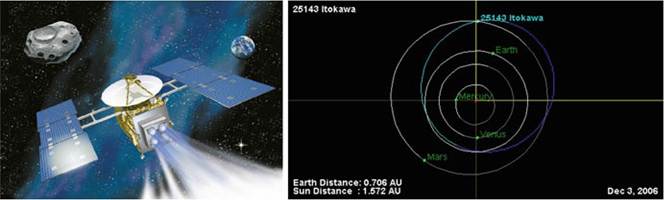
Fig. 5.11 Hayabusa’s voyage and Itokawa-orbit, December 3, 2006. Source: ISAS/JAXA Space Exploration Center (2008)
He worked as an aircraft engineer at the Nakajima Aircraft Company, and was responsible for the design of the Nakajima Ki-43 Hayabusa Oscar (Type 1 Fighter), the main fighter plane used by the Japanese Air Force throughout the Second World War. Between 1941 and 1967, he held a professorship at the department of engineering at the University of Tokyo. Despite a ban on research and education on aeronautics after the war, he continued his work.[62]
With the ban on the study of aeronautics, Itokawa first moved to the area of acoustic engineering and attempted to construct a violin.
He then used the ban as an impetus to move into the study of rocketry. This gave rise to a Japanese project around innovation in aerospace, which grew into the Japan Aerospace Exploration Agency (JAXA). The success of the Hyabusa spacecraft started from the launch of his 23-cm pencil rocket on April 12, 1955 (Fig. 5.10).The Hayabusa mission nearly collapsed several times. At each critical point, engineers cooperated to find a solution and successfully guide Hayabusa. One case provides an example of the use of creative coincidences (Fig. 5.11).
JAXA had several important objectives for both astrophysical observations and aerospacial engineering. Tasks included ion engine operation, autonomous and optical navigation, deep space communication, and close movement of objects with low gravity, as well as a challenging task of making contact with the surface of an asteroid, though this was regrettably not fully achieved.
The Hayabusa project was characterized by the following four new innovative requirements:
1. A round trip between planets using ion engine thrust.
2. Autonomous navigation and guidance from optical observations.
3. Sampling the planetary surface.
4. Re-entry into the atmosphere from an interplanetary trajectory and collection of the sampler.
These required equipment including the ion engine,[63] sampler horn, target marker, and capsule (see Fig. 5.12).
Hayabusa had four ion engines, Thrusters A to D. Each thruster consisted of two units: ion source and neutralizer. Thruster A became inactive shortly after launch, and Thruster B’s neutralizer deteriorated in April 2007, rendering it inactive. Thruster C also had to be stopped for safety reasons. On the return trip on November 4, 2009, Thruster D stopped automatically when the neutralizer deteriorated. JAXA nearly had to abandon the spaceship. Fortunately, a solution was found, and Hayabusa successfully re-entered Earth’s atmosphere, enabling recovery of samples.
The recovery was possible because of a small idea: combining the neutralizer unit from Thruster A with the ion source unit of Thruster B to create a new combined thruster, in a cross-operation. This massively increased the redundancy of operation.[64]
A cross-operation seems a smart solution, but could never be realized without valid circuit recombination. The basic technology required for this, a relay, was too heavy to include in the spacecraft, rendering a cross-operation impossible. However, the project had incorporated a new technology to achieve the same results, a single tiny diode embedded in the engine.[65]
This problem could not have been solved without this new technology. A crossoperation is a mathematical solution, but also required engineering expertise and forethought to make it possible. The use of mathematical solutions may therefore be useless without further engineering (Fig. 5.13).
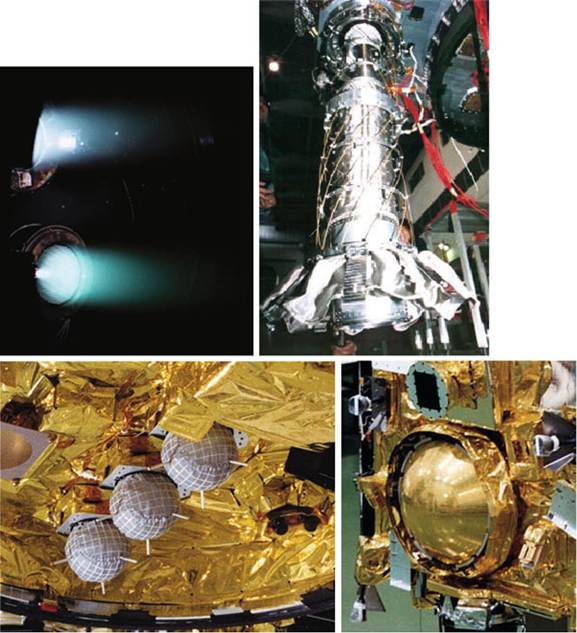
Fig. 5.12 Ion engine, sampler horn, target marker, and capsule. Source: ISAS/JAXA Space Exploration Center (2008)
5.3.4 An Assessment of the Hayabusa Mission
The history of the development of space technology in Japan was surely sparked by Itokawa’s creative inspiration as well as his interest. The Government was always reluctant to support it, so that it was largely driven by the passion of scientists and engineers. This particular mission relied on cooperation with private sector engineers. Put another way, this consortium was motivated by common academic interests.
Development was only able to continue thanks to the cost performance of solid fuel rockets. The idea of solid fuels for rocket propelling was developed by Itokawa, as a response to cost pressures after the war. JAXA’s Government-supplied budget is estimated as only one tenth of NASA’s budget. Its performance is therefore truly efficient.
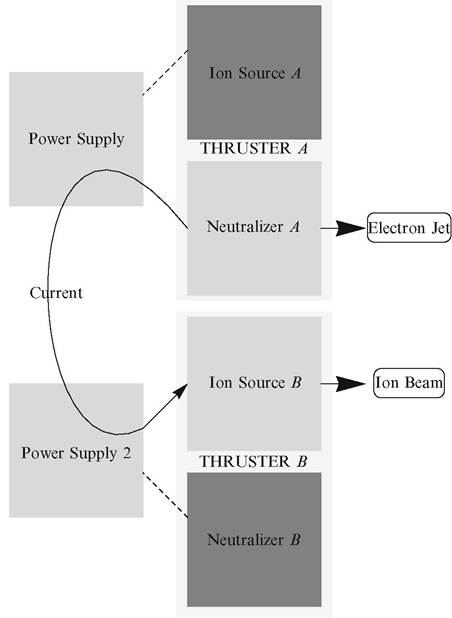
Fig.
5.13 Cross-operation for restoration5.3.4.1 Vertical Integration and the Financial Circuit
According to econophysics, the market economy usually produces a power law distribution of price fluctuations, share holdings, capital size, and sales, which is characterized by a heavy or fat tail. In other words, there is strong vertical integration in the market network. This is valued in modern markets, even though it quickly leads to a monopolistic concentration. However, vertical integration in the public sector is often criticized.
Hayek’s self-organization is triggered by a creative coincidence in the market function, but prefers a special distribution of a heavy tail to a Gaussian distribution. Put another way, his self-organized market is often doomed to become a vertically integrated economy that is heavily biased towards the financial circuit. Paradoxically, the result may not be an efficient market. A modern financial circuit cannot guarantee stability of the market or system.
Table 5.6 Barabasi rule

Source: Barabasi and Albert (1999)
Table 5.7 Ohkubo rule

Source: Ohkubo and Yasuda (2005) and Ohkubo et al. (2006)
Note: Here km is the degree of node m, and βm a fitness parameter of node m
5.3.4.2 A Complex Network in Terms of a Polya Urn Process and a Non-growing Network
Complex network analysis cannot explain circumstances with deep logic and information. However, it can be used to show that a monetary exchange system can generate a feedback system.
Recent developments of network analysis since Barabasi and Albert (1999) have tended to focus on how a network could generate a scale-free property. As complex network analysis showed, a huge network system is vulnerable to collapse following strategic aggression. This kind of vulnerability is closely connected to the scale- free property. We therefore examine a preferential attachment to a random network to see whether the network evolves as a scale-free system. Reciprocity is one of the important features of networking, and may be dominated by a type choice of preferential attachment. This analysis suggests management of complex networks is possible. More importantly, it is essentially equivalent to a Polya urn process, which may also generate the increasing returns or winner-takes-almost-all process of a modern production system.
A monetary network may be regarded as a random exchange system. Customers, however, often like a preferential attachment. Suppose that a network never grows but reconnects mutually. Ohkubo and Yasuda (2005) and Ohkubo et al. (2006) proposed a new rule for this non-growing network and also proved that the rule was equivalent to a Polya urn process. We presume a fitness parameter distribution ≠(β) = {βi g as time independent that is capable of creating a different possibility for network formation. The rule will be shown in Tables 5.6 and 5.7:
Table 5.8 A Polya urn rule

Source: Ohkubo and Yasuda (2005) and Ohkubo et al. (2006)
Table 5.9 Equivalence of the preferential random network and the Polya urn process

5.3.4.3 The ‘Rich Get Richer’ Process
Now we can show the rich get richer phenomenon on k under the Barabasi rule. The average (mean) is written as:

The probability that the node added at the s—th step becomes degree k is p(k,s,t) and the probability that the node of degree k increases its own degree is 2. We then have the equation:

which gives the solution:

If k is a large number, it leads to the power law (Table 5.8):

Table 5.9 shows the ways in which the preferential random network and Polya urn process are directly comparable or equivalent.
5.3.4.4 Interpretation by a Polya Urn Process
Suppose we have a system where there are N urns and M balls. We denote the number of balls in the urn i by ni. The total number of balls is:

We then define the energy of each urn as:

The Hamiltonian of the whole system is then:

The definition of energy may lead to attaching the un-normalized Boltzman weight to urn i :

The use of the heat-bath rule gives the transition rate Wni→ni+1 from the state ni to ni+ι (Fig. 5.14).
5.4