Measurement by means of theory
The main methodological tool of a scientific discipline is provided by its own theory. The view of theories as systems of set-theoretical structures naturally leads to a particular view of theory-application, measurement, and testing.
Typically, to conceptualize a certain phenomenon means to ‘apply’ the conceptual apparatus of the theory, fleshing out the terms with a particular concrete meaning. For instance, in order to explain a target system σ, a real and concrete human consumer, demand theory (T) requieres that σ be represented by a certain model system S, which is a consumer with unlimited memory that knows beforehand what would be his choice in confronting any budget set {x 2 X ∣px q0)). Since the agent is assumed rational, the agent must maximize (the still unknown) utility function u for each pair (p, w), obtaining (among others) the indirect utility function v(p, w), which assigns to each such pair the level of utility obtained by the agent under such prices and level of wealth. Let μ be the compensation function which assigns to (p, p0, w) the minimum cost of reaching the (still unknown) utility level v(p0, w) if the prevailing price system is p.Out of the integrability equations
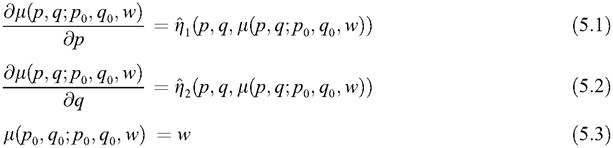
we can obtain a compensation function implicitly containing a compensation function and, out of it, it is possible to get the direct utility function solving the next problem:
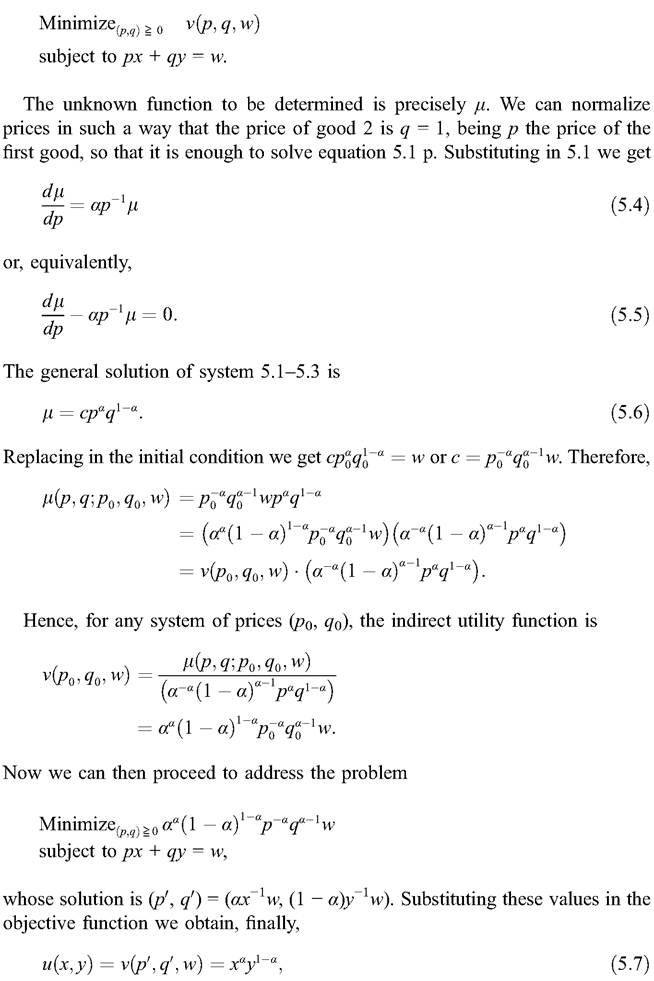
which is precisely the utility function we were looking for. Clearly, ^ turns out to be precisely the Walrasian demand function associated to u.
The non-parametric method, on the other hand, does not try to build directly the complete demand function η, but rather uses an algorithm to build directly a utility function that ‘rationalizes’ the data, provided that structure D satisfies any of the conditions of the following theorem.
5.3.1 Theorem
(Afriat) The following conditions are equivalent:
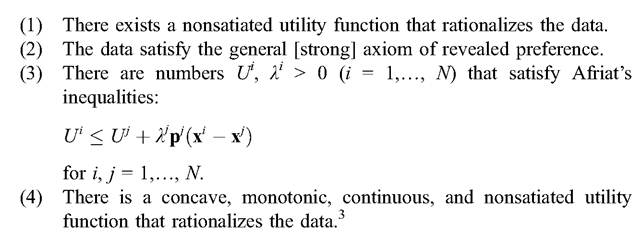
(The proof is omitted.)
Afriat (1967) and Varian (1982) provided algorithms by means of which it is possible to build a utility function u that rationalizes the data of structure D.
This is “jumping”, so to say, from a model of data to the theoretic function u. Then it is possible to imbed D into the partial structure consisting of the Walrasian demand function η induced by u. That is to say, η restricted to F coincides with ~. The parametric method, on the other hand, tries first to determine the non- theoretic demand function η without involving u and afterward tries to recover u out of η.The upshot of this example is that there are some applications of economic theories that require methods other than those of rtm in order to flesh out the terms of the theory, to actually measure the magnitudes referred to by the terms of the theory. Suppes himself used methods more similar to this (fleshing out the magnitudes out of models of data) in his classical experiments on learning theory.4
Hence, more than a method to flesh out the terms of a theory in empirical application or testing, in economics rtm seems to be rather a methodology to establish the existence of metrizations, sometimes for idealized magnitudes.
5.4