A New Production Scheme in View of the Dominance of the Service Economy
This scheme is important in the new century, with the prevalence of the servicedominant economy. This new style of production characterizes the fundamental propositions of the economy.
In advanced countries, the ratio of service production to GDP is formally estimated to be over 70 percent on average, but this estimation excludes service activities in manufacturing industries. Taking the service activities of the ICT industry as an example, a major company like IBM often earns over two-thirds of its pre-tax income from service provision, as Fig. 1.2 shows. High productivity in manufacturing may therefore be mainly from service activities, so it is vital that we understand the essential features of service production and the service economy.The attributes of a service, as distinct from a tangible good, may be defined as follows:
1. The service is intangible
2. Provision and consumption cannot be separated, but must occur at the same time
3. It will have different effects for different people, especially in terms of physical efficiency and mental satisfaction
4. Stock (inventory) is either perishable or cannot be held
5. The customer participates in a value assessment process
It is possible to define service-dominant logic following the work of service scientists.[7] They defined service as “the application of specialized competences (knowledge and skills) through deeds, processes, and performances for the benefit of another entity or the entity itself”.
According to Vargo and Lusch (2004b), there are ten fundamental principles of service-dominant logic in a socioeconomic system:
1. Service is the fundamental basis of exchange.
2. Indirect exchange masks the fundamental basis of exchange.
3. Goods are distribution mechanisms for service production.
4. Operant resources are the fundamental source of competitive advantage.
5. All economies are service economies.
6. The customer is always a co-creator of value.
7. The enterprise cannot deliver value, but only offers value propositions.
8. A service-centered view is inherently customer-oriented and relational.
9. All social and economic actors are resource integrators.
10. Value is always uniquely and phenomenologically determined by the beneficiary.
It seems reasonable to change our view of production to one of service dominance. This new view suggests a Copernican revolution of economic theory as an economic science. An attempted change such as the introduction of bounded rationality, which is similar to attempting to introduce epicycles to justify geocentrism, will no longer suffice to rescue the old-fashioned view. Therefore, the way that we produce and consume has changed profoundly, and a structural change is required that accommodates the unpredictability of human behavior.
1.1.2.1 The Collapse of Market Independence
Alongside the transition of the economy towards service dominance, we also face the collapse of market independence. This phenomenon may reinforce the econ-
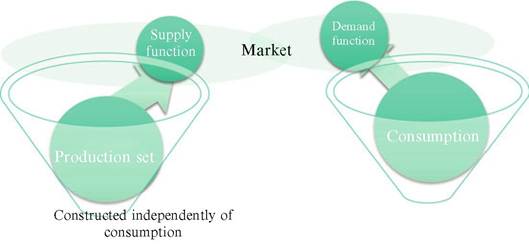
Production set n Consumption set = 0
Fig. 1.3 Independence of the market
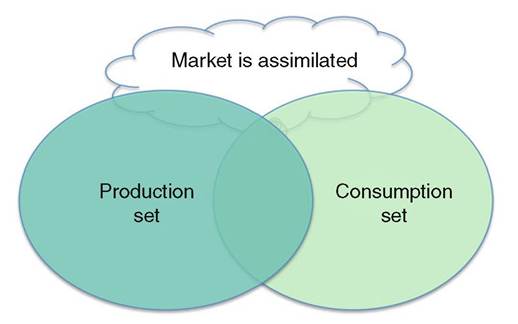
Fig. 1.4 Assimilation of the market
omy’s dependency on the financial sector, as shown in Chaps. 4 and 5. In traditional economic theory, the market is independent of production and consumption. The supply curves are independently derived from production, which itself is separate from consumption. Likewise, the demand curves are independently derived from consumption (the utility function, for instance). The market is simply defined as the field for the interaction between the supply and demand curves, which are mutually distinct, as shown in Fig. 1.3. However, as service dominance develops, this will change, and market independence will break down. Some of the market activities will be internalized into production and consumption, as shown in Fig. 1.4.
I conclude, therefore, that traditional economics has been restrictively limited, especially in terms of its links to actual activities. In Chaps. 4 and 5, I will discuss this transfiguration of market image, but before that, I will examine why and how traditional economics has been forced ever further from reality. It is but a short distance from the doctrines of political economy to the doctrines of economics.
1.2