The Classical Production Scheme
For future reference, I will summarize here the traditional production scheme. We are used to a time profile of production starting from the initial period, when the primary factor enters the process, through the intermediate product, to the final one.
There are two kinds of primary factor: land and labor. “Consumption”, the final column of the table, is outside the economic process. This means a complete separation of production from consumption. The traditional production scheme cannot help but be broken down if there is any intersection between production and consumption. The introduction of service-dominant processes suggests the emergence of such an intersection (Fig. 1.1).The actual time profile may become much more complicated with the existence of durable capital goods. The diagonal elements on the table show the vertically integrated process in this scheme of production, while the rows show the horizontally cross-operated process. The gray cells {κ1(0), κ2(0)}, {t1(1)}, {f1(2)} show the time structure of production. The bold framework shows the input-output relationship, with the time structure synchronized as a simultaneous system of production of general form with multiple final products, i.e., a joint-product system (Table 1.1):
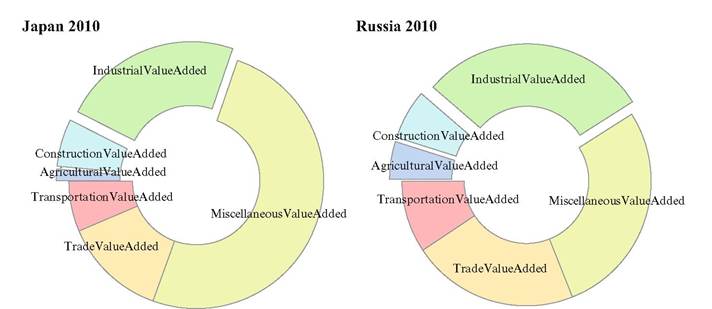
Fig. 1.1 ContributionofGDPindustries
Table 1.1 The classical production scheme
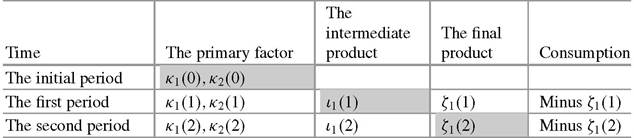
Table 1.2 The simultaneous system of production
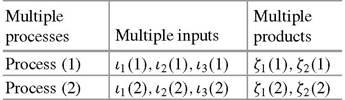
Note: This is an extension of Table 10.1 in Aruka (2012, p. 165) from a single durable capital good to multiple durable capital goods
In Table 1.2, the periods can be interpreted for process 1, 2, and so forth, by dropping the times and establishing the von Neumann balanced growth scheme of production first generated in the 1930s.[6]
The replacement of land with capital as a primary factor has been promoted because of the prevalence of the Cobb-Douglas-type production function since the 1930s.
However, its replacement was not recommended in a scientific sense, because capital is currently used as a reproducible good except in particular circumstances. Capital, after industrialization, must not be primarily perpetuated in a natural sense.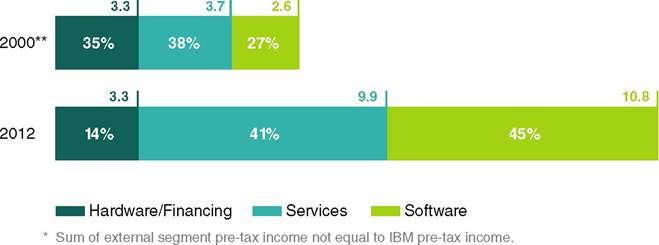
** Excludes Enterprise Investments and not restated for stock-based compensation. 2000 Segment PTI is reclassified to conform with 2012 presentation.
About 50% of IBM segment profit expected to come from Software by 2015.
Fig. 1.2 Pre-tax income of IBM in 2012. Source: 2012 IBM Annual Report (IBM 2012, p. 9)
Capital is merely an intermediate product even if it can be carried over for more than 1 year. Capital, in the production function, is a real product (and not financial) if its durability is a year, and a virtual intermediate product of a fictitious process if its durability is more than a year. Capital cannot be given the same status as labor in the production function.
1.1.2