A simple idea-based growth model
3.1. Themodel
It is useful to begin with the simplest possible idea-based growth model in order to see clearly how the key ingredients fit together to provide an explanation of long-run growth.
To strip the model to its essence, we ignore physical capital and human capital; these will be introduced in the richer framework of Section 4.Suppose that in our toy economy the only rivalrous input in production (the X variable in the Introduction) is labor. The economy contains a single consumption good that is produced according to

where Y is the quantity of output of the good, A is the stock of knowledge or ideas, and Ly is the amount of labor used to produce the good. Notice that there are constant returns to scale to the rivalrous inputs, here just labor, and increasing returns to labor and ideas taken together. To double the production of output, it is sufficient to double the amount of labor using the same stock of knowledge. If we also double the stock of knowledge, we would more than double output.
The other good that gets produced in this economy is knowledge itself. Just as more workers can produce more output in Equation (6), more researchers can produce more new ideas:

If A is the stock of knowledge, then A is the amount of new knowledge produced at time t. La denotes the number of researchers, and each researcher can produce υ(A) new ideas at a point in time. To simplify further, we assume that υ(A) is a power function.
Notice the similarity between Equations (6) and (7). Both equations involve constant returns to scale to the rivalrous labor input, and both allow departures from constant returns because of the nonrivalry of ideas.
Ideas are simply another good in this economy that labor can produce.If φ > 0, then the number of new ideas a researcher invents over a given interval of time is an increasing function of the existing stock of knowledge. We might label this the standing on shoulders effect: the discovery of ideas in the past makes us more effective researchers today. Alternatively, though, one might consider the case where φ < 0, i.e. where the productivity of research declines as new ideas are discovered. A useful analogy in this case is a fishing pond. If the pond is stocked with only 100 fish, then it may be increasingly difficult to catch each new fish. Similarly, perhaps the most obvious new ideas are discovered first and it gets increasingly difficult to find the next new idea.
With these production functions given, we now specify a resource constraint and a method for allocating resources. The number of workers and the number of researchers sum to the total amount of labor in the economy, L,

The amount of labor, in turn, is assumed to be given exogenously and to grow at a constant exponential rate n, 
Finally, the only allocative decision that needs to be made in this simple economy is how to allocate labor. We make a Solow-like assumption that a constant fraction s of the labor force works as researchers, leaving 1 - s to produce goods.
3.2. Solvingfor growth
The specification of this economy is now complete, and it is straightforward to solve for growth in per capita output, y ? Y/L. First, notice the important result that yt = (1 - s}A°, i.e. per capita output is proportional to the stock of ideas (raised to some power). Because of the nonrivalry of ideas, per capita output depends on the total stock of ideas, not on the stock of ideas per capita.
Taking logs and time derivatives, we have the corresponding relation in growth rates

Growth of per capita output is proportional to the growth rate of the stock of knowledge, where the factor of proportionality measures the degree of increasing returns in the goods sector.
The growth rate of the stock of ideas, in turn is given by

Under the assumption that φ < 1, it is straightforward to show that the dynamics of this economy lead to a stable balanced growth path (defined as a situation in which all variables grow at constant rates, possibly zero).
For the growth rate of A to be constant in Equation (11), the numerator and denominator of the right-hand side of that equation must grow at the same rate. Letting gx denote the growth rate of some variable x along the balanced growth path, we then have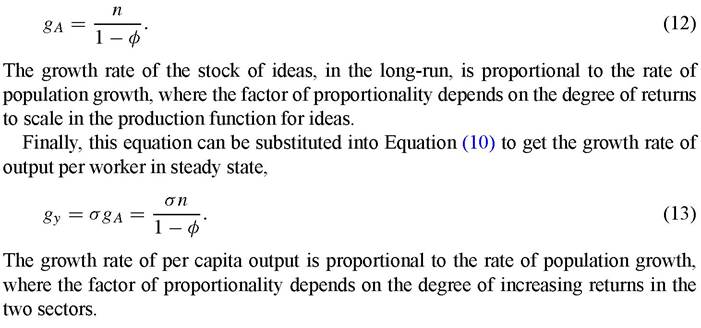
3.2. Discussion
Why is this the case? There are two basic elements of the toy economy that lead to the result. First, just as the total output of any good depends on the total number of workers producing the good, more researchers produce more new ideas. A larger population means more Mozarts and Newtons, and more Wright brothers, Sam Waltons, and William Shockleys. Second, the nonrivalry of knowledge means that per capita output depends on the total stock of ideas, not on ideas per person.[11] Each person in the economy benefits from the new ideas created by the Isaac Newtons and William Shockleys of the world, and this benefit is not degraded by the presence of a larger population.
Together, these steps imply that output per capita is an increasing function, in the long run, of the number of researchers in the economy, which in turn depends on the size of the population. Log-differencing this relation, the growth rate of output per capita depends on the growth rate of the number of researchers, which in turn is tied to the rate of population growth in the long run.
At some basic level, these results should not be surprising at all. Once one grants that the nonrivalry of ideas implies increasing returns to scale, it is nearly inevitable that the size of the population affects the level of per capita income. After all, that is virtually the definition of increasing returns.
In moving from this toy model to the real world, one must obviously be careful. Probably the most important qualification is that our toy model consists of a single country. Without thinking more carefully about the flows of ideas across countries in the real world, it is more accurate to compare the predictions of this toy economy to the world as a whole rather than to any single economy.
Taiwan and China both benefit from ideas created throughout the world, so it is not the Taiwanese or Chinese population that is especially relevant to those countries’ growth experiences.Another qualification relates to the absence of physical and human capital from the model. At least as far as long-run growth is concerned, this absence is not particularly harmful: recall the intuition from the Solow growth model that capital accumulation is not, by itself, a source of long-run growth. Still, because of transition dynamics these factors are surely important in explaining growth over any given time period, and they will be incorporated into the model in the next section.
Finally, it is worth mentioning briefly how this result differs from the original results in the models of Romer (1990), Aghion and Howitt (1992), and Grossman and Helpman (1991). Those models essentially make the assumption that φ = 1 in the production function for new ideas. That is, the growth rate of the stock of knowledge depends on the number of researchers. This change serves to strengthen the importance of increasing returns to scale in the economy, so much so that a growing number of researchers causes the growth rate of the economy to grow exponentially. We will discuss this result in more detail in later sections.
4.