Size, openness and growth: Theory
2.1. The costs and benefits of size
We think of the equilibrium size of countries as emerging from the trade-off between the benefit of size and the costs of preference heterogeneity in the population, an approach followed by Alesina and Spolaore (1997, 2003) and Alesina, Spolaore and Wacziarg (2000).
2.1.1. The benefits of size
The main benefits from size in terms of population are the following:
(1) There are economies of scale in the production of public goods. The per capita cost of many public goods is lower in larger countries, where more taxpayers pay for them. Think, for instance, of defense, a monetary and financial system, a judicial system, infrastructure for communications, police and crime prevention, public health, embassies, national parks, etc. In many cases, part of the cost of public goods is independent of the number of users or taxpayers, or grows less than proportionally, so that the per capita costs of many public goods is declining with the number of taxpayers. Alesina and Wacziarg (1998) documented that the share of government spending over GDP is decreasing in population; that is, smaller countries have larger governments.
(2) A larger country (both in terms of population and national product) is less subject to foreign aggression. Thus, safety is a public good that increases with country size. Also, and related to the size of government argument above, smaller countries may have to spend proportionally more for defense than larger countries given economies of scale in defense spending. Empirically, the relationship between country size and share of spending of defense is affected by the fact that small countries can enter into military alliances, but in general, size brings about more safety. Note that if a small country enters into a military alliance with a larger one, the latter may provide defense, but it may extract some form of compensation, direct or indirect, from the smaller partner.
Inthis sense, even allowing for military alliances, being large is an advantage.(3) Larger countries can better internalize cross-regional externalities by centralizing the provision of those public goods that involve strong externalities.[341]
(4) Larger countries are better able to provide insurance to regions affected by imperfectly correlated shocks. Consider Catalonia, for instance. If this region experiences a recession worse than the Spanish average, it receives fiscal and other transfers, on net, from the rest of the country. Obviously, the reverse holds as well. When Catalonia does better than average, it becomes a net provider of transfers to other Spanish regions. If Catalonia, instead, were independent, it would have a more pronounced business cycle because it would not receive help during especially bad recessions, and would not have to provide for others in case of exceptional booms.[342]
(5) Larger countries can build redistributive schemes from richer to poorer regions, therefore achieving distributions of after tax income which would not be available to individual regions acting independently. This is why poorer than average regions would want to form larger countries inclusive of richer regions, while the latter may prefer independence.[343]
(6) Finally, the role of market size is the issue on which we focus most in this article. Adam Smith (1776) already had the intuition that the extent of the market creates a limit on specialization. More recently, a well established literature from Romer (1986), Lucas (1988) to Grossman and Helpman (1991) has emphasized the benefits of scale in light of positive externalities in the accumulation of human capital and the transmission of knowledge, or in light of increasing returns to scale embedded in technology or knowledge creation.[344] Murphy, Shleifer and Vishny (1989) focused instead on the benefits of size in models of “take-off” or “big push” of industrialization, where the take-off phase is characterized by a transition from a slow growth, constant returns to scale technology to an endogenous growth, increasing returns to scale technology.
Finally, several papers have stressed the pro-competitive effects of a larger market size: size enhances growth by raising the intensity of product market competition.[345] In these various models, size represents the stock of individuals, purchasing power and income that interact in the market. This market may or may not coincide with the political size of a country as defined by its borders. It does coincide with it if a country is completely autarkic, i.e. does not engage in exchanges of goods or factors of production with the rest of the world. On the contrary, market size and country size are uncorrelated in a world of complete free trade. So in models with increasing returns to scale, market size depends both on country size and on trade openness.In theory, with no obstacle to the cross-border circulation of factors of productions, goods and ideas, country size should be, at least through the channel of market size, irrelevant for economic success. Thus, in a world of free trade, redrawing borders should have no effect on economic efficiency and productivity. However, a vast literature has convincingly shown that even in the absence of explicit trade policy barriers, crossing borders is indeed costly, so that economic interactions within a country are much easier and denser than across borders. This is true both for trade in goods and financial assets.[346] What explains this border effect, even in the absence of explicit policy barriers, is not completely clear.[347] Whatever the source of the border effect, however, the correlation between the “political size” of a country and its market size does not totally disappear even in the absence of policy-induced trade barriers. Still, one would expect that the correlation between size and economic success is mediated by the trade regime. In a regime of free trade, small countries can prosper, while in a world of trade barriers, being large is much more important for economic prosperity, measured for instance by income per capita.
2.1.2. The costs of size
If size only had benefits, then the world should be organized as a single political entity. This is not the case. Why? As countries become larger and larger, administrative and congestion costs may overcome the benefits of size pointed out above. However, these types of costs become binding only for very large countries and they are not likely to be relevant determinants of the existing countries, many of which are quite small. As we noted above, the median country size is less than six million inhabitants.
A much more important constraint on the feasible size of countries lies in the heterogeneity of individuals’ preferences. Being part of the same country implies sharing public goods and policies in ways that cannot satisfy everybody’s preferences. It is true that certain policy prerogatives can be delegated to subnational levels of government through decentralization, but some policies have to be national.[348] Think for instance of defense and foreign policy, monetary policy, redistribution between regions, the legal system, etc.
The costs of heterogeneity in the population have been well documented, especially for the case in which ethnolinguistic fragmentation is used a as proxy for heterogeneity in preferences. Easterly and Levine (1997), La Porta et al. (1999) and Alesina et al. (2003) showed that ethnolinguistic fractionalization is inversely related to economic success and various measure of quality of government, economic freedom and democracy.[349] Easterly and Levine (1997), in particular, argued that ethnic fractionalization in Africa, partly induced by absurd borders left by colonizers, is largely responsible for the economic failures of this continent. There is indeed a sense in which African borders are “wrong”, not so much because there are too many or too few countries in Africa, but because borders cut across ethnic lines in often inefficient ways.15
We can think of trade openness as shifting the trade-off between the costs and benefits of size.
As international markets become more open, the benefits of size decline relative to the costs of heterogeneity, thus the optimal size of a country declines with trade openness. Or, to put it differently, small and relatively more homogeneous countries can prosper in a world of free trade. With trade restrictions, instead, heterogeneous individuals have to share a larger polity to be economically viable. Incidentally, above and beyond the income effect, this may reduce their utility if preference homogeneity is valued in a polity. While in this paper we focus on preference heterogeneity rather than income heterogeneity, the latter plays a key role as well, a point raised by Bolton and Roland (1997). Poor regions would like to join rich regions in order to maintain redistributive flows, while richer regions may prefer to be alone. There is a limit to how much poor regions can extract due to a nonsecession constraint, which is binding for the richer regions. Empirically, often more racially fragmented countries also have a more unequal distribution of income. That is, certain ethnic group are often much poorer than others and economic success and opportunities are associated with belonging to certain groups and not others. These are situations with the highest potential for political instability and violence.2.2. A model of size, trade and growth
In this section we will present a simple model linking country size, international trade and economic growth. The model builds upon Alesina and Spolaore (1997, 2003), Alesina, Spolaore and Wacziarg (2000) and Spolaore and Wacziarg (2005).
2.2.1. Productionandtrade
Consider a world in which individuals are located on a segment [0, 1]. The world population is normalized to 1. Each individual living at location i ∈ [0, 1] has the following utility function

Li(t) denote aggregate capital and labor at location i at time t.
Both inputs are supplied inelastically and are not mobile. At each location i a specific intermediate input Xi (t) is produced using the location-specific capital according to the linear production function
15 On this point see in particular Herbst (2000).
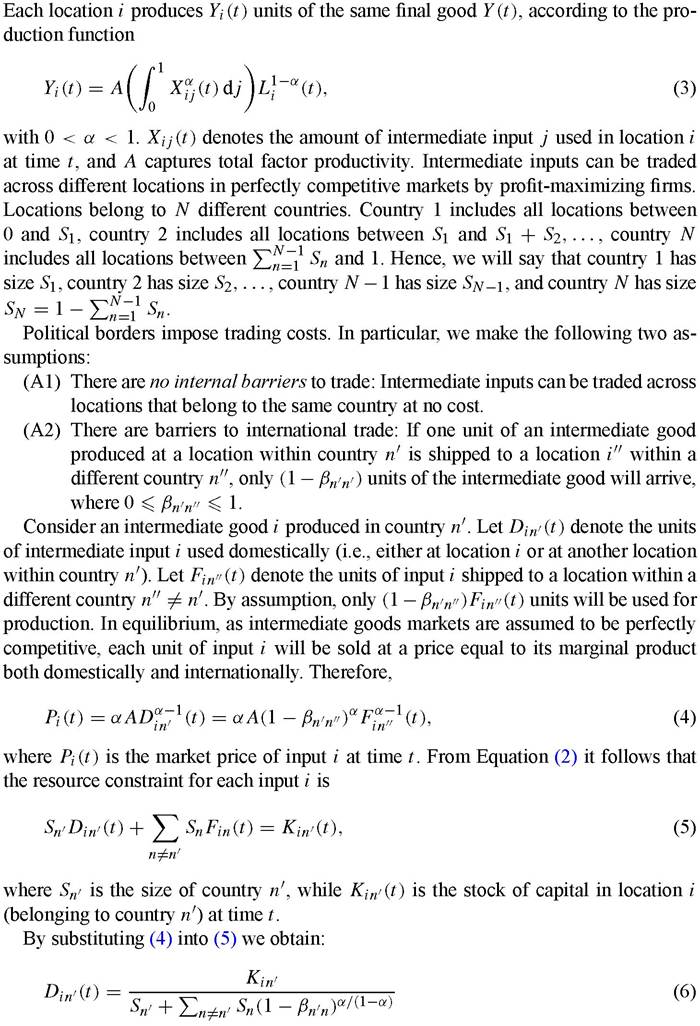
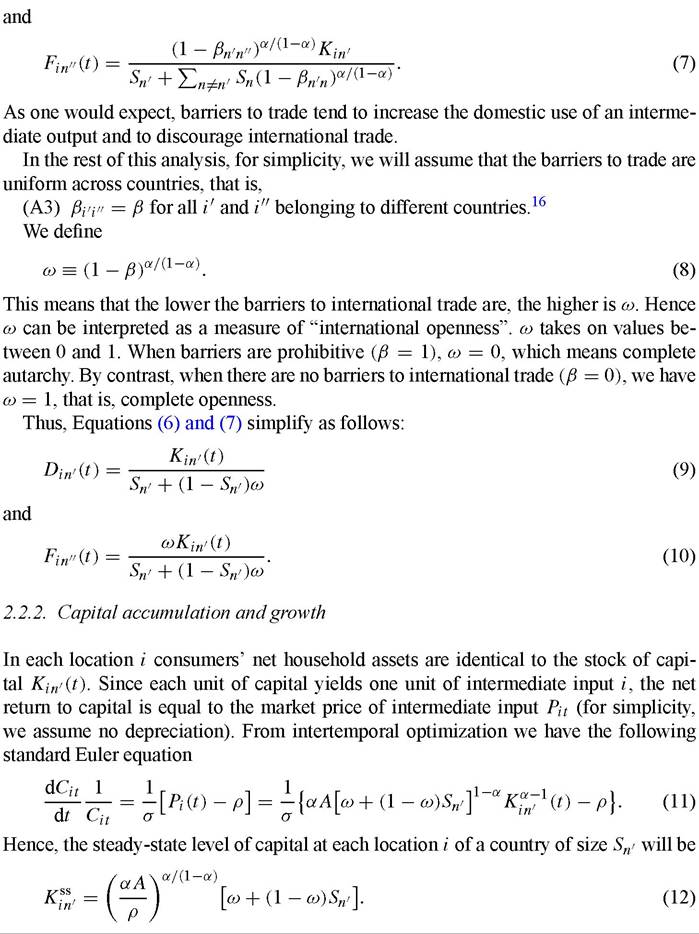
By substituting (12) into (9) and (10), and using (3), we have the following proposition.
16 For an analysis in which barriers are different across countries and are an endogenous function of size, see Spolaore and Wacziarg (2005).
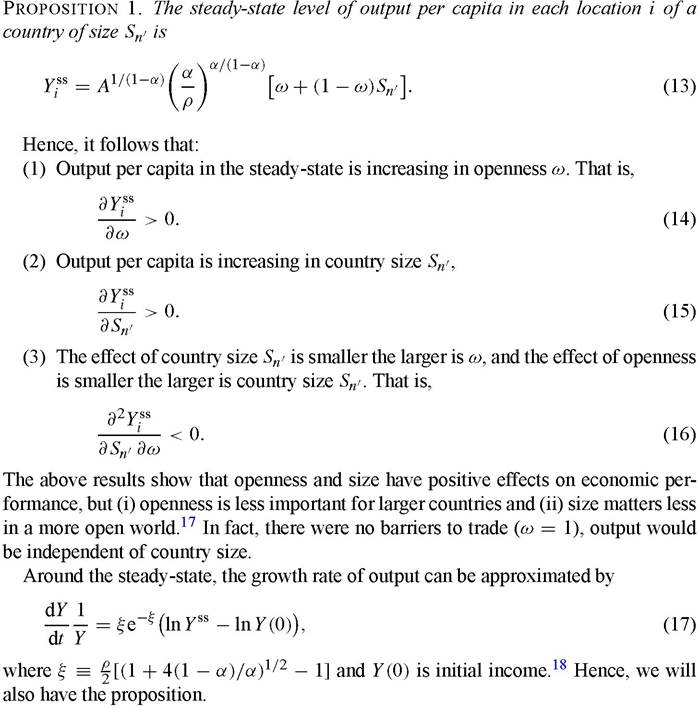
Proposition 2. The growth rate of income per capita around the steady-state is increasing in size, increasing in openness, and decreasing in size times openness.
These results show how the economic benefits of size are decreasing in openness and the economic benefits from openness are decreasing in size. We will test the empirical implications of this model in Section 4.
17 The result does not depend on the assumption that barriers to trade are uniform across countries. In particular, one can derive analogous results for the case of non uniform barriers. Moreover, analogous results can be obtained when “openness” is defined as trade over output rather than in terms of trade barriers. See Spolaore and Wacziarg (2005).
18 For a derivation of this result, see Barro and Sala-i-Martin (1995, Chapter 2).
2.3. The equilibrium size of countries
So far we have taken the number and size of countries as given. However, in the long- run borders do change, and our model suggests that international openness may play a role in this process. As we have seen, country size affects output and growth when barriers to trade are high, while country size is less important in a world of international integration. Hence, the reduction of trade barriers should reduce the incentives to form larger countries. In what follows we will formalize this insight using the framework of country formation developed by Alesina and Spolaore (1997, 2003).19
If there were no costs associated with size, world welfare would be maximized by having only one country, which seems rather unrealistic. Following our previous discussion we model the costs of size as the result of heterogeneity of preferences over public policies and public goods, the collection of which we label “government”. We assume that, for each location, there exists an “ideal” type of government. If individuals in location i belong to a country whose government is different from their ideal type (say j ≠ i), their utility will be reduced by h∆ij, where ∆ij is the distance between j and i, and h is a parameter that measures “heterogeneity” costs - that is, the costs of being far from the median position in one’s country. The distance from the government that give raise to these costs should be interpreted both as a distance in terms of preferences and in terms of location.20
On the other hand, in a country of size Sn the fixed costs of government can be spread through a larger population.21 For example, if the fixed cost of government is G and it is shared equally by all citizens, each individual in a country of size Sn will have to pay G∕Sn - which is obviously decreasing in Sn.
We consider the case in which borders are determined to maximize net income minus heterogeneity costs in steady-state.22 That is, we assume that each individual at location i in a country n of size Sn is interested in maximizing the following steady-state welfare

19 The economics literature on the endogenous formation of political borders, while still in its infancy, has been growing substantially in the past few years. An incomplete list of contributions, besides those cited in the text, includes Friedman (1977), Casella and Feinstein (2002), Findlay (1996) and Bolton and Roland (1997).
20 This assumption is extreme but allows to have only one dimension. For more discussion see Alesina and Spolaore (2003).
21 Obviously, not all the costs of government are fixed. Some depend positively on size, such as infrastructure spending ortransfers. See Alesina and Wacziarg (1998) for an empirical examination ofthis point using crosscountry data.
22 The analysis could be extended in order to consider the more complex issue of border changes along the transitional dynamics, in which adjustment costs from changing borders would be explicitly modeled. Here we abstract from such issues and focus on borders in steady-state.
Country ns budget constraint is

How are borders going to be determined in equilibrium? First we consider how borders would be determined efficiently, that is, when the sum of everybody’s welfare ∕01 Win di is maximized. First of all, one can immediately see that the efficient solution implies countries of equal size. This is due to the assumption that people are distributed uniformly in the segment [0, 1].[350] [351] Second, the government should be located “in the middle” of each country, since the median minimizes the sum of distances. When countries are all of equal size (call it S — 1/N, where N is the number of countries), and governments are located “in the middle”, the average distance from the government is S/4. Hence, the sum of everybody’s welfare becomes
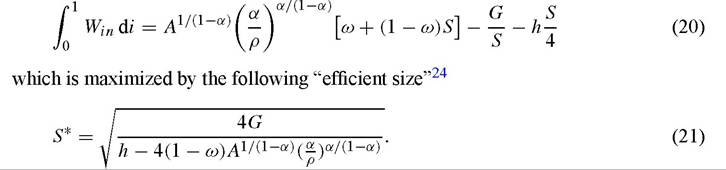
Hence, we have that the “efficient size” of countries is:
(1) increasing in the fixed cost of public goods provision (G),
(2) decreasing in heterogeneity costs (h),
(3) decreasing in the degree of international openness (ω),
(4) increasing in total factor productivity (А).
Therefore, in our model, if borders are set efficiently, increasing economic integration and globalization should be associated with a breakup of countries.
Should we expect such a breakup to take place if borders are not set optimally? For example, what if, more realistically, borders are set by self-interested governments (“Leviathans”) who want to maximize their net rents? We can model the equilibrium of those Leviathans by assuming that (a) they want to maximize their rents in steady-state, but (b) they are constrained in their rent maximization, since they must provide a minimum level of welfare to at least a fraction S of their population (we can interpret this as a “no-insurrection constraint”). Hence, S measures the degree to which Leviathans are constrained by their subjects’ preferences.
If we assume that each individual in a given country must pay the same taxes (that is, if we rule out inter-regional transfers), we can use t to denote taxes per person in a
country of size S. Then, a Leviathan’s total rents in a country of size N is given by

where t is chosen in order to satisfy the constraint
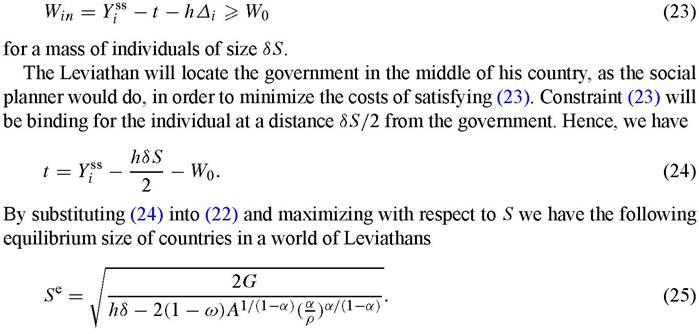
Again, the size of countries is increasing in the economies of scale in the provision of public goods (G) and in the level of total factor productivity (A), while decreasing in heterogeneity costs (h) and openness (ω).
We can note that Se = S * when the Leviathans must provide minimum welfare to exactly half of their population, while countries are inefficiently large (Se > S*) when Leviathans are really dictatorial, that is, they can stay in power without the need to take into account the welfare of a majority of the population. But even in that case, more openness induces smaller countries.
The comparative statics predict that technological progress, in a world of barriers to trade, should be associated with larger countries. This result is intuitively appealing, since technological progress improves the gains from trade, and barriers to international trade increase the importance of domestic trade, and hence a larger domestic market. However, if technological progress is accompanied by a reduction in trade barriers, the result becomes ambiguous.25 Moreover, a reduction in trade barriers (more openness) has a bigger impact (in absolute value) on the size of countries at higher levels of development - that is, the effect of globalization and economic integration on the size of countries is expected to be larger for more developed societies. Formally,

[1] Another element of ambiguity would be introduced if one were to assume that the costs of government G are decreasing in A.
Of course, these comparative statics results are based on the highly simplifying assumption that technological progress is exogenous. An interesting extension of the model would be to consider endogenous links between political borders, the degree of international openness, and technological progress.[352]
Alesina and Spolaore (2003) also analyze the case in which borders are chosen by democratic rule (majority voting). They show that in this case one may or may not obtain the efficient solution depending on the availability of credible transfer programs. When the latter are not available, in a fully democratic equilibrium in which no one can prevent border changes decided by majority rule or prevent unilateral secessions, there would be more countries than the efficient number. A fortiori the democratically decided number of countries would be larger that the one chosen by a Leviathan for any value of S < 1. An implication of this analysis is that democratization should lead to secessions. For the purpose of this paper, even in the case of majority rule choice of borders, the comparative statics regarding trade, size and growth are the same as in the efficient case and in the Leviathan case.
2.2. Summingup
In this section we have provided a model in which the benefits of country size go down as international economic integration increases. Conversely, the benefits of trade openness and economic integration are larger, the smaller the size of a country. Secondly, we have argued that economic integration and political disintegration should go hand in hand. As the world economy becomes more integrated, one of the benefits of large countries (the size of markets) vanishes. As a result, the trade-off between size and heterogeneity shifts in favor of smaller and more homogeneous countries. This effect tends to be larger in more developed economies. By contrast, technological progress in a world of high barriers to trade should be associated with the formation of larger countries.
One can also think of the reverse source of causality: small countries have a particularly strong interest in maintaining free trade, since so much of their economy depends upon international markets. In fact, if openness were endogenized, one could extend our model to capture two possible worlds as equilibrium border configurations: a world of large and relatively closed economies, and one of many more smaller and more open economies. Spolaore (1995, 2002) provides explicit models with endogenous openness and multiple equilibria in the number of countries. Spolaore and Wacziarg (2005) also treat openness as an explicitly endogenous variable, and show empirically that larger countries tend to be more closed to trade. Empirically, both directions of causality between country size and trade openness, which are not mutually exclusive, likely coexist.
Smaller countries do adopt more open trade policies (and are consequently more open when openness is measures using trade volumes), so that a world of small countries will tend to be more open to trade.[353] Conversely, changes in the average degree of openness in the world (brought forth for example by a reduction in trading costs) should be expected to lead to more secessions and smaller countries, as we will argue extensively below.
3.