6. Towards a non-aggregative growth theory
6.1. Anillustration
The presumption of neo-classical growth theory was that being a citizen of a poor country gives one access to many exciting investment opportunities, which eventually lead on to convergence.
The point of the previous section was to argue that most citizens of poor countries are not in a position to enjoy most of these opportunities, either because markets do not do what they ought to or the government does what it ought not to, or because people find it psychologically difficult to do what is expected of them.What can we say about the long-run evolution of an economy where there are rewarding opportunities that are not necessarily exploited? In this section we will explore this question under the assumption that the only source of inefficiency in this economy comes from limited access to credit. The goal is to illustrate what non-aggregative growth theory might look like, rather than to suggest an alternative canonical model.
The model we have in mind is as follows: There are individual production functions associated with every participant in this economy that are assumed to be identical and a function of capital alone (F(K)) but otherwise quite general. In particular, we do assume that they are concave. Individuals maximize an intertemporal utility function of the form: 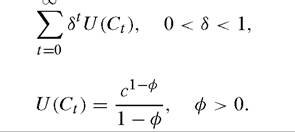
People are forward-looking and at each point of time they choose consumption and savings to maximize lifetime utility. However, the maximum amount they can borrow is linear and increasing in their wealth and decreasing in the current interest rate: An individual with wealth w can borrow up to λ(rt)w. Credit comes from other members of the same economy and the interest rate clears the credit market. We do not assume that everyone starts with the same wealth, but rather that at each point of time there is a distribution of wealth that evolves over time.
This model is a straightforward generalization of the standard growth model. What it tells us about the evolution of the income distribution and efficiency depends, not surprisingly, on the shape of the production function.
The simplest case is that of constant returns in production. In this case, inequality remains unchanged over time, and production and investment is always efficient.
With diminishing returns, greater inequality can lead to less investment and less growth, because the production function is concave. However, inequality falls over time and in the long run no one is credit constrained, although we do not necessarily get full wealth convergence. The long run interest rate converges to its first best level, and hence investment is efficient. To see why this must be the case, note first that because of diminishing returns the poor always have more to gain from borrowing and investing than the rich. In other words, the rich must be lending to the poor. As long as the poor are credit constrained, they will earn higher returns on the marginal dollar than their lenders, i.e., the rich (that is what it means to be credit constrained). As a result, they will accumulate wealth faster than the rich and we will see convergence. This process will only stop when the poor are no longer credit constrained, i.e., they are rich enough to be able to invest as much as they want.
With increasing returns, inequality increases over time; we converge to a Gini coefficient of 1. Wealth becomes more and more concentrated with only the richest borrowing and investing. Because there are increasing returns, this is also the first best outcome. The logic of this result is very similar to the previous one: Now it is the rich who will be borrowing and the poor who will be lending, with the implication that the rich are the ones who are credit constrained and the ones earning high marginal returns. Therefore, they will accumulate wealth faster and wealth becomes increasingly concentrated.
Finally we consider the case of “S-shaped” production functions, which are production functions that are initially convex and then concave. The Cobb-Douglas with an initial set-up cost discussed at length in Section 5.2 is a special case of this kind of technology.
What happens in the long run in this model depends on the initial distribution of income. When the distribution is such that most people in the economy can afford to invest in the concave part of the production function, the economy converges to a situation that is isomorphic to the diminishing returns case, with the entire population “escaping” the convex region of the production function.
The more unusual case is the one where some people start too poor to invest in the concave region of the production function. The poorer among such people will earn very low returns if they were to invest and therefore will prefer to be lenders. Now, as long as the interest rate on savings is less than 1 ∕δ, they will decumulate capital (since the interest is less than the discount factor) and eventually their wealth will go to zero. On the other hand, anyone in this economy who started rich enough to want to borrow will stay rich, even though they are also dissaving, in part because at the same time they benefit from the low interest rates. The economy will converge to a steady state where the interest rate is 1∕δ, those who started rich continue to be rich and those who started poor remain poor (in fact have zero wealth).
This is classic poverty trap: Moreover, since no one escapes from poverty, nor falls into it, there is a continuum of such poverty traps in this model. This kind of multiplicity is, however, fragile with respect to the introduction of random shocks that allow some of the poor to escape poverty and impoverish some of the rich.
Even in a world with such shocks there can be more than one steady state: The reason is that the presence of lots of poor people drives down interest rates, and low interest rates make it harder for the poor to save up to escape poverty even with the help of a positive shock.
As a result, in an economy that starts with lots of poor people, a greater fraction of people may remain poor.The key to this multiplicity is the endogeneity of the interest rate. It is the pecuniary externality that the poor inflict on other poor people that sustains it. This is why such poverty traps are sometimes called collective poverty traps, in contrast to the individual poverty traps described above.
The investigation of the evolution of income distribution in models with credit constraints and endogenous interest rates goes back to Aghion and Bolton (1997). Matsuyama (2000, 2003) and Piketty (1997) emphasize the potential for collective poverty traps in a variant of this model, without the forward-looking savings decisions.
This class of models is a part of a broader group of models which study the simultaneous evolution of the occupational structure, factor prices and the wealth distribution in a model with credit constraints. Loury (1981) studied this class of modelsand showed that in the long run the neo-classical predictions tend to hold as long as the production function is concave. Dasgupta and Ray (1986) and Galor and Zeira (1993) provide examples of individual poverty traps in the presence of credit constraints and S-shaped production functions. Banerjee and Newman (1993) show the possibility of a collective poverty trap in a model with a S-shaped production function which is driven by the endogeneity of the wage - essentially high wages allow workers to become entrepreneurs easily, which keeps the demand for labor, and hence wages, high. Recent work by Buera (2003) shows that the multiplicity results in Banerjee and Newman survive in an environment where savings is based on expectations of future returns.[303] Ghatak, Morelli and Sjostrom (2001, 2002) and Mookherjee and Ray (2002, 2003) explore related but slightly different sources of individual and collective poverty traps.
5.3. Can we take this model to the data?
Models like the one we just developed (as well as political economy models that we do not discuss here[304]) have been invoked as motivation for a large empirical literature on the relationship between inequality and growth in cross-country data.
In 1996, Benabou cited 16 studies on the question, and the number has been growing rapidly since then, in part due to the availability of more complete data sets, due to the effort of Deininger and Squire [see Deininger and Squire (1996)], expanded by the World Institute for Development Economics Research (WIDER). However, it is not clear that if we were to take this class of models seriously, they would justify estimating relationships like the ones that are in the literature: First because the exact form of the predicted relationship between inequality and growth depends on the shape of the production function. Imposing the assumption that there are diminishing returns helps in this respect, but with this assumption functional form issues loom large. Finally, it is not clear how, given the model’s structure, we can avoid running into serious identification problems.In this section, we evaluate whether, given these concerns, estimating the relationship between inequality and growth in a cross-country data set remains useful. Having concluded that it has, at best, very limited use, we discuss an alternative approach based on calibrating non-aggregative models using micro data.
6.2.1. What are the empirical implications of the above model?
Functional form issues With constant returns to scale, distribution is irrelevant for growth. With diminishing returns, an exogenous mean-preserving spread in the wealth distribution in this economy will reduce future wealth and, by implication, the growth rate. However, the impact depends on the level of wealth in the economy: Once the economy is rich enough that everyone can afford the optimal level of investment, inequality should not matter. The estimated relationship between inequality and growth should therefore allow for an interaction term between inequality and mean income. Moreover, an economy closer to the steady state has both lower inequality and lower growth. This has two implications for the estimation of the inequality growth relationship.
First, the fact that the economy becomes more equal as it grows tends to generate a spurious positive relation between growth and inequality, both in the cross-section as well as in time-series. As a result, both the cross-sectional and the first differenced (or fixed effects) estimates of the effect of inequality on growth run the risk of being biased upwards, compared to the true negative relation that we might have found if we had compared economies at the same mean wealth levels. Moreover, consider a variant of the model where there are occasional shocks that increase inequality. Since the natural tendency of the economy is towards convergence, we should expect to see two types of changes in inequality: Exogenous shocks that increase inequality and therefore reduce growth, and endogenous reductions in inequality that are also associated with a fall in the growth rate. In other words, measured changes in inequality in either direction will be associated with a fall in growth.Controlling properly for the effect of mean wealth (or mean income), is therefore vital for getting meaningful results. The usual procedure is to control linearly (as in most other growth regressions) for the mean income level at the beginning of the period. It is, however, not clear that there is any good reason why the true effect should be linear. Moreover, it seems plausible that different economies will typically have different λs, and therefore will converge at different rates.
The model also tells us that while initial distribution matters for the growth rate, it only matters in the short run. Over a long enough period, two economies starting at the same mean wealth level will exhibit the same average growth rate. In other words, the length of the time period over which growth is measured will affect the strength of the relationship between inequality and growth.
The preceding discussion assumed that the interest rates converged. As we noted, that does not need to be the case. If we do not assume it, variants of the simple concave economy may no longer converge, even in the weaker sense of the long-run mean wealth being independent of the initial distribution of wealth. Intuitively, poor economies will tend to have high interest rates, and this in turn will make capital accumulation difficult (note that λ' < 0) and tend to keep the economy poor.[305] This effect reinforces the claim made above that inequality matters most in the poorest economies.[306] This economy can have a number of distinct steady states that are each locally isolated. This means that small changes in inequality can cause the economy to move towards a different and further away steady state, making it more likely that the relationship will be non-linear.
With increasing returns, growth rates increase with a mean preserving spread in income. As the economy grows, it also becomes more unequal. Interpreting the relationship between inequality and growth is difficult even after controlling for convergence.
In the S-shaped returns case, the relationship between inequality and growth can be negative or positive depending on the initial distribution, and the size of the increase. For example, if everybody is very poor (on the left of the convex zone), a small increase in inequality will reduce growth, but increasing inequality enough may push more people to the point where they are able to take advantage of the more efficient technology, and increases in inequality will increase growth. The relation between inequality and growth delivered by this model is clearly non-monotonic. Moreover, the strong convergence property does not hold in general. In other words, the growth rate of wealth may jump up once the economy is rich enough, with the obvious implication that economies with higher mean wealth will not necessarily grow more slowly. In other words, the effect of mean wealth, that is the so-called convergence effect, may not be monotonic in this economy. Linearly controlling for mean wealth therefore does not guarantee that we will get the correct estimate of the effect of inequality. It is worth noting that this economy will have a connected continuum of steady states. This means that after a shock the economy will not typically return to the same steady state. However, since it does converge to a nearby steady state, this is not an additional source of non-linearity.
Identification issues Even if we could agree on a specification that is worth estimating, it is not clear how we can use cross-country data to estimate it. Countries, like individuals, are different from each other. Even in a world of perfect capital markets, countries can have very different distributions of wealth because, for example, they have different distributions of ability. There is no causal effect of inequality on growth in this case, but they could be correlated for other reasons. For example, cultural structures (such as a caste system) may restrict occupational choices and therefore may not allow individuals to make proper use of their talents, causing both higher inequality and lower growth. Conversely, if countries use technologies that are differently intensive in skilled labor, those countries using the more skill intensive technology can have both more inequality and faster growth.
As we discussed in detail above, countries have different kinds of financial institutions, implying differences in the λ's in our model. Ourbasic model would predict that the country with the better capital markets is likely both to be more equal and to grow faster (at least once we control for the mean level of income). The correlation between inequality and growth will therefore be a downwards-biased estimate of the causal parameter, if the quality of financial institutions differs across countries.[307]
If these country specific effects were additive, one could control for them by including a country fixed-effect in the estimated relationship (or by estimating the model in first difference). This strategy will be valid only under the assumption that changes in inequality are unrelated to unobservable country characteristics that are correlated with changes in the growth rate. While this is a convenient assumption, it has no reason to hold in general. For example, skill-biased technological progress will lead both to a change in inequality and a change in growth rates, causing a spurious positive correlation between the two. To make matters worse, we have to recognize the fact that λ itself (and therefore the effect of inequality on growth at a given point in time) may be varying over time as a result of monetary policies or financial development, and may itself be endogenous to the growth process.[308]
The more general point that comes out of the discussion above is that unless we assume capital markets are extremely efficient (which, in any case, removes one of the important sources of the effect of inequality), changes in inequality will be partly endogenous and related to country characteristics which are themselves related to changes in the growth rate. Identifying the effect of inequality by including a country fixed-effect would not necessarily solve all the endogeneity problems. Moreover, as we discussed above, the theory suggests that the specification should allow for non-linear functional forms, and interaction effects, which will be difficult to accommodate with a fixed effect specification.
5.3.2. Empirical evidence
The preceding discussion suggests that empirical exercises using aggregate, crosscountry data to estimate the impact of inequality and growth will be extremely difficult to interpret. The results are also likely to be sensitive to the choice of specification. This may explain the variety of results present in the literature. A long literature [see Benabou (1996) for a survey] estimated a long run equation, with growth between 1990 and 1960 (say) regressed on income in 1960, a set of control variables, and inequality in 1960. Estimating these equations tended to generate negative coefficients for inequality. As the discussion in the previous subsection suggests, there are many reasons to think that this relationship may be biased upward or downwards. To address this problem, Li and Zou (1998) and Forbes (2000) used the Deininger and Squire data set to focus on the impact of inequality on short run (5 years) growth, and introduced a linear fixed effect.[309] The results change rather dramatically: The coefficient of inequality in this specification is positive, and significant. Finally, Barro (2000) used the same short frequency data (he is focusing on ten-year intervals), but does not introduce a fixed effect. He finds that inequality is negatively associated with growth in the poorer countries, and positively in rich countries.
Banerjee and Duflo (2003) investigate whether there is any reason to worry about the non-linearities that the theory suggests should be present. They find that when growth (or changes in growth) is regressed non-parametrically on changes in inequality, the relationship is an inverted U-shape. There is also a non-linear relationship between past inequality and the magnitudes of changes in inequality. Finally, there seems to be a negative relationship between growth rates and inequality lagged one period. These facts taken together, and in particular the non-linearities in these relationships (rather than the variation in samples or control variables), account for the different results obtained by different authors using different specifications.
Townsend and Ueda (2003) illustrate very clearly that this diversity of results is likely to come from the functional form and identification problems we just discussed. They simulate the 30 year evolution for 1,000 economies based on a model similar to the ones we describe in this section, with non-linear individual production function and credit constraints. The economies start in 1976, with a distribution of wealth calibrated to match the Thai economy in the same year. They then introduce aggregate and individual level shocks, and run regressions similar to the regressions run in the literature. Using the 1985 year as the “base year”, they replicate the findings of the long run regressions. Using 1980 as the base year, they do not replicate those results. A regression similar to that of Forbes (2000) finds either a positive or negative relationship, depending on sampling decisions. This exercise clearly shows that aggregate cross-country regressions are the wrong tool to evaluate the pertinence of this class of models.
6.3. Where do we go from here?
The discussion on functional form and identification, coupled with the empirical evidence of non-linearities even in very simple exercises, suggests that cross-country regressions are unlikely to be able to shed any meaningful light on the empirical relevance of models that integrate credit constraints and other imperfections of the credit markets. This is made worse by the poor quality of the aggregate data, despite the considerable efforts to produce consistent and reliable data sets. This contrasts with the increased availability of large, good quality, micro-economic data sets, which allow for testing specific hypotheses and derive credible identifying restrictions from theory and exogenous sources of variation. Throughout this chapter, we quoted many studies using micro-economic data which tested the micro-foundations for the models we discussed in this section.
Even a series of convincing micro-empirical studies will not be enough to give us an overall sense of how, together, they generate aggregate growth, the dynamics of income distribution, and the complex relationships between the two. The lessons of development economics will be lost to growth if they are not brought together in an aggregate context. In other words, it is not enough to use them to loosely motivate cross-sectional growth regression exercises - the discussion in this section is but an example of the misleading conclusions to which this can lead.
An alternative that seems likely to be much more fruitful is to try to build macroeconomic models that incorporate the features we discussed, and to use the results from the microeconomic studies as parameters in calibration exercises. The exercise we performed in Section 5 of this chapter is an illustration of the kind of work that we can hope to do. There are a number of recent papers that in some ways go further in this direction than we have gone. In particular, Quadrini (1999) and Cagetti and De Nardi (2003), for the U.S., and Paulson and Townsend (2004), for Thailand, try to calibrate a model with credit constraints to understand the correlation between wealth and the probability ofbecoming an entrepreneur. The paper by Buera (2003), mentioned above, emphasizes the fact that the long run correlation between wealth and entrepreneurship is weaker than the short run correlation, because, as noted by Skiba (1978), Deaton (1992), Aiyagari (1994) and Carroll (1997), those who are credit constrained now but want to invest in the future have a very strong incentive to save. This, Buera points out, reduces the ultimate efficiency cost of imperfect credit markets, though in spite of this, the person with the median ability level and the median starting wealth loses about 18% of lifetime welfare because of the credit constraints. Caselli and Gennaioli (2002) offer a slightly different calibration: Like Buera, they are worried about the fact that with credit constraints the biggest firms may not be run by the best entrepreneurs. This can be a source of very large productivity losses in the short run. However, since the best entrepreneurs will make the most money, in the long run their firms would necessarily become the largest, unless they died young. They show that even with this limiting factor, reasonable death rates would imply a 20% loss of productivity when we compare an economy without credit constraints with one that has them.
The calibrations so far have not attempted to see if the path of wealth distribution that results from calibrating this type of model matches the data. Our exercise above, for example, tries to match the distribution of firm sizes at a point of time, but says nothing about the path, while Buera does not try to match the data. The one exception is the papers by Robert Townsend and his collaborators based on Thai data [Jeong and Townsend (2003), Townsend and Ueda (2003)].
These papers, as well as those mentioned in the previous paragraphs, start from the assumption that every firm has a single, usually strictly concave, production technology. The only fixed cost comes from the fact that the firm needs an entrepreneur. As we saw above, this model does not do very well in terms of explaining the cross-sectional variation in the firm sector or the overall productivity gap, as compared to a model with a small number of alternative technologies and varying fixed costs. More generally, we need both a better empirical understanding of where the most important sources of inefficiency lie and better integration of this understanding when we assess the predictions of growth theory.
And perhaps above all, we need better growth theory: Our exercise at the beginning of this section was intended to advertise the possibility of a growth theory that does not assume aggregation. While we attempted to link the results to some relatively general properties of the production function, our analysis relies heavily on the fact that the inefficiency we assumed was in the credit market and that this took the form of a credit limit that was linear in wealth. One can easily imagine other ways for the credit market to be imperfect and other results from such models. Moreover, while the class of production technologies covered by our model was broader than usual, it does not include the (multiple-fixed-cost) technology that the previous section advocates.
There are, of course, other types of non-aggregative models: There are some examples of non-aggregative growth models that build on the inefficiency that comes from poorly functioning insurance markets.[310] There are also interesting attempts to build growth models that emphasize the fact that some people are favored by the government while others are not, and especially the fact that this changes over time in some predictable way (see Roland Benabou’s contribution to this volume). Some interesting recent work has been done on the dynamic interplay between growth and political institutions (see the chapter by Acemoglu, Johnson and Robinson in this volume) as well as between growth and social institutions [see Oded Galor’s contribution to this volume, as well as Cole, Mailath and Postlewaite (1992, 1998, 2001)]. However, even more than in the case of the literature on credit markets and growth, it is not clear how much the insights from these models rely on specific details of how the environment or the imperfection was modeled and to what extent they can be seen as robust properties of this entire class of models.
There are also areas where growth theory has not really reached: We have no models that, for example, incorporate reputation-building or learning into growth theory. The same can be said about the entire class of behavioral models of underinvestment.
Finally, there is the open question of whether we gain anything by building grand models that incorporate all these different reasons for inefficiency in a single model. To answer this we would need to assess whether the fact that different forms of inefficiency interact with each other has empirically important consequences.
This is an exciting time to think about growth. We are beginning to see the contours of a new vision, both more rooted in evidence and more ambitious in its theorizing.
Acknowledgements
The authors are grateful to Pranab Bardhan, Michael Kremer, Rohini Pande, Chris Udry and Ivan Werning for helpful conversations and Philippe Aghion and Seema Jay- achandran for detailed comments. A part of this material was presented as the Kuznets Memorial Lecture, 2004, at Yale University. We are grateful for the many comments that we received from the audience.
References
Acemoglu, D., Angrist, J. (2001). “How large are human-capital externalities? Evidence from compulsory schooling laws”. In: Bernanke, B., Rogoff, K. (Eds.), NBER Macroeconomics Annual 2000, vol. 15. MIT Press, Cambridge and London, pp. 9-59.
Acemoglu, D., Johnson, S., Robinson, J. (2001). “The colonial origins of comparative development: An empirical investigation”. American Economic Review 91 (5), 1369-1401.
Acemoglu, D., Zilibotti, F. (1997). “Was Prometheus unbound by chance? Risk, diversification, and growth”. Journal of Political Economy 105 (4), 709-751.
Acemoglu, D., Zilibotti, F. (2001). “Productivity differences”. Quarterly Journal of Economics 116 (2), 563606.
Aghion, P., Bolton, P. (1997). “Atrickle-downtheory ofgrowth and developmentwithdebt overhang”. Review of Economic Studies 64 (2), 151-172.
Aghion, P., Howitt, P. (1992). “A model of growth through creative destruction”. Econometrica 60 (2), 323351.
Aghion, P., Howitt, P., Mayer-Foulkes, D. (2004). “The effect of financial development on convergence: Theory and evidence”. Working Paper 10358, National Bureau of Economic Research.
Aiyagari, S.R. (1994). “Uninsured idiosyncratic risk and aggregate saving”. Quarterly Journal of Economics 109, 569-684.
Aleem, I. (1990). “Imperfect information, screening and the costs of informal lending: A study of a rural credit market in Pakistan”. World Bank Economic Review 3, 329-349.
Alesina, A., Rodrik, D. (1994). “Distributive politics and economic growth”. Quarterly Journal of Economics 109 (2), 465-490.
Anderson, S., Baland, J.-M. (2002). “The economics of ROSCAs and intrahousehold resource allocation”. Quarterly Journal of Economics 117 (3), 963-995.
Angeletos, G.-M., Calvet, L. (2003). “Idiosyncratic production risk, growth and the business cycle”. Mimeo, MIT.
Aportela, F. (1998). “The effects of financial access on savings by low-income people”. Mimeo, MIT.
Arellano, M., Bond, S. (1991). “Some tests of specification for panel data: Monte Carlo evidence and an application to employment equations”. Review of Economic Studies 58 (2), 277-297.
Ashraf, N., Karlan, D.S., Yin, W. (2004). “Tying Odysseus to the mast: Evidence from a commitment savings product in the Philippines”. Mimeo, Harvard University.
Banerjee, A.V. (1992). “A simple model ofherdbehavior”. Quarterly Journal ofEconomics 117 (3), 797-817.
Banerjee, A.V. (2003). “Contracting constraints, credit markets and economic development”. In: Hansen, L., Dewatripont, M., Turnovsky, S. (Eds.), Advances in Economics and Econometrics: Theory and Applications, Eighth World Congress, vol. III. Cambridge University Press.
Banerjee, A.V. (2004). “Educational policy and the economics of the family”. Journal of Development Economics 74 (1), 3-32.
Banerjee, A.V. (2005). “The two poverties”. In: Dercan, S. (Ed.), Insurance Against Poverty. Oxford University Press, pp. 59-75.
Banerjee, A.V., Duflo, E. (2000). “Reputation effects and the limits of contracting: A study of the Indian software industry”. Quarterly Journal of Economics 115 (3), 989-1017.
Banerjee, A.V., Duflo, E. (2003). “Inequality and growth: What can the data say?”. Journal of Economic Growth 8, 267-299.
Banerjee, A.V., Duflo, E. (2004). “Do firms want to borrow more? Testing credit constraints using a directed lending program”. Mimeo, MIT. Also BREAD WP 2003-5, 2003.
Banerjee, A.V., Duflo, E., Munshi, K. (2003). “The (mis)allocation of capital”. Journal of the European Economic Association 1 (2-3), 484-494.
Banerjee, A.V., Gertler, P., Ghatak, M. (2002). “Empowerment and efficiency: Tenancy reform in West Bengal”. Journal of Political Economy 110 (2), 239-280.
Banerjee, A.V., Munshi, K. (2004). “How efficiently is capital allocated? Evidence from the knitted garment industry in Tirupur”. Review of Economic Studies 71 (1), 19-42.
Banerjee, A.V., Newman, A. (1991). “Risk bearing and the theory of income distribution”. Review of Economic Studies 58 (2), 211-235.
Banerjee, A.V., Newman, A. (1993). “Occupational choice and the process of development”. Journal of Political Economy 101 (2), 274-298.
Bardhan, P. (1969). “Equilibrium growth in a model with economic obsolescence of machines”. Quarterly Journal of Economics 83 (2), 312-323.
Bardhan, P., Udry, C. (1999). Development Microeconomics. Oxford University Press, Oxford, New York.
Barro, R.J. (1974). “Are government bonds net wealth?”. Journal of Political Economy 82 (6), 1095-1117.
Barro, R.J. (1991). “Economic growth in a cross section of countries”. Quarterly Journal of Economics 106 (2), 407 443.
Barro, R.J. (2000). “Inequality and growth in a panel of countries”. Journal of Economic Growth 5 (1), 5-32.
Barro, R.J., Lee, J.-W. (2000). “International data on educational attainment updates and implications”. Working Paper 7911, National Bureau of Economic Research, September.
Barro, R.J., Sala-i-Martin, X. (1995). Economic Growth. McGraw-Hill, New York.
Basta, S.S., Soekirman, D.S., Karyadi, D., Scrimshaw, N.S. (1979). “Iron deficiency anemia and the productivity of adult males in Indonesia”. American Journal of Clinical Nutrition 32 (4), 916-925.
Becker, G. (1981). A Treatise on the Family. Harvard University Press, Cambridge, MA.
Benabou, R. (1996). “Inequality and growth”. In: Bernanke, B., Rotemberg, J.J. (Eds.), NBER Macroeconomics Annual 1996. MIT Press, Cambridge and London, pp. 11-73.
Benhabib, J., Rustichini, A. (1998). “Social conflict and growth”. Journal of Economic Growth 1 (1), 143158.
Benhabib, J., Spiegel, M.M. (1994). “The role of human capital in economic development: Evidence from aggregate cross-country data”. Journal of Monetary Economics 34 (2), 143-174.
Bennell, P. (1996). “Rates of return to education: Does the conventional pattern prevail in sub-Saharan Africa?”. World Development 24 (1), 183-199.
Bertrand, M., Karlan, D., Mullainathan, S., Zinman, J. (2004). “Pricing psychology.” Mimeo, Harvard University.
Besley, T. (1995). “Savings, credit and insurance”. In: Behrman, J., Srinivasan, T.N. (Eds.), Handbook of Development Economics, vol. 3A. Elsevier Science, Amsterdam, pp. 2123-2207. Chapter 6.
Besley, T., Case, A. (1994). “Diffusion as a learning process: Evidence from HYV cotton”. Discussion Paper 174, RPDS, Princeton University.
Bigsten, A., Isaksson, A., Soderbom, M., Collier, P. (2000). “Rates of return on physical and human capital in Africa’s manufacturing sector”. Economic Development and Cultural Change 48 (4), 801-827.
Bikhchandani, S., Hirshleifer, D., Welch, I. (1992). “A theory of fads, fashion, custom, and cultural change as informational cascades”. Journal of Political Economy 100 (5), 992-1026.
Bils, M., Klenow, P. (2000). “Does schooling cause growth?”. American Economic Review 90 (5), 11601183.
Binswanger, H., Rosenzweig, M. (1986). “Behavioural and material determinants of production relations in agriculture”. Journal of Development Studies 22 (3), 503-539.
Blanchflower, D., Oswald, A. (1998). “What makes an entrepreneur?”. Journal of Labor Economics 16 (1), 26-60.
Bottomley, A. (1963). “The cost of administering private loans in underdeveloped rural areas”. Oxford Economic Papers 15 (2), 154-163.
Bourguignon, F., Chiappori, P.-A. (1992). “Collective models of household behavior”. European Economic Review 36, 355-364.
Buera, F. (2003). “A dynamic model of entrepreneurship with borrowing constraints”. Mimeo, University of Chicago.
Cagetti, M., De Nardi, M. (2003). “Entrepreneurship, frictions and wealth”. Staff Report 324, Federal Reserve Bank of Minneapolis.
Carroll, C. (1997). “Buffer-stock saving and the life cycle/permanent income hypothesis”. Quarterly Journal of Economics 112, 1-56.
Carvalho, I. (2000). “Household income as a determinant of child labor and school enrollment in Brazil: Evidence from a social security reform”. Mimeo, MIT.
Case, A., Lin, I.-F., McLanahan, S. (2000). “How hungry is the selfish gene?”. Economic Journal 110 (466), 781-804.
Case, A., Paxson, C. (2001). “Mothers and others: Who invests in children’s health?”. Journal of Health Economics 20 (3), 301-328.
Case, A., Paxson, C., Ableidinger, J. (2002). “Orphans in Africa”. Working Paper 9213, National Bureau of Economic Research.
Caselli, F. (2005). “Accounting for cross-country income differences”. In: Aghion, P., Durlauf, S. (Eds.), Handbook of Economic Growth. Elsevier, Amsterdam.
Caselli, F., Gennaioli, N. (2002). “Dynastic management”. Mimeo, Harvard University.
Caselli, F., Gennaioli, N. (2004). “Dynastic management, legal reform and regulatory reform”. Mimeo, London School of Economics.
Coate, S., Ravallion, M. (1993). “Reciprocity without commitment: Characterization and performance of informal insurance arrangements”. Journal of Development Economics 40, 1-24.
Cole, H., Mailath, G., Postlewaite, A. (1992). “Social norms, savings behavior and growth”. Journal of Political Economy 100 (6), 1092-1126.
Cole, H., Mailath, G., Postlewaite, A. (1998). “Class systems and the enforcement of social norms”. Journal of Public Economics 70 (1), 5-35.
Cole, H., Mailath, G., Postlewaite, A. (2001). “Investment and concern for relative position”. Review of Economic Design 6, 241-261.
Commission on Macroeconomics, and Health (2001). Macroeconomics and Health: Investing in Health for Economic Development: Report. World Health Organization, Geneva.
Conley, T., Udry, C. (2003). “Learning about a new technology: Pineapple in Ghana”. Mimeo, Northwestern University.
Dasgupta, A. (1989). Reports on Informal Credit Markets in India: Summary. National Institute of Public Finance and Policy, New Delhi.
Dasgupta, P., Ray, D. (1986). “Inequality as a determinant of malnutrition and unemployment: Theory”. The Economic Journal 96 (384), 1011-1034.
Deaton, A. (1992). Understanding Consumption. Oxford University Press, Oxford.
Deaton, A. (1997). The Analysis of Household Surveys. World Bank, International Bank for Reconstruction and Development.
Deaton, A., Paxson, C. (1994). “Intertemporal choice and inequality”. Journal of Political Economy 1-2 (3), 437-467.
Deininger, K., Squire, L. (1996). “A new data set measuring income inequality”. World Bank Economic Review 10, 565-591.
Djankov, S., La Porta, R., Lopez de Silanes, F., Shleifer, A. (2002). “The regulation of entry”. Quarterly Journal of Economics 117 (1), 1-37.
Djankov, S., La Porta, R., Lopez de Silanes, F., Shleifer, A. (2003). “Courts”. Quarterly Journal of Economics 118 (2), 453-518.
Do, T., Iyer, L. (2003). “Land rights and economic development: Evidence from Vietnam”. Mimeo, Harvard Business School.
Dreze, J., Kingdon, G.G. (2001). “School participation in rural India”. Review of Development Economics 5 (1), 1-24.
Duflo, E. (2004). “The medium run effects of educational expansion: Evidence from a large school construction program in Indonesia”. Journal of Development Economics 74 (1), 163-197.
Duflo, E. (2003). “Poor but rational”. Mimeo, MIT.
Duflo, E., Kremer, M., Robinson, J. (2003). “Understanding technology adoption: Fertilizer in Western Kenya, preliminary results from field experiments”. Mimeo, MIT.
Durlauf, S. (1993). “Nonergodic economic growth”. Review of Economic Studies 60 (2), 349-366.
Eaton, J., Kortum, S. (2001). “Trade in capital goods”. European Economic Review 45 (7), 1195-1235.
Edmonds, E. (2004). “Does illiquidity alter child labor and schooling decisions? Evidence from household responses to anticipated cash transfers in South Africa”. Working Paper 10265, National Bureau of Economic Research.
Ellison, G., Fudenberg, D. (1993). “Rules of thumbs for social learning”. Journal of Political Economy 101 (4), 93-126.
Ellison, G., Glaeser, E. (1997). “Geographic concentration in U.S. manufacturing industries: A dartboard approach”. Journal of Political Economy 105 (5), 889-927.
Ellison, G., Glaeser, E. (1999). “Geographic concentration of industry: Does natural advantage explain agglomeration?”. AmericanEconomic Review 89 (2), 311-316.
Eswaran, M., Kotwal, A. (1985). “A theory of contractual structure in agriculture”. American Economic Review 75 (3), 352-367.
Fafchamps, M. (2000). “Ethnicity and credit in African manufacturing”. Journal of Development Economics 61, 205-235.
Fafchamps, M., Lund, S. (2003). “Risk-sharing networks in rural Philippines”. Review of Economic Studies 71 (2), 261-287.
Fazzari, S., Hubbard, G., Petersen, B. (1988). “Financing constraints and corporate investment”. Brookings Papers on Economic Activity 0 (1), 141-195.
Forbes, K.J. (2000). “A reassessment of the relationship between inequality and growth”. American Economic Review 90 (4), 869-887.
Foster, A.D., Rosenzweig, M.R. (1995). “Learning by doing and learning from others: Human capital and technical change in agriculture”. Journal of Political Economy 103 (6), 1176-1209.
Foster, A.D., Rosenzweig, M.R. (1996). “Technical change and human-capital returns and investments: Evidence from the green revolution”. American Economic Review 86 (4), 931-953.
Foster, A.D., Rosenzweig, M.R. (1999). “Missing women, the marriage market and economic growth”. Mimeo, University of Pennsylvania.
Foster, A.D., Rosenzweig, M. (2000). “Technological change and the distribution of schooling: Evidence from green revolution in India”. Mimeo, Brown University.
Freeman, R. (1986). “Demand for education”. In: Ashenfelter, O., Layard, A. (Eds.), Handbook of Labor Economics, vol. 1. Elsevier, Amsterdam. Chapter 6.
Freeman, R., Oostendorp, R. (2001). “The occupational wages around the world data file”. International Labour Review 140 (4), 379-401.
Galor, O., Zeira, J. (1993). “Income distribution and macroeconomics”. Review of Economic Studies 60 (1), 35-52.
Gelos, R.G., Werner, A. (2002). “Financial liberalization, credit constraints, and collateral: Investment in the Mexican manufacturing sector”. Journal of Development Economics 67 (1), 1-27.
Gertler, P., Gruber, J. (2002). “Insuring consumption against illness”. American Economic Review 92 (1), 51-76.
Gertler, P.J., Boyce, S. (2002). “An experiment in incentive-based welfare: The impact of PROGESA on health in Mexico”. Mimeo, University of California, Berkeley.
Ghatak, M., Morelli, M., Sjostrom, T. (2001). “Occupational choice and dynamic incentives”. Review of Economic Studies 68 (4), 781-810.
Ghatak, M., Morelli, M., Sjostrom, T. (2002). “Credit rationing, wealth inequality, and allocation of talent”. Mimeo, London School of Economics.
Ghate, P. (1992). Informal Finance: Some Findings from Asia. Oxford University Press for the Asian Development Bank, Oxford.
Goldstein, M., Udry, C. (1999). “Agricultural innovation and resource management in Ghana”. Mimeo, Yale University. Final Report to IFPRI under MP17.
Goldstein, M., Udry, C. (2002). “Gender, land rights and agriculture in Ghana”. Mimeo, Yale University.
Greenwood, J., Jovanovic, B. (1999). “The information technology revolution and the stock market”. American Economic Review 89 (2), 116-122.
Grossman, G., Helpman, E. (1991). Innovation and Growth in the Global Economy. MIT Press, Cambridge, MA.
Gugerty, M.K. (2000). “You can’t save alone: Testing theories of rotating savings and credit associations”. Mimeo, Harvard University.
Hart, O., Moore, J. (1994). “A theory of debt based on inalienability of human capital”. Quarterly Journal of Economics 109, 841-879.
Heston, A., Summers, R., Aten, B. (2002). “Penn World Table version 6.1”. Technical Report, Center for International Comparisons at the University of Pennsylvania.
Hoff, K., Stiglitz, J. (1998). “Moneylenders and bankers: Price-increasing subsidies in a monopolistically competitive market”. Journal of Development Economics 55 (2), 485-518.
Howitt, P, Mayer, D. (2002). “R&D, implementation and stagnation: A Schumpeteriantheory of convergence clubs.” Working Paper 9104, National Bureau of Economic Research.
Hsieh, C.-T. (1999). “Productivity growth and factor prices in East Asia”. American Economic Review 89 (2), 133-138.
Hsieh, C.-T., Klenow, PJ. (2003). “Relative prices and relative prosperity”. Mimeo, University of California, Berkeley.
Jacoby, H. (2002). “Is there an intrahousehold flypaper effect? Evidence from a school feeding program”. Economic Journal 112 (476), 196-221.
Jeong H., Townsend R. (2003). “Growth and inequality: Model evaluation based on an estimation-calibration strategy”. Mimeo, University of Southern California.
Johnson, S., McMillan, J., Woodruff, C. (2002). “Property rights and finance”. American Economic Review 92 (5), 1335-1356.
Jovanovic, B., Rob, R. (1997). “Solow vs. Solow: Machine prices and development”. Working Paper 5871, National Bureau of Economic Research.
Jovanovic, B., Rousseau, P (2003). “Specific capital and the division of rents”. Mimeo, New York University.
Kanbur, R. (1979). “Of risk taking and the personal distribution of income”. Journal of Political Economy 87, 769-797.
Karlan, D. (2003). “Using experimental economics to measure social capital and predict financial decisions”. Mimeo, Princeton University.
Kihlstrom, R., Laffont, J. (1979). “A general equilibrium entrepreneurial theory of firm formation based on risk aversion”. Journal of Political Economy 87, 719-748.
Klenow, P.J., Rodriguez-Clare, A. (1997). “The neoclassical revival in growth economics: Has it gone too far?”. In: Bernanke, B., Rotemberg, J.J. (Eds.), NBER Macroeconomics Annual 1997. MIT Press.
Knack, S., Keefer, P. (1995). “Institutions and economic performance: Cross-country tests using alternative institutional measures”. Economics and Politics 7 (3), 207-227.
Kremer, M., Miguel, E. (2003). “The illusion of sustainability”. Mimeo, University of California, Berkeley.
Kremer, M., Moulin, S., Namunyu, R. (2003). “Decentralization: A cautionary tale”. Mimeo, Harvard University.
Krueger, A. (1967). “Factor endowments and per capital income differences among countries”. Economic Journal 78, 641-659.
Krueger, A., Lindahl, M. (2001). “Education for growth: Why and for whom?”. Journal of Economic Literature 39 (4), 1101-1136.
Krussel, P., Smith, A. (1998). “Income and wealth heterogeneity in the macroeconomy”. Journal of Political Economy 106 (5), 867-896.
La Porta, R., Lopez de Silanes, F., Shleifer, A., Vishny, R. (1998). “Law and finance”. Journal of Political Economy 106 (6), 1113-1155.
Laffont, J.-J., Matoussi, M.S. (1995). “Moral hazard, financial constraints and sharecropping in El Oulja”. Review of Economic Studies 62 (3), 381-399.
Laibson, D. (1991). “Golden eggs and hyperbolic discounting”. Quarterly Journal of Economics 62, 443^77.
Levine, R., Renelt, D. (1992). “A sensitivity analysis of cross-country growth regressions”. American Economic Review 82 (4), 942-963.
Li, H., Zou, H.-f. (1998). “Income inequality is not harmful for growth: Theory and evidence”. Review of Development Economics 2 (3), 318-334.
Li, R., Chen, X., Yan, H., Deurenberg, P, Garby, L., Hautvast, J.G. (1994). “Functional consequences of iron supplementation in iron-deficient female cotton workers in Beijing China”. American Journal of Clinical Nutrition 59, 908-913.
Lloyd-Ellis, H., Bernhardt, D. (2000). “Enterprise, inequality and economic development”. Review of Economic Studies 67 (1), 147-169.
Long, S.K. (1991). “Do the school nutrition programs supplement household food expenditures?”. Journal of Human Resources 26, 654-678.
Loury, G.C. (1981). “Intergenerational transfers and the distribution of earnings”. Econometrica 49 (4), 843867.
Lucas, R. (1990). “Why doesn’t capital flow from rich to poor countries?”. American Economic Review 80 (2), 92-96.
Lundberg, S., Pollak, R. (1994). “Noncooperative bargaining models of marriage”. American Economic Review 84 (2), 132-137.
Lundberg, S., Pollak, R. (1996). “Bargaining and distribution in marriage”. Journal of Economic Perspectives 10 (4), 139-158.
Mankiw, N.G., Romer, D., Weil, D.N. (1992). “A contributionto the empirics of economic growth”. Quarterly Journal of Economics 107 (2), 407-437.
Manski, C. (1993). “Identification of exogenous social effects: The reflection problem”. Review of Economic Studies 60, 531-542.
Matsuyama, K. (2000). “Endogenous inequality”. Review of Economic Studies 67 (4), 743-759.
Matsuyama, K. (2003). “On the rise and fall of class societies”. Mimeo, Northwestern University.
Mauro, P. (1995). “Corruption and growth”. Quarterly Journal of Economics 110 (3), 681-712.
McKenzie, D., Woodruff, C. (2003). “Do entry costs provide an empirical basis for poverty traps? Evidence from Mexican microenterprises”. Working Paper 2003-20, Bureau for Research in Economic Analysis of Development.
McKinsey Global Institute (2001). “India: The growth imperative”. Report, McKinsey Global Institute.
Miguel, E., Kremer, M. (2003). “Networks, social learning, and technology adoption: The case of deworming drugs in Kenya”. Working Paper 61.
Miguel, E., Kremer, M. (2004). “Worms: Identifying impacts on education and health in the presence of treatment externalities”. Econometrica 72 (1), 159-218.
Mookherjee, D., Ray, D. (2002). “Contractual structure and wealth accumulation”. American Economic Review 92 (4), 818-849.
Mookherjee, D., Ray, D. (2003). “Persistent inequality”. Review ofEconomic Studies 70 (2), 369-393.
Morduch, J. (1993). “Risk production and saving: Theory and evidence from Indian households”. Mimeo, Harvard University.
Munshi, K. (2004). “Social learning in a heterogeneous population: Technology diffusion in the Indian green revolution”. Journal of Development Economics 73 (1), 185-213.
Munshi, K., Myaux, J. (2002). “Development as a process of social change: An application to the fertility transition”. Mimeo, Brown University.
Munshi, K., Rosenzweig, M. (2004). “Traditional institutions meet the modern world: Caste, gender, and schooling choice in a globalizing economy”. Mimeo, Brown University.
Murphy, K., Shleifer, A., Vishny, R. (1989). “Industrialization and the big push”. Journal of Political Economy 97 (5), 1003-1026.
Murphy, K., Shleifer, A., Vishny, R. (1995). “The allocation of talent: Implications for growth”. In: Tolli- son, R., Congleton, R. (Eds.), The Economic Analysis of Rent Seeking. In: Elgar Reference Collection: International Library of Critical Writings in Economics, vol. 49. Ashgate, Elgar, pp. 301-328.
Murshid, K. (1992). “Informal credit markets in Bangladesh agriculture: Bane or boon?”. In: Sustainable Agricultural Development: The Role of International Cooperation: Proceedings of the 21st International Conference of Agricultural Economists, Tokyo, Japan, 22-29 August 1991. Dartmouth/Ashgate, Aldershot, UK/Brookfield, VT, pp. 657-668.
Newman, A. (1995). “Risk-bearing and ‘Knightian’ entrepreneurship”. Mimeo, ColumbiaUniversity.
Olley, G.S., Pakes, A. (1996). “The dynamics of productivity in the telecommunications equipment industry”. Econometrica 64 (6), 1263-1297.
Parente, S., Prescott, E. (1994). “Barriers to technology adoption and development”. Journal of Political Economy 102 (2), 298-321.
Parente, S., Prescott, E. (2000). Barriers to Riches: Walras-Pareto Lectures, vol. 3. MIT Press, Cambridge, MA.
Paulson, A., Townsend, R. (2004). “Entrepreneurship financial constraints in Thailand”. Journal of Corporate Finance 10 (2), 229-262.
Persson, T., Tabellini, G. (1991). “Is inequality harmful for growth? Theory and evidence”. American Economic Review 48, 600-621.
Pessoa, S., Cavalcanti-Ferreira, P, Velloso, F. (2004). “The evolution of international output differences (1960-2000): From factors to productivity”. Mimeo, EPGE-FGV Rio.
Piketty, T. (1997). “The dynamics of the wealth distribution and the interest rate with credit rationing”. The Review of Economic Studies 64 (2), 173-189.
Powell, C., Grantham-McGregor, S., Elston, M. (1983). “An evaluation of giving the Jamaican government school meal to a class of children”. Human Nutrition: Clinical Nutrition 37C, 381-388.
Powell, C., Walker, S., Chang, S., Grantham-McGregor, S. (1998). “Nutrition and education: A randomized trial of the effects of breakfast in rural primary school children”. American Journal of Clinical Nutrition 68, 873-879.
Psacharopoulos, G. (1973). Returns to Education: An International Comparison. Jossy Bass-Elsevier, San Francisco.
Psacharopoulos, G. (1985). “Returns to education: A further international update and implications”. Journal of Human Resources 20 (4), 583-604.
Psacharopoulos, G. (1994). “Returns to investments in education: A global update”. World Development 22 (9), 1325-1343.
Psacharopoulos, G., Patrinos, H.A. (2002). “Returns to investment in education: A further update”. Policy Research Working Paper 2881, The World Bank.
Qian, N. (2003). “Missing women and the price of tea in China”. Mimeo, MIT.
Quadrini, V. (1999). “The importance of entrepreneurship for wealth concentration and mobility”. Review of Income and Wealth 45, 1-19.
Rauch, J. (1993). “Productivity gains from geographic concentration of human capital: Evidence from the cities”. Journal of Urban Economics 34 (3), 380M00.
Ravallion, M., Chaudhuri, S. (1997). “Risk and insurance in village India: Comment”. Econometrica 65 (1), 171-184.
Ray, D. (1998). Development Economics. Princeton University Press, Princeton, NJ.
Ray, D. (2003). “Aspirations, poverty and economic change”. Mimeo, New York University.
Restuccia, D., Urrutia, C. (2001). “Relative prices and investment rates”. Journal of Monetary Economics 47 (1), 93-121.
Rosenstein-Rodan, P.N. (1943). “Problems of industrialization of Eastern and South-Eastern Europe”. Economic Journal 53, 202-211.
Rosenzweig, M.R., Binswanger, H. (1993). “Wealth, weather risk and the composition and profitability of agricultural investments”. Economic Journal 103 (416), 56-78.
Rosenzweig, M.R., Schultz, T.P. (1982). “Market opportunities, genetic endowments, and intrafamily resource distribution: Child survival in rural India”. American Economic Review 72 (4), 803-815.
Rosenzweig, M.R., Wolpin, K.I. (1993). “Credit market constraints, consumption smoothing, and the accumulation of durable production assets in low-income countries: Investments in bullocks in India”. Journal of Political Economy 101 (21), 223-244.
Sala-i-Martin, X. (1997). “I just ran four million regressions”. Working Paper 6252, National Bureau of Economic Research.
Schultz, T.P. (2004). “School subsidies for the poor: Evaluating the Mexican PROGRESA poverty program”. Journal of Development Economics 74 (1), 199-250.
Shaban, R. (1987). “Testing between competing models of sharecropping”. Journal of Political Economy 95 (5), 893-920.
Skiba, A.K. (1978). “Optimal growth with a convex-concave production function”. Econometrica 46, 527539.
Stiglitz, J. (1969). “The effects of income, wealth, and capital gains taxation on risk-taking”. Quarterly Journal of Economics 83 (2), 263-283.
Stiglitz, J. (1974). “Incentives and risk sharing in sharecropping”. Review of Economic Studies 41 (2), 219255.
Strauss, J., Thomas, D. (1995). “Human resources: Empirical modeling of household and family decisions”. In: Behrman, J., Srinivasan, T.N. (Eds.), Handbook of Development Economics, vol. 3A. North-Holland, Amsterdam, pp. 1885-2023. Chapter34.
Strauss, J., Thomas, D. (1998). “Health, nutrition, and economic development”. Journal of Economic Literature 36 (2), 766-817.
Svensson, J. (1998). “Investment, property rights and political instability: Theory and evidence”. European Economic Review 42 (7), 1317-1341.
Thomas, D. (2001). “Health, nutrition and economic prosperity: A microeconomic perspective”. Working Paper, Bulletin of the World Working Paper 7, Working Group 1, WHO Commission on Macroeconomics and Health.
Thomas, D., Frankenberg, E. (2002). “Health, nutrition and prosperity: A microeconomic perspective”. Bulletin of the World Health Organization 80 (2), 106-113.
Thomas, D., Frankenberg, E., Friedman, J., Habicht, J.-P. (2003). “Iron deficiency and the well being of older adults: Early results from a randomized nutrition intervention”. Mimeo, UCLA.
Timberg, T., Aiyar, C.V. (1984). “Informal credit markets in India”. Economic Development and Cultural Change 33 (1), 43-59.
Tirole, J. (1996). “A theory of collective reputations (with applications to the persistence of corruption and to firm quality)”. Review of Economic Studies 63 (1), 1-22.
Townsend, R. (1994). “Risk and insurance in village India”. Econometrica 62 (4), 539-591.
Townsend, R. (1995). “Financial systems in Northern Thai villages”. Quarterly Journal of Economics 110 (4), 1011-1046.
Townsend, R., Ueda, K. (2003). “Financial deepening, inequality, and growth: A model-based quantitative evaluation”. Mimeo, University of Chicago.
Udry, C. (1990). “Credit markets in Northern Nigeria: Credit as insurance in a rural economy”. World Bank Economic Review 4 (3), 251-269.
Udry, C. (1996). “Gender, agricultural production, and the theory of the household”. Journal of Political Economy 101 (5), 1010-1045.
Udry, C. (2003). “A note on the returns to capital in a developing country”. Mimeo, Yale University.
United Nations Development Program (2001). Human Development Report 2001: Making New Technologies Work for Human Development. Oxford University Press, Oxford and New York.
Vermeersch, C. (2002). “School meals, educational achievement and school competition: Evidence from a randomized evaluation”. Mimeo, Harvard University.
Young, A. (1995). “The tyranny of numbers: Confronting the statistical realities of the East Asian growth experience”. Quarterly Journal of Economics 110 (3), 641-680.
Zeldes, S. (1989). “Consumption and liquidity constraints: An empirical investigation”. Journal of Political Economy 97 (2), 305-346.