When does social capital matter?
The conceptual discussion has clarified the definition of social capital and its possible role in the development process. This discussion, however, has not precisely identified the conditions under which social capital matters.
To achieve this, we need a general conceptual framework in which there is room for social capital to be beneficial.3.1. Sources of inefficiency
For social capital to increase Pareto efficiency, the decentralized equilibrium without social capital must not be Pareto efficient in the first place. Social capital can only have a beneficial effect in a second-best world. Deviations from first-best outcomes arise for a variety of reasons including externalities and free-riding, imperfect information and enforcement, imperfect competition, and the like. For social capital to be beneficial, it must therefore resolve or compensate for one of these sources of inefficiency. Secondly, whatever the source of inefficiency, there are only a limited number of ways by which social capital - or any other mechanism - may improve upon a decentralized equilibrium. First, it may resolve a coordination failure in an economy that has multiple Pareto-ranked equilibria. Second, it may alter individual incentives so as to replace the decentralized equilibrium with a superior one. Third, it may affect the technology of social exchange, for instance by opening new avenues for the circulation of information.
From these two preliminary observations, it is immediately obvious that social capital will never be the only possible solution to inefficiency. There always exist alternative mechanisms to solve coordination failure, improve individual incentives, and upgrade the technology of social exchange - such as contracts, vertical integration, state intervention, or redefinition of property rights. Of course, there are many circumstances in which social capital is a less expensive or simpler institutional solution, but it is important to recognize that it can never be the only one.
These observations have immediate implications regarding empirical investigation. Suppose social capital improves efficiency by solving a coordination failure problem. For this to occur, the economy must have multiple Pareto-ranked equilibria. Social capital provides the leadership or coordination device necessary to select a superior equilibrium among the many possible ones. Suppose further that the researchers have multiple observations of such economies, some with social capital and some without. Since nothing precludes these economies from achieving a high equilibrium without social capital, it is inherently difficult to test its effect. Furthermore, social capital may arise endogenously as an institutional response to an inferior equilibrium. To the extent that social capital does not always succeed in moving the economy to the better equilibrium, one could have the paradoxical situation in which economies with social capital are on average at a lower equilibrium than those without. This is a standard difficulty with multiple equilibria but it is not always adequately recognized in empirical work.
Even when there is a single equilibrium, social capital never is the only possible way of improving efficiency by altering incentives or technology. Identifying the effect of social capital requires that the researcher adequately control for other possible institutional solutions. Here too, self-selection is a concern.
3.2. Channels
The literature has identified a number of channels by which social capital improves efficiency. Most of these channels fall under one or a combination of the following three categories: information sharing, group identity, and explicit coordination.
3.2.1. Information sharing
It is a commonplace that human beings derive satisfaction from interacting with others. Socializing often involves the transfer of information, even if the purpose of socialization is not to transfer this information. The sharing of information is then a by-product of social interaction, a Marshallian externality.
To the extent that the shared information is economically useful, socialization generates a positive externality.Socialization may also be initiated with the intent of acquiring a specific piece of information. In this case, the transfer of information is the purpose of socialization. Because interacting with others is also a consumption good, collecting information through socialization benefits from a kind of ‘subsidy’ relative to nonsocial forms of information collection (e.g., going to the library).
The literature on social capital contains many applications of this simple idea. Barr (2000), for instance, argues that social networks among Ghanaian entrepreneurs serve to channel information about new technology. Fafchamps and Minten (1999), Granovet- ter (1975, 1995), Montgomery (1991), Rauch (1996), Rauch and Casella (2003) and many others have emphasized the role of social networks in conveying information about employment and market opportunities. Fafchamps (2004), Greif (1993), Johnson, McMillan and Woodruff (2000), Kandori (1992) and McMillan and Woodruff (2000) have brought to light the role of social networks in circulating information about breach of contract, thereby enabling business groups to penalize and exclude cheaters. Wade (1987,1988) discusses the role of social capital in reducing incentive problems in teams by circulating information about effort. This point has also been made in the theoretical literature on industrial organizations, where the possibility for members of a team of workers to monitor and penalize each other has been shown to increase efficiency. Social capital may also circulate information about what tasks need to be done and when. Platteau and Seki (2002) provide an illustration of this idea in the case of Japanese fishermen and the coordination of their fishing efforts to minimize cost (e.g., exchange information about fish location) and maximize revenue (e.g., coordinate the landing of fish to maximize prices). The different mechanisms that link networks and economic outcomes may be simultaneously present; Rauch and Trindade (2002), for example, argue that the role of ethnic Chinese networks in bilateral trade between countries reflects both the ability of networks to match buyers and sellers in product characteristic space as well as to facilitate social sanctions.
While the evidence provided is impressive, the literature remains somewhat naive in its assumption regarding the ease with which accurate information can be exchanged. In practice, three conditions must be satisfied for social capital to raise Pareto efficiency through the sharing of information: (1) imperfect information must be the source of inefficiency; (2) there are disincentives to spread erroneous information; (3) there are no obstacles to Pareto efficiency other than imperfect information. Even if social capital satisfies the first condition, it may not satisfy the other two. It is also important to recognize that the information sharing benefits generated by social capital can always be obtained in another way. For instance, information sharing can be explicitly organized and budgeted within a large organization, whether public or private (enterprise, NGO). To empirically test the effect of social capital, one should control for the possible presence of such organizations.
It is so customary to blame imperfect information for economic inefficiency that other sources of inefficiency, such as imperfect contract enforcement and insufficient protection of property rights, are sometimes disregarded. Fafchamps (2002), for instance, shows how the decentralized enforcement of contracts naturally takes the form of relational contracting, even without exchange of information. In this example, contract enforcement is the channel through which social capital raises efficiency, not information sharing. In his analysis of market institutions in Sub-Saharan Africa, Fafchamps (2004) points out that incentives often exist to distort the conveyed information, either to hurt a competitor or to hide one’s own shortcomings. Interviews with entrepreneurs suggest that gossip is never regarded as reliable information. Guaranteeing that accurate information is transferred through social networks requires the existence of punishment mechanisms - such as the loss of reputation - penalizing false reporting.
Finally, there often are obstacles to Pareto efficiency other than imperfect information. The most common one is coordination failure. We revisit this issue below.3.2.2. Group identity and modification of preferences
Under the general heading of group identity and modification of preferences, we put various effects that arise because identification with a group or network affects individual preferences and choices. Economists usually regard individual preferences as exogenously given and relatively stable over time. As psychologists have shown, however, individual preferences can be manipulated through advertising or propaganda. Individual preferences can also fluctuate over time in a systematic, somewhat predictable fashion. Impulses are one particularly relevant example of such phenomenon. Individuals have been shown to violate their own stated preferences in response to an impulse - to eat, to drink, to buy.
This introduces time inconsistency in preferences. Because agents anticipate they may be subject to impulses, they often resort to various ‘tricks’ that limit their future choices - such as putting money on a savings account that cannot be accessed easily, or carrying a limited amount of cash when shopping. Agents may also voluntarily enter in restrictive social arrangements in order to protect themselves against their own impulses. Alcoholics Anonymous is a good example of such a process. Participation in Rotating Savings and Credit Associations (ROSCAs) can similarly be understood as a way of forcing oneself to save.
The literature on social capital is replete with descriptions of such virtuous processes. Because these descriptions implicitly assume that social capital alters individual preferences, they often seem alien to economists. One such claim often made in the literature is the idea that social capital favors altruism and raises concerns for the common good - the ‘touchy-feely’ side of social capital. To see how even a minor increase in altruism can raise efficiency, consider a standard prisoner’s dilemma (PD) game with standardized payoff matrix
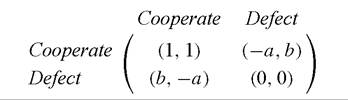
with a > 0, b > 1.
It is standard that (Defect, Defect) is the unique Nash equilibrium. Now suppose that players become altruistic, so that their utility is the weighted sum of their individual payoff ∏i and their opponent’s individual payoff ∏j, so that Ui = (1 — α)∏i + αΠj where α > 0. In this case, Defect is no longer necessarily a best response strategy; (Cooperate, Cooperate) is now a Nash equilibrium ifI > b( 1 — α) — aα or equivalently, a > (b — 1)∕(b + a). This condition can be satisfied for values of α well below one half, implying that, depending on the values of a and b, even moderate levels of altruism can eliminate the prisoner’s dilemma. Similar reasoning can be applied to games with inferior equilibria, such as the assurance game: in these games some altruism can also eliminate Pareto inferior outcomes. The intuition behind this result is obvious: the more players internalize others’ payoffs, the more they care about Pareto efficiency. When both players give equal weight to their payoff and others’, they only care about aggregate welfare, what we call the common good. In this case, the equilibrium is always Pareto efficient.[413] [414] Altruism provides an efficient solution to free-riding - a principle that most religions seem to have discovered centuries ago. The relationship between altruism and social capital probably has to do with group identity [Akerlof and Kranton (2000)]. Economic experiments using the dictator game and the trust game indeed suggest that agents exhibit more altruism and play more cooperatively if they have been induced to identify with a group [e.g., Fershtman and Gneezy (2001)].11 This is true even if members of the group are unknown and even if they are not even seen during the experiment. These results suggest that group identification may trigger agents to adopt more altruistic preferences, thereby yielding more efficient group outcomes. If identification with a group is necessary for preferences to become more altruistic and better aligned with the common good, efforts to foster a sense of community may naturally be seen as an essential component of social capital by many researchers. This probably explains why community building is often construed as a way to foster social capital. Social capital may also affect preferences in other ways. As argued by Fafchamps (1996) and Platteau (1994a), several mechanisms can be used to enforce contractual obligations: legal and extra-legal penalties, loss of reputation, and guilt. These same mechanisms can enforce contributions to the public good in case individual preferences are not aligned with the common good. By circulating information, social capital can magnify reputational sanctions, a point we have discussed in the previous subsection. Group identification can also raise guilt for acting against the group’s common interest. In our PD game, this is formally equivalent to deducting the subjective cost associated with guilt, call it g, from the payoff b associated with defection. If this feeling is strong enough so that b - g < 1, defection is deterred. Since Max Weber, the literature on market development has emphasized the role played by religion in fostering business honesty [Ensminger (1992), Geertz, Geertz and Rosen (1979), Poewe (1989)]. Communist work ethics propaganda can be seen as a similar effort to improve team performance by raising guilt among shirkers. One should not dismiss the power of such propaganda, especially when it is present in conjunction with other incentives including coercion, as evidenced by the Stakhanovite movement in the Soviet Union in the 1930s, see Siegelbaum (1988) for a nuanced discussion. By favoring identification with a group, social capital may also affect preferences through mimicry. In the literature, this idea appears in many guises, the phrase most commonly used being ‘role model’. Coleman’s example of PTA-run schools is a good illustration. According to Coleman, children whose parents are involved in running the school adopt a more positive attitude towards study. This change in preferences cannot be understood as altruism: it is in the children’s long-term self-interest to study. Nor does it appear to be purely the result of a sharpened sense of guilt for not studying. Rather it is related to a demonstration or role model effect: children change their preferences to mimic that of their parents. By visibly and credibly demonstrating their positive attitude towards school, parents induce a change in attitude among their children. This kind of phenomenon is related to what economists have called ‘herding behavior’, that is, the drive to mimic the behavior of others. More research is needed in this area to fully comprehend the phenomenon and its implications for economic efficiency. As has been argued formally in Blume (2002), however, mimicry need not result in superior equilibria: nothing in mimicry itself precludes agents from copying bad behaviors instead of good ones. One famous example is that of a group of high school students who refused to take their graduation exam as a symbol of group identity, even though doing so hurt them all. Other examples of bad mimicry involve hazing, gang rape, crime culture, and the like. Unlike altruism, mimicry is a double-edged sword. 3.2.3. Coordination and leadership Some of the beneficial effects of social capital on preferences occur by osmosis, without any purposeful action by anyone: people chat around a glass of beer and, quite by chance, a relevant piece of information is exchanged. In many cases, however, the benefits of social capital are only achieved through purposeful action: someone has to want to improve the group’s welfare and must do something about it for benefits to materialize. This is particularly true of any benefit that requires coordination in order to be achieved. This raises a host of difficult issues having to do with the decision making process within groups. It is well beyond the scope of this chapter to discuss these issues in detail. A few remarks are nevertheless in order. First, two essential ingredients seem to play fundamental roles in purposeful group action: leadership, and rules regarding group decision making. At this level of generality, their respective role is unclear. What is inescapable, however, is that neither of them constitutes social capital. In very informal groupings, leadership is likely to be essential to alter individual preferences and elicit voluntary contributions to the common good. While social capital may assist the action of leaders by facilitating the circulation of information and favoring group identification, the respective roles of leadership quality and social capital are likely to be extremely difficult to disentangle. This has important implications for empirical work: if good leadership is required to achieve the coordination required to benefit from social capital, testing the effect of social capital requires controlling for the quality of leadership. This observation also has implications for policy. Good leaders may improve efficiency by using the levers of social capital - e.g., by fostering altruistic preferences and concern for the common good; favoring group identification; preaching good behavior and making free-riders feel guilty; encouraging mimicry of good behavior through role models and the manipulation of group symbols and representations (e.g., religion, ideology). This is what practitioners in the field call ‘building social capital’.[415] Many NGOs, for instance, are engaged in precisely this kind of work. Sometimes they focus on the identification and training of local leaders, something to which many NGOs refer as an example of ‘capacity building’ [Barr, Fafchamps and Owens (2004)]. Purposeful coordination can also be obtained through formal rules by which decisions are made and deviance penalized. A simple majority rule combined with fines and jail sentences for free-riders is in many cases sufficient to reach efficiency. As long as free-riding is not so prevalent as to overwhelm policing, punishments directly alter incentives in ways that align individual behavior with the common good. In this case, social capital plays little role - except perhaps in coordinating not to overwhelm the enforcement apparatus. Leadership also becomes less critical since there is no need for a charismatic leader who can affect individual preferences directly. All that is required is a ‘bureaucratic’ leader who can apply and enforce the rules decided by the group. A proper investigation of the importance of social capital in economic life therefore requires a careful analysis of the rules by which decisions are reached. It is important not to credit social capital with outcomes due to formal rules. This means distinguishing between the benefits resulting directly from formal organization and the indirect benefits members derive from contact with each other. For instance, the Rotary Club has a decision-making body to coordinate the date and venue of its next dinner. The coordination benefit of meeting on the same day in the same place follows directly from the Club’s formal rules. But once at the dinner, there is probably no coordinated mechanism to share information among members. This same sort of reasoning applies to schools. In addition to the effects of student attitudes discussed by Coleman, PTA-run schools have an organizational structure different from that of other schools. In particular, decisions are taken differently and funding is allocated in a different manner when parents and teachers possess decision making power in schools. As Jimenez and Sawada (1999) have shown in the case of El Salvador, PTA-run schools tend to provide greater remuneration and select better teachers than other schools. These schools also exhibit lower rates of teacher absenteeism. At least part of these differences may plausibly be attributed to differences in funding and internal decision-making rules. Disentangling these effects from those of social capital is likely to be difficult and contentious. 3.3. Formal theory While the ideas associated with social capital have been linked to many strands of modern microeconomic theory, there has been relatively little formal modeling of social capital per se. One reason for this, we conjecture, is the absence of a generally accepted and coherent definition of social capital, as discussed. In terms of the efforts to embody social capital in formal economic models, one approach that has been taken is to incorporate social capital in models in the context of repeated prisoner’s dilemma games. In environments in which agents change partners, the sustainability of a cooperative equilibrium depends on either the likelihood with which a match today will be repeated in the future and/or the ability of an agent to access information about the past behavior of a new partner [Kandori (1992)]. In this context, social capital is interpreted in terms of the factors that facilitate the existence of a cooperative equilibrium. Routledge and von Amsburg (2003), using a prisoner’s dilemma environment of the type we described above, define social capital as present whenever a cooperative equilibrium exists; the key variable that determines whether cooperation can occur is the probability of trade between a pair of agents. Intuitively, if this probability is high, two agents meeting today are likely to meet in the future, so that any loss from cooperation today is compensated by future cooperation in the repeated relationship. Routledge and von Amsberg apply this idea to study how migration across regions or sectors, can, by lowering the likelihood of repeated interactions, lead to a loss of social capital. Annen (2003) defines social capital as an individual’s reputation for cooperation in prisoner’s dilemma games. In his analysis, this reputation depends on the extent to which information transmission about past behavior is reliable and the complexity of the network in which agents interact. Changes in either reliability or complexity can thus alter levels of social capital. Annen focuses on the question of when increases in network complexity lead to a reduction of network size or an increase in network size accompanied by greater investment in communication capacity. Other formal theory relevant to social capital includes efforts to model the notions of trust and trustworthiness. Zak and Knack (2001) study a general equilibrium growth model in which agents facing moral hazard problems decide how much to invest in monitoring. The presence and strength of formal and informal sanctions for dishonesty are shown to have powerful implications for growth because of their role in reducing the need to invest in monitoring. Another approach to modeling trust is due to Somanathan and Rubin (2004), who study the evolutionary stability of honest types in a population and provide conditions under which honest players can survive. The notion that some agents are intrinsically more trustworthy than others is employed by Rob and Zemsky (2002) to understand how cooperative versus noncooperative corporate cultures are produced by ex ante differences in the proclivity of agents to cooperate. Huang (2003) extends work of this type to considering how parents might invest in ways to make their children more trustworthy; when the payoff to trustworthy behavior depends on the investments of others, then multiple equilibria in population-level trustworthiness can arise. Perhaps the most important contribution to formal theory is Dasgupta (2003) which provides a wide ranging discussion of the relationship between social capital and formal modeling. Dasgupta argues that social capital should not be defined in terms of the presence of cooperation or some other outcome; rather that it should be regarded directly as social structure, ... social capital is most usefully viewed as a system of interpersonal networks... If the externalities network formation gives to are “confined”, social capital is an aspect of “human capital”, in the sense economists use the latter term. However, if network externalities are more in the nature of public goods, social capital is a component of what economists call “total factor productivity” (pp. 6-7). Dasgupta’s analysis is important as it indicates how the role of social capital in growth cannot be reduced to the addition of a variable to a linear cross-country growth regression. His analysis is also important in its recognition that theoretical claims about the desirability of the sorts of social structures that have been equated to social capital are to some extent artifices of particular modeling assumptions. For example, he argues that the claim that repetition of a one-shot game necessarily benefits the players of the game is not a generic finding and in fact does not generally hold for payoff structures other than the prisoner’s dilemma, going on to argue that work such as Fudenberg and Maskin (1996) shows how social capital can lead to exploitive relationships. As such Dasgupta’s analysis makes clear how functional notions of social capital are inconsistent with rigorous theorizing. Other conceptual discussions of social capital and social science include Ostrom and Ahn (2002) and Paldam and Svendsen (2000); the former is particularly interesting to contrast with Dasgupta (2003) as it is written from the perspective of noneconomists and indicates some of the conceptual gaps between economists and other social scientists on this topic. Dasgupta’s equating of social capital with social structure is reflected in a number of theoretical developments to link social capital with network formation. Redondo- Vega (2003) studies the evolution of a social network that links agents both through the determination of playing partners in repeated PDs and through the way in which information about previous play is used. Agents also receive opportunities to form new network links with others. An important substantive feature of the analysis is that various types of uncertainty affect measures of network density, measures which formally capture some of intuitive ideas behind the idea of rich versus poor social capital. Rauch and Watson (2004) model the formation of partnerships between others with whom one has previously worked versus strangers; while the former are less costly to form the latter produce higher expected profits. They show how the resultant social networks can exhibit clusters (densely interconnected subgroups within a population) and bridges (sparse connections between clusters), which have been described by Burt (2000) as salient features of social capital as embodied in networks. This type of work illustrates the great potential for the new economic theory of networks, see Jackson (2003) for an outstanding survey, in providing a rigorous foundation for social capital theories. 4.