9 Supermac
Among mid-twentieth-century prime ministers, Harold Macmillan ranks below demi-gods Attlee and Churchill, sharing third place with Wilson, and ahead of Eden and Home. ‘Supermac … the Super Statesman’, headlined the Daily Mail on his death in 1986.
The superlatives now sound distinctly overblown. Even in 1963 journalist Nora Beloff argued that the prime minister ‘also had his part in the final rupture’ with de Gaulle. Biographers disagree on the merits of Macmillan’s European initiatives. ‘The Common Market application’, writes Francis Beckett, ‘was an achievement’. Without the premier’s ‘groundwork on British public opinion, on the British political class, and on the leaders of Europe … membership would have taken longer’, D.R. Thorpe dissents. Britain ‘made the worst of both worlds – missing the opportunities afforded by Messina … Macmillan must take his portion of the blame for the lack of clarity and commitment in the British approach to European membership’.1‘All our policies … are in ruins,’ lamented Macmillan after de Gaulle harpooned his EEC membership bid.2 Nevertheless, the image of a humane, courageous and witty one-nation conservative outlasted the shambles of his European projects. The premier organized immortality in six doorstopper tomes of autobiography, portraying a Jekyll and Hyde de Gaulle – by turns friendly, charming, obstinate and inscrutable. In short, a plausible alibi for the failure to reach an understanding on Europe. Alistair Horne’s two-decker official biography published shortly after the premier’s death gave the icon a final burnish.
Macmillan over-egged the pudding. Sesquipedalian prose, freighted with detail and self-justification, obfuscated crucial questions. What happened to the Macmillan who in 1949 enthused about collaborating with a new cohort of continental politicians in the rebirth of Europe? Or, the apparent Francophile who in June 1962 reminded de Gaulle ‘how a close Anglo–French alliance, really effectively managed from day to day, would have avoided both wars’.
Ambition drove out any real sympathy for France and Europe. Climbing the greasy pole demanded ruthlessness. The public persona of an urbane Edwardian gentleman concealed a killer politician. In the ‘Night of the Long Knives’ in July 1962 Macmillan sacked seven ministers on the trot. Curiously, his European strategy lacked urgency and boldness. It evoked Labour politician Nye Bevan’s characterization of wartime Allied Command’s approach to the conquest of Italy – ‘like an old man approaching a young bride – fascinated, sluggish and apprehensive’.3There was nothing sluggish about the way British commentators blackened the French. Nora Beloff led the charge: ‘Is there still … hidden somewhere inside this incredible artifact [de Gaulle], a real person with pity for his fellow men … no one will ever know.’ On British and French advisers: ‘the British team … headed by Sir Roderick Barclay … a gentle, persuasive British diplomat with … a disarming smile. Opposite him … M Olivier Wormser – redoubtable dialectician, tall, elegant, crushingly sarcastic’. Official historian and former diplomat Stephen Wall compares the Franco–British stand-off of the 1960s to the hostility of the Napoleonic wars. Britain gave the 1961 entry bid its best shot in the teeth of Gallic bloody-mindedness. Whitehall worried how ‘to get round’ the French ‘or defeat them or convert them’. British leaders ‘all realized that … accession would only be possible if an accommodation could be reached with the French’. De Gaulle wrecked everything, belittling and excluding Britain.4
What more can be said? Plenty. To assert that ministers ‘realized’ entry depended on an accommodation with the French misleads – No. 10 dropped hints of future collaboration but made no offers. In the classic Irish tale a tourist asks a local for directions to Dublin: ‘Well, sir, if I were you, I wouldn’t start from here,’ replies the Irishman. He might have added, first catch your general. After wasted years pursuing a Six/Seven compromise, Macmillan announced in July 1961 an application to join the EEC – giving Paris just three days’ notice.
Downing Street viewed French support as desirable but not essential. There was no seduction – mostly sticks and a few post-dated carrots. The prime minister assumed the general would not risk a veto. Macmillan, as biographer D.R. Thorpe concluded, shares responsibility for the failure of the UK’s European ambitions. The French president was no ogre. In vetoing British bids he defended French interests as obdurately as the British defended theirs.Denigrating de Gaulle diverted attention from British singularities – tired premier, obsolescent machine and gloom-ridden political class. In exaggerating Macmillan’s incipiently doddering manner, satirists and others did him a disservice. Health, not age, was the issue. Years before the prostate operation of October 1963 ended his political career, severe stress debilitated the premier. Symptoms that today would be diagnosed as indicative of chronic fatigue syndrome (CFS) surfaced from the mid-1950s. No fresh thinking on Europe inspired Macmillan. The memoirs attempted to establish an alibi by invoking ‘old friendship’ with de Gaulle and the restoration of ‘old relations’ with France. The premier assumed the role of injured party, victim of the general’s antipathy. The ploy underwhelms – the diaries provide ample evidence of mutual dislike. As minister resident at Allied headquarters in wartime Algiers, Macmillan liaised with the general. ‘Ramrod’ de Gaulle, recalled the premier, had ‘all the rigidity of a poker without its occasional warmth’. A beach afternoon says it all. The minister skinny-dipped while a uniformed general looked on.5
Macmillan showed scant sympathy for mainland Europeans. Condescending towards the French, apprehensive of Germans, he shared the nation’s ambivalence towards continental neighbours. ‘Don’t you think’, suggested a colleague, ‘that in our country we have a special aptitude for not seeing the other country’s point of view?’. Cranford’s Miss Pole, denouncing ‘that wicked Paris, where they are always having Revolutions’, was alive and well.
Cross-channel elites, like Dover Mail passengers, suspected each other. The premier’s condemnation of de Gaulle’s veto of 1963 accused president and people: ‘French duplicity has defeated us all … there is the return of the old feeling “the French always betray you in the end.”’6Like Churchill, Macmillan flirted with Europeanism. At Zurich in September 1946 Churchill called for a United States of Europe and founded the British United Europe Movement. With fellow Conservatives, Macmillan joined the UK delegation to the Council of Europe at Strasbourg, briefly bonding with continental colleagues. Churchill’s indifference to the European cause after returning to power in 1951 made Macmillan as housing minister wary of going out on a limb. Delivery of the government’s promised 300,000 new-builds a year claimed energies. In a last flourish of European sentiments in March 1952 he criticized cabinet proposals for the Council’s reorganization. As foreign secretary in the Eden government he steered clear of the Messina conference’s integration initiative in June 1955. Spaak pleaded with him to seize the initiative in creating a united Europe. By 1958 the sympathetic Strasbourg colleagues of yesteryear had become pushy continentals exploiting, in Macmillan’s words, ‘our natural good manners and reticence. We are apt not to press our points too strongly in the early stages of a negotiation, and then when a crisis arises and we have to take a definite position we are accused of perfidy’.7
‘Perfidy’ was the word. Macmillan’s refusal to give a strong lead on integration seemed a betrayal of the European loyalties he and Churchill espoused in the early post-war years. As premier from January 1957, Macmillan had the authority to craft a post-Suez London–Paris rapprochement capable of shoehorning Britain into the Community. The UK had an economic and political edge over a beleaguered France, nascent EEC and uncertain West Germany. Fourth Republic notables sought an understanding.
Instead, Macmillan prioritized the repairing of the special relationship. Hostility overflowed on a visit to Paris in March 1957. The premier indulged in ‘a very long, and rather unpleasant argument’ about money-saving British force reductions in Europe. Were it not for the two hours of wasted argument about force reductions, he ‘would have attacked the French’ for their management of the last stages of the common market negotiations. Rather than concert approaches to the United States, Macmillan elbowed France aside in the race to mend fences. At Bermuda on 20 March he cosied up to President Eisenhower to win help for a British nuclear deterrent. Bermuda ‘makes all the difference to us … I was afraid the French would be hurt; or, worse still, want to make it a Tripartite meeting’.8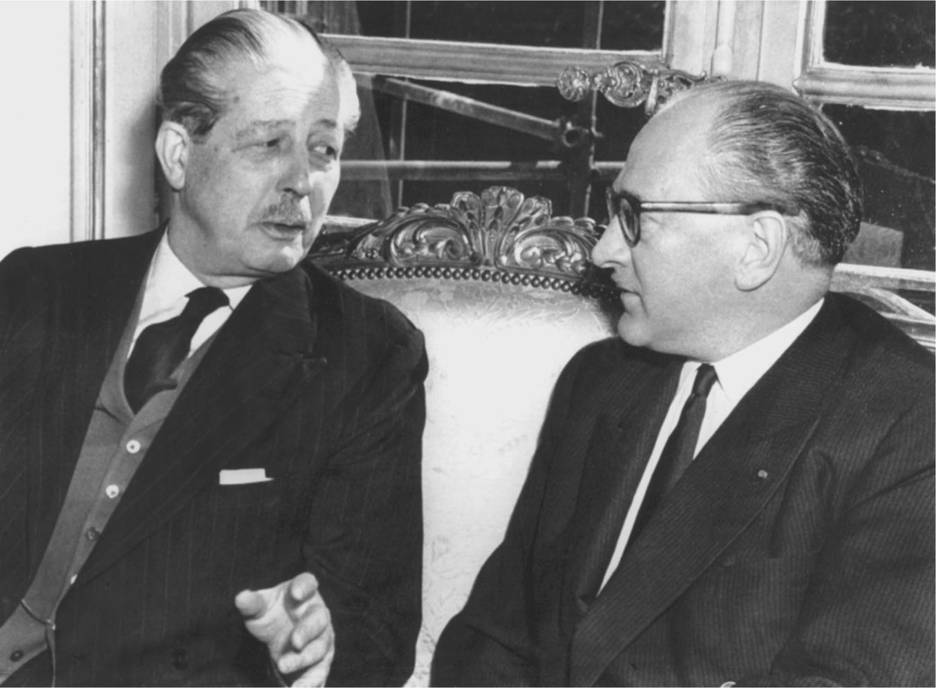
Figure 9.1 British Prime Minister Harold Macmillan and French Prime Minister Guy Mollet, 9 March 1957. Credit: Everett Collection Inc. / Alamy Stock Photo.
Undismayed, French ministers in June 1957 hinted at acceptance of a British free trade area in return for support in the Middle East. ‘Times had changed very much recently’, declared premier Bourges Maunoury: ‘old-fashioned rivalries which still seemed to preoccupy our representatives on the spot were entirely out of date … the additional constitution of a Free Trade Area on the lines suggested by London was vital.’ Downing Street spurned the advance: ‘it is far more important to achieve a meeting of minds with the Americans.’9
The shock of the military–settler Algiers coup of 13 May 1958 catapulted de Gaulle back to power – heading a transitional government charged with devising a new constitution. Macmillan had the advantage over a crisis-riven general, juggling with the Algerian war, the creation of a new Republic and EEC membership. He approached their first meeting since the Second World War with gladiatorial swagger. Ahead of the 29–30 June 1958 encounter, a macho premier emphasized duelling, not dialogue:
If little Europe is formed without a parallel development of the Free Trade area we will have to reconsider the whole of our political and economic attitude towards Europe.
I doubt if we could remain in NATO. We should certainly put on highly protective tariffs and quotas … adopt a policy of isolationism … surround ourselves with rockets … say to the Germans, the French and all the rest … ‘Look after yourselves with your own forces. Look after yourselves when the Russians overrun your countries.’10
Cheering crowds at Orly airport and lining the route into the capital surprised and delighted Macmillan. ‘All affability and charm’, the general apologized for being ‘so tiresome’ during the war. Unmoved, Macmillan adopted a minatory tone: ‘If the negotiations [free trade talks] broke down’, it would be ‘a great effort for us to keep four divisions on the continent … we would be driven back on ourselves and would have to seek our friends elsewhere … Europe would break up’. De Gaulle’s reminder that France could not go faster in the trade talks because of Treaty of Rome obligations triggered an ultimatum – failure to reach agreement by 1 January 1959 ‘might even spell the end of NATO’.11
The ultimatum was no tantrum. The prime minister handed his host ‘a very strong letter’ confirming the verbal warning. De Gaulle’s mellowness went untested – Macmillan’s ‘willing to wound, and yet afraid to strike’ language excluded amity. He stayed on the warpath, redoubling efforts to muster American support for Britain’s FTA project. Infuriated by what he perceived as procrastination, the premier let rip, ‘it looks as if the whole of this great effort will break down, foiled by the selfishness and insularity of the French’. In November de Gaulle confirmed opposition to the FTA. The Times, dancing to Macmillan’s tune, denounced ‘France the Wrecker’.12
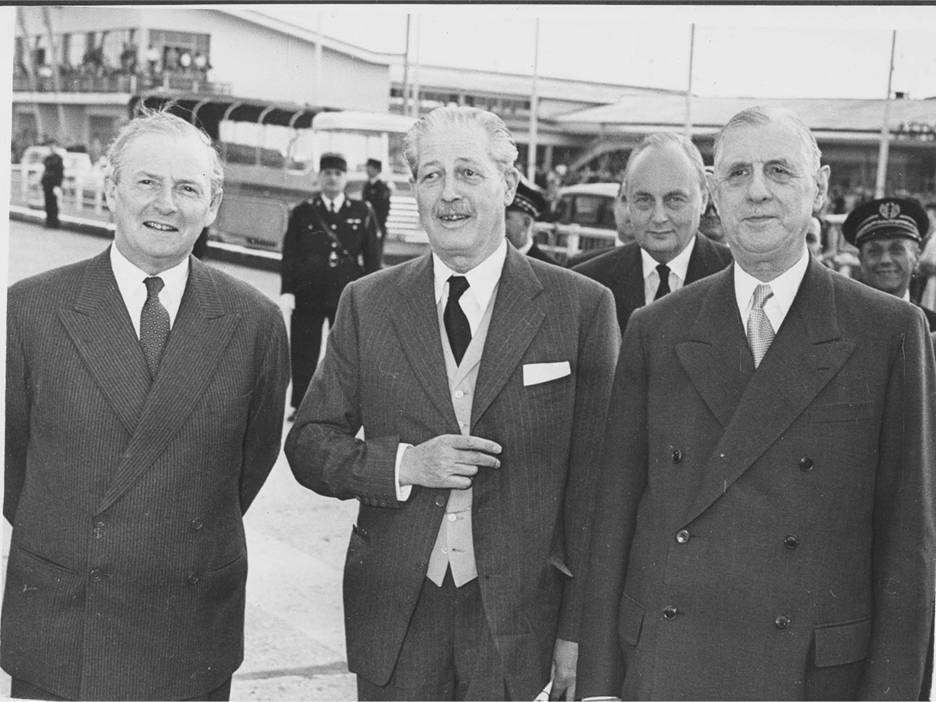
Figure 9.2 Prime Minister Macmillan and Foreign Secretary Selwyn Lloyd welcomed to Paris by General de Gaulle, 30 June 1958. Credit: Keystone Press / Alamy Stock Photo.
The electoral triumph of October 1959 made Macmillan ‘one of the most powerful prime ministers in British history … All options were open to him’. De Gaulle’s prime minister, Michel Debre, hastened to congratulate Macmillan, looking forward to regular contacts and ‘the closest cooperation’. An opportunity came in mid-December. Hosting preparatory Anglo–Franco–American talks for an upcoming East–West summit, de Gaulle, president of France since December 1958, invited Macmillan to join him for tea after the formal talks ended. The impromptu one-on-one at the Elysee Palace exuded pre-Christmas cheer. The general spoke ‘very freely and in a most friendly and even affectionate mood – Cher ami and all that’.13
Trapped in a Six/Seven box of his own making Macmillan saw no further than ‘the chance of getting some European economic compromise with the only man who is capable of making it today’. A refurbished Anglo–American alliance ‘must never be abandoned’, the premier strategized. Paris would get a limited settlement. In return for UK sponsorship of France’s re-entry into ‘the ranks of the Great Powers’, de Gaulle would have to give ‘the greatest practical accommodation that he can on the economic front’.14
Clearly a revamped Entente was not on the premier’s wish list. Nevertheless, two meetings with de Gaulle in the spring of 1960 gave him every opportunity to rethink the relationship. A meeting at the Chateau de Rambouillet on 12–13 March 1960 to finalize arrangements for the general’s state visit to the UK set the scene for a game-changing initiative. The prime minister’s arrival in the latest Citroën DS seemed a good omen. The president radiated bonhomie – which Macmillan ascribed to the successful testing of France’s first atom bomb the previous month. Alas, not the faintest wisp of white smoke escaped the chimneys. Fixated by the will-o’-the-wisp of a Six/Seven compromise, Macmillan again missed the bus. His demand for an immediate French commitment to resist an acceleration of EEC tariff reductions sat uncomfortably with calls for frequent get-togethers and ‘a real renewal’ of friendship. Nuclear cooperation surfaced: ‘I put the idea in his mind that we might be able to help him, either with American agreement or connivance.’ De Gaulle pricked up his ears – declaring that a Six/Seven agreement should be possible. Macmillan’s call for tri-monthly meetings went unanswered – his interlocutor prudently awaited delivery of nuclear know-how.15
Flying home empty-handed, the premier put a good face on failure – discussions revitalized ‘our old friendship’. Macmillan drew a blank because he sought only limited cooperation on his terms. Old friends from wartime Algiers were old adversaries. De Gaulle’s request for one-on-one conversations in French without interpreters did not make for smooth exchanges. Shared melancholic temperaments and elliptical speech frustrated full understanding at the best of times. The weekend left the premier with a severe headache. ‘The strain of talking French … and trying not to fall into any major error of judgement’ exhausted him. Why did he accept a procedure guaranteed to sow confusion? The image of a born world leader cultivating friendship with peers tickled his vanity. More importantly, conversations without interpreters allowed both leaders maximum wiggle room.16
The disproportion between the razzmatazz of the French president’s 5–7 April 1960 state visit and the exiguous political results would have supplied a skit for the comedy stage revue Beyond The Fringe which premiered later that year. Ministers spared no expense. Huge Crosses of Lorraine lit by fireworks decorated the façade of Buckingham Palace and the general enjoyed the rare privilege of addressing both Houses of Parliament in the Palace of Westminster. Even the Queen, ‘with appropriate humility’, asked the general ‘what he thought her role ought to be’. Instead of strengthening the Entente, leaders speculated about the intentions of Nikita Khrushchev, general secretary of the Soviet communist party. The Soviet leader had just ended a visit to France and an East–West summit loomed the following month. The preoccupation with Khrushchev and Cold War politics pointed up the poverty of ideas for a post-colonial global order and how Britain and France might shape it.17
Wasted pyrotechnics? Unexpectedly, during an exchange about Sixes and Sevens de Gaulle offered a cue, ‘Why didn’t England enter the Common Market?’ – the very question engaging Macmillan. Caught on the hop he responded brusquely in one word, ‘Impossible’, reiterating the urgency of a Six/Seven alignment. A chance missed? After the 1963 veto American president John F. Kennedy observed: ‘If you had applied one year earlier – before Algeria was settled, de Gaulle couldn’t have stopped you’. In fact, this was what the premier attempted in mid-July 1960 – to secure cabinet approval for an application.18
Several pressures pushed an application upfront. The Six/Seven impasse heightened a sense of time running out. The electoral victory of October 1959 was losing its shine, and voters expected big initiatives at home and abroad. Delaying decisions on Europe lengthened the odds against acceptable entry terms. Applying for entry would enhance Britain’s standing with a new American president after the November 1960 presidential election. The collapse of the four-power East–West Paris summit in May dashed the premier’s hopes of playing world statesman, making movement on Europe essential to keep up momentum. From late 1959 the premier’s consigliere, deputy cabinet secretary Freddie Bishop, advocated the importance of courting France and Western Europe. In early July 1960 he proposed ‘developing a special bilateral relationship’ with joint control over nuclear capability. Macmillan conceded that ‘what he [de Gaulle] says, counts – and nothing else’. The public success of de Gaulle’s April 1960 state visit invited closer links. Delay reinforced continental suspicions of British motives. An exchange between Macmillan and a dance partner circulated in Brussels: ‘“Oh! Prime Minister. Are we going to join the Common Market? It’s awful!” … he squeezed her in his arms and replied: “Don’t worry my dear, we shall embrace them destructively!”’
In politics as in comedy, timing is everything. Macmillan made a costly misjudgement. Ignoring warnings from aides, he took the issue of EEC membership to the full cabinet on 13 July 1960 without first exploring a cross-channel understanding. The misstep derailed the initiative for another year. Bizarrely, after ruminating for months the premier rushed his fences, and provoked heavy flak. It was an avoidable defeat. Softening up individual ministers and small group retreats at Chequers could have won early support for entry.
Why lose another year before announcing a bid? Mismanaged exploratory talks with France heightened cross-channel suspicions. Launched with a clear mandate the conversations might have created a pathway for an application. Instead, noted a participant, ‘We did little more than state the problems … because we were not allowed to show most of the cards in our hand.’ The French spent a good deal of time ‘in telling us that we would have to move from this or that position when in fact we knew perfectly well … we would have to go a good long way further to meet the Six’.19
Macmillan fretted about ‘getting nearer to the French without losing the Americans’. Panic attacks about breaking transatlantic ties provoked ‘an unrealistic search for the best of all possible worlds’. The premier’s ‘Grand Design’ of December 1960 presented Britain ‘as one of the great forces of the Free World’ beside Europe and America. It did not occur to Macmillan that America might welcome a Franco–British Europe. Advice came from the Paris embassy. ‘The key to the whole business’, wrote ambassador Sir Pierson Dixon, ‘may in fact lie in somehow conveying to de Gaulle that the French are as important to us as the Americans.’ Britain, the envoy urged, would have to take ‘some significant step … in the nuclear field’. Dixon proposed offering a deal, ‘provided that we did not too obviously appear to be trying to get the best of both worlds, European and American … [though] what we are after is precisely the best of both worlds’.20
De Gaulle remained friendly, despite Macmillan’s unresponsiveness. For a Rambouillet summit on 29–30 January 1961 he upgraded his guests – better plumbing, warmer bedrooms, plentiful bed clothes, and an after dinner treat – a French documentary about a priapic New Guinea tribe. At the very start of conversations de Gaulle emphasized the urgency of a genuinely close alliance. Evading a direct response the premier went off at a tangent on a different topic – the Cold War and the West’s economic strength.
Preferring stealth to trumpets, No. 10 announced a UK membership application on 31 July – just before the parliamentary summer recess. The bare-bones Commons statement had all the passion of a train station announcement. No one explained why ministers had changed their minds since the formation of the EEC. The Times deplored the Scottish mist, and censured the lord privy seal Edward Heath for claiming the decision had been taken ‘after searching debate’, concluding: ‘the best way to breed confidence is to show the greatest possible candour’. France was not consulted. The FO advised the government to confine itself ‘to telling him [De Gaulle] what we propose to do and do not invite him to declare his attitude in advance’. The veto of 14 January 1963 locked Britain out of the Community for another decade.21
The rest is history – or, is it? Politicians, civil servants and commentators pilloried de Gaulle for the deadlock. The exception was Sir Eric Roll on the UK’s Brussels negotiating team. Instead of castigating the general, Roll criticized his country’s performance. The breakdown, he informed colleagues in February 1963, was ‘not so much a failure of negotiations per se, but a failure of a major aspect of our foreign policy’. London and Paris shared responsibility for an avoidable outcome.22
Would the general have lowered the drawbridge? ‘From the start and continuously,’ concluded a leading French scholar, ‘de Gaulle opposed British entry into the common market’. How, then, should we interpret the general’s friendliness? Until mid-1962 de Gaulle, I contend, anticipated a marriage proposal. For sure, he had mixed feelings about British membership, but as a pragmatist he sought the best outcome for his country. London’s reluctance to negotiate a comprehensive deal, and the frustrations of the Brussels multi-dimensional chess game, determined the veto.23
Caveats are necessary. The fragmentary and circumstantial nature of the evidence excludes definitive judgements about the French president’s intentions. We know much more about Macmillan’s thinking than de Gaulle’s. No presidential secret diaries have surfaced – fake or real. The president considered the secrecy of policy-making part of the mystique of power. Governing without kitchen cabinet or think tank he played his cards close, forcing historians to lean heavily on information minister Alain Peyrefitte’s notes of meetings. The thirty-year gap between events and publication of Peyrefitte’s memoir imposes caution. The records of Franco–British swordplay carry a special health warning. There was no agreed record of discussions – both sides made separate versions to allow for editing and fudging. The general’s aversion to interpreters for one-on-one conversations forced Macmillan to speak French. Private secretaries took notes but the premier’s secretary believed that at Rambouillet in December 1962 de Gaulle had not ‘entirely understood everything that was said’. One unrecorded conversation took place on that occasion.24
The president was not a one-man band. Advisers, people and Community partners fretted about a destructive British embrace merging the Community into an Atlanticist free trade area shorn of supranational ideals. Britain’s EFTA grouping suggested a traditional divide and rule approach in Europe. Washington’s overly zealous lobbying for the UK might portend an American Trojan Horse. The virtually simultaneous applications of Britain’s escorts – Ireland (31 July) and Denmark (10 August) – added to the Six’s unease. Enlargement negotiations sharpened the Community’s sense of identity. To jump from six to nine seemed more threat than blessing. An ambassador’s gaffe captured the anxieties of the time. Presenting the UK application to the president of the European Commission, a nervous British envoy made a Freudian slip – implying the EEC might join the Commonwealth.25
Pigeonholing de Gaulle as an unreconstructed nationalist playing king of the castle undervalues his pragmatism. The ideologue concealed an opportunist. Grain and grandeur motivated the president. His abandonment of earlier opposition to the EEC forced French protectionist interests to accept the liberalization measures of the Treaty of Rome. The Community supplied an economic and political armoury for leadership in Europe. The measured response to Macmillan’s bid illustrates the balancing of principle and pragmatism. For de Gaulle, Britain’s quest for EEC entry had a plus side, opening up vistas of a Paris–London–Bonn troika leading Western Europe. The willingness to pay upfront for French sponsorship would provide a litmus test of commitment to the Six and shared direction of a European Europe.
The Gaullist rulebook prized secrecy, surprise and avoiding the opening move in negotiations. ‘He [de Gaulle] knows nothing of the gentle art whereby an opponent’s face can be saved’, remarked a French diplomat, ‘so the problem lies in being prepared to make all the advances before starting talks with him’. There was no stooping to conquer – presidential hospitality at Rambouillet featured a pheasant shoot with the general standing behind – he did not participate – commenting loudly each time guests missed. They paid for their cartridges. Likewise, de Gaulle expected Macmillan as an applicant would do his sums and make an offer.26
True, the general had red lines – rejecting Britain’s FTA and EFTA initiatives because they jeopardized the new-born EEC. Nevertheless, Elysee cordiality flagged a desire for rapprochement. At Rambouillet in January 1961 the general appealed for a Franco–British alliance – a big step for a leader chary of making the first move. To dismiss charm as a delaying device until the president felt strong enough to slam the door is simplistic. The adage, ‘keep your friends close, but your enemies closer’, guided Gaullist realpolitik. Affability telegraphed readiness for rapprochement while protecting France’s world image. UK admission under French aegis would balance West Germany and advance a European Europe.
De Gaulle walked a tightrope. Too negative a posture risked upsetting Brussels partners, endangering agreement on CAP and France’s Fouchet Plan of 1961–2 for an intergovernmental EEC. Any weakening of the Community would hinder the hexagon’s economic modernization. Too welcoming a stance would encourage Britain to believe it could enter on the cheap without a quid pro quo. The high risks make it unlikely that de Gaulle decided from the outset to veto the bid. France had worries enough without adding to them. Threats of civil war rumbled on. The Algiers military putsch in April 1961 highlighted the fragility of the new Republic and the urgency of peace-making in North Africa. The UK’s choice of a two-stage application format – exploratory talks to clarify admission terms, then confirmation or withdrawal, reassured the general. The likelihood of Britain becoming ensnared in prolonged bargaining promised a breathing space to finalize CAP and stabilize the Fifth Republic. Protracted discussions might persuade Macmillan to settle on France’s terms or withdraw.
The divas pirouetted but would not dance together, despite professing amity. Early agreement would have fast-tracked the bid before Macmillan’s domestic critics woke up. Apart from inviting the general to play concierge and leave the Brussels door open, No. 10 made no overtures. Whispers of nuclear treats remained whispers. The premier vowed not to go to Paris ‘as if we are a supplicant’ and had no plans for a new Entente. Macmillan acknowledged French mistrust but believed de Gaulle would not dare pull up the drawbridge. Shortly after France’s veto a Whitehall intelligence chief blamed the premier for trying to run two hares at the same time – America and Europe. Like novelist William Golding’s Pincher Martin, Macmillan clung to a mid-Atlantic rock.27
Why did No. 10 make a dog’s dinner of the bid? Great power assumptions, reluctance to leave the Anglo-American comfort zone, and lack of sympathy for the EEC and its ideals, are only part of the answer. More specifically, three influences – often overlooked – hobbled the handling of the application: the prime minister’s health, character and decision-making style. Tiredness plagued performance – action and lethargy alternated. The premier presented symptoms of chronic fatigue syndrome (CFS), then unrecognized as an illness. Long before the prostate operation of September 1963 Macmillan’s health seesawed, blighting many working days. A gallstone operation in May 1954 left him ‘very tired … the truth is that my work is getting rather too much for me, with all the speaking engagements which I have unwisely accepted’. Promotion to foreign secretary cranked up the stress: ‘One sees people all day and we work from one morning till the early hours of the next … I am beginning to feel the strain’. No. 10 workloads knocked him for six: ‘very tired and overdone’ (4 December 1958); ‘retired to Chequers for four days as I am completely exhausted. I am alone and staying in bed’ (30 October 1959). Age was not an issue – sixty in 1954, he lived into his nineties.28
On Eden’s resignation in January 1957 Churchill recommended Macmillan for the succession, believing him to be more decisive than rival R.A. Butler. In fact, indecisiveness and inconsistency flawed the premier’s handling of Sixes/Sevens and the UK bid. The would-be world statesman cultivated the image of an unflappable wonder working leader reading Trollope while acolytes slaved. In reality, lassitude strengthened a natural melancholy that magnified difficulties – ‘problems crowd in upon us. I do not see how to deal with them’. Aides fretted over a slowing down: ‘he seems unable to sustain the same intensity of concentration and effort over prolonged periods.’ In private, Macmillan confessed bafflement at the ‘intractability’ of everything. Overdosing on historian Arnold Toynbee’s A Study of History fed a natural pessimism. The slowly shrinking power of ‘the civilized world in the face of the barbarians’, the premier confessed, dwarfed the common market and everything else.29
A rigid top-down style starved policy-making of fresh ideas and thinking. Slow, solitary reflections authored several ‘Grand Designs’, but no one master design. The much touted ‘Grand Design’ of December 1960 primarily addressed external policy aims for 1961, not long-range strategy. Its genesis illustrates the limitations of the premier’s style: leisurely ruminations, then bouncing ideas off intimates, followed by feedback meetings with a chosen few, finally circulation among boss mandarins.
Craving centre stage the premier selected a mediocre FO ministerial team – keeping Selwyn Lloyd, Eden’s foreign secretary, in post until July 1960, despite rubbishing him as ‘one of Eden’s stooges’. Lloyd dismissed the EEC as ‘much ado about nothing’. From July 1960 a duo operated – Alec Douglas-Home, Earl of Home, as foreign secretary in the Lords, Lord Privy Seal Edward Heath as deputy foreign secretary in the Commons with responsibility for Europe. The premier picked Heath because he would follow instructions – describing him as ‘a first class staff officer, but no army commander’. Macmillan’s premiership reveals the extent to which a powerful prime minister and advisers could sideline cabinet, parliament and people and initiate major policy changes. That ministers finally fought back and stipulated the terms of the EEC application does not weaken the significance of the marginalization. Greater decisiveness and better management would have enabled Macmillan to see off critics and launch a bid in 1960. Prime minister Harold Wilson’s handling of the second bid demonstrated how a savvy leader tamed his cabinet.30
An efficient and sophisticated machine would have energized and buttressed Macmillan. Whitehall had nothing to rival France’s superb SGCI with its own secretariat and research committees. A visiting US President joked nervously about whether the floors in No. 10 would stand the extra weight of TV cameras. In the summer of 1960 the premier moved to Admiralty House before No. 10 collapsed. Policy-making, like No 10, was structurally flawed. ‘It’s a strange thing,’ remarked Macmillan on becoming prime minister, ‘I have now got the biggest job I ever had and less help in doing it than I have ever known’. A sclerotic engine supplied patchy support at best. Once the envy of the world, the Rolls-Royce Phantom IV only fired on two cylinders. The Treasury, Macmillan groused, could produce ‘a perfectly adequate short-term policy to cope with an existing situation, but could not put it into a long-term context’. The premier did not install a policy unit in No. 10, despite a warning from a senior minister that ‘The present system’ was ‘breaking down’.31 Snail-pace interdepartmental committees, weakly coordinated and riddled with turf wars, conducted ad hoc policy reviews. A major post-war ‘horizon scanning’ exercise, ‘Future Policy for 1960–1970’, chugged along for nearly a year until shelved without its recommendations going to cabinet. The lead economic policy committee had a three-month gap in its meetings schedule. Plagued by inertia, policy drift and poor coordination, mandarins shrank from confronting the implications of changing geopolitics.
The pudding had no theme. As foreign secretary, Macmillan searched in vain for a sequel to the island story about imperial glory. ‘There is a vision and (or) a theme – if ever we can get away from negotiations on the future of eggs and pig meat – it is the march to the unity of the whole world – United Europe with Commonwealth, USA.’ The premier diagnosed world-wide unease, ‘a malaise which is beginning to show itself everywhere’. The malaise began nearer home – a crisis of confidence in the political class that rubbed off on the premier. Fresh from a round of gold star international conferences, economist Roy Harrod alerted Macmillan to negative perceptions of the UK – ‘now universally recognized as a country of very low growth … we are on our way out as a country of leadership’.
Crumbling power fostered self-doubt. Labour’s Roy Jenkins warned the Commons of ‘a real danger … we shall go into a drab decline’. Suez shredded the moral leadership inherited from the war. The British, wrote journalist Peregrine Worsthorne, ‘never have … been so completely in the dark about what, as a nation, they are trying to do’. The premier lacked the fire to enthuse parliament and nation. A friend heard him speak at a WEU meeting, ‘It was the old, old story, nothing he could say or do would make it [European unity] grew any faster. Then came the old stuff about the Commonwealth, our EFTA partners, British agriculture. There was one dreadful passage, “Let us count our blessings.”’ Inconsistent pronouncements about the nation’s ranking undermined trust. Paris ambassadress Cynthia Gladwyn dismissed Macmillan’s insistence on Britain still being a great power as ‘further proof of the sickening hypocrisy of politicians. Only a few weeks ago … he was giving us a long tirade on how European civilization had come to an end, that England was finished’.32
A sense of amputated identity and loss of purpose impacted policy-making, and generated ennui with European issues. Asked why the government had not fully committed to the Six at Messina in 1955 the then chancellor of the exchequer answered – ‘boredom’. Labour leader Hugh Gaitskell belittled EEC and EFTA talks as ‘always a bore and a nuisance’. The badges of conventional greatness – missiles, East–West summits, Anglo–American conclaves, one foot high white fur hats Macmillan mode – were sexier than Brussels agricultural quotas and pig meat.33 Ennui explains why in the 1950s politicians and planners were slow to pick up on the desire for greater integration and increasing distrust of Britain. Meeting continental economists in 1953, Robert Hall, director of the Cabinet Office economic section, observed ‘a strong desire for integration, a common market’. Suez dissolved Britain’s residual moral primacy. ‘Scandinavian opinion’, declared the Swedish ambassador in London, ‘has never been more shocked by a British Government action’. In 1958 European students at the LSE rebuked Britain for refusing to join the EEC, ‘We don’t trust you because … you want to be a great Imperial power still’.34
The government’s approach to negotiations helped scupper the bid. Insistence by a Johnny-come-lately on bespoke terms for British agriculture, Commonwealth trade and EFTA partners was fundamentally flawed. ‘Forcing the Six to provide satisfactory terms for New Zealand, for Australia, for India and for Africa had become an impossible task before 1961,’ notes the official history. The misjudgement guaranteed protracted wrangling at the expense of the European ideals Britain claimed to espouse. Macmillan’s mix of cajolery and bullying towards de Gaulle betrayed naïvety and arrogance. There was no plan B and no back channel to the Elysee. Nor did the premier reach out to Labour Party leader Hugh Gaitskell in order to build a bipartisan approach.35
Ministers made a pig’s ear of marketing the bid. Assuming talks lasting weeks rather than months, No. 10 damped down expectations and protected its negotiating hand. The sprint became a marathon, but Macmillan resisted engagement with the public. The failure to sell Europe to the country and the unconscionable slowness of the multilateral Brussels game gave the Labour Party and anti-common market lobbies time to mobilize. Support for the bid peaked at 53 per cent in December 1961 before plummeting in 1962. Domestic dissensions confirmed the reservations of the Six about the UK’s readiness for Europe.
Contradictions wrong-footed the application. The contrast between Treaty of Rome aspirations and the Brussels sausage factory was a turnoff for the nation. Efforts to secure an American replacement for Blue Streak, Heath warned, meant that ‘at the same time as we are trying to negotiate our entry … we are giving every indication of wishing to carry out policies which are anathema to the two most important members of the Community. This can only increase the mistrust and suspicion felt towards us’.36
In the summer of 1962 pro-Europe groups accused the government of neglecting the case for membership. A leading public relations specialist warned: ‘To date the government has shown a marked lack of ability – one might say responsibility – over even attempting to explain the intricacies of this complicated problem [EEC entry] to the inhabitants of Coronation Street and their neighbours, a pamphlet and the weekend utterances of ministers are not enough.’ Education minister David Eccles alerted Macmillan to voter fatigue: ‘The intelligent voter doubts whether we are as a nation fit enough to enter the Common Market. The doubts are spreading like measles … the cry goes up, “the Government doesn’t tell us anything.” Everyone is left in the dark about how the Common Market will affect him … So we will lose votes because we are not explaining things well.’37
Whitehall hierarchs cheered the ministerial Rolls for successfully navigating Brussels road blocks and almost reaching the finishing line. Reality was less flattering. Hubris bred over-confidence: ‘we’re a match for The French at civil service level … we’ll put de Gaulle in his place. He’ll learn to speak English in a year or two.’ Uninspired leadership hobbled the UK delegation. Styled ‘Mr Europe’, Heath ‘had no particular liking for the French, nor any conspicuous empathy with foreigners’. In Brussels he played solo, suppressing the voices of colleagues. French foreign minister Couve and his enarques, outranked and outgunned him. Ambassador Pierson Dixon kept his Paris posting and commuted between the two capitals. The intention was to preserve the envoy’s rapport with de Gaulle, but the double harness sapped his effectiveness in both cities and contributed to an early death.38
Whitehall naïvely assumed a level playing field, but community procedures emphasized applicant status. Sir Eric Rolls’s legendary fluency in several languages and ability to lip read in three was wasted. Instead of face-to-face bargaining, the Six withdrew behind closed doors to hammer out a collective response on each issue, leaving the British to kick their heels in ante-rooms. Unacceptable responses triggered a repeat of the whole process. London requested an independent chair and strong secretariat but had to accept a rotating chair and weak secretariat. ‘We never succeeded in establishing … [that] the Conference was a place where seven governments were together seeking solutions’, bewailed UK officials.39
Too many cooks. Multiple actors and plots crisscrossed. It was Uncle Tom Cobley and all: the Six as a Community and as individual member states, together with Britain, Ireland, Denmark, EFTA states, Commonwealth countries, the United States, the European Commission and visiting missions. Rattled by the ‘leisurely pace’, Heath recommended a more ‘aggressive’ stance. Gossip and disinformation overwhelmed UK officials: ‘It was impossible to circulate a document or make a statement … unless we were ready to see its substance published at once.’ Something safely said on one front, exploded on another.40
Without an effective nerve centre and triage the delegation drifted. Commonwealth governments pressed trading interests regardless of relative importance. Under instructions the delegation put forward proposals ‘on questions ranging from the trivial to the essential irrespective of the prospects of negotiability’. At weekends senior officials – ‘flying knights’ – scurried back to London. The commuting made it difficult to take the temperature – ‘it was seldom possible … to make a considered assessment of the current position and decide what fresh instructions were needed’. London did not welcome feedback – severely restricting circulation of the team’s forecasts of what might be obtainable. The forecasts ‘appeared to have no direct impact on ministerial and official opinion … or on our instructions’.41
Macmillan made no effort to break out of the cage, and lead negotiator Heath was determined to play hardball. As talks got bogged down he sounded off about the need ‘to stand up to the French and outwit and outmanoeuvre them’. Strangely, in a city jam-packed with players there were no behind-the-scenes initiatives, despite plenty of potential go-betweens. Bernard Clappier, director of external economic policy at the French Treasury, and Jean François Deniau, leading the Community delegation, proffered advice – one of three senior Eurocrats to resign after the veto. Rolls’s friendship with Marjolin, French representative on the European Commission, supplied another conduit. A rigidly hierarchical delegation lacked the resilience for informal probes. On many issues instructions precluded it from taking the initiative.42
There is no consensus on the debâcle of 14 January 1963. Explanations of the motive and timing of the veto are ‘varied, complex and conflicting’. Was it an expression of settled French policy or an angry swipe provoked by the Anglo–American Nassau agreement about Polaris missiles on 21 December 1962? Allegedly, de Gaulle felt betrayed because a week earlier at Rambouillet on 15–16 December Macmillan had not fully briefed him. For want of a nail? ‘All might have been so different’, claimed a French diplomat, if the premier had stayed awake instead of snoozing over his Armagnac while de Gaulle rambled on after lunch. Nice anecdote but implausible. Before the encounter the general had decided on a veto – how, when and where was the question. What he said at Rambouillet reads like a dry-run for the 14 January press conference. Nassau was pretext, not cause.43
The official history of Britain’s European policy asserts that French internal developments drove the veto decision.44 Opposed on principle to UK membership de Gaulle waited until he felt strong enough to risk a unilateral veto. The simplistic argument conveniently lets British decision-makers off the hook. Certainly, France’s internal consolidation mattered. Through 1962 the nation rebounded economically and politically: completion of CAP; Algerian independence; referendum approving the president’s election by universal suffrage; and a large Gaullist victory in November legislative elections. But turbulence remained – the general had a narrow escape from an OAS ambush at Petit-Clamart on 22 August. By early autumn external forces dominated the general’s decision-making. A triumphal state visit to West Germany in early September made the French president anxious to finalize a Paris–Bonn axis and speed detente with the Soviet Union and eastern Europe. American President John F. Kennedy’s minimalist style of consultation with NATO allies in the October Cuban Missile Crisis reinforced the resolve to build an independent nuclear force.
De Gaulle’s perceptions of UK intentions decisively swayed his decision-making. Macmillan’s tacit ‘Non’ to the general’s overtures binned hopes of partnership. At the Château de Champs summit on 3 June 1962 the general made a final throw of the dice – inviting military and political collaboration. The prime minister again dodged a direct response, and made it clear that cooperation would have to await admission to the Community. The snub alarmed British officials when they checked the official record a few days later: ‘De Gaulle could very easily have interpreted this, if not as a refusal to agree to talks … at least as an attempt to put them off indefinitely.’ Precisely. Macmillan’s rebuff persuaded the general that he had nothing to gain by prolonging negotiations.45
Macmillan’s increasingly beleaguered home base had already given the general second thoughts about the desirability of alliance. An avalanche of woes hit No. 10: faltering economic performance, by-election defeats (especially Orpington in March 1962), sex and spy scandals, Conservative party rifts, and resistance to EEC membership culminating in the Labour’s Party’s condemnation of the bid at its October conference. The sixties countercultural revolution strengthened perceptions of a country in disarray. Labour looked set to win the next general election in 1964. Given Macmillan’s growing unpopularity and refusal to make an offer, the general deliberated how to end the talks – regaling ministers in December 1962 with excerpts from Edith Piaf’s song Ne pleurez pas, Milord (Don’t weep, My Lord), including the refrain Allez-vous en, Milord (Clear off, My Lord). Macmillan was now an unwanted ally.
Why wait so long to pull the plug? The narrative lacks a convincing explanation of the delay. Brussels supplies an answer. The stately dialogues of president and premier against the backdrop of historic chateaux captured media attention, and turned the horse-trading over Canadian pig meat quotas and New Zealand butter into a dull side show. In reality, the Brussels Leviathan determined the denouement. As the largest multilateral exercise since the Marshall Plan era of the late 1940s the British, Danish and Irish applications marked a seismic moment in European affairs. The negotiation was one of the most complex in the history of international economic relations. How to escape Leviathan? The seemingly endless talks ensnared London and Paris in a multi-dimensional chess game which they could influence, but not control. France’s foot-dragging initially paid off, enabling completion of CAP and consolidation of French hegemony in the Community. By late 1962 slow strangulation tactics had served their purpose. With no prospect of a British deal the general wanted out.
The intractability of the Brussels monster swallowed up time and resources, preventing him moving forward. On 12 December Wormser, senior economic adviser, warned of a crisis looming in the coming weeks. Strengthening domestic opposition to membership would compel Macmillan to demand more concessions or withdraw. France, concluded Wormser, should act quickly to protect its interests.46 For de Gaulle, the alert conjured up unpleasant scenarios: a limpet-like Macmillan launching a formal application, locking France into the Brussels maze; a UK withdrawal saddling France with the blame; deadlock with recriminations on all sides – destabilizing the Community. The scenarios menaced France’s standing with Community partners, global publics and French opinion. A veto seemed the lesser evil, offering an emergency exit and opportunity for France to defend the decision. But there was no quick fix. To rush into a veto without a credible pretext and adequate preparation risked breaking up the Community and becoming the fall guy.
Two things rescued the general from the quandary – his press conference machine and the Nassau meeting. Nassau supplied a plausible pretext and the conference a superb propaganda weapon for blaming the Anglo-Saxons and posing as Europe’s true champion. The Anglo–American agreement on Polaris missiles, claimed de Gaulle, contradicted Macmillan’s avowals of European loyalty. The semi-annual regal-like press conference, the regime’s heavy artillery, gathered the political elite and a global television audience – an unrivalled opportunity to sell France’s case. The elaborately choreographed performance required lengthy preparation – the president took weeks to memorize script and responses to questions submitted in advance. Hence the delay of nearly a month between Nassau and the veto.
An old-fashioned power struggle triumphed over partnership. De Gaulle won – but not hands down. Shunting the bid aside merely postponed the issue. The contrast between the Six’s surging economic clout and UK doldrums guaranteed a second bid. In the meantime, the contest continued – as farce. In March 1963 Heath – to avoid meeting French ambassador Courcel – excused himself from the England–France rugby match at Twickenham. Assured the ambassador had refused an invitation he went, and bumped into Courcel. England won the game. After toasting ‘The Queen’ the English captain proposed a toast to the ‘President of France’ – turning to Heath with the mikes on: ‘I wasn’t going to mention that bastard’s name’.47
Heath commanded the Death to the French brigade: ‘so bitterly anti-French as to be … almost unbalanced in his hatred of de Gaulle’, noted Macmillan. Cancellation of a visit by Princess Margaret left Parisians unfazed. The Quai seemed unperturbed when the BBC provocatively televised an interview at a London Chinese restaurant with former foreign minister and OAS chief Bidault, fleeing an angry general. Paris protested the anti-French salvos but held its fire, anticipating a second try in the near future – including efforts to mobilize Community partners against France. The general’s ‘I want her naked’ remarks put Britain on notice that the next round would mean taking off American and Commonwealth clothes.48
An avoidable veto? Maybe. The thumbs down is usually regarded as an inescapable expression of French antipathy caused by clashing national ambitions – an Anglo–American Europe vs. a French-led European Europe. This interpretation ignores the shades of grey in the bruising encounter – the general’s friendliness, Macmillan’s missteps and the Brussels Godzilla. Though the premier recognized the need for ‘a personal deal with de Gaulle … what he says, counts – and nothing else,’ the American alliance acted like a ball and chain, inhibiting a pact. The years 1958–60 – prime-time for rapprochement – were squandered in ill-conceived moves: corralling the French into the FTA, searching for a Six/Seven accommodation, and applying for Community membership without first getting the French on board. As well as stoking cross-channel distrust, the initiatives altered continental perceptions of Britain. ‘The whole experience since 1959’, concluded a Whitehall mandarin, ‘has been that those in Europe who would like us to join have recognized more and more that Europe can be a going concern without us. Any proposition that we should like to join if certain conditions could be fulfilled will get us nowhere.’49
The Dictionary of National Biography lauded Macmillan for coordinating ‘with skill, cunning, and a certain degree of deception Britain’s retreat from world power status … He was sometimes unwilling to do more than hint to his party and his nation the direction in which he was leading, but this was perhaps because he saw that the Britons of his day could not and would not face the facts’. The complacency is telling. On Europe, the premier’s condescension, ineptitude, and inability to engage with the nation, proved disastrous. True, membership bids gave citizenry a voice in external policy-making – via polls, parties, pressure groups and the 1975 referendum – but political masters imposed narrow limits, presenting voters ‘with the answer rather than the question’ – pre-empting advance debate.50
The American poet William Carlos Williams wrote of ‘the rare occurrence of the expected’. That leaders would draw a line under the interwar mesentente and make a fresh start was a reasonable post-war expectation. Diminishing power made collaboration a potential life-saver for post-imperial neighbours. Bungling the application blighted Community development and the cross-channel relationship for over a decade, leaving a large legacy of UK Euroscepticism. Macmillan provided his own epitaph – telling de Gaulle, ‘Britain had done some very silly things in the past. A really close Anglo–French alliance would have prevented many mistakes’.51