8 Unshakable, Constant, Effective
Parisians chanted ‘Chur-chill’ as the premier walked down the Champs-Elysees at de Gaulle’s side on Armistice Day 11 November 1944. ‘The alliance with France’, promised Churchill, ‘should be unshakable, constant, and effective’.
Rapprochement seemed the natural expression of post-Liberation euphoria. ‘Unforgettable days and nights,’ recalled a British observer, ‘when the toughest French and British hearts were fit to burst with love, and it seemed the whole world must be warmed by so much cheering.’ In April 1945 79 per cent of French people polled wanted an alliance with Britain. Time was of the essence. ‘Never have circumstances so favoured a Franco–British rapprochement. We have three months of euphoria to realize it; perhaps less; afterwards it may be too late’, urged a French adviser. Three years later, after talks with French premier Paul Ramadier, Bevin claimed: ‘We’ve made the union of England and France this morning’. ‘If there was a window for the development of a special Anglo–French relationship’, writes historian Andrew Knapp, ‘it was surely in 1944–47.’1Alliance-shy divas decided otherwise. The prime minister flew home empty-handed, having banned in advance any negotiations. The Treaty of Dunkirk of March 1947 was a far cry from the close relationship trumpeted in 1944. Minefields separated London and Paris: Middle East rivalry, France’s German claims, and the design of a West European bloc. French delays in granting independence to mandated Syria and the Lebanon brought London and Paris to the brink of war in June 1945. French troops, de Gaulle warned, had orders to fire on Syrian and British soldiers if force was used against them. Minefields can be cleared, however. A Syrian settlement came in 1946, and mutual goodwill could have defused other disputes, including Germany. Great power ambitions, personality conflicts and defective policy engines combined to scupper an alliance.
Cooperation offered a fulcrum for a Franco–British Europe, and London had the initiative. ‘France has not – and will not have for several years – the material resources of a great power’, Raymond Aron told a Chatham House audience in 1945. Two decades later France’s assertion of primacy in Western Europe provoked British politicians and commentators to ask what went wrong. Anthony Nutting’s Europe Will Not Wait claimed Britain ‘could have had the leadership of Europe on any terms which she cared to name’. Debating ‘lost opportunities’ became a stamping ground for historians. Bevin is said to have ‘spurned’ leadership. ‘It is not true’, wrote Alan Milward, ‘that the United Kingdom had a fund of goodwill in Europe on which it could have traded to lead Europe in support of shared common interests. Europe was not asking to be led’. John Young opined: ‘The fact is that Britain could not have had the leadership of Europe on its own terms because Britain saw no need to abandon its sovereignty to common institutions’.2
As the strongest West European state and member of the ‘Big Three’ wartime alliance, Britain in 1945 possessed both primacy and a large fund of goodwill. Approval ratings had never stood higher. The director of the British Institute in Prague described how ‘people, hearing us talking in English, ran after us, sometimes with tears in their eyes, to tell us how glad they were that we had come; as if “we” were the precursors of a relieving army for which they had been waiting’. Nobel novelist Thomas Mann, observed Harold Nicholson, ‘really believes that the English are the hope of the world … Only we can establish “humanistic socialism.”’3 So what happened? The timeline is crucial. Britain wanted to take the initiative but what seemed desirable in 1945 quickly looked unrealistic. Britain lacked the wherewithal to build a European bloc. By the close of 1950 an Anglo–American-sponsored Atlanticist Europe had replaced Bevin’s Western Union proposal for a Franco–British Europe.
Initially, prospects for a British-led Europe appeared promising. In a ‘Stocktaking’ exercise of July 1945 planners advised the Attlee government that influence should be increased by encouraging ‘cooperation between the three World Powers’, and by leadership of the Dominions, France and smaller West European powers – ‘only so shall we be able to compel our two big partners to treat us as an equal.’ Ministers accepted that rapprochement with France should underpin a wider West European grouping, giving London extra muscle in Washington and Moscow. ‘There was a tendency in the United States’, counselled an adviser, ‘to consider the UK as an exhausted and rather second rate Power, the USSR treated us with scant consideration. If we became the recognized and vigorous leader of a group of Western Powers with large dependent territories we could gain weight in the counsels of the Big Three … the obvious starting point for such a grouping was a close association with France’.4 The mission statement left the shape of a Franco–British Europe undefined.
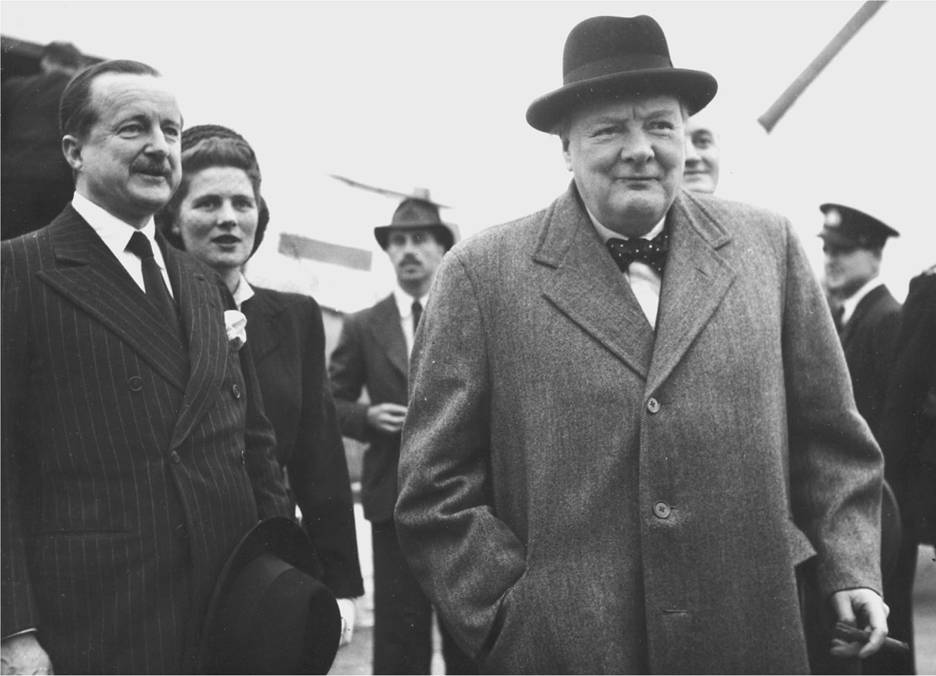
Figure 8.1 Winston Churchill in Paris, with his daughter Mary and British ambassador Alfred Duff Cooper, 1945.
Early in 1947 mandarins checked the temperature. Drafted in the middle of one of the worst winters on record the document made grim reading. The main assumption of 1945, Big Three cooperation, had dissolved. The necessity for an independent British foreign policy was judged ‘still valid’, but in the light of the nation’s weakness and Soviet threats, ‘too great an independence of the United States would be a dangerous luxury’. The goal of leading Western democratic states held good but Britain could not play an active role in solving European economic problems because ‘we do not seem to have any economic resources available for political purposes’. Britain could offer only the model of a successful Labour government as a ‘workable alternative to Communism’.5 A sea of troubles engulfed Britons: dollar drain, food and fuel shortages, fears of Soviet expansion, civil war in Greece, rebellion in Palestine, withdrawal from India, the soaring cost of the British zone of occupation in Germany, and ‘General Winter’.
Huddled in overcoats the cabinet met by candlelight. Bevin’s charwoman asked to start work in the mornings at 6am instead of 7 so that she could be away by 10am to make sure of a place in food queues for her family.By 1948 VE-Day prestige had lost its fizz. Britain’s reluctance to commit to European supranational ideals corroded continental goodwill. In 1945 journalist and politician Pierre Maillaud from the BBC’s wartime French service warned that half-heartedness towards Europe would ‘alienate the Continent’. The deepening Cold War and rapid contraction of power eroded the ascendancy of 1945. The haemorrhaging encouraged France and the Benelux countries to pursue their own agendas, lengthening the odds against a Franco–British Europe. London’s Atlanticist, intergovernmental vision aroused continental fears of reversion to a traditional divide and rule strategy in Europe. Belgian foreign minister Paul-Henri Spaak later confided his disappointment at the fall from grace, ‘You had no idea just how much Britain meant to all of us … during the years immediately after the war … she represented something pure and untarnished … and we looked for … moral leadership’.6
Was a Franco–British Europe a mirage? Not necessarily. Understandably, the French had no desire to recreate the old entente discordiale of the interwar years. But the experience of working together from 1944–5 could have generated trust and momentum for the future. Crucially, leaders were unwilling to reimagine the relationship. Personality conflicts and the neglect of forward thinking prevented a duumvirate. The Churchill government’s wartime ban on discussion of post-war Europe, despite the presence of de Gaulle and European governments in exile, stymied the building of an understanding and disadvantaged the incoming Attlee cabinet. The prima donnas, Churchill and de Gaulle, opposed rapprochement on their watches, while shrinking from the opprobrium of openly obstructing it. From London, ambassador Massigli vented his frustration, deploring his country’s ingratitude to Britain and intransigence in Syria: ‘England passionately wished for an entente in 1944 and even into the middle of 1945 … you [Chauvel] know how [de Gaulle] by his words and deeds responded.’7
Churchill matched de Gaulle’s obduracy.
Self-styled victim of a megalomaniac – his ‘heaviest cross … the Cross of Lorraine’, the prime minister relished infantilizing his adversary: de Gaulle had come back from Washington ‘in a most mischievous mood’; ‘We should be most unwise to appear to be suppliants. This would give de Gaulle every opportunity for misbehaviour’. The premier sought to outgeneral the general, censuring his ambassador for advocating alliance, ‘Why on earth cannot he remain passive and be wooed, instead of always playing into de Gaulle’s hands’. The envoy’s diary captured the seesaw between the divas: 5 January 1945: ‘He [de Gaulle] is not keen on one [alliance]and doesn’t wish to appear so. Nor is the prime minister’; April 1945: de Gaulle ‘most friendly and most anxious for an Anglo–French treaty while saying “there was no hurry”’. Foreign minister Bidault and Chauvel favoured agreement before the opening of the United Nations foundation conference in San Francisco in late April. Reassured, the ambassador departed on a provincial tour only to find on return that nothing had happened. Churchill, primed for a French initiative, sulked.8Realpolitik ruled. Notwithstanding a soft spot for France, Churchill followed his head, not his heart. At wartime summits prime minister and foreign secretary fought for an independent France as a barrier to Germany, but had no desire to jeopardize Big Three membership by going to bed with a weak and demanding ally. Before going to Paris Churchill flew to Moscow in October 1944 to carve out spheres of influence in Eastern Europe – the percentages agreement with Stalin. Ministers ignored Duff Cooper’s warning in June 1945 that without a British lead on a customs union Europe would develop independently. Kowtowing to the United States and the Soviet Union paralysed initiatives on Europe. Committed to Roosevelt’s vision of Big Three cooperation, the prime minister feared lest alliance with France might be interpreted as endorsement of de Gaulle’s German claims.
Regrets about his offer of union in 1940 may have influenced Churchill – he was ‘never sure’ it was ‘a good idea’. Churchill rebuffed President Auriol’s request in March 1950 for France’s inclusion in East–West summit talks: ‘if you took part we would have to bring in Italy.’ ‘France’, he told President Truman in 1953, ‘has lived in ignominy ever since the war and enjoyed every moment of it’.9In September 1945 De Gaulle proposed a remodelled Entente pursuing common policies world-wide, including support for French plans to create Rhineland client states while placing the Ruhr under international mandate and giving the Saar autonomy. But the general was in no hurry to tie the knot – fearing France was too weak to get the best terms. Accordingly, in early December 1944, he wooed Stalin, in the hope of enlisting Soviet sympathy for France’s German claims and pleasing Communist ministers in his government. Russians were indifferent to the French visit – Londoners would have greeted de Gaulle much more warmly. In the Moscow subway people jostled the general, treading on his large feet as they tried to enter and exit overcrowded carriages. Stalin also trod on the French leader – refusing to underwrite German claims and voting to exclude France from the Yalta Conference in February 1945.
Once bitten, twice shy. The general’s belief that Britain bounced France into the Second World War made him chary of an instant pact. No one wanted to rehire the English governess and repeat the Alice in Wonderland world of the 1930s – with London the capital of Paris. The only way to get support for German claims, de Gaulle believed, was to play hard to get. Other concerns impacted. The urgency of mobilizing Anglophobe ex-Vichyites for unity and reconstruction meant avoiding any suggestion of British tutelage. Wishful thinking played a part. A rapid withdrawal of Anglo–American forces from Germany would enable French troops, with Soviet backing, to enforce territorial claims. Deteriorating Anglo–Soviet relations in 1946 applied a further brake – a pact might force France to take sides. Leading Anglophiles like Chauvel and Massigli stood no chance of influencing de Gaulle. Headship of the provisional government put him in the driving seat. An irate general scrawled across one of Massigli’s telegrams, ‘Idiot’. The efforts of Churchill and Roosevelt to dump him induced paranoia about Anglo-Saxon machinations. ‘The Allies! They are betraying us’, he thundered in September 1944, ‘as they are betraying Europe, the bastards, but I’ll make them pay for it’!10
De Gaulle’s low opinion of the French – ‘the natural propensity … to yield to foreigners and become divided’ – applied especially to diplomats because of the Quai’s pre-war appeasement record. Officials were scolded for truckling to London in the 1930s: ‘for many of the men in charge of our foreign relations, concord with England was a kind of principle’. While Bidault honeymooned, the general lambasted the Quai: ‘The foreign ministry, led by Massigli and Chauvel, has engaged us in a so-called agreement with the English, which is turning into a swindle … All that I’ve said to Bidault on this subject has been wasted.… I insist that no new decisions on this important matter are taken in my absence’.11
A tough and experienced foreign minister would have had a hard fight on his hands. For the goblin-like, highly-strung Bidault – ‘Georges Bidet’, as Le Canard Enchaîne dubbed him – there was no contest. Jesuit-educated like his master, looking younger than his 45 years, a fiery opponent of pre-war appeasement, and a founder of the Christian Democrat party Mouvement republicain populaire (MRP), Bidault became president of the council of the resistance following the Gestapo’s execution of Free French representative Jean Moulin in July 1943. His inexperience recommended him to de Gaulle. From day one the general put the former history professor in his place. At the parade celebrating the liberation of Paris the minister started to walk alongside the general only to be told: ‘Monsieur, a little further back please.’12
The foreign minister’s decision to live over the shop gave Chauvel a tutoring opportunity:
The round table was covered with breakfast leftovers next to all kinds of papers. In the corner of the fireplace grog was heating. On the floor, piles of documents of all kinds were spread out in an order not immediately obvious to the uninitiated … Bidault, in lambskin slippers, padded about with a cat-like agility, grabbing on the way a salted almond, drinking a mouthful of grog, prodding a book … I arrived with a big pile of dossiers, inserted myself edgeways into the ministerial monologue … people came and went, my interlocutor went to shave, dressing himself bit by bit.13
Bidault probably learnt little from the crash course – Chauvel’s habit of mumbling into his tie and finishing sentences with a hissing noise made him barely audible.
The general bullied and bypassed his foreign minister. On the eve of the London conference of foreign ministers in September 1945 de Gaulle called for a new Franco–British alliance. Bidault learned of it at the conference. Gaullist micromanagement fooled no one. ‘The French delegation, unable to express even the worst platitude without prior authorization from General de Gaulle, remained entirely in the background’, recorded an American observer at the 1945 UN foundation conference in San Francisco. Serving de Gaulle after playing hide and seek with the Gestapo shattered Bidault’s nerves. After eating almost nothing during the day a couple of glasses of wine knocked him out. In December 1944 during the parliamentary debate on the Franco–Soviet Alliance the minister staggered to the podium, hardly able to speak: ‘We will do what we say and we will say what we will do’, he repeated fifteen times. ‘That pig has had one glass too many’, barked de Gaulle. Returning to his seat Bidault gasped: ‘Have I been too awful?’ ‘You haven’t had the time’, snapped his master.14
De Gaulle’s wedding present to Bidault was a Cartier gold cigarette case left over from gifts taken to Moscow in December 1944. When Bidault became head of government in June 1946 Cartier billed him for the cigarette case – none of the gifts had been paid for. Much worse followed in the early 1960s. Bidault’s decision to lead the underground far right OAS (organization armee secrète) paramilitary movement against de Gaulle’s policy of Algerian independence finished him politically. Having fled to Brazil to escape vengeance he waited until 1968 for an amnesty.
The Churchill–de Gaulle feud made policy rifts harder to settle. Dogfights over Germany, the Middle East and European construction spoke to the unpreparedness of policy-makers and creaky machinery. In the last months of war ministers floundered. ‘Altogether our foreign policy seems a sad wreck’, bemoaned Eden in March 1945. ‘He [Eden] never has time to read our papers now,’ an aide complained, ‘so his handling has become very superficial’.15 Churchill banned discussions of Europe’s future.
The new Labour government had good intentions. ‘Without Anglo–French cooperation’, affirmed a Labour party pamphlet, ‘it is difficult to see how she [Britain]could make her proper contribution to the alliance [Big Three] or be an effective partner rather than a subordinate’.16 Flawed assumptions, ignorance and stereotypes lamed policy-making. The sudden ending of Lend-Lease in August 1945 could have been anticipated. No one pointed out the need to secure an American loan before the war in Europe ended. UK negotiator John Maynard Keynes lived in cloud cuckoo land, confident of getting most of the loan interest free or as a gift.
Bevin lauded the Entente and called for an ‘Anglo–French Monnet Plan’, but rebuffed a French appeal for a five-year Anglo–French cooperation plan: ‘We don’t do things like that in our country’. Bidault expressed astonishment that British and French recovery plans might be shaped or implemented without consultation. UK economic ministries anathematized planning and customs unions. When The Times called for a plan to integrate plans, Whitehall riposted: ‘It would be better to review the immediate day to day problems as they come’. An Anglo–French economic committee set up by Bevin in 1946 had its remit redefined as one of preventing ‘conflicts’ rather than harmonizing national economic plans.17
Bevin and Bidault were like chalk and cheese. Bevin’s patronizing ‘such a dear little man’ epitomized the relationship. The foreign secretary’s respect for former Popular Front leader Leon Blum did not extend to Blum’s more doctrinaire colleagues. At a Paris embassy dinner Bevin was ‘barely polite’ towards socialist ministers. Bevin and his jokes did not travel well. The bayonet-sharp snapshots of interactions with Parisian elites catch the forced jollity. ‘Socially he [Bevin] is a bore. Whisky improved his temper and caused him to tell endless stories about drunkards and churchmen. He unbent so far as to sing some songs … while Mrs. Bevin kept clucking: “Sing us some more Ernest” … vastly amused, Lady Diana Cooper [ambassadress] beamed on the scene … with a fond eye’. She was less pleased when Ernie groped her in the embassy lift, urging her to join him in bed. Conviviality was more apparent than real. ‘The Embassy staff of elegant young and not so young Etonians … had obviously fortified themselves for the evening with every drop of alcohol they could lay their hands on’. ‘Ernie turned to me,’ recalled an aide: ‘Now let’s tell Monsieur Schuman my story about the bull in an English pub’. This was a story which might have gone down well enough in an English pub, but translated into French in a salon of the Quai d’Orsay ‘was not a great success’.18
Over two years went by before the signature of a no-frills utility pact in March 1947. Why so long for so little? France seemed a poor bet. ‘Looks like civil war within a year’, observed Bevin in early 1946, adding, ‘the Channel ports will virtually be in Russian hands’. Without the cash and coal France needed, a treaty seemed problematical. Lingering hopes of Big Three cooperation, coupled with the desire to keep in step with the United States, and fear of the international communist movement in France and Western Europe, imposed extreme caution. Without a Whitehall nerve centre, and beset by firestorms in Germany, Greece, India and the Middle East, ministers stumbled from one ill-defined policy to the next. Edward Bridges, permanent secretary to the Treasury, asked the FO to explain to him and other senior colleagues the meaning of Western Union. Alas, the FO was equally at a loss.19
In December 1946 an increasingly bumpy ride with the Soviet Union prompted fresh talk of a French alliance to shore up a democratic ally and rally Western Europe. This was music to the ears of Duff Cooper who had campaigned for it since 1944. The ambassador seized the moment and recruited premier Leon Blum. Even without cash and coal an alliance would buttress the Republic. A sense of time running out for Britain’s European ambitions spurred FO thinking. The longer the delay in taking an initiative towards Western Europe the less chance of Britain becoming the great European power envisioned in July 1945. ‘If we make every move … contingent on American prior approval,’ argued permanent secretary Orme Sargent, ‘our prospects of being able to give a lead to western Europe will vanish and we shall never attain … our primary objective … to create a European group which will enable us to deal on a footing of equality with our two gigantic neighbours, the USA and the USSR’.20 Even so, the British constantly looked over their shoulders lest the United States made the Dunkirk Treaty a pretext for pulling out of Europe.
London offered a basic fifty-year defence pact against German aggression, rejecting Duff Cooper’s preference for a two-stage arrangement – general treaty followed by detailed agreements on defence, colonial and economic matters. The choice of Dunkirk for the signing evoked unwelcome memories for everyone. Freezing winds and pouring rain assaulted a town in ruins. An old Citroën carrying an official with the treaty text broke down – holding up the ceremony in the Sous-Prefecture – the only rebuilt building. An aide spotted Bevin venting frustration in the courtyard, ‘raising his hands to heaven amidst the pouring rain and crying with gusto “I love the French! I love the French!”’. As Bidault headed back to the station fans waylaid him with a song to Jean Bart, the local corsair who savaged English shipping in the Anglo–French conflicts of the 1690s.21
Within days officialdom sounded an alert: ‘little reliance can be placed in a country whose largest party, dominating the trades unions and controlling half the life of the country, takes its orders from a foreign capital.’ Whitehall vetoed economic and military cooperation: ‘we have no confidence in French security.’ Military weakness and Communist participation in ruling coalitions until May 1947 panicked defence chiefs. Britain, Monnet noted, ‘has no confidence that France and the other countries of Europe have the ability or even the will effectively to resist a possible Russian invasion’. The Observer newspaper mirrored changing perceptions. Eighteen months after calling for an Anglo–French economic plan the paper warned, ‘France is an ally on which we cannot count’.22
Britain shrugged off wartime debts to French nuclear know-how, and denied requests for help, citing Anglo–American agreements prohibiting third country sharing of nuclear information. Sure, security was an issue. Soviet agents infiltrated French state agencies. Moscow, it is claimed, may have read ‘much of the cypher traffic between the Quai d’Orsay and French embassies abroad’. The operative word is ‘may’. The quality of secret material accessed is unknown. The Russians hit the jackpot in London, not Paris. British spies – Burgess, Maclean, Fuchs, Philby, Blunt, Vassall – quarried a rich seam for Moscow. Blackballing the French from the nuclear secrets club strengthened their determination to build an independent deterrent. American covert assistance to France in the 1970s made nonsense of earlier Anglo–American negativity.23
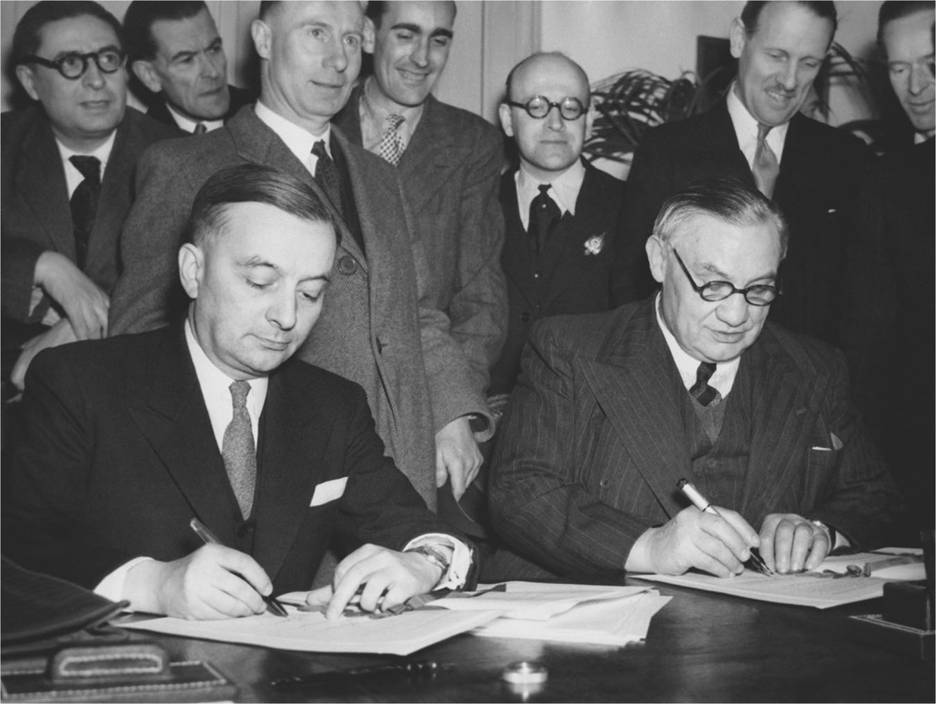
Figure 8.2 French foreign minister Bidault and British foreign secretary Bevin sign Anglo-French alliance in Dunkirk, 4 March 1947. Credit: J. Walforf / INP / AFP / Getty Images.
The Treasury and Board of Trade opposed a customs union, citing adverse trade patterns. France’s top trading partner until 1930, Britain lost ground to Germany and the United States. Its main market became North America and the Commonwealth. More to the point, American and German coal replaced British. Within months of loaning France £100 million in March 1945 Britain went bankrupt. Cross-channel trade picked up in 1949–50, but not enough to tempt London. Both countries increasingly competed for the same markets.
But the main stumbling block was Britain’s ‘one-world strategy’, a return to a pre-1931 multilateral free trade regime. The aim was to re-establish the country as a premier commercial and financial player alongside the United States, ending trade discrimination and retaining sterling as a leading reserve currency. Between 1945 and 1950 Britain applied strict import controls as a transitional regime for launching the system. There was no room for a struggling neighbour. Too weak to compete in a global free trade economy without endangering post-Liberation social reforms, France sought shelter in a customs union with access to Britain’s imperial trade and preferences.
Dunkirk proved a damp squib – a sop to the French instead of the coal they begged. A leading French historian, J.-B. Duroselle, scathingly dismissed the treaty as ‘only a platonic and sentimental gesture – Britain’s real policy was to place Anglo–American cooperation above everything else’. This is far too harsh a verdict. No one bought a pig in a poke. Both sides knew the treaty was a sop. Yet it could have jump-started real cooperation – Bevin, despite Whitehall reservations, remained committed to working with France.24
Stalled by Whitehall resistance to a customs union, Bevin played his imperial card – collaboration in Africa. Fearful of a Big Three plot to confiscate her colonies, France welcomed Euro-Africa as insurance against predators and nationalist movements. ‘We must free ourselves of financial dependence on the United States as soon as possible,’ Bevin announced in September 1947; ‘we shall never be able to pull our weight in foreign affairs until we do so.’ Harnessing empires would keep London and Paris safe from superpower hugs. ‘The British Commonwealth’, announced Bevin, ‘had a separate contribution to make in world leadership, which it would be unable to make if the UK became dependent on the US.’ Britain and France ‘with their populations of 47 millions and 40 millions respectively and with their vast colonial possessions,’ Bevin assured French premier Paul Ramadier in September 1947, ‘could if they acted together be as powerful as either the Soviet Union or the United States.’ A wildly over-sanguine foreign secretary fantasized about American dependency on Britain: ‘if only we pushed on and developed Africa we would have the US dependent on us and eating out of our hands in four or five years … the US was very barren of essential minerals … in Africa we have them all.’ African partnership was a non-starter because it put the cart before the horse – cooperation had to begin in Europe. There was no money for imperial development. The 30 per cent sterling devaluation of September 1949 demonstrated Britain’s plight, and established a unique dollar–sterling link, persuading ministers that Euro-Africa was ‘unworkable’.25
Feet firmly in Europe, Duff Cooper in December 1947 pleaded for the treaty’s consummation. If the Entente had a hero it was the ambassador. ‘You may think that I am making a lot of fuss about nothing, and that it matters little whether staff conversations start in January, or in June, or in the year after next. But, to my mind, this is just one of those many small matters upon the settlement of which depends the fate of great nations.’ Approaching retirement, the envoy pulled no punches – comparing the Attlee government’s procrastination with Britain’s interwar foreign policy. ‘I watched the process in operation during the twenty years that separated the wars … The attitude of the Government at every turn was always defensible, logical, and supported by sound arguments, but it lacked one thing – a guiding policy behind it – and so, in the end, it landed us in a ghastly war’.26
Bevin moved on: ‘Western Union’, a Franco–British-led West European bloc, to include Africa and a customs union. Launched in January 1948 Western Union proposed to mobilize the resources of Africa, enabling Europe to ‘equal the Western hemisphere and Soviet blocs in terms of productive capacity and manpower’. The ‘terribly vague’ proposal required, as writer and diplomat Harold Nicolson mischievously observed, half a dozen different and equally imprecise expressions to define it. Nevertheless, a flurry of cooperation on new economic and security architecture suggested a Franco–British Europe taking shape: the signing of the Brussels Treaty of March 1948; the coordination of American Marshal Aid through the OEEC; partnering the United States in establishing a West German state; joining Brussels Pact powers in talks with the United States on an Atlantic Pact, leading to the North Atlantic Treaty of April 1949 establishing NATO.27
Cracks appeared in the façade. In May 1948 the federalist inspired Hague Congress called for a European parliament with powers over a political union. Notwithstanding Franco–Belgian backing for the proposal, Bevin objected: ‘Never ’eard such bloody rubbish.’ Tussles over the creation of a Council of Europe exposed the conflict between the UK’s intergovernmental approach and France’s willingness to make supranational concessions. A neutered Council of Europe emerged as a consultative body limited to short annual meetings and chaperoned by a ministerial committee. By the end of 1949 the foreign secretary had a new script, prioritizing the USA and Canada because ‘in the last resort we cannot rely upon the European countries’.28
Why the about-face? True, the Cold War and fears of a third world war magnified Europe’s vulnerability and ramped up American dominance – but East–West enmity had not deterred Bevin from launching Western Union. His methods of working and the paucity of personal papers rule out any certainty about intentions. To be sure, he was no federalist. ‘If you open that Pandora’s Box [European federalism] you never know what Trojan ’orses will jump out.’ Bidault accused him of ‘playing with Europe’. The Economist expressed doubts: ‘If he is not fully committed to the idea of Western Union, then let him not talk as though he were. Britain’s European neighbours will be watching suspiciously for every sign that the British are not really in earnest but are once again … using a European alliance as a temporary measure to be abandoned when the need is past’.29
Vanishing power, accelerating Cold War, life-threatening illness and no think tank, all imposed a sticking-plaster approach. In the spring of 1950, ‘half-alive’ and ‘too ill to speak’ at a NATO Council, Bevin ‘could barely read out the agenda, let alone take charge’. Until the creation of a Central Economic Planning Staff (CEPS) in mid-1947 there was no machinery to implement economic cooperation with France. An assessment of Bevin’s January 1947 customs union proposal had to be outsourced to Cambridge dons who did not report until late October. Whitehall acknowledged ‘our lack of a foreign economic policy’. The director of the cabinet’s economic section conceded, ‘We had done little work on what we mean by European Cooperation’. The FO’s first think tank, the PUSC, only came online in mid-1949. As a result, immediate post-war initiatives lacked clarity and coherence. Bevin improvised, confessing ‘he had to bluff his way through in foreign policy, given the financial weakness of this country’.30
What drove the foreign secretary? Affection for France and Europe? Not by a long chalk. The problem, in his own words, was how to keep the ‘little bit of dignity we have left’. In a topsy-turvy world Bevin reached for grab bars – Big Three partnership, Anglo–French cooperation, then an Anglo–American duumvirate – to bind Western Europe ‘more closely to the United Kingdom’. Regional leadership would give the UK extra clout in Washington – ‘a question of saving Europe rather than joining it’. Once assured of an American military commitment, Bevin wanted ‘to get away from talk about Europe. We must think in terms of the west … the “Free World”’.31
The intensity of the Cold War – Communist coup in Czechoslovakia in February 1948, and Berlin Blockade in June, together with strong doubts about the ability of the French economy to deliver its targets, pulled the plug on Western Union. On 25 November 1948 the Cabinet’s Economic Policy Committee decided against joint economic planning. Less than a year later, in September 1949, Britain devalued sterling by 30 per cent without consulting European allies – forcing France’s third devaluation in eleven months.
The decision to abandon joint economic planning is said to have ‘consigned’ a Franco–British bloc ‘to the realm of might-have-beens’. This is too hasty a conclusion. A Franco–British Europe remained an option through 1950. Monnet, head of the French planning commissariat, tried twice in 1949 to initiate cooperation, suggesting talks to integrate national economic plans for 1950–2. Hosting British negotiators at his country house he proposed a dramatic gesture – British coal for French beef. Monnet envisaged ‘an Anglo–French nucleus around which a European Community could be built’. The FO fired a warning shot. The ‘special relationship’ took precedence and nothing should be agreed ‘which would render us incapable of sustaining an independent resistance if France were overrun’. Towards the end of 1949 Monnet tried again, only to be told ‘there is at present little basis for an arrangement of the kind you suggest outside the ordinary commercial exchanges’.32
As Bevin backpedalled, foreign minister Robert Schuman advanced, inviting others to join France and Germany in pooling coal and steel production under a common authority (ECSC) as a first step towards European federation. His press conference of 9 May 1950 was almost a non-event. Journalists received such short notice that many did not attend and those who did had difficulty following it because of the minister’s mumbling, elliptical speech. Angered by lack of prior consultation, and a request on 1 June for a response within twenty-four hours, British ministers suspected a plot to exclude them. They missed the irony of an allegedly super leaky neighbour keeping a mainspring post-war initiative secret.
UK membership of the Schuman Plan would have opened a new European future, powering the partnership which had eluded the couple since 1944. UK decision-making on the Plan – sometimes portrayed as a knee-jerk reaction – was more open-ended than was supposed. There was no wicked French plot to keep Britain out. The lack of advance consultation was not payback for London’s failure to consult on sterling’s devaluation in September 1949. Schuman’s announcement surprised colleagues as much as UK politicians. France needed Britain to balance Germany and provide a bridge to the United States. Shutting out a major ally made no sense to French policy-makers.
First reactions to Schuman’s invitation were welcoming. ‘We must be in from the beginning’, Attlee insisted. Paris ambassador Harvey enthused about ‘a never-to-be-repeated opportunity of getting a real move on in Europe … We really have the ball at our feet’. There was nothing cut and dried about Schuman’s proposal – it was a statement of intentions, no more. On 18 May Bevin and Schuman conceded they had not had time to consider its implications thoroughly. With Bevin in the London Clinic and many ministers away because of the Whit holiday, junior FO minister Kenneth Younger coordinated responses. Though credited with urging Bevin to accept the Plan, his diary confirms the timidity and indecisiveness of the political elite.33
What motivated the decision to stay out? Was it, in Eden’s words, something which ‘we know, in our bones, we cannot do’? According to historian Tony Judt, non-participation reflected an existential crisis, standing aside ‘was above all an instinctive, psychological and even emotional’ decision – ‘a product of the utter peculiarity of recent British experience’. This reads too much into an essentially pragmatic and opportunist decision. The FO permanent secretary claimed that ‘a cool appraisement of the national interest’ drove rejection – joining Schuman risked jeopardizing the nation’s ability to maintain independence should Western Europe be overwhelmed. It’s far from obvious, however, why participation would have threatened the nation’s independence in war. The project had yet to be fleshed out and Britain would have wielded a substantial say in its design.34
Three considerations decided the outcome: commitment to a one-world economic strategy; determination to assert British leadership; and complacency. The one-world economic strategy supplied the chief reason for the decision to steer clear of the Plan and later the EEC. The strategy precluded alignment with a protectionist France and Western Europe. Far from cold-shouldering European allies, Britain was poised to insert new proposals. Franco–German talks ‘would inevitably break down … we would then have a chance of coming in as deus ex machina with a solution of our own’. Whitehall considered ‘the whole thing nonsense … a French attempt to evade realities’. The issue of sovereignty played a minor role. For one thing, it had not stopped Churchill offering France union in 1940; for another, the concept of supranationality baffled officials. In 1952 the FO had difficulty deciding whether the ECSC was supranational or intergovernmental. Once the community bedded down the UK pragmatically negotiated associated status. Lastly, complacency. The afterglow of world power induced an ‘I’m all right, Jack’ attitude – British ways were best and London would roll out its own proposals.35
At Messina, Sicily, in June 1955, ECSC foreign ministers agreed on further integration. The initiative created a quandary for a Britain intent on exercising leadership in its own way. Joining the Messina powers ran counter to the UK’s one-world economic strategy and perceived global interests; ignoring a customs union threatened exclusion from a potentially dominant economic bloc. London adopted a two-pronged response: sending Board of Trade official Russell Bretherton as a representative to Messina; devising its own proposals for a free trade area. Both actions were self-harming. Emile Noël, future grey eminence of the EEC, an adviser of socialist premier Guy Mollet, recalled Bretherton playing ‘hookie from the receptions and out-of-conference discussions, skipping even some formal sessions’, indulging his passion as an entomologist chasing moths and butterflies in the Sicilian countryside.36
UK proposals for a free trade area to counter a customs union of the Six coincided with the eruption of the Suez crisis. Egyptian president Gamal Abdel Nasser’s nationalization of the Franco–British-owned Suez canal company on 26 July 1956 sparked the biggest international scare since the Korean War. On 31 October Britain and France, in cahoots with Israel, intervened militarily – ostensibly to stop an Israeli invasion of Egypt, in fact to repossess the canal and topple Nasser. Superpower and UN disapproval imposed a cease-fire and ignominious withdrawal, a last hurrah for Britain and France as independent world powers.
One train may hide another. The Suez fiasco destroyed a bid for a Franco–British Europe. Out of the blue on 10 September premier Mollet, soccer-loving anglophile and former English teacher, asked British prime minister Eden for union. The main narratives barely acknowledge a request that could have transformed Western Europe. London and Paris kept the approach secret. In 1976 Mollet’s foreign minister, Christian Pineau, revealed the proposal – dismissing it as a quickly scuttled spur of the moment idea. Franco–British media claimed in 2007 to have ‘discovered’ the union request story, despite the UK’s release of the file in the mid-1980s.37
Excellent rapport between the two premiers encouraged Mollet to ask for union. Eden claimed he had never enjoyed ‘a more completely loyal understanding with any man’. The request caught No. 10 on the hop: ‘The French have been proposing Anglo–French union again, we feel it is impossible at present because of the Commonwealth.’ After sitting on the idea for three days Downing Street took it on board. The request was much more than a ploy to beef up action against Egypt and win help for France’s Algerian war. It reflected the radical rethinking generated by post-war reconstruction. Nation state unions and a Euro-Commonwealth were buzzwords in European political elites. Veteran Pan-Europeanist Richard Coudenhove-Kalergi lobbied for closer Commonwealth–Europe links, including a Franco–German Republic associated with the Commonwealth. In January 1956 a British minister suggested bribing France with Commonwealth membership in order to block the project for a common market.38
Why propose marriage in the middle of a gale? The lack of French files rules out any certainty, but a speech by Pineau supplies a clue. The fact that neither Britain nor France could stand alone in the storm, argued Pineau, made it urgent to create Europe with Britain. Current European integration negotiations, not Suez, motivated the French leader. In early September 1956 six-power talks on a common market reached a critical stage. The pros and cons of a common market and a British free trade area splintered French opinion. Mollet gambled on winning a British concession package as an alternative to both a common market and UK free trade area, including perhaps a lasting political connection, and Sterling Area membership. Support for the French empire and the Algerian war would have put icing on the cake. The premier had a strong negotiating position. The hexagon had the ability to exercise a stranglehold on both a common market and a free trade area. The size of its economy ensured that partners would be unlikely to proceed without France. Entering the market would enable France to bar member states from a free trade area.39
As a bolt from the blue the union idea stood no chance. Whitehall was intent on finalizing its free trade area plan G. The absence of a French archival footprint underscores the personal character of the request and the casualness of Mollet’s policy-making. Even his chef de cabinet Emile Noël ‘had not worked on it’. Did Mollet act on impulse? Almost certainly. There was no consultation with advisers and colleagues. Distrust of the Quai, old habits of wartime clandestinity, and the secrecy of Suez planning, supply a partial explanation of the premier’s solo style. More importantly, the clustering of hard-hat ventures – intervention in Egypt, collusion with Israel, Algerian war and common market negotiations, overwhelmed a dysfunctional government, forcing Mollet to bypass the machine.40
The French leader over-valued his relationship with Eden. The prime minister grasped the importance of the union request, but lacked time, energy and imagination to explore it. Sickness and obsession with Nasser narrowed his vision. When cabinet discussion of a free trade area resumed on 18 September, Eden damned union with faint praise: ‘There might prove to be scope for a closer association in military, financial and economic affairs which would make the two countries a powerful partnership.’ Eden had in mind Bevin’s idea of a ‘Commonwealth union’ to include Belgium, the Netherlands and Scandinavia which would break up the Six and leave Britain and France running Western Europe. Opening the Commonwealth to France, however, would mean including Belgium and the Netherlands – raising difficulties with Germany and Italy: ‘against these, there should be weighed the additional strength which the adhesion of some European countries would give to offset the weakness of the Asian members of the Commonwealth.’41
A strong pro-French constituency did not exist. Grandees like FO permanent secretary Kirkpatrick distrusted the French – ‘they would be certain to let us down’. The UK’s one-world free trade strategy excluded union and common market. To protect their pet project, captious mandarins pulled out all the stops. France’s ‘weakness and ineffectiveness’ presented ‘one of the gravest problems’ facing ‘the Western Alliance’. Differences ‘of race, religion and above all outlook’ militated against union. A shotgun marriage would upset everyone, especially the United States and the Commonwealth. The rise of multilateralism had outdated Churchill’s wartime offer of 1940. Partnership would endanger Britain’s global stance, especially the special relationship. Apparently unaware of France’s growth rate, the Treasury refused to partner a sluggish, protectionist economy. Association would bring ‘a large number of new problems’ because France’s economic axis lay with Germany and the Benelux countries. As a sop, advisers suggested ‘it might please Mollet to be told of an impending new British initiative [Plan G] for a European free trade area’. The machine spat out yet more negatives in response to the French premier’s appeal on 26 September for Commonwealth membership and common citizenship. Membership ‘could not be offered to France alone’, but the inclusion of other countries would rock the boat dangerously.42
During the Suez adventure France’s ambassador in London read Agatha Christie’s Death on the Nile. The title catches the ironies of the affair. Joint action against Egypt closed off any prospect of partnership. The misconceived and badly planned intervention put paid to a fragile Entente. The first major Franco–British military intervention since 1940 left a legacy of misunderstanding and distrust. Mollet’s one-off union gamble in September was tied to the flow of the Brussels common market talks. Within days of accepting the UN ceasefire of 6 November 1956, disillusioned French officials conducted a reality check. The two leading Western European powers lacked the strength to impose their will, leaving France’s security dependent on America. Officials accused Britain of timid and clumsy conduct throughout the crisis, and concluded that making Europe was now more urgent than ever. Paris, London and Washington, advised the Quai, should patch up differences and resist Soviet penetration of the Middle East.43
France scored, gaining a Franco–German entente and a strengthening of French pro-common market opinion. Angered by international censure and threats of Soviet rockets, the French closed ranks behind Mollet and the common market. When Eden on 6 November called Mollet about a cease fire in Egypt, a Franco–German summit had reached agreement on the EEC and Euratom. West German chancellor Konrad Adenauer affirmed the need ‘to make Europe’.
Nothing solid emerged from the heady post-Liberation days. What would it have taken to reboot the connection? A Harry Potter-like Ministry of Magic? A race of supermen? In a Nietzschean moment a British diplomat reported that the authors of the Schuman Plan regarded a ‘supra-national authority controlled by supermen as essential to success’. Simply, the magic of an imaginative leap inspired by recognition that collaboration could bring decisive benefits. In 1950 English soccer suffered its first defeat in a World Cup. ‘If there was a time when English football should have … taken a long hard look at itself’, opined star Stanley Matthews, ‘it was in the aftermath of the 1950 World Cup’. Far more than soccer, overseas policy needed a long hard look. A post-Schuman review of UK responses to European integration ambled along for nearly two years.44 Nor did the UK make a better fist of attempts at association with the ECSC. ‘The history of the attempt at association between summer 1950 and April 1954’, concluded Alan Milward, ‘is a model of how policy should not be formulated.’
Leaders and government machines decisively shaped outcomes. Bevin’s ‘ignorance of and contempt for the realities’ of Fourth Republic politics, concluded historian Geoffrey Warner, prevented him ‘from seeing that successive French governments were no more eager to surrender their sovereignty to some federal entity than he was’, and ‘shared his objective of an independent Europe’. With goodwill, understanding and a fair wind, ‘a European community might have grown up around an Anglo–French instead of a Franco–German axis’. Disillusioned by Bevin’s efforts to emasculate the Council of Europe, a senior member of the UK delegation resigned because government tactics called into question its sincerity. ‘What was needed was … an act of faith.’45
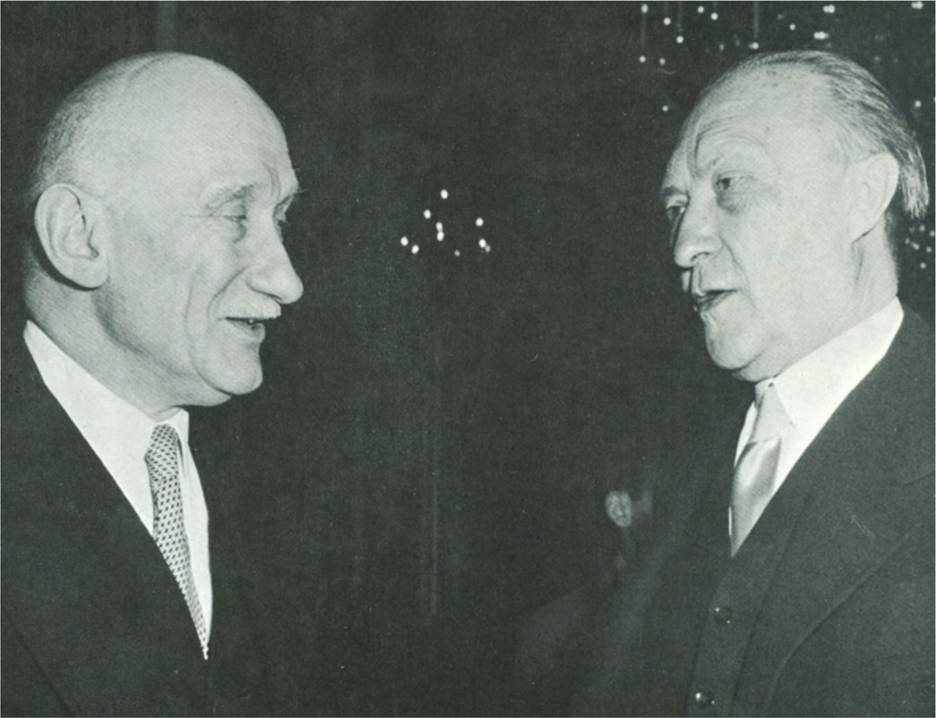
Figure 8.3 French foreign minister Robert Schuman and German Chancellor Konrad Adenauer, 27 May 1952. Credit: World History Archive / Alamy Stock Photo.
UK policy-makers lacked the faith to follow Schuman’s ‘leap in the dark’. They underestimated the continent’s growing desire for integration, and Britain’s loss of moral authority. The one-world strategy was fatally flawed because the economy was better suited to EEC protectionism than to the government’s free trade vision. Deputy premier Herbert Morrison’s response to Schuman – ‘It’s no good. We cannot do it; the Durham miners won’t wear it’ – illustrates a central trope of this book, the democratic deficit of a ‘mature’ democracy. No one asked the people what they thought. Government did not consult the electorate about the likely harsh consequences of its commitment to a one-world free trade strategy. If there was a moment of truth when Britain might have reset the relationship with France and Europe it was between 1950 and 1952. ‘Courageous leadership’, wrote official historian Alan Milward, ‘would have … set out these … facts about the national future to the population … They had faced worse in 1940. They were left in ignorance’. Trollope deserves the last word: ‘the cross-grainedness of men is so great that things will often be forced to go wrong, even when they have the strongest possible natural tendency of their own to go right.’46