Chapter 57 Business Intelligence Enterprise Solution at Abu Dhabi Finance: Issues and Challenges
Salam Abdallah
Abu Dhabi University, UAE
ABSTRACT
The challenge of transforming data and information in enterprise information systems into knowledge that can be rolled up and presented to management as key performance indicators is business-critical.
The implementation of a business intelligence layer on top of the transaction processing systems and management information systems is viewed as an opportunity to move up a level to promote knowledgebased decision-making and strategic planning. This chapter attempts to examine the issues and challenges associated with the initiative by Abu Dhabi Finance to implement business intelligence solutions that extract information from the enterprise information systems, present them as KPIs for senior management, and produce knowledge that can be used to support decision-making and strategic planning.Organization history
AND BACKGROUND
Abu-Dhabi Finance Trust (AFT) is Semi-government Company opened its doors in November 2008 with the goal to be the leading source of mortgages in UAE and then expand its services throughout the MENA province. It was built by four leading organizations in UAE.
AFT main strategy is to make clients expect more, as they are willing to dedicate their efforts to maintain a high quality standards and customer satisfaction.
The vision of Abu Dhabi Finance is stated as: “Our inspiration is to be the leading real estate mortgage company in the UAE and over time in the MENA region.”
The mission of Abu Dhabi Finance is indicated as the purpose:
• To become a leading innovator in mortgage solutions and services with a specific focus on delivering superior client service.
• To enable real estate investment through offering financial solutions to individuals in pursuit of home ownership and wealth creation.
DOI: 10.4018/978-1-4666-6268-1.ch057
.
• To become an employer of choice, attracting and developing top talent.
• To promote and support the formation of the real estate sector in Abu Dhabi.
• To create value for our stakeholders.
The values of Abu Dhabi Finance include the following:
• Each of our clients is one of a kind.
• More than a supplier, we are a companion.
• The Abu Dhabi Finance experience is always memorable.
• We create value equally to our clients, our stakeholders, and our employees.
• We make a difference in our community.
The above vision, mission, and values configure that AFT devotes their services with high quality, as they care about their stakeholders and most of all their clients. They believe that organization success comes by dedicating strong rooted standards with superior customer satisfaction; as they are the drive towards achieving their goal to be the leading mortgage company and to sustain and grow more in the market.
SETTING THE STAGE/ CASE DESCRIPTION
Business Perspective
AFT is a mortgage financer; therefore, they need to adopt software that will deliver effectiveness to their business activities. As they are financing their business activities lies between calculating the down payment, the interest rate as it varies between 5.75 and 8.5 depending on the market, method of repayment either a interest only mortgage loans, a part from the repayment and part of the interest, or a interest roll-up loans, and developing financial reports. Therefore, the required software must perform these calculations and every client data must have a separate report that presents their due payments, method of payment, requested product. The requested software must alert the mortgage advisor if any due payment were not placed and when is the next payment will be needed upon the client plan of repayment process.
Technology Perspective
By the above description of the company activities and work processes here comes the description of processes and systems they use to maintain the superior customer satisfaction and internal integrated company.
Abu-Dhabi Finance Trust uses the SLAs; S ales Level Agreements software which is an Oracle Business Intelligence Enterprise Edition (OBIEE) that is primarily a business intelligence tool to report key performance indicators information and other relevant departmental and management reports. AFT chose this software as they need to have each client account information separately formatted in reports, as it has to do with finance; payments should be well organised and the interest rates adjusted to the amount remaining. Also, they chose this software as it integrates all company departments together and enable them to share documents and reports along together, to make sure that everything is moving on the right loop.In addition to the above, it also allows the users to create and share ad-hoc reports to use them without requiring any technical assistance. The ad-hoc reports is a visualization approach it allows users to interact with the system easily and efficiently, as the reports goals is to seek out the answers to different questions and adjust the resources available according to current business requirements. The ad-hoc reports are easy to navigate and search through them, they are built easily through self-service; it demonstrates how each department in the company is functioning and what their activity level of business is. The ad-hoc reports as mentioned above are all about visualization as “a picture is worth a thousand words” it organizes the information in a clear concise form, it allows the users to view the required information in a powerful yet managed environment, the uniqueness of the ad-hoc reports is that you can filter out the data to the exact required field to measure and compare easily. In addition, it allows the users to build out hypothesis from what if scenario functions to visualize and analyse how changes will bring on growth and development to the organization. The ad-hoc reporting is a win-win process as it is a self-service both users and IT department are benefiting from it; it offers a strong robust enterprise to assemble all the present and future challenges and requirements.
Moreover, the dashboards in OBIEE are the overview of the information and pages; it is an interface that allows several reports to be viewed at the same time. The dashboards are like the warehouse, it is a container for reports that allows them to be interactive and retrieval; also, it can view data and reports in a summarized way and in graphical method if applicable.
The SLAs helped in managing the organization and the tasks required as the software allows the company to increase efficiency and accuracy by automating daily ad-hoc reports which provides effective communication tool and it also saves a lot of time and effort as they do not have to create those reports manually. In addition, it helped in getting the required information instantly by assessing the user definable fields. The hypothesis option id the SLAs helped the organization by improving their budgets and time spent on projects. The tools that are built within the system for financial plans helped a lot in managing the future plan for consumer’s repayment process efficiently, as mistakes were minimized and ensure that everything is being handled accurately.
Issues and Problems before Implementation
The company had more than 30 legacy systems running at the same time on different databases including, Oracle, MS Access and SQL Server and were also running on different platforms. These legacy systems were used by nearly 2000 employees from different business areas, such as; Maintenance, Inspection, Inventory, Purchasing, Contracts, Finance, Human Resources, and Payroll.
New technology implementation and installation is compatibly easy as there is expert people who can implement it, but when it comes to staff and workers issues and problems starts to emerge. Changing people means and techniques in conducting work and behavior is the most challenging part. The human element is the essential to activate and work out the effectiveness of the new software, but it can lead to high costs with less productivity, hence leading to more mistakes, inefficiency, and longer time to implement the software.
As the system was relatively new to the IT resources in Abu-Dhabi Finance, therefore there was a very steep learning curve involved, along with some teething problems during the initial setup. Workers at the initial stage lack the required and proper skills to adopt with the software. If the workers fail to communicate effectively with the new software, then this whole project and implementation process will be jeopardized. So, AFT realized those problems from the beginning and started to devote their efforts to ensure that each member attitude must be influenced to accept the new software; as well as, adapting the new necessary skills to guarantee a successful implementation. They started by conducting a systematic diagnostic approach, as they analyzed the areas of inadequate performance, then overcoming issues that emerged by the implementation the system. They had a prior training session to reduce errors and facilitate the process of adapting to the new software skills; however, prior training is not enough; they used the e-learning sessions for post implementation; the e-learning sessions and modules costs less and requires less effort from the IT resources, as this technique will be self service learning and engaging with the system. This type is better as its available always at any time with unlimited number of access, so each member can keep on learning and practicing by looking into the online sessions and modules until they become mastery in it.ERP PROCESSES
Software Selection Process
AFT chose the SLAs after a Proof of Concept process (POC), which they first build the expectations by inviting various business intelligence software vendors to conduct on site workshops, the purpose of the invitation was is to determine if the software scope meets with the organizational goal and mission. After building the expectations, they started to filter out and weigh the presented software to locate the best suited one, this process was held by controlling the expectations; here comes the cancellation and incorporation of the presented software’s.
The proof of concept process will minimize the ambiguity of the software requirements and provide an understanding of the new software resources, potentials, and limitations. Also, it’s a tool that helps in defining the design decisions at an early stage in the process, and it reduce the possibility of project failure as it minimize the uncertainty of adapting new software. However, the proof of concept does not provide the final deliverable as it only view and demonstrate the methods and functionality of the software, but not the requirements of the implementation process as it require specialised resources. AFT faced some issues that are mainly related to overlapping or missing features in the various options provided and considered.Software Implementation Process
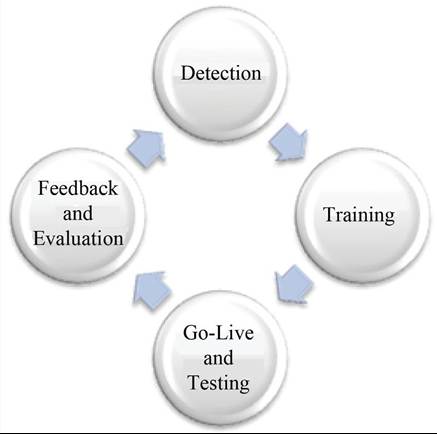
Abu-Dhabi Finance Trust went through four different phases to implement the SLAs software, the implementation phases were built to provide a faultless transformation; from a paper-based procedure to an electronic procedure, that ensure all the client information and operation has been inserted into the system; to supply and deliver superior high level of performance, support, and managing relations. The four phases are discussed below (also see Figure 1):
1. Detecting the Software: This phase is done after the proof-of concept process; that determines the organization needs and match to the right software. At this phase, a demonstration has been done to ensure that the SLAs applications and services are assessing in delivering the organization goals. It defines the software structure and explores the policy of operating the software, it also provides more clear understanding about the
Figure 1. Four implementation phases
2.
3.
4.
software weaknesses and strengths, and it helps in collaborating the conversion process and software configuration.
Training: At this phase, a training session is done for the staff in form of a demonstration or by doing the daily activities, to learn how to enter data and interpret it. The training session is done before the Go-live phase to make sure that the staffs has been trained to optimize the system and get the best out of it, and ensure that they are being able to perform their tasks and activities effectively. AFT has used a tailored training session, which has been developed to deliver the requirements of the organization and the tasks that should be performed by their staff. After finishing the training, they made sure that each member of the organization has been trained properly to Go-live and use it with the clients, this way they will minimize faults and ambiguity while using the new software.
Go-Live and Testing: After performing the training session and system configuration and analysis for readiness, that gave the organization the green light to Go-live and initiate and the system. Here the system has been initiated and used actively by the staff, and then comes the testing phase to detect if the system has delivered the requested goals or not. Testing is very important to make sure that the company has invested their money in a worthy valuable project, rather than keeping moving on it and at last turns to be a catastrophe.
Feedback and Evaluation: Following the testing a feedback and evaluating must be performed to demonstrate the effectiveness of the software on the organization and how it made the organization deliverables be performed in a better effective way. SLAs have taken the organization into a journey of continuous improvements and leveraging the organization into a new enhanced edge.
The SLAs is not just software, it is a business strategy that has been adopted after an advanced planning and research, to promote effectiveness and efficiency through better integration channels and effective report development process.
Report Development Process
Figure 2 illustrates the summarization of report development process and how it moves through the organization to start the production phase. It views how the client information and operations are being inserted into the SLAs software and how it runs through several levels to be operated and optimized to reach high productivity level, and provide high level of performance in a manageable and convenient process.
The Cycle shows how the report being transferred in the management level and start producing, developing reports is which requires several phases in which some reports needs to be passed through departments to be build. Then reports must enter into a testing phase to make sure
Figure 2. Development process
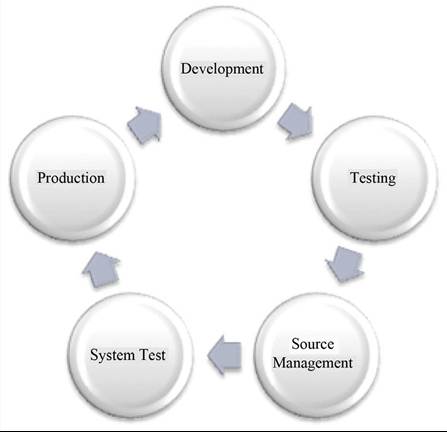
that data that have been entered are correct and reduce errors and redundancy. The third phase is to manage the resources that have been reported and interpret them to test them if they work with both client and business requirements, and then start the production phase.
BENEFITS AND CONCERNS
Software Benefits
Abu-Dhabi Finance Trust reveals the benefits that they have attained from the software. The software provided a full automation of the business critic al; Key Performance Indicators (KPIs), by allowing the management to view how each department is growing and performing, as it automated the process of seeing how the organization is performing toward the goals and strategic objective, it also helped in making decisions in quicker time with less effort as there is an available accurate measures that can be looked into at anytime.
In addition to the above, it didn’t automated the KPIs only but also the MI (Management Information) reports, by using the business information to build a measurement plans and forecasts. Also, it had a significant reduction on man-hours spent on developing manual reports, as the SLAs is all about having a formalized reports that can be also be changed easily into graphs if applicable. The SLAs has a connectivity with Smartphone’s, so the time of sharing reports has minimized through auto notifications and auto alerts features that the SLAs send to the Smartphone once the reports has been sent and the user can check it directly, this feature helped in having a fast rich interaction process. Moreover, the SLAs is the single source of truth for all data reported in the organization.
The software has changed the process of customer care, as there is enhanced auditing and monitoring by understanding how the users interact with the software and provide the feedback for the customers. The SLAs software is built on a unified infrastructure, so it has reduced costs and improved productivity by having a system that delivers several services. Users’ knowledge and expertise has increased; it is a task-oriented software and encourage users on self-learning by engaging themselves and interacting actively with the system features, reports, and innovative rich graphics. The SLAs software that provides a well integration between all organization departments and minimizes redundancy, also it avails a measurement and feasibility to reach organization goals; it is a reliable system that provides scalability and optimizes performance.
Technology Concerns
Abu-Dhabi Finance Trust had one technology concern; it was around running the software on a Microsoft Windows Server Platform, since the product is more stable on Linux Platform, they implement it on Microsoft windows Server due to the lack of the in-house expertise in Linux Administration, they have decided to deploy the software on a Windows Server. This is a challenging step to take as it may cause lots of problems and failures due to the failure to the system to function properly on the Windows Server, as it designed to be on a Linux Platform. The Platform is the framework for operating any system; it supports and limits its functionality. This may lead to having a poor investment, if the platform turns to be a failure; however, Abu-Dhabi finance have studied the challenges that can be raised by implementing the system, and till now no major problems has accord.
Management and Organization Concerns
The management was concerned about the steep learning curve involved, especially for the nontechnical users, as they require lots of training and auditing process. They were aware if the no proper training is available, it will cause the system to fail, and the new investment will just collapse at once. In addition, they were concerned about the accuracy and data presented in the system database; even they have studied their choice precisely the concern was still there until they started to use it and optimize it.
TECHNOLOGY COMPONENTS
The SLAs implementation process required five different technology components to implement and initiate it.
1. Microsoft Windows Server 2003
Windows Server 2003 is a reliable and flexible server for the SLAs software, its features, visualization tools, resources, and management tools integrates with the SLAs to accelerate and enhance its functionality. The server saves time as its efficient and dynamic, and it delivers high quality features, valuable functions, and a powerful operating system. It provides with a solid infrastructure for the SLAs software system, it enables the system to operate on highly dependable, consistent, and scalable platform. Windows server has provided the organization with better solutions, as management concerns in deploying a platform that is compatible with both management goals and the changing environment is solved.
In addition, the server has benefited the organization by reducing power consumption, as it is one server the initiates and supports organization computers. As well as, reducing power consumption it has improved management tasks as well, by enhancing command-line tasks and improving remote management by having better visualization and graphical integration process. Windows server has the ability to extend features and utility by integrating it with other software. In short, windows server 2003 increases productivity, efficiency, and provides rich experiences for users and management.
2. Oracle Business Intelligence Enterprise Edition Answers
As the business environment is always changing, an OBIEE Answers is a solution for all the operational and business intelligence tactics it has been developed by Siebel but provided as a part of OBIEE. This application allows users to find answers and build their own customized queries and reports without having any IT technical assistance. It is also the tool that business developers use it to build the reports and dashboards; it is a warehouse of retrieving information that answers business questions.
3. Business Intelligence Publisher
This is formerly called XML Publisher; it provides a powerful design and building structure for delivering information securely and in the correct format. Business Intelligence Publisher has new features that works perfectly with the SLAs software to leverage dashboards, data, calculations, and allows requesting for business intelligent services.
In addition, it allows collecting data from multiple records and reports to display it in one single document, and it allows having fast communication and performing business tasks quicker by connecting to smart phones. It helps having a faster report interaction; it highly optimizes reports with using less memory space as it uses a compatible version of reports. So, BI Publisher results in better integration process and allows its reports to be designed in Microsoft word; as well as, Adobe Acrobat, this means it is easy, efficient, and most of all an intelligent technology component.
4. Oracle Database 10g
Oracle Database is a relational database that it’s main goal to calculate resources and present the relation between them, its system architecture for the SLAs software. Oracle Database Features:
• Creating tables and views, to display sequences and consistent data modeling.
• Specifies attributes, relationships, and entities.
• Building Web-based applications.
• Flashback features, to undo the mistakes that users perform.
• Creates database backups to prevent massive failures.
• Information management and managing its lifecycle.
• Managing the unstructured data and it acts as a warehouse for reports and databases.
It enables to bring a change into the organization environment with a very low risk, as it has many features that benefit the organization in having great performance scalability, secured and centralized communication, and it helps to move from single to clustered open communications.
5. MS SQL Server 2005
SQL server developer is exclusively supported with graphical tool developing databases; it has many features that enhance business activities.
• Data Mining: This is an option in the SQL server, it helps users to extract their required data, describe, save, and share it. In addition, it provide data in visualize and transforming data to graphics. It automates knowledge by allowing users to build and discover information and databases (Anonymous, 2011).
• Data Modeler: SQL server allows users to design and build data models; it provides instructions for designing and building data models.
• DBMS Scheduler: This feature provides the users to form a schedules, chains, jobs allocation, jobs authenticated, and databases targeted.
DBA Functionality: It enables users to review database arrangement and construction, and edit it to initialize their activity. It mange resource plans and prioritize them, and it identifies inspection settings and maintains users roles and profiles secured.
Exporting and Importing Data: It acts as an interface to have a dynamic secured data exchange.
Menus: It allows recompiling plans by connections, and generating API tables; which are tables builds based on user ID, it helps in having a dynamic and easy configuration process.
Migrations: All migrated tasks are managed by the project navigator; it delivers the tasks to right persons in the company as the users profiles are being captured, so it redistribute and migrate tasks by targeting the appropriate person for the task.
PDF: It generates PDF documents for the databases, to have a faster sharing process and maintain secured documents transfer as it is authorized to have different levels of document encryptions and a password- PDF document.
Query Builder: SQL worksheet is tightly integrated with the query builder; it allows automatic determination of connected and joint data, helps in grouping and sorting procedures of databases.
Schema Browser: This feature allows having easier navigation process between databases and objects, and it supports a filtering and narrowing information to display the precised requested information.
Times Ten: It supports the memory storage of the databases; it compresses databases to avail more storing space.
Therefore, the SQL Server helps in having accelerated database development, faster communication and productivity, and easier database designing process.
MAIN CHALLENGES
Current Challenges
Abu-Dhabi Finance Trust faced some problems regarding the SLAs software; the software is a combination of XML Publisher by Oracle Corporation and Seibel Analytics, it’s marketed by Oracle as a single product; however, there are some integration and user management issues due to the coupling of these two corporations.
Future Challenges
Managing the various backend database connections, and report repository is becoming a bit tedious as the number of reports and the available data gradually increase. Therefore, upgrading to the newer version is a future concern, since it will involve a minor learning curve for the new features and system changes.
RECOMMENDATIONS
The software should be deployed and installed only after a thorough analysis of business requirement and after consulting the deployment guides provided in order to avoid issues arising post deployment. Also, finding the right software for the organization guarantee a successful investment, as it will help in achieving organizational goals.
REFERENCES
Adam, F., & O’Doherty, P. (2003). ERP projects: Good or bad for SMEs? In G. Shanks, P. B. Seddon, & L. P. Willcocks (Eds.), Second-Wave Enterprise Resource Planning Systems: Implementing for Effectiveness (pp. 275-298). Cambridge, UK: Cambridge University Press. doi:10.1017/ CBO9780511815072.012
Adler, P. S., & Kwon, S.-W. (2002). Social capital: Prospects for a new concept. Academy of Management Review, 27(1), 17-40.
Ahituv, N., Neumann, S., & Zviran, M. (2002). A system development methodology for ERP systems. Journal of Computer Information Systems, 42(3), 56-67.
Ahuja, G., & Lampert, C. M. (2001). Entrepreneurship in the large corporation: A longitudinal study of how entrepreneurial firms create breakthrough inventions. Strategic Management Journal, 22(67), 521-543. doi:10.1002/smj.176
Bancroft, N., Seip, H., & Sprengel, A. (1998). Implementing SAPR/3 (2nd ed.). New York, NY: Manning Publications.
Barki, H., & Pinsonneault, A. (2005). A model of organizational integration, implementation effort, and performance. Organization Science, 16(2), 165-179. doi:10.1287/orsc.1050.0118
Baskerville, R., Pawlowski, S., & McLean, E. (2000). Enterprise resource planning and organizational knowledge: Patterns of convergence and divergence. In Proceedings of the 21st International Conference on Information Systems, (pp. 396-406). Brisbane, Australia: IEEE.
Boudreau, M.-C., & Robey, D. (2005). Enacting integrated information technology: A human agency perspective. Organization Science, 16(1), 3-18. doi:10.1287/orsc.1040.0103
Braa, K., & Rolland, K. H. (2000). Horizontal information systems: Emergent trends and perspectives. In R. Baskerville, J. Stage, & J. I. DeGross (Eds.), Organizational and Social Perspectives on Information Technology (pp. 83-101). Boston, MA: Kluwer Academic Publishers.
Brown, C., & Vessey, I. (1999). ERP implementation approaches: Toward a contingency framework. In Proceedings of the International Conference on Information Systems, (pp. 411-416). IEEE.
Davenport, T. (2000). Realizing the promise of enterprise systems. Boston, MA: Harvard Business School Press.
Ross, J. (1999). Dow cornings corporation: Business processes and information technology. Journal of Information Technology, 14(3), 253-266. doi:10.1080/026839699344557
Stebel, P. (1992). Breakpoints: How managers exploit radical change. Boston, MA: Harvard Business School Press.
Stoddard, D., & Jarvenpaa, S. (1995). Businesss process reengineering: Tactics for managing radical change. Journal of Management Information Systems, 12(1), 81-108.
KEY TERMS AND DEFINITIONS
Ad-Hoc Reporting: Tools to allow end users to easily build their own reports and modify existing ones with little technical skills.
Business Intelligence (BI): A set of applications and technologies for gathering, storing, analyzing data to make better business decisions.
CRM: Customer Relationship Management. Dashboards: A set of tools to allow business users to define, monitor and analyze business performance via Key Performance Indicators (KPIs).
DBA: Database Administrator.
ERP: Enterprise Resource Planning.
Key Performance Indicators (KPI): Quantifiable measurements to help an organization define and measure progress toward organizational goals.
MENA: Middle East and North Africa.
MI: Management Information.
OBIEE: Business Intelligence Enterprise Edition.
Proof of Concept (POC): The demonstration that a product is technically and financially viable.
SLA: Service Level Agreement.
SQL: Structure Query Language.
This work was previously published in Cases on Enterprise Information Systems and Implementation Stages, edited by Fayez Albadri, pages 310-323, copyright 2013 by Information Science Reference (an imprint of IGI Global).